

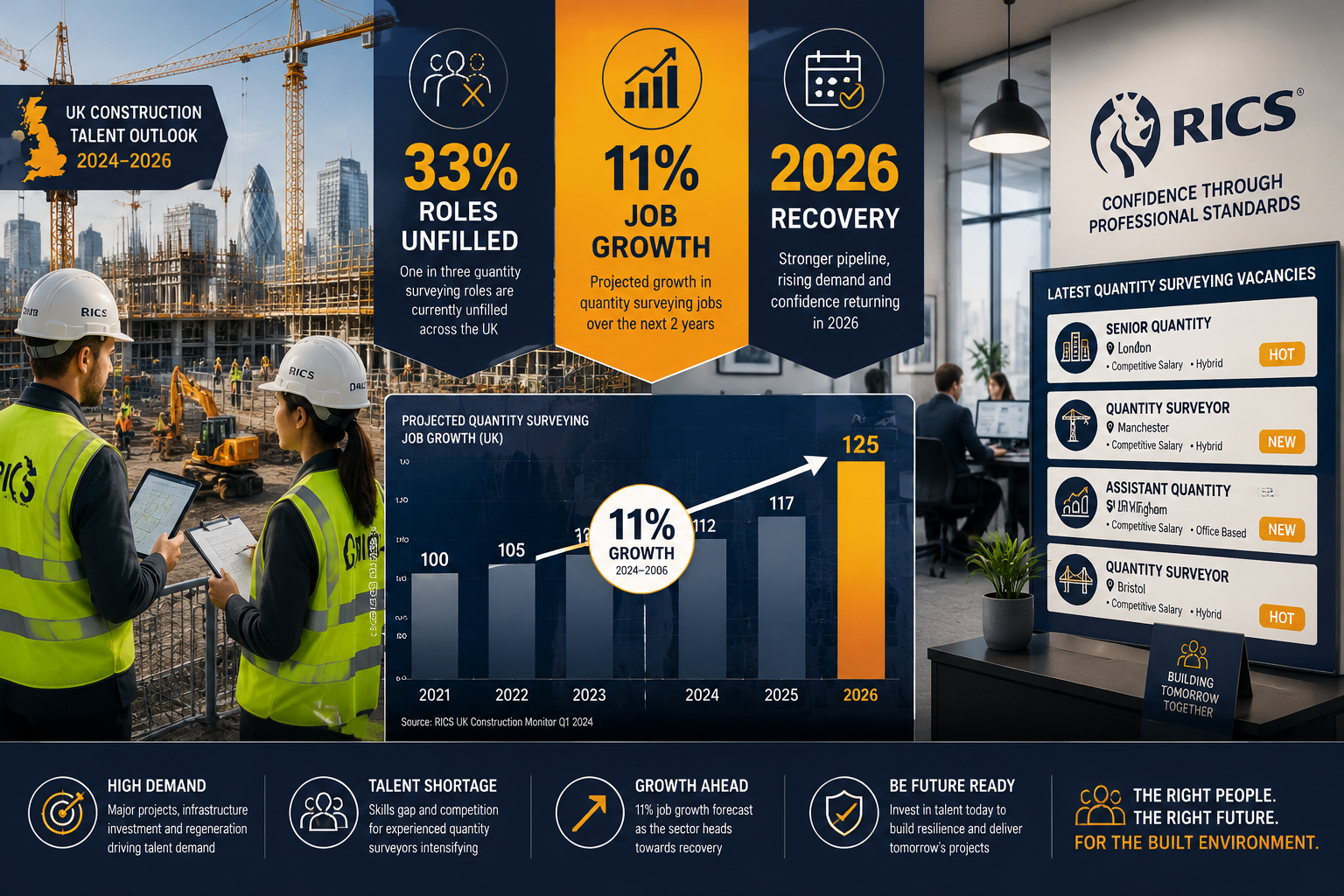
One in three quantity surveyor roles sat vacant across the UK throughout 2025 — and the profession is now racing to prevent that gap from widening further as 2026 brings a fresh wave of demand. [1][4] The Building Surveyor Recruitment Surge in 2026 Recovery: RICS Strategies for Addressing the 11% Job Growth Demand is not a distant forecast. It is a live operational challenge reshaping how firms hire, train, and retain talent right now.
With RICS projecting an 11% rise in building surveyor roles and Q2 2026 analysis pointing to a meaningful uptick in survey instructions, the profession stands at a genuine inflection point. [6] Firms that build structured hiring playbooks today will be positioned to capture the recovery. Those that wait risk being outpaced by competitors who moved first.
Key Takeaways 📌
- 11% job growth in building surveyor roles is forecast for 2026, creating urgent hiring pressure across UK firms.
- 33% of quantity surveyor roles remained unfilled in 2025, signalling deep structural skills shortages that carry into 2026. [4]
- RICS has deployed multiple strategies — including its dedicated RICS Recruit platform, the 2025 Surveying Skills Report, and the 2026 Awards programme — to address workforce gaps. [7][10]
- Specialist skills in building safety, housing compliance, valuation, and expert witness work are the hardest to fill and command premium salaries.
- Urban regeneration schemes and Q2 2026 market recovery are the primary demand drivers, making regional hiring strategy critical. [6]
Why the 2026 Building Surveyor Recruitment Surge Is Happening Now
The timing of the current recruitment pressure is not accidental. Several forces converged simultaneously.
A Market in Cautious Recovery
The April 2026 RICS UK Residential Market Survey painted a picture of subdued but stabilising activity. Higher mortgage rates and geopolitical uncertainty continued to weigh on buyer demand, yet transaction volumes showed early signs of resilience. [2] Meanwhile, the Q1 2026 RICS UK Construction Monitor reported declining workloads across most major sectors, with forward-looking sentiment weakening — a soft start that nonetheless masks pockets of strong pipeline activity in urban regeneration and retrofit. [3]
"The market is not uniformly weak. Surveyors who understand where demand is concentrating — rather than where it is absent — will find significant opportunity in 2026."
Q2 2026 analysis confirms this nuance. A building survey demand surge is emerging in specific segments, particularly in areas where post-pandemic planning consents are finally translating into physical starts. [6] For homebuyers and investors navigating this environment, understanding why a RICS building survey is essential has never been more relevant.
The Pipeline of Unfilled Roles
The structural shortfall is stark. Approximately 33% of quantity surveyor positions across the UK remained unfilled throughout 2025. [4] Building surveyor vacancies mirror this pattern, with specialist roles in building safety, fire safety compliance, and housing regulation proving especially difficult to fill. [5]
Several factors drive this:
- An ageing workforce: A significant cohort of senior chartered surveyors is approaching retirement without sufficient mid-career professionals to replace them.
- Regulatory complexity: The Building Safety Act 2022 and tightening housing compliance frameworks have created demand for skills that training pipelines have not yet fully produced. [5]
- Competition from adjacent sectors: Infrastructure, energy transition, and defence construction are all competing for the same talent pool.
- Regional imbalance: Demand is concentrated in London, the South East, and major urban centres, while supply is more evenly distributed geographically.
For firms managing complex projects, understanding building surveyor access requirements and the scope of work involved helps clarify exactly what skill profiles are needed at each project stage.
RICS Strategies for Addressing the 11% Job Growth Demand: Recruitment Playbooks for Firms

The Building Surveyor Recruitment Surge in 2026 Recovery: RICS Strategies for Addressing the 11% Job Growth Demand has prompted RICS to deploy a coordinated set of workforce interventions. Firms scaling in this environment should align their own hiring strategies with these frameworks.
1. 🎯 RICS Recruit: The Dedicated Talent Platform
RICS operates RICS Recruit, described as the market-leading job portal dedicated to matching surveying professionals across construction, land, property, and infrastructure with global vacancies. [10] For firms posting roles, RICS Recruit offers access to a pre-qualified audience of RICS members and APC candidates — a significant advantage over generic job boards where surveying vacancies are often buried.
Best practice for firms using RICS Recruit:
| Action | Why It Matters |
|---|---|
| Post roles with APC competency mapping | Attracts candidates already aligned to RICS standards |
| Specify CPD support offered | Differentiates your firm from competitors |
| Include hybrid/flexible working details | Critical for attracting mid-career professionals |
| Highlight specialist project exposure | Appeals to candidates seeking career progression |
2. 📚 The RICS Surveying Skills Report 2025
RICS published its comprehensive Surveying Skills Report in 2025, addressing workforce development and the skills challenges facing the profession. [7] The report provides firms with a framework for identifying which competencies are most at risk and where training investment will yield the highest return.
Key themes from the report include:
- Digital skills gaps: BIM, data analytics, and proptech literacy are increasingly expected but inconsistently present.
- Building safety specialisms: Post-Grenfell regulatory changes have created demand for surveyors with specific fire safety and cladding assessment expertise. [5]
- Sustainability and retrofit: Net-zero commitments are generating a new category of surveying work that existing professionals are not always trained to deliver.
Firms that map their current workforce against the Skills Report framework will identify gaps before they become operational problems.
3. 🏆 RICS Awards 2026: Retention Through Recognition
RICS has launched the 2026 RICS Awards programme, providing industry recognition and professional development opportunities for surveyors. [9] Recognition programmes are consistently cited in retention research as a cost-effective tool for reducing turnover among high-performing professionals.
For firms scaling rapidly, entering award programmes signals to candidates that the organisation values excellence — a meaningful differentiator in a competitive hiring market.
4. Training Paths for Valuation and Expert Witness Specialisms
Two specialisms deserve particular attention in 2026: valuation and expert witness work. Both are experiencing demand growth driven by market complexity and increased litigation in property disputes.
Valuation pathways typically require:
- APC completion with Valuation as a core or optional competency
- Registration with the RICS Valuer Registration scheme
- Ongoing CPD in market analysis, comparable evidence, and specialist asset classes
Expert witness development requires:
- A strong foundation in a primary surveying specialism (building pathology, dilapidations, party wall, etc.)
- Completion of RICS or CPD-accredited expert witness training
- Experience preparing reports to Civil Procedure Rules (CPR) standards
For firms advising clients on complex transactions, the ability to offer Level 3 full building survey services and dilapidations expertise depends directly on having surveyors trained to these advanced levels.
Regional Demand Hotspots and Urban Scheme Opportunities in 2026

Understanding the Building Surveyor Recruitment Surge in 2026 Recovery: RICS Strategies for Addressing the 11% Job Growth Demand requires a regional lens. Demand is not uniform across the UK.
Where the Work Is Concentrating
London and the South East remain the highest-demand areas, driven by:
- Urban regeneration schemes in East London, South East London, and inner-city boroughs
- High volumes of residential transactions requiring Level 3 full building surveys and homebuyer surveys
- Retrofit and cladding remediation projects generating sustained instruction volumes
Major regional cities — Manchester, Birmingham, Leeds, Bristol — are seeing strong demand from:
- Build-to-rent development pipelines
- Commercial-to-residential conversion schemes
- Infrastructure-adjacent surveying work
Hiring Strategies for Firms in High-Demand Regions
Firms operating in competitive urban markets should consider the following approaches:
🔹 Grow-your-own pipelines
Partner with universities offering RICS-accredited surveying degrees. Offer structured APC mentoring programmes that convert graduates into chartered surveyors within two years of joining.
🔹 Lateral hiring from adjacent disciplines
Structural engineers, architects, and project managers with relevant site experience can transition into building surveying roles with targeted upskilling. The RICS APC Assessment of Professional Competence provides a structured pathway for this.
🔹 Flexible resourcing models
Associate and consultant surveyor arrangements allow firms to scale capacity without the fixed overhead of permanent hires — particularly useful for managing the uneven demand patterns visible in Q1 and Q2 2026 data. [3][6]
🔹 Retention-first thinking
With 33% of roles unfilled across the sector, the cost of losing an experienced surveyor is extremely high. [4] Structured career development plans, CPD funding, and flexible working arrangements are now baseline expectations, not differentiators.
For firms managing building safety and compliance work, having surveyors qualified to assess urgent or dangerous building issues is a non-negotiable capability in 2026's regulatory environment.
Specialist Skills Shortages: Building Safety, Compliance, and Beyond
The skills shortage is not evenly distributed across the profession. Certain specialisms are experiencing acute shortfalls that are already affecting project delivery timelines and client service quality. [5]
The Building Safety Act Effect
The Building Safety Act 2022 created an entirely new category of compliance work. Higher-risk buildings now require Principal Accountable Persons, Building Safety Managers, and surveyors capable of producing Gateway documentation. The profession was not fully prepared for this volume of specialist demand.
Critical shortage areas in 2026:
- 🔴 Fire safety and cladding assessment — demand far exceeds supply
- 🔴 Building safety case preparation — very few surveyors currently qualified
- 🟡 Housing compliance and EPC advisory — growing shortfall as net-zero deadlines approach
- 🟡 Asbestos surveying — steady demand, limited new entrants (see asbestos building surveys)
- 🟢 General residential building surveys — high volume but more accessible entry point
What Firms Should Do Right Now
- Audit current competency coverage against the RICS Surveying Skills Report framework. [7]
- Identify which specialist areas represent the highest revenue risk if left unfilled.
- Commission targeted CPD programmes — either in-house or through RICS-accredited providers — for surveyors ready to upskill into shortage specialisms.
- Consider secondment arrangements with larger firms or public sector bodies to accelerate specialist experience accumulation.
- Engage with RICS Recruit proactively, not reactively — post roles before they become urgent. [10]
Conclusion: Turning the Recruitment Surge Into a Competitive Advantage
The Building Surveyor Recruitment Surge in 2026 Recovery: RICS Strategies for Addressing the 11% Job Growth Demand presents a clear choice for every firm in the sector. The 11% job growth forecast is not simply a labour market statistic — it is a signal that the profession is entering a period of genuine expansion, even against the backdrop of a subdued residential market and a soft construction start to the year. [2][3]
Firms that act on this signal with structured, deliberate hiring strategies will build the capacity to serve clients better, win more instructions, and develop the specialist capabilities that command premium fees. Those that treat recruitment as a reactive, vacancy-by-vacancy exercise will find themselves consistently behind the curve.
Actionable Next Steps for Firms in 2026 🚀
- Register on RICS Recruit and build a proactive talent pipeline, not just a reactive vacancy list. [10]
- Download and apply the RICS Surveying Skills Report 2025 to audit your workforce against emerging competency requirements. [7]
- Identify two or three specialist areas — valuation, expert witness, building safety — and invest in CPD pathways for existing staff.
- Map regional demand against your current geographic coverage and identify where associate or consultant arrangements could extend capacity quickly.
- Enter the RICS Awards 2026 to strengthen your employer brand and improve retention of high performers. [9]
- Review your building survey service offering — clients navigating a complex market need surveyors who can explain how long a building survey takes, what different survey levels cover, and how findings translate into negotiating power.
The recovery is uneven, the talent market is tight, and the regulatory environment is demanding more than ever. But for firms that invest in their people now, 2026 represents one of the most significant opportunities the building surveying profession has seen in a decade.
References
[1] Rics Recruit – rics.org
[2] Survey Profession Goes Live 5 May 2026 – rics.org
[3] Update From Justin Young Rics Ceo May 2026 – rics.org
[4] Quantity Surveyor Shortages Impacting Building Survey Firms Rics 2025 Strategies For 2026 Project Delivery – kingstonsurveyors.com
[5] Surveying Recruitment Trends 2026 Skills Shortages In Building Safety And Housing Compliance Roles – nottinghillsurveyors.com
[6] Building Survey Demand Surge In Q2 2026 Capitalising On Market Recovery While Managing Regional Price Divergence – wimbledonsurveyors.com
[7] Surveying Skills Report 2025 – rics.org
[8] Building Surveyor – ricsrecruit.com
[9] facebook – facebook.com
[10] ricsrecruit – ricsrecruit.com