

{"cover":"Professional landscape format (1536x1024) hero image featuring bold text overlay 'Building Survey Standards Post-2026 RICS Retrofit Summit: Enhanced Protocols for Energy and Quality Assessments' in extra large 70pt white sans-serif font with dark shadow and semi-transparent navy overlay box, positioned in upper third. Background shows modern surveyor using thermal imaging camera on residential property exterior with visible insulation layers, energy efficiency diagrams, and RICS professional badge visible. Color scheme: deep navy blue, white, green energy accents. High contrast, magazine cover quality, editorial architectural photography style with professional lighting.","content":["Detailed landscape format (1536x1024) image showing RICS Surveyor's House London conference room during Quality in Retrofit Summit with diverse built environment professionals reviewing residential retrofit standards documentation, large projection screen displaying new AssocRICS pilot pathway competency framework, attendees examining thermal imaging reports and building pathology assessment tools, professional networking atmosphere, modern conference setting with RICS and Retrofit Academy branding visible, warm professional lighting, editorial quality architectural interior photography","Comprehensive landscape format (1536x1024) infographic illustration displaying enhanced building survey protocols workflow: left side shows traditional survey methods (clipboard, visual inspection), center features integrated technology tools (thermal cameras, moisture meters, drone surveys, data analytics dashboards), right side demonstrates consumer protection outcomes (detailed reports, quality benchmarks, professional certifications), connected by flowing arrows, clean professional design with icons representing Warm Homes Plan pillars, RICS standards badges, color-coded risk assessment levels, modern technical illustration style with navy, green, and orange accents","Detailed landscape format (1536x1024) split-screen composition showing before-and-after residential retrofit assessment: left half displays surveyor conducting whole-house assessment with digital tablet showing building pathology analysis, moisture detection equipment, and energy performance data collection; right half shows completed retrofit monitoring with smart sensors, thermal imaging overlay demonstrating improved insulation performance, data dashboard tracking outcomes, professional surveyor reviewing compliance documentation, high-quality architectural photography with technical overlay graphics, professional lighting emphasizing quality standards and consumer protection"]}
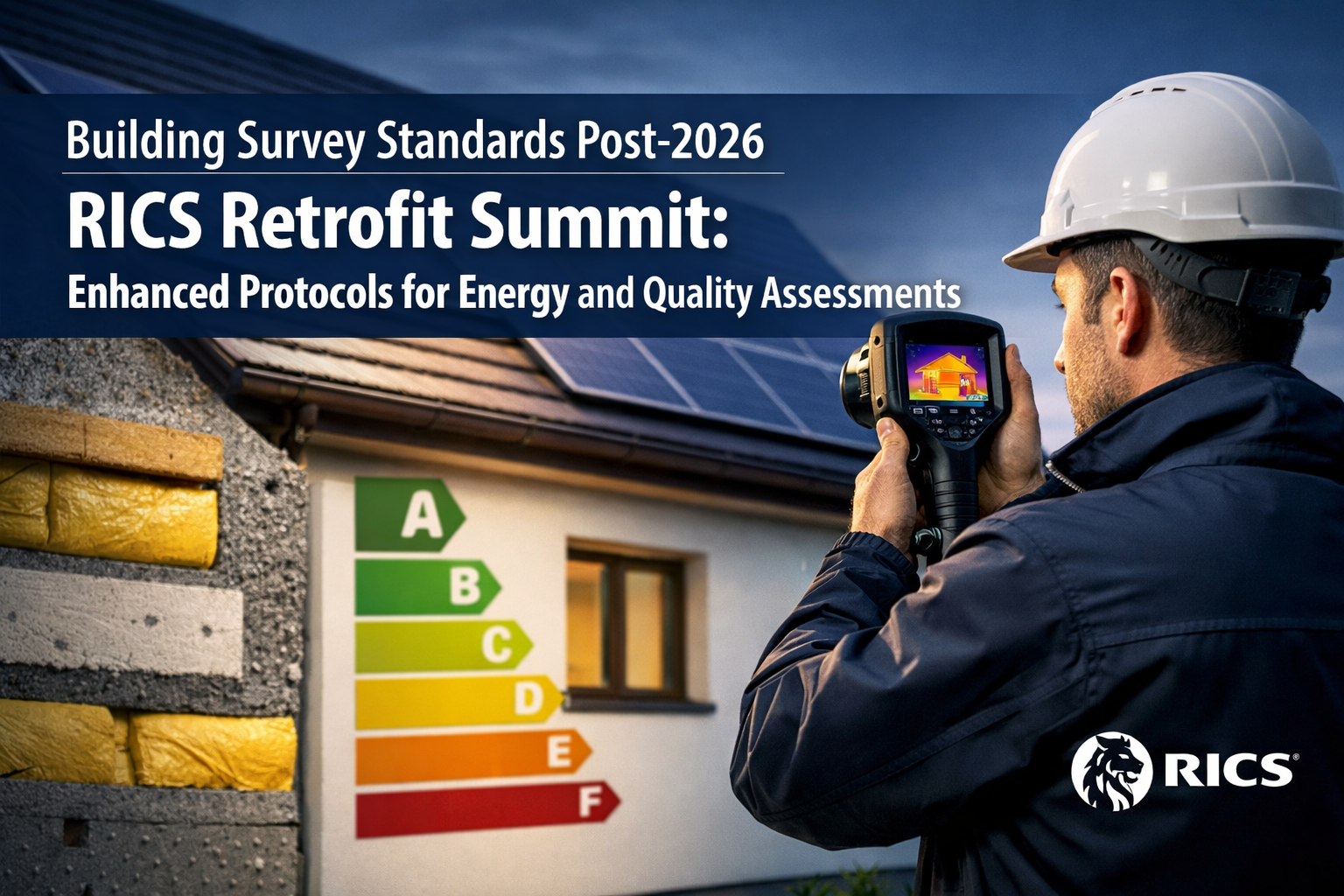
The landscape of building surveying in the UK has transformed dramatically following a landmark gathering of industry leaders. On January 20, 2026, the Quality in Retrofit Summit brought together surveyors, retrofit specialists, and built environment professionals at RICS Surveyor's House in London, establishing new benchmarks that will reshape how properties are assessed, retrofitted, and protected for decades to come.[1][2]
The Building Survey Standards Post-2026 RICS Retrofit Summit represent a comprehensive overhaul of professional protocols, integrating energy efficiency assessments with traditional structural evaluations while placing consumer protection at the heart of every inspection. This sell-out event, co-hosted by RICS and The Retrofit Academy, addressed critical gaps in retrofit quality, professional competency, and technological integration that have hindered the UK's progress toward net-zero targets.[1][2]
Key Takeaways
- New Professional Pathway: RICS launched a dedicated AssocRICS pilot accreditation for retrofit professionals, already oversubscribed, focusing on building pathology, risk assessment, and monitoring protocols[1][4]
- Enhanced Survey Standards: Building surveys now integrate whole-house energy assessments, moisture risk analysis, and retrofit readiness evaluations under unified RICS frameworks
- Consumer-Centered Protections: The Residential Retrofit Standard places homeowners at the center of delivery, establishing quality benchmarks and professional accountability measures[1]
- Five-Year Funding Commitment: The Warm Homes Plan provides long-term financial security, enabling surveyors to invest in advanced training and technology infrastructure[2]
- Data-Driven Quality: Industry consensus established "data is king" as the foundation for retrofit success, requiring robust monitoring systems and comprehensive outcome tracking[2]
The 2026 RICS Retrofit Summit: A Turning Point for Building Survey Standards
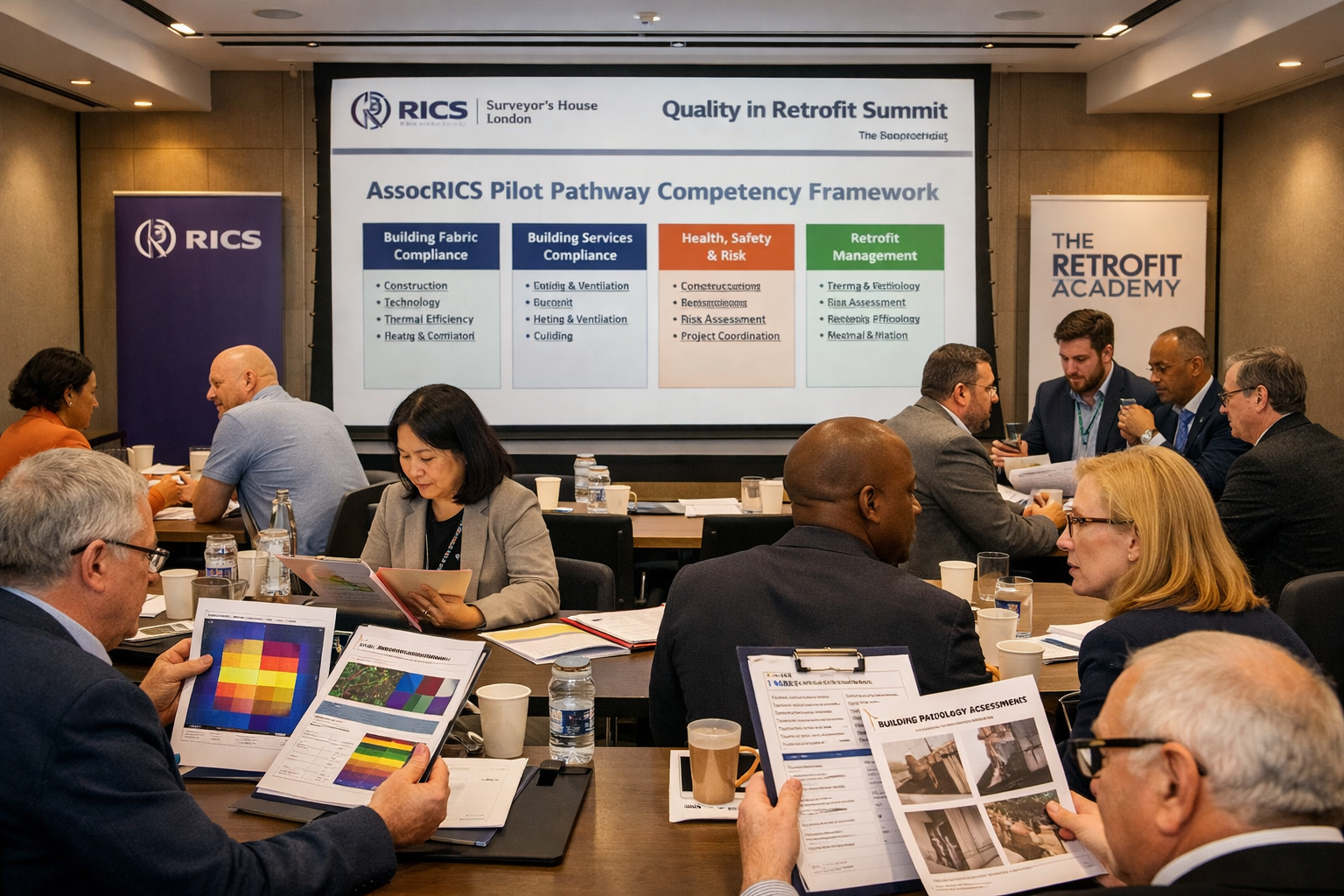
Summit Outcomes and Industry Consensus
The Quality in Retrofit Summit marked a pivotal moment in the evolution of building survey standards. RICS President Nick Maclean OBE RD FRICS framed retrofit as requiring "a relentless focus on standards, skills and professionalism," emphasizing that retrofit at scale can "stimulate innovation and employment, cut emissions, reduce fuel poverty and ensure the longevity of our housing stock."[1]
The summit brought together professionals from surveying and retrofit sectors to address critical challenges:
📊 Professional Competency Gaps: Attendees unanimously agreed that retrofit professionals cannot be adequately prepared by short 5-day training courses, highlighting the need for comprehensive qualification pathways[2]
🏗️ Quality Control Requirements: Industry leaders emphasized that Retrofit Coordinators should visit every site, with strengthened technical inspection protocols becoming mandatory[2]
🔍 Consumer Protection Priorities: The residential retrofit standard developed by RICS promotes best practices, aligns with national frameworks, and places consumers at the center of service delivery[1]
New AssocRICS Retrofit Pathway
One of the summit's most significant announcements was the launch of a dedicated pilot accreditation pathway for retrofit professionals. Developed in consultation with the Retrofit Academy and industry partners, this pathway includes:[1]
- Core Competencies: Foundational knowledge in building science and retrofit principles
- Specialized Training: Retrofit testing, monitoring and evaluation protocols
- Risk Assessment: Comprehensive frameworks for identifying and mitigating retrofit risks
- Building Pathology: Advanced understanding of building defects and remediation strategies
The pathway was already oversubscribed at the time of announcement, demonstrating strong industry demand for professional credentials that distinguish qualified practitioners from inadequately trained operators.[4]
Enhanced Protocols for Energy and Quality Assessments Under Building Survey Standards Post-2026 RICS Retrofit Summit
Integrated Energy Performance Evaluations
The Building Survey Standards Post-2026 RICS Retrofit Summit established new protocols that integrate energy performance assessments into traditional building surveys. These enhanced evaluations include:
Whole-House Assessment Framework 🏠
Modern building surveys now incorporate comprehensive energy evaluations that examine:
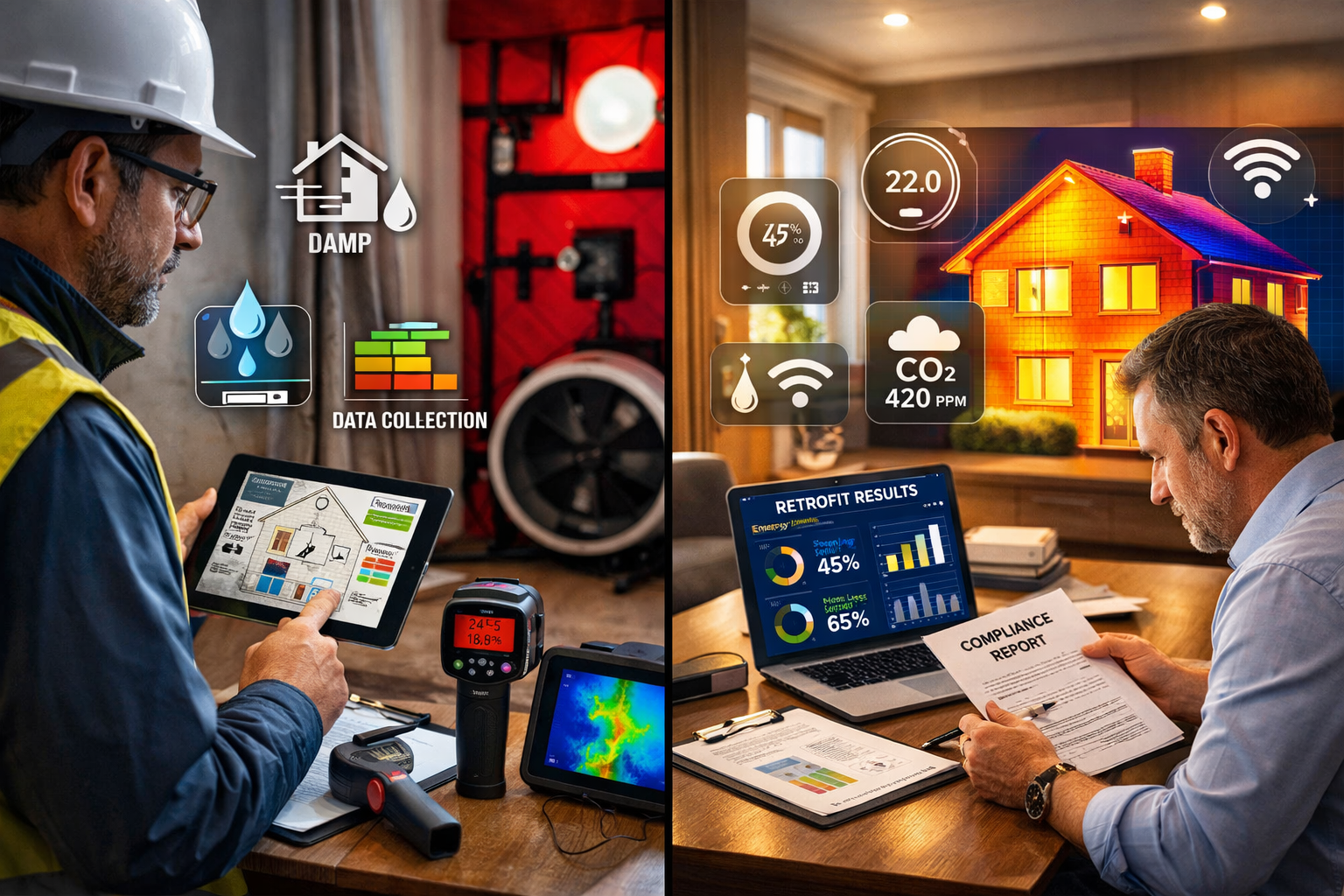
- Thermal Performance: Infrared thermography to identify heat loss patterns and insulation deficiencies
- Air Tightness Testing: Blower door tests to measure infiltration rates and identify air leakage paths
- Ventilation Analysis: Assessment of existing ventilation systems and moisture management strategies
- Building Fabric Evaluation: Detailed examination of walls, roofs, floors, and windows for retrofit readiness
Moisture Risk Assessment Protocols
One of the most critical enhancements addresses the intersection of energy efficiency and moisture management. Surveyors now conduct detailed moisture risk assessments that:
- Evaluate existing moisture patterns and sources
- Assess ventilation adequacy before and after proposed retrofit measures
- Identify condensation risks associated with improved air tightness
- Recommend mitigation strategies to prevent post-retrofit moisture issues
This focus aligns with government priorities under Awaab's Law, which requires landlords to manage damp and mould risks effectively, with surveyors playing expanded roles in compliance monitoring.[1]
Technology Integration in Modern Building Surveys
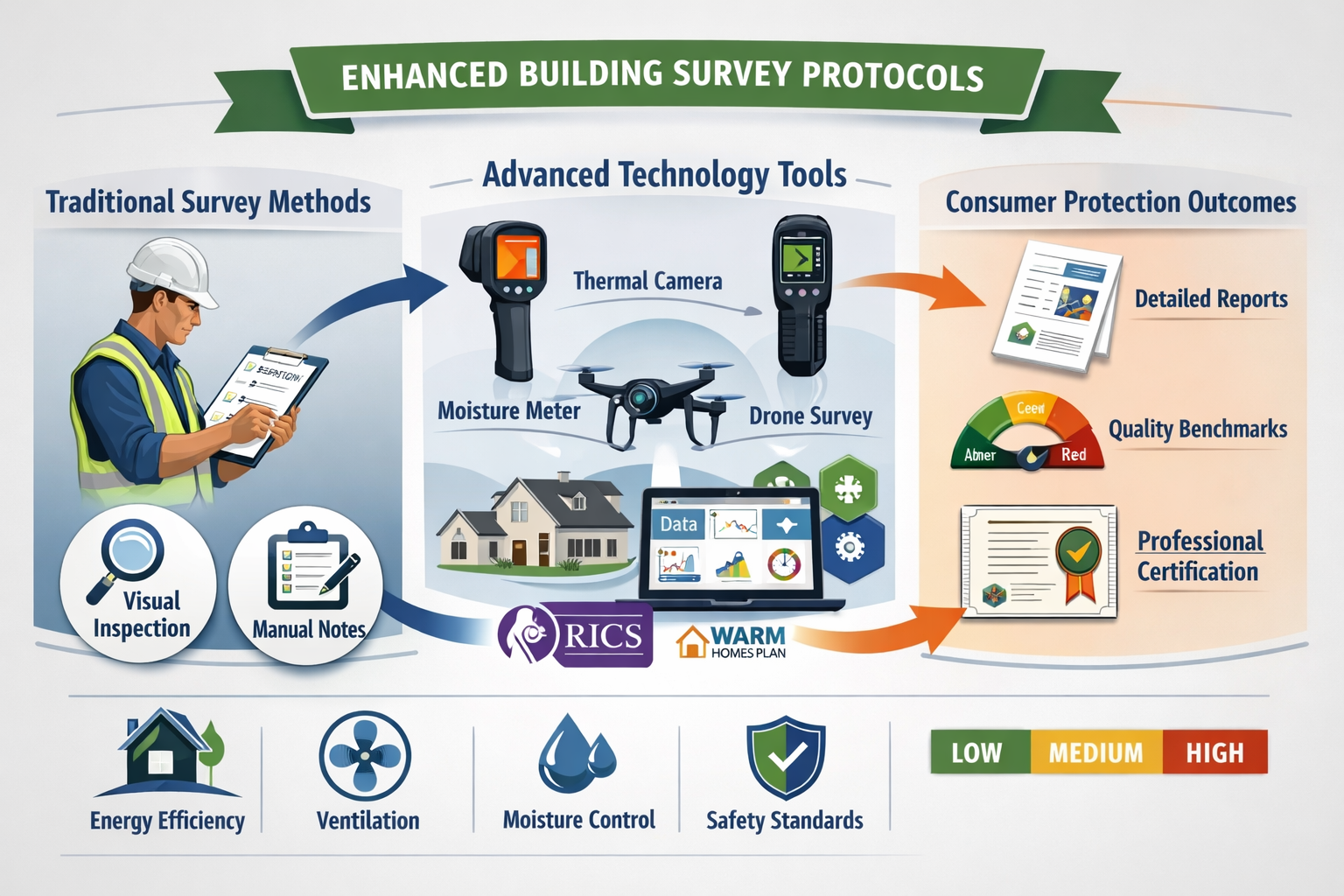
The summit emphasized that quality retrofit depends on robust data collection and analysis. Enhanced building survey protocols now incorporate:[2]
Advanced Diagnostic Technologies 🔬
- Thermal Imaging Cameras: High-resolution infrared cameras that detect temperature variations indicating insulation gaps, thermal bridging, and air leakage
- Moisture Meters: Electronic sensors measuring moisture content in building materials to identify hidden dampness
- Drone Surveys: Aerial inspections providing comprehensive roof assessments and hard-to-access area evaluations
- Environmental Monitors: Sensors tracking temperature, humidity, and CO₂ levels to assess indoor air quality
Data Analytics and Monitoring Systems
Industry leaders at the summit prioritized "data is king" as essential to retrofit quality, establishing frameworks for:[2]
| Monitoring Component | Purpose | Frequency |
|---|---|---|
| Pre-Retrofit Baseline | Establish existing performance metrics | One-time comprehensive assessment |
| Installation Quality Checks | Verify workmanship during retrofit | At key project milestones |
| Post-Completion Testing | Confirm performance improvements | Immediately after completion |
| Long-Term Monitoring | Track outcomes and identify issues | Ongoing (12-24 months) |
Consumer Protection and Professional Accountability
The RICS Residential Retrofit Standard establishes comprehensive consumer protections that fundamentally reshape the surveyor-client relationship:[1]
Transparency Requirements ✅
- Clear Scope Documentation: Detailed explanations of survey methodologies and limitations
- Risk Communication: Plain-language reporting of identified risks and recommended actions
- Cost-Benefit Analysis: Transparent assessments of retrofit investment returns
- Quality Benchmarks: Performance standards against which completed work can be measured
Professional Accountability Measures
The enhanced protocols establish clear accountability through:
- Competency Verification: Only appropriately qualified professionals can conduct retrofit assessments
- Site Visit Requirements: Mandatory on-site inspections by Retrofit Coordinators for every project[2]
- Outcome Tracking: Monitoring systems that identify issues when they occur, enabling corrective action
- Complaint Resolution: Clear pathways for consumers to address quality concerns
Understanding what questions to ask during a building survey becomes even more critical under these enhanced protocols, empowering property owners to engage meaningfully with the assessment process.
Implementing Building Survey Standards Post-2026 RICS Retrofit Summit: Practical Applications
The Warm Homes Plan and Surveyor Involvement
Announced immediately after the summit, the Warm Homes Plan provides the policy framework within which enhanced building survey standards will operate. The plan includes three pillars that directly impact surveying practice:[1]
Pillar 1: Targeted Support for Low-Income Households 💰
Surveyors conduct comprehensive assessments to:
- Identify properties with greatest energy efficiency needs
- Prioritize interventions based on fuel poverty risk
- Ensure vulnerable households receive appropriate retrofit solutions
- Monitor outcomes to verify improvements in living conditions
Pillar 2: Universal Offer for Investment-Ready Households
For homeowners able to invest in retrofits, surveyors provide:
- Detailed retrofit readiness assessments
- Cost-benefit analyses of various improvement options
- Quality assurance during installation
- Post-completion verification testing
Pillar 3: Stronger Protections for Renters
Surveyors support landlord compliance through:
- Stock condition surveys identifying substandard properties
- Minimum standards compliance verification
- Damp and mould risk assessments under Awaab's Law
- Enforcement support for local authorities
The plan's five-year funding commitment enables surveyors and firms to invest confidently in training, technology, and infrastructure needed to deliver these enhanced services.[2]
Neighborhood-Level Retrofit Planning
Beyond individual property assessments, the enhanced standards support strategic, area-based retrofit approaches:
Stock Condition Surveys 🏘️
Surveyors conduct comprehensive neighborhood assessments that:
- Identify common building typologies and retrofit challenges
- Prioritize areas for coordinated intervention
- Enable economies of scale in retrofit delivery
- Support local authority strategic planning
Community Engagement
Professional surveyors facilitate:
- Resident education about retrofit benefits and processes
- Coordination of multiple property owners for shared solutions
- Communication between homeowners, contractors, and funders
- Quality assurance across entire neighborhoods
Devolved Nations Frameworks
RICS has tailored retrofit frameworks to address regional variations:[1]
Scotland 🏴
The joint-industry report "Meeting Scotland's Retrofit Challenge" provides Scottish Government with:
- Building survey protocols adapted to Scottish building stock characteristics
- Integration with Scottish energy efficiency standards
- Professional pathways aligned with Scottish qualifications frameworks
Northern Ireland
RICS is working with the Department for Communities to:
- Develop residential retrofit services markets
- Support net-zero objectives
- Establish professional standards appropriate to Northern Irish context
Wales
Tailored approaches address:
- Welsh housing stock characteristics
- Integration with Welsh Government decarbonization targets
- Professional development pathways for Welsh surveyors
Future-Proofing Building Surveys: Emerging Specialisms and Continuing Development
Data Analytics and Sustainability Pathways
Beyond retrofit, RICS opened the Data Analytics and Intelligence pathway for expressions of interest in early 2026, alongside the already-launched Sustainability Advisory pathway.[3] These emerging specialisms reflect the profession's evolution toward:
Predictive Analytics 📈
- Machine learning models predicting building performance
- Risk assessment algorithms identifying likely defect patterns
- Investment optimization tools for retrofit prioritization
- Outcome forecasting based on historical data
ESG Integration
Environmental, social, and governance criteria are increasingly influencing property valuations.[6] Surveyors now assess:
- Carbon footprint and embodied energy
- Social impact of housing conditions
- Governance structures ensuring quality delivery
- Long-term sustainability and resilience
Skills Development and Training Infrastructure
The five-year funding security enables investment in comprehensive training programs that address summit concerns about inadequate short-course preparation:[2]
Structured Learning Pathways
- Foundation Level: Basic building science and retrofit principles
- Intermediate Level: Specialized technical skills (thermal imaging, moisture assessment, air tightness testing)
- Advanced Level: Complex building pathology, risk management, project coordination
- Expert Level: Strategic planning, quality assurance, professional leadership
Practical Experience Requirements
Enhanced standards mandate:
- Minimum supervised site visit requirements
- Portfolio development demonstrating competency progression
- Mentorship by experienced retrofit professionals
- Continuing professional development (CPD) obligations
Understanding how long a building survey takes helps property owners appreciate the thoroughness required under these enhanced protocols.
Quality Assurance and Outcome Verification
The summit's emphasis on "data is king" translates into robust quality assurance frameworks:[2]
Installation Quality Verification ✓
Surveyors conduct inspections at critical stages:
- Pre-installation baseline documentation
- Mid-installation compliance checks
- Post-installation performance testing
- Defect identification and remediation verification
Long-Term Performance Monitoring
Enhanced protocols require:
- 12-24 month post-completion monitoring periods
- Sensor networks tracking temperature, humidity, and energy consumption
- Anomaly detection systems identifying underperformance
- Corrective action protocols when issues arise
This comprehensive approach addresses historical weaknesses in retrofit quality, where inadequate oversight led to moisture problems, thermal bridging, and underperforming installations.
Professional Standards and Consumer Confidence
Building Trust Through Competency
The oversubscribed AssocRICS retrofit pathway demonstrates that property owners and industry stakeholders recognize the value of properly qualified professionals.[4] This demand reflects:
Consumer Awareness 🎯
Property owners increasingly understand that:
- Retrofit is complex, requiring specialized expertise
- Poor-quality work creates costly problems
- Professional qualifications indicate competency
- Independent oversight protects their interests
Industry Differentiation
Professional accreditation enables qualified surveyors to:
- Distinguish themselves from inadequately trained competitors
- Command appropriate fees for comprehensive services
- Build reputations based on verified competency
- Contribute to industry professionalization
For those considering which building survey they need, understanding these enhanced standards helps inform decisions about appropriate levels of assessment.
Addressing Urgent and Dangerous Issues
Enhanced protocols strengthen surveyors' ability to identify and communicate urgent or dangerous building issues, particularly those related to:
Moisture and Ventilation Risks ⚠️
- Condensation risks from improved air tightness without adequate ventilation
- Hidden moisture sources that retrofit might exacerbate
- Mould growth potential in thermally improved but poorly ventilated spaces
- Structural moisture damage requiring remediation before retrofit
Safety Hazards
- Asbestos in older properties requiring specialist removal before retrofit
- Electrical systems inadequate for heat pump installations
- Structural deficiencies that retrofit loading might worsen
- Fire safety considerations in insulation specifications
Conclusion: A New Era for Building Survey Standards
The Building Survey Standards Post-2026 RICS Retrofit Summit mark a transformative shift in how the UK approaches property assessment, energy efficiency, and consumer protection. By integrating comprehensive energy evaluations with traditional structural surveys, establishing robust professional pathways, and prioritizing data-driven quality assurance, RICS has created a framework that supports the UK's net-zero ambitions while protecting homeowners from poor-quality work.
The summit's outcomes—from the oversubscribed AssocRICS retrofit pathway to the emphasis on comprehensive site visits and long-term monitoring—demonstrate industry commitment to professionalism and quality. The five-year funding commitment through the Warm Homes Plan provides the stability needed to invest in training, technology, and infrastructure that will elevate standards across the profession.
Actionable Next Steps
For Property Owners 🏡
- Engage only RICS-qualified surveyors with retrofit accreditation for energy efficiency assessments
- Request detailed explanations of survey methodologies and technology used
- Ensure surveys include whole-house assessments, moisture risk analysis, and retrofit readiness evaluations
- Verify that monitoring and quality assurance protocols are included in retrofit projects
For Surveying Professionals 📋
- Pursue AssocRICS retrofit pathway accreditation to demonstrate competency
- Invest in advanced diagnostic technologies (thermal imaging, moisture meters, data analytics tools)
- Develop expertise in building pathology, risk assessment, and monitoring protocols
- Engage with continuing professional development focused on emerging specialisms
For Industry Stakeholders 🤝
- Support implementation of enhanced standards through collaborative frameworks
- Contribute data to monitoring systems that track outcomes and identify quality issues
- Participate in neighborhood-level retrofit planning initiatives
- Advocate for consumer protections and professional accountability measures
The enhanced protocols established following the 2026 RICS Retrofit Summit position the UK to deliver high-quality, consumer-focused retrofit at the scale required to meet climate targets while ensuring the longevity and performance of the nation's housing stock. By embracing these standards, the surveying profession demonstrates its essential role in the transition to a sustainable built environment.
References
[1] Retrofit Leaders Meet Rics Hq Discuss Importance Transformative Projects – https://www.rics.org/news-insights/retrofit-leaders-meet-rics-hq-discuss-importance-transformative-projects
[2] Quality In Retrofit Summit 2026 – https://retrofitacademy.org/quality-in-retrofit-summit-2026/
[3] Update From Justin Young Rics Ceo January 2026 – https://www.rics.org/news-insights/update-from-justin-young-rics-ceo-january-2026
[4] Sparks Of 2026 9 Rics And The Return Of Professional Trust In Retrofit – https://www.refurbandretrofit.com/sparks-of-2026-9-rics-and-the-return-of-professional-trust-in-retrofit/
[5] Uk Influence And Advocacy Update January 2026 – https://www.rics.org/news-insights/uk-influence-and-advocacy-update-january-2026
[6] Future Property Valuation Influence Esg Criteria Residential Buildings – https://www.rics.org/news-insights/future-property-valuation-influence-esg-criteria-residential-buildings