

The UK rental market is undergoing a seismic shift in 2026. As smaller landlords exit due to mounting tax pressures and regulatory burdens, institutional investors are stepping in to acquire entire portfolios. This transformation demands a fundamental rethinking of how properties are surveyed, assessed, and valued. Building Survey Standards for Buy-to-Let Institutional Investors: Assessing Properties for Yield in 2026's Rental Market Tightening has become the critical framework that separates successful acquisitions from costly mistakes in today's competitive landscape.
With rental demand remaining intense and supply constraints driving growth, institutional players need survey protocols that go far beyond traditional homebuyer assessments.[5] The stakes are higher, the portfolios larger, and the yield calculations more complex than ever before.
Key Takeaways
- 📊 Enhanced survey protocols for institutional investors must extend beyond standard residential assessments to include detailed yield modeling, portfolio risk analysis, and long-term stewardship considerations
- 🏗️ Future Homes Standards and sustainability requirements now directly impact property valuations, requiring comprehensive retrofit cost assessments during due diligence[3]
- 💰 Yield compression pressures from high build costs and development taxation demand rigorous structural surveys that identify hidden maintenance liabilities affecting long-term returns[5]
- 📈 Market consolidation is accelerating as the Renters' Rights Act drives smaller landlords out, creating acquisition opportunities for institutional investors with robust due diligence frameworks[5]
- 🔍 Multi-layered assessment frameworks combining structural surveys, EPC compliance reviews, and service charge projections are essential for accurate yield calculations in 2026's tightening market
Understanding Institutional Survey Requirements vs. Traditional Assessments
The Institutional Difference
Traditional homebuyer surveys focus primarily on identifying defects that might affect purchase decisions or negotiation leverage. However, institutional investors require a fundamentally different approach. When assessing properties for buy-to-let portfolios, the survey must serve multiple strategic purposes: risk quantification, yield optimization, portfolio integration, and long-term asset management planning.
Professional landlords and institutional investors need survey protocols that extend significantly beyond traditional homebuyer assessments, reflecting more complex yield and risk evaluation needs.[2] This means examining not just what's broken today, but what will require capital expenditure over the next 10-20 years.
Key Components of Institutional Building Surveys
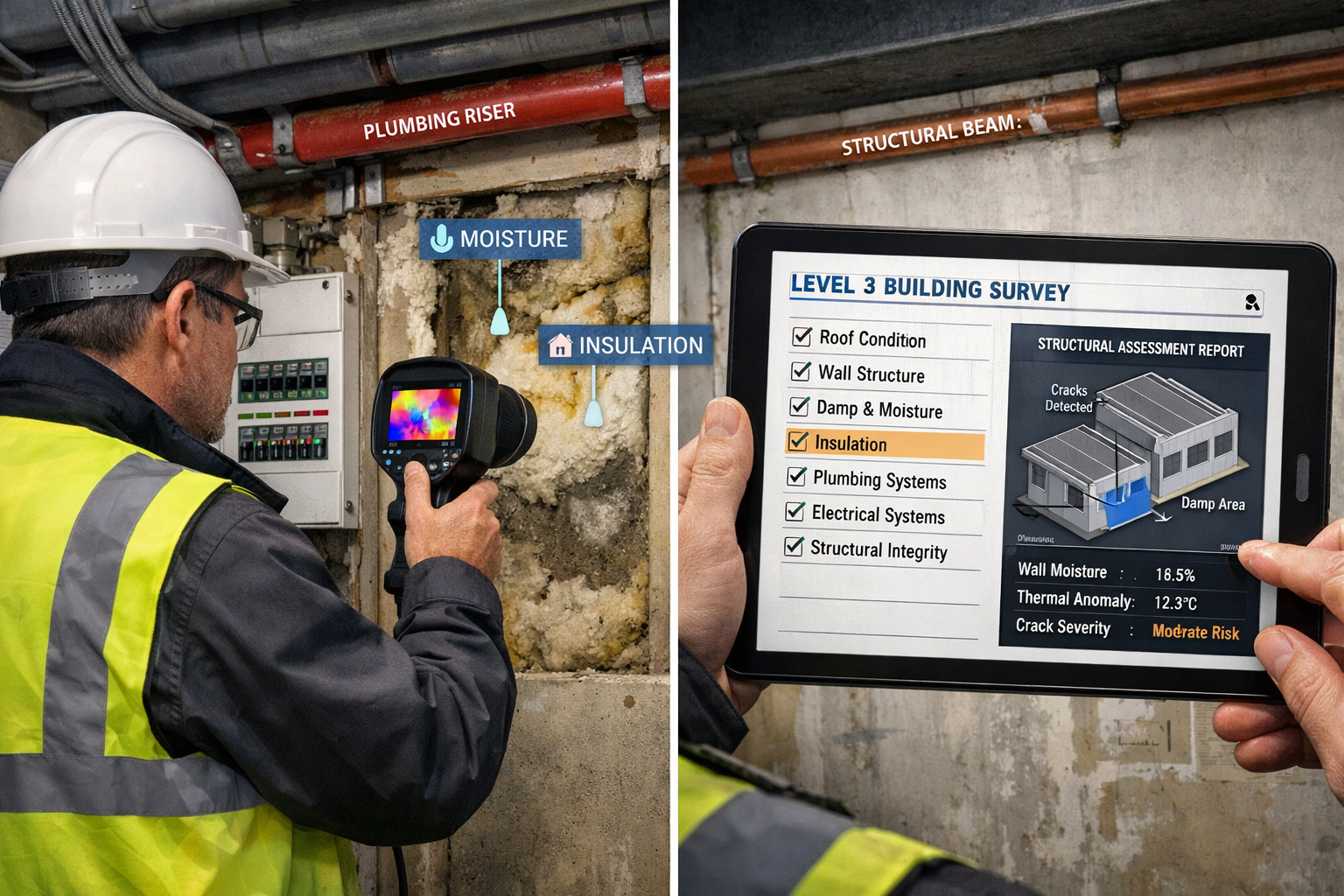
A comprehensive Level 3 building survey forms the foundation, but institutional assessments require additional layers:
Structural and Fabric Assessment
- Detailed analysis of building envelope integrity
- Roof condition with remaining service life projections
- Foundation and subsidence risk evaluation
- Damp and moisture ingress identification
- Load-bearing wall and structural beam condition
Building Services Evaluation
- Heating system age, efficiency, and replacement timeline
- Electrical installation compliance and capacity
- Plumbing infrastructure and water service condition
- Fire safety systems and regulatory compliance
- Lift and mechanical systems (for multi-unit buildings)
Regulatory and Compliance Review
- Energy Performance Certificate (EPC) ratings and improvement pathways
- Fire safety compliance post-Grenfell
- Building Regulations adherence
- Planning permissions and permitted development rights
- Statutory considerations affecting future use
Enhanced documentation requirements now mandate detailed recording of encroachments, boundary discrepancies, and comprehensive property characterization for institutional assessments.[1] This level of detail enables investors to build accurate financial models and identify properties that align with portfolio strategies.
Portfolio-Level Risk Assessment
Institutional investors don't acquire properties in isolation. Each acquisition must be assessed for how it fits within the broader portfolio context. Survey standards must therefore include:
- Diversification analysis: Geographic concentration risks
- Tenant profile compatibility: Alignment with target demographic
- Service charge implications: For leasehold and mixed-use properties
- Management intensity: Required oversight and maintenance burden
- Exit strategy viability: Future marketability and liquidity
Understanding which building survey you need becomes more nuanced when evaluating multiple properties simultaneously for portfolio acquisition.
Building Survey Standards for Buy-to-Let Institutional Investors: Yield Calculation Frameworks in 2026
The Yield Compression Challenge
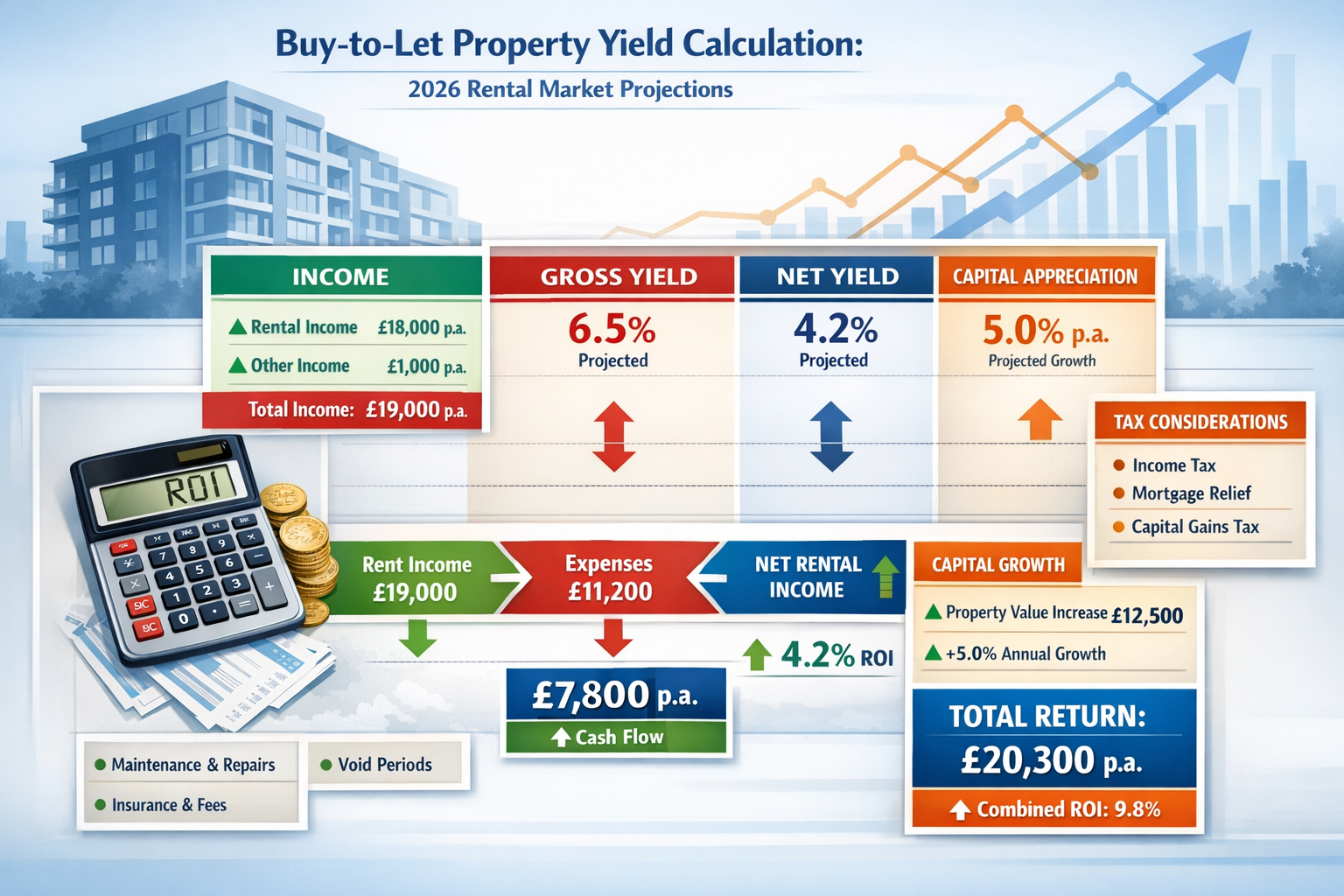
High construction costs, layers of development taxation, and unpredictable fiscal conditions have pushed many schemes to the edge of viability, requiring rigorous surveying and cost assessment for yield calculations.[5] In 2026's market, understanding the true net yield requires looking beyond simple rental income calculations.
Comprehensive Yield Assessment Model
Gross Yield Foundation
The starting point remains straightforward:
- Annual rental income ÷ property purchase price × 100 = Gross yield %
However, institutional investors must immediately move beyond this basic metric to understand the true investment performance.
Net Yield Calculation Components
| Cost Category | Assessment Requirements | Survey Impact |
|---|---|---|
| Maintenance & Repairs | 10-year capital expenditure forecast | Structural survey identifies upcoming major works |
| Property Management | Professional management fees (8-12%) | Portfolio scale affects negotiated rates |
| Insurance | Building and landlord liability | Survey findings directly impact premiums |
| Service Charges | Leasehold properties | Maintenance obligations must be quantified |
| Void Periods | Expected vacancy rates | Property condition affects tenant retention |
| Regulatory Compliance | EPC improvements, safety upgrades | Survey identifies required investments |
| Taxation | Corporation tax, SDLT, CGT planning | Affects post-tax yield calculations |
The 2026 Retrofit Cost Factor
The Royal Institution of Chartered Surveyors welcomed the UK Government's Future Homes and Buildings Standards publication in March 2026, positioning it as essential for net-zero delivery and energy-efficient housing requirements that will affect property valuations and retrofit costs.[3]
This regulatory shift means building surveys must now include:
✅ Current EPC rating and compliance trajectory
✅ Retrofit cost estimates for achieving minimum standards
✅ Payback period analysis for energy efficiency investments
✅ Rental premium potential from improved energy performance
✅ Future-proofing assessment against upcoming regulatory changes
RICS is developing new membership pathways to build surveyor expertise in retrofit and sustainability, indicating institutional investors should expect enhanced sustainability due diligence requirements.[3] This creates a competitive advantage for investors who integrate these assessments early in the acquisition process.
Hidden Yield Killers Identified Through Surveys
Experienced institutional investors know that the biggest threats to projected yields often hide in plain sight. Comprehensive building inspections and surveys can identify:
🔴 Structural issues requiring immediate remediation
🔴 Outdated building services approaching end-of-life
🔴 Fire safety deficiencies demanding costly upgrades
🔴 Moisture and damp problems indicating systemic failures
🔴 Cladding concerns with potential remediation liabilities
🔴 Shared infrastructure problems in mixed-use buildings
Each of these issues can transform an apparently attractive gross yield into a marginal or negative net return once remediation costs are factored in.
The 33/33/33 Portfolio Model
A realistic development model for large sites incorporates a three-way blend of open market housing (33%), affordable housing (33%), and BTR (33%), representing institutional investors' evolving approach to portfolio diversification and yield structuring.[5]
This model recognizes that yield optimization in 2026 requires balancing:
- Higher-yield market-rate rentals with greater volatility
- Stable affordable housing income with regulatory constraints
- Build-to-Rent premiums from professional management and amenities
Building surveys must assess properties against their intended role within this diversified framework.
Enhanced Due Diligence: Building Survey Standards for Buy-to-Let Institutional Investors in the Regulatory Environment

The Renters' Rights Act Impact
An implementation roadmap for the Renters' Rights Act is expected shortly, with the new tenancy system arriving ahead of database and ombudsman reforms, creating potential implications for long-term asset stewardship and service standards in BTR portfolios.[5]
The Act is expected to accelerate the shift from fragmented buy-to-let toward larger, professionally managed institutional landlords, sharpening focus on building performance, service quality, and long-term stewardship—factors institutional investors should emphasize in yield models.[5]
This regulatory shift fundamentally changes what constitutes an "acceptable" property for institutional acquisition. Building surveys must now evaluate:
Tenant Experience Factors
- Property condition standards that support long-term tenancies
- Maintenance responsiveness capabilities
- Building amenity quality and functionality
- Noise insulation and privacy considerations
- Accessibility and inclusive design features
Long-Term Stewardship Requirements
- Planned preventative maintenance schedules
- Component lifecycle management
- Building performance monitoring capabilities
- Resident communication systems
- Complaint handling and resolution frameworks
Multi-Unit and Portfolio Acquisition Surveys
When acquiring multiple properties or entire portfolios, institutional investors require standardized assessment frameworks that enable comparison and prioritization. This demands:
Standardized Condition Grading
Consistent rating systems across all properties:
- Grade A: Excellent condition, minimal immediate investment
- Grade B: Good condition, routine maintenance only
- Grade C: Fair condition, moderate investment required
- Grade D: Poor condition, significant investment needed
- Grade E: Critical condition, major remediation essential
Risk-Adjusted Yield Modeling
Each property's survey findings feed into a risk-adjusted yield calculation that accounts for:
- Probability of major repairs within 5-year horizon
- Regulatory compliance investment requirements
- Tenant turnover risk based on property condition
- Insurance cost variations
- Management intensity factors
Portfolio Optimization Analysis
Survey data enables strategic decisions about:
- Which properties to acquire from available portfolios
- Optimal rehabilitation investment sequencing
- Disposal candidates that don't meet yield thresholds
- Geographic and property-type diversification balance
Areas Requiring Further Investigation
Comprehensive surveys often identify areas requiring further investigation that demand specialist assessment:
🔬 Structural engineering reports for significant defects
🔬 Specialist damp surveys for persistent moisture issues
🔬 Electrical condition reports for older installations
🔬 Asbestos surveys for pre-2000 buildings
🔬 Fire risk assessments for multi-occupancy properties
🔬 Drainage surveys for recurring blockage problems
Institutional investors must budget both time and capital for these follow-up investigations, as they frequently reveal deal-breaking issues or require significant price renegotiation.
Geographic Considerations and Local Market Expertise
Building survey standards must adapt to regional variations in construction methods, climate challenges, and local regulatory requirements. Institutional investors benefit from working with surveyors who have deep local expertise, such as chartered surveyors in North London, chartered surveyors in Hertfordshire, or other regional specialists who understand area-specific issues.
Regional expertise helps identify:
- Local subsidence and ground condition patterns
- Area-specific construction defect trends
- Regional rental market dynamics affecting yield
- Local authority enforcement priorities
- Neighborhood trajectory and regeneration impacts
Technology Integration in Survey Processes
Leading institutional investors are integrating technology throughout the survey and due diligence process:
Digital Survey Tools
- Thermal imaging for insulation and moisture detection
- Drone surveys for roof and exterior assessments
- 3D scanning for accurate spatial documentation
- IoT sensors for ongoing building performance monitoring
Data Management Systems
- Centralized survey repositories for portfolio comparison
- Automated compliance tracking and alerting
- Predictive maintenance scheduling based on survey findings
- Integration with property management platforms
Analytics and Modeling
- Machine learning for defect pattern recognition
- Predictive modeling for capital expenditure forecasting
- Scenario analysis for different investment strategies
- Portfolio optimization algorithms incorporating survey data
Conclusion
Building Survey Standards for Buy-to-Let Institutional Investors: Assessing Properties for Yield in 2026's Rental Market Tightening represents more than just enhanced due diligence—it's a strategic framework for navigating one of the most significant transitions in UK rental market history. As smaller landlords continue to exit and institutional capital flows into the sector, the quality of building survey protocols directly determines investment success.
The convergence of multiple factors makes 2026 a pivotal year: intense rental demand meets constrained supply, regulatory reform accelerates market consolidation, and sustainability requirements reshape property valuations.[3][5] Institutional investors who implement comprehensive survey standards gain decisive advantages in acquisition negotiations, yield optimization, and long-term portfolio performance.
Actionable Next Steps for Institutional Investors
-
Upgrade Survey Protocols: Move beyond basic homebuyer surveys to comprehensive institutional assessment frameworks that integrate structural, regulatory, and sustainability evaluations
-
Build Specialist Networks: Establish relationships with chartered surveyors who understand institutional requirements and can provide consistent, portfolio-scale assessments
-
Integrate Retrofit Analysis: Incorporate Future Homes Standards compliance and energy efficiency improvement costs into all yield calculations from day one
-
Develop Standardized Frameworks: Create consistent condition grading and risk assessment methodologies that enable meaningful comparison across acquisition opportunities
-
Invest in Technology: Deploy digital survey tools, data management systems, and analytics platforms that scale with portfolio growth
-
Plan for Regulatory Change: Build flexibility into acquisition models to accommodate evolving tenant protection legislation and sustainability requirements
-
Focus on Long-Term Stewardship: Prioritize properties that support professional management standards and tenant retention, not just immediate yield metrics
The UK housing market sentiment is improving, with confidence returning and expectations for sales and prices turning "decisively more positive."[3] This creates a favorable backdrop for strategic acquisitions, but only for investors who can accurately assess property condition, quantify risks, and model true net yields in a complex regulatory environment.
Institutional investors who master Building Survey Standards for Buy-to-Let Institutional Investors: Assessing Properties for Yield in 2026's Rental Market Tightening will be positioned to capitalize on the ongoing market transformation, building portfolios that deliver sustainable returns while meeting the rising standards for professional residential management.
The opportunity is substantial, the demand is proven, and the capital is available. Success now depends on implementing the rigorous due diligence frameworks that separate exceptional acquisitions from expensive mistakes. 🏢
References
[1] Building Survey Due Diligence For Institutional Landlords Navigating Tax Pressures And Portfolio Risk In 2026 – https://nottinghillsurveyors.com/blog/building-survey-due-diligence-for-institutional-landlords-navigating-tax-pressures-and-portfolio-risk-in-2026
[2] Building Survey Protocols For Professional Landlord Acquisitions Assessing Yields In 2026s Bullish Buy To Let Recovery – https://nottinghillsurveyors.com/blog/building-survey-protocols-for-professional-landlord-acquisitions-assessing-yields-in-2026s-bullish-buy-to-let-recovery
[3] Rics Ceo Comments On The Publication Of The Future Homes And Building Standards – https://www.rics.org/news-insights/rics-ceo-comments-on-the-publication-of-the-future-homes-and-building-standards
[5] 2026 Will Test Btr S Potential And Government S Resolve – https://www.lrg.co.uk/news-and-insights/2026-will-test-btr-s-potential-and-government-s-resolve/