

The UK surveying profession crossed a critical threshold in 2026: Whole Life Carbon Assessment (WLCA) has transitioned from voluntary best practice to an embedded requirement in property valuations, fundamentally reshaping how chartered surveyors evaluate retrofit projects [3]. This regulatory shift, driven by RICS PAS 2080 2nd Edition standards, means that surveyors conducting building surveys must now integrate carbon metrics alongside traditional condition assessments—transforming retrofit valuations from purely financial exercises into strategic net zero investment decisions.
For surveyors accustomed to focusing on structural integrity, damp issues, and repair costs, Building Survey Integration with Whole Life Carbon Metrics: Practical Tools for 2026 Retrofit Valuations represents both a challenge and an opportunity. The integration of carbon data into Level 3 surveys isn't merely about regulatory compliance—it's about providing clients with the comprehensive intelligence needed to make informed retrofit decisions in an increasingly carbon-conscious property market.
Key Takeaways
- RICS PAS 2080 2nd Edition now mandates whole life carbon considerations in property valuations, making carbon assessment a core competency for surveyors in 2026 [3]
- Whole Life Carbon Assessment tracks two components: embodied carbon (materials and construction) and operational carbon (building use), reported across standardized lifecycle stages [1]
- Retrofit properties demonstrating carbon reductions are showing measurable positive impacts on market valuations, creating a "green premium" for energy-efficient homes [5]
- Specialized software tools like One Click LCA, IES Virtual Environment, and eTool enable surveyors to calculate and integrate carbon metrics into traditional survey reports
- Net zero targets require projects from 2030 to achieve operational carbon neutrality with greater than 40% embodied carbon reductions compared to baseline [1]
Understanding Whole Life Carbon Assessment in Building Survey Integration with Whole Life Carbon Metrics
What Makes Up a Whole Life Carbon Assessment?
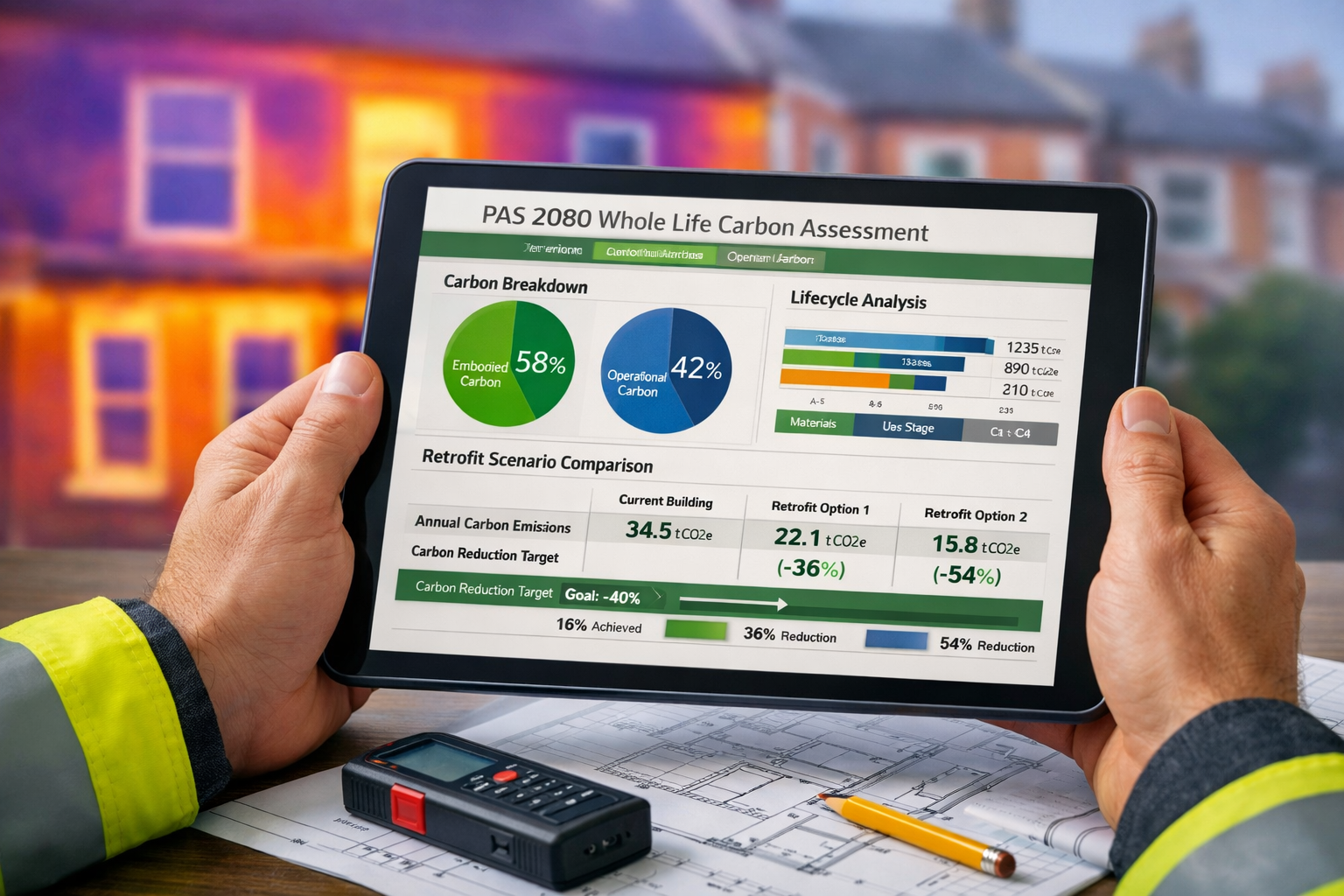
Whole Life Carbon Assessment represents a comprehensive methodology for tracking the total carbon impact of a building throughout its entire existence. Unlike traditional energy performance certificates that focus solely on operational energy, WLCA captures the complete carbon story from raw material extraction through demolition.
The assessment comprises two primary components [1]:
Embodied Carbon 🏗️
- Materials extraction and manufacturing (Stages A1-A3)
- Transportation to site (Stage A4)
- Construction and installation processes (Stage A5)
- Replacement materials during building life (Stage B1-B5)
- End-of-life demolition and disposal (Stages C1-C4)
Operational Carbon ⚡
- Energy consumption for heating, cooling, and lighting
- Water heating and ventilation systems
- Appliances and equipment usage
- Ongoing maintenance activities
For retrofit projects specifically, the carbon calculation becomes more nuanced. Surveyors must establish a baseline carbon footprint of the existing building, then model the carbon implications of various retrofit interventions—from simple insulation upgrades to comprehensive deep retrofits involving heat pumps, solar panels, and ventilation systems.
The Regulatory Framework Driving 2026 Requirements
The shift toward mandatory carbon assessment didn't happen overnight. Following commitments made at COP26 in November 2021, major industry players like Arup pledged to undertake whole lifecycle carbon assessments of all building projects, including retrofits [1]. This industry leadership paved the way for regulatory formalization.
RICS PAS 2080 2nd Edition has now embedded these practices into professional standards, creating clear expectations for surveyors conducting valuations in 2026 [3]. The standard recognizes WLCA as "an essential tool for informing better design, construction, and investment decisions in the built environment" [4].
For chartered surveyors, this means that Level 3 full building surveys must now incorporate carbon considerations alongside traditional assessments of structural condition, damp, timber defects, and services. The integration isn't optional—it's becoming a professional obligation.
How Carbon Metrics Impact Retrofit Property Values
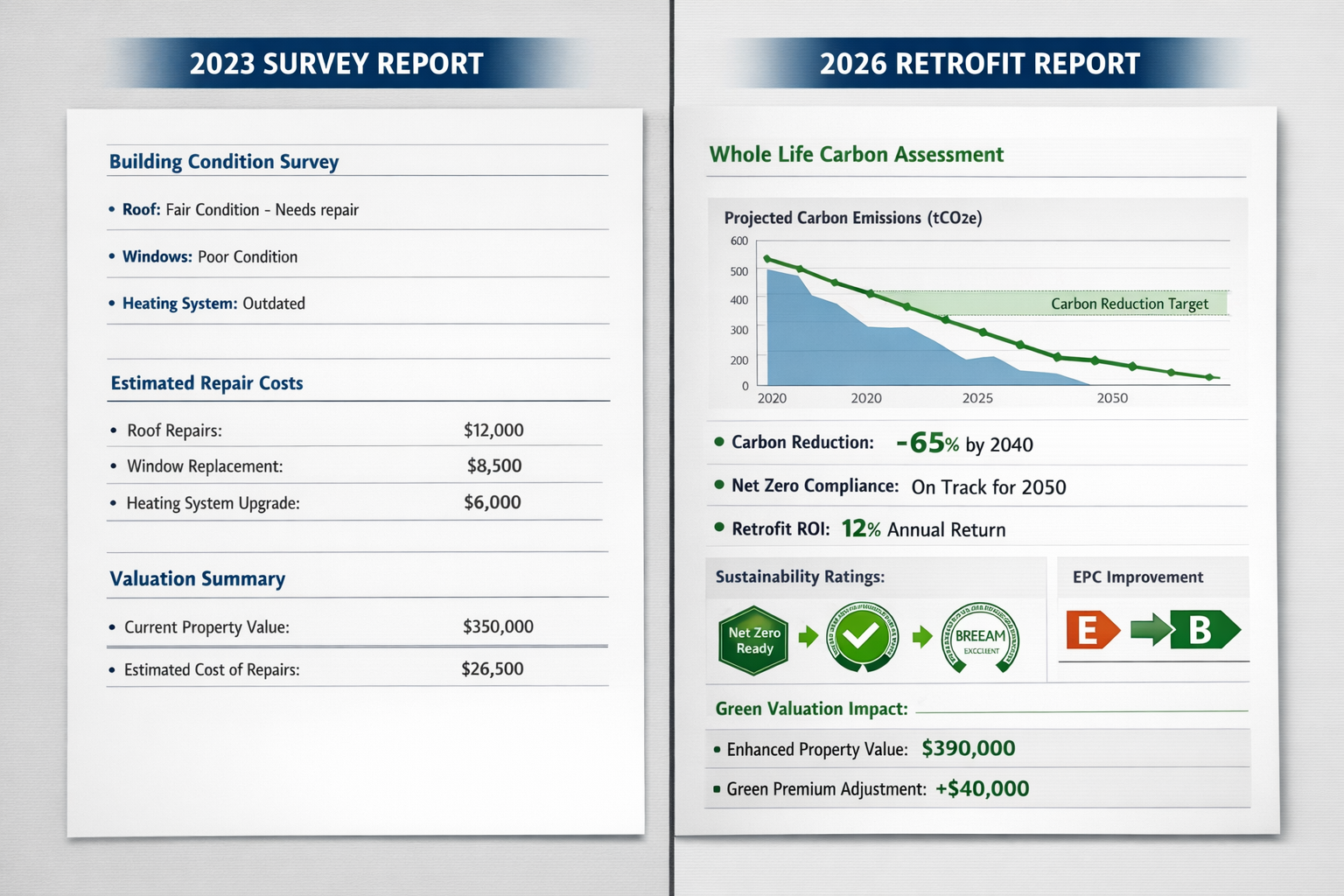
Research from the National Energy Foundation has demonstrated a positive correlation between retrofitted homes and their market values [5]. This "green premium" reflects several market dynamics:
| Value Driver | Impact on Valuation | Measurement Approach |
|---|---|---|
| Reduced operational costs | £50-150/month energy savings | Energy bill comparison pre/post retrofit |
| Enhanced EPC rating | 5-10% value increase (E to B rating) | EPC certificate improvement |
| Future-proofing against regulations | Risk mitigation premium | Compliance with net zero trajectory |
| Buyer preference shifts | Faster sales, higher offers | Market data analysis |
| Carbon reduction achievement | Emerging green mortgage discounts | Certified carbon savings |
For surveyors preparing commercial valuations or residential assessments, quantifying these value impacts requires integrating carbon data into traditional comparable analysis and investment method calculations.
Practical Tools for Building Survey Integration with Whole Life Carbon Metrics in 2026
Software Solutions for Carbon Calculation
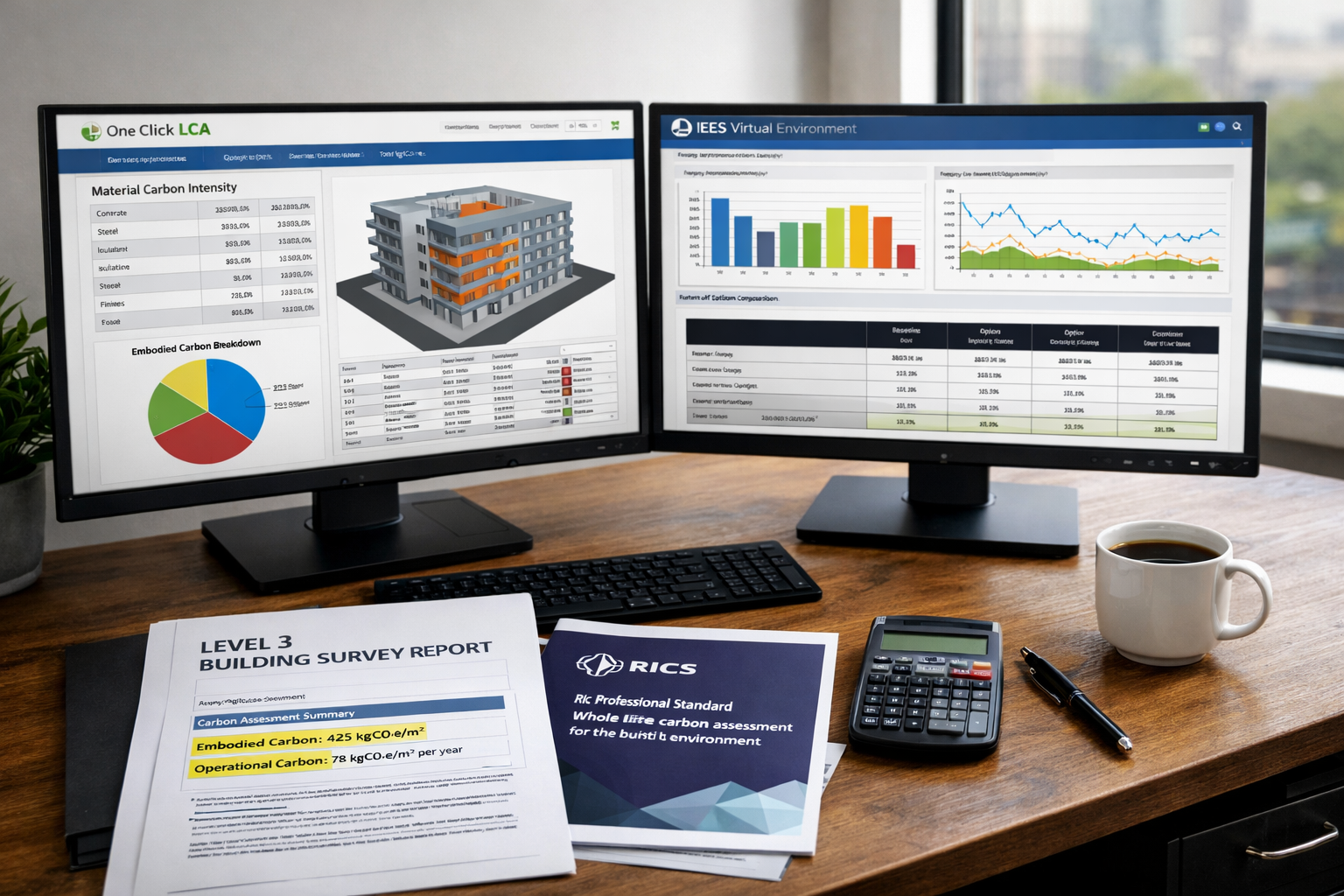
Surveyors seeking to integrate carbon metrics into their practice have several specialized software platforms available in 2026. These tools transform complex lifecycle carbon calculations into actionable data that can be incorporated into survey reports.
One Click LCA 🖥️
This cloud-based platform has become a leading choice for building carbon assessment. Key features include:
- Pre-populated material carbon intensity databases covering 1,000+ construction products
- Automated calculation across all lifecycle stages (A1-C4)
- Integration with BIM models for new builds and retrofit projects
- Scenario comparison tools for evaluating retrofit options
- Compliance reporting aligned with RICS PAS 2080 standards
IES Virtual Environment
Particularly valuable for operational carbon modeling, IES offers:
- Dynamic thermal simulation for existing buildings
- Energy consumption prediction under various retrofit scenarios
- HVAC system performance modeling
- Renewable energy integration analysis
- Whole building lifecycle assessment capabilities
eTool
An increasingly popular option for retrofit-focused assessments:
- Simplified interface designed for non-specialists
- Retrofit-specific calculation templates
- Material substitution carbon impact analysis
- Cost-benefit analysis integrating carbon savings with financial returns
- Export functionality for incorporation into survey reports
Tally and Embodied Carbon in Construction Calculator (EC3)
These complementary tools provide:
- Material-specific embodied carbon data
- Supply chain transparency for carbon-intensive products
- Alternative material comparison for retrofit specifications
- Industry benchmark comparisons
Integrating Carbon Data into Level 3 Survey Reports
The practical challenge for surveyors lies not just in calculating carbon metrics, but in presenting them meaningfully within traditional survey report structures. The environmental issues section of Level 3 surveys provides a natural integration point, but 2026 best practice extends carbon considerations throughout the report.
Recommended Report Structure Enhancement:
Executive Summary Addition
- Whole life carbon rating (baseline vs. post-retrofit potential)
- Carbon reduction opportunity summary
- Net zero alignment status
Main Survey Body Integration
- Roof Section: Embodied carbon of insulation materials, operational carbon savings from improved thermal performance
- Walls Section: Carbon implications of cavity wall insulation, external wall insulation systems
- Windows Section: Embodied carbon of replacement vs. repair, operational savings from double/triple glazing
- Services Section: Heat pump vs. gas boiler lifecycle carbon comparison, renewable energy integration carbon benefits
New Dedicated Section: Whole Life Carbon Assessment
- Baseline carbon footprint (tCO2e)
- Retrofit scenario modeling (minimum 3 options)
- Lifecycle stage breakdown (A-C stages)
- Payback period for carbon investment
- Net zero trajectory alignment
Valuation Impact Statement
- Green premium quantification
- Energy cost savings capitalization
- Future regulatory compliance value
- Comparable evidence from retrofitted properties
Step-by-Step Workflow for Surveyors
Implementing Building Survey Integration with Whole Life Carbon Metrics: Practical Tools for 2026 Retrofit Valuations requires a systematic approach:
Phase 1: Pre-Survey Preparation (1-2 hours)
- Request existing EPC certificates and energy bills
- Obtain building age, construction type, and previous alteration records
- Identify retrofit objectives from client brief
- Select appropriate carbon calculation software
Phase 2: On-Site Survey (Standard survey time + 30 minutes)
5. Conduct traditional Level 3 survey as per established protocols
6. Photograph building fabric details needed for carbon modeling
7. Measure wall thicknesses, window types, and insulation presence
8. Document existing heating systems and controls
9. Note renewable energy installations (solar panels, heat pumps)
Phase 3: Carbon Modeling (2-4 hours)
10. Input building geometry and construction details into carbon software
11. Model baseline whole life carbon footprint
12. Create retrofit scenario models (e.g., insulation only, full deep retrofit, intermediate options)
13. Calculate embodied carbon of retrofit materials
14. Project operational carbon savings over 30-year assessment period
Phase 4: Report Integration (1-2 hours)
15. Generate carbon assessment summary graphics
16. Integrate carbon findings into relevant survey sections
17. Prepare retrofit option comparison table with carbon and cost data
18. Draft valuation impact statement incorporating carbon metrics
19. Include carbon reduction recommendations prioritized by impact/cost ratio
Phase 5: Client Presentation (1 hour)
20. Present carbon findings alongside traditional survey results
21. Explain net zero trajectory implications
22. Discuss green premium potential for property value
23. Provide sourcing recommendations for retrofit specialists
Retrofit Valuation Methodologies Enhanced by Carbon Metrics
The Green Premium Calculation Framework
Traditional property valuation methods—comparative, investment, and residual—require adaptation to incorporate carbon performance. The "green premium" represents the additional value attributable to superior environmental performance, including carbon reduction.
Comparative Method Enhancement
When using comparable sales evidence, surveyors should now adjust for:
- EPC Rating Differential: Properties with B rating commanding 5-10% premium over E-rated comparables
- Carbon Certification: Properties with verified carbon reduction achieving 2-5% premium
- Future-Proofing Value: Compliance with 2030 net zero trajectory adding 3-7% value
Example Calculation:
Base comparable value: £450,000 (EPC Rating E)
Subject property post-retrofit: EPC Rating B
Carbon reduction: 65% vs. baseline
Net zero compliant: Yes

Adjustments:
EPC improvement (E to B): +7.5% = £33,750
Verified carbon reduction: +3% = £13,500
Future-proofing premium: +4% = £18,000

Adjusted valuation: £515,250
Green premium: £65,250 (14.5%)
Investment Method Integration
For commercial valuations and rental properties, carbon performance affects both rental value and yield:
- Rental Premium: Energy-efficient properties achieving 5-12% higher rents
- Yield Compression: Lower risk profile of net zero-compliant properties reducing yield by 0.25-0.50%
- Void Period Reduction: Faster letting due to tenant preference for efficient properties
Net Zero Compliance and Valuation Risk
Properties failing to meet emerging carbon standards face valuation penalties reflecting future compliance costs and market obsolescence risks. Surveyors must assess:
2030 Net Zero Trajectory Compliance [1]
- Operational carbon neutrality requirement
- 40% embodied carbon reduction vs. baseline
- Renewable energy integration expectations
Stranded Asset Risk Assessment
Properties with poor carbon performance face:
- Regulatory Risk: Potential rental restrictions for low EPC ratings
- Financing Risk: Mortgage availability constraints for inefficient properties
- Market Risk: Declining buyer pool for non-compliant properties
- Obsolescence Risk: Accelerated depreciation of carbon-intensive building systems
Surveyors should quantify these risks through:
- Retrofit cost-to-value analysis
- Compliance timeline assessment
- Market absorption period projections for non-compliant properties
Retrofit Option Appraisal Matrix
Effective retrofit valuations require systematic comparison of intervention options. The following matrix framework integrates carbon metrics with financial analysis:
| Retrofit Scenario | Capital Cost | Embodied Carbon (tCO2e) | Operational Carbon Saving (tCO2e/year) | Payback Period (Carbon) | NPV (30 years) | Valuation Impact |
|---|---|---|---|---|---|---|
| Baseline (no action) | £0 | 0 | 0 | N/A | -£45,000 | -£35,000 |
| Fabric-first (insulation + windows) | £35,000 | 8.5 | 3.2 | 2.7 years | £28,000 | +£42,000 |
| Intermediate (fabric + heat pump) | £58,000 | 12.3 | 5.8 | 2.1 years | £67,000 | +£73,000 |
| Deep retrofit (full net zero) | £95,000 | 18.7 | 7.9 | 2.4 years | £98,000 | +£115,000 |
This analysis enables clients to understand not just the financial return, but the carbon return on investment—increasingly important for property development decisions and institutional investors.
Incorporating Carbon into Red Book Valuations
For RICS Red Book compliant valuations, carbon considerations should be integrated into:
Assumptions and Special Assumptions
- State assumptions about future carbon regulation compliance
- Clarify whether valuation assumes retrofit completion
- Note market evidence limitations for carbon-enhanced properties
Market Commentary
- Discuss emerging green premium trends in local market
- Reference comparable carbon-enhanced property transactions
- Analyze buyer/tenant preference shifts toward efficient properties
Valuation Reasoning
- Explain carbon performance impact on comparable selection
- Justify green premium or obsolescence discount applied
- Document retrofit cost-to-value analysis methodology
Sustainability Section (New 2026 Requirement)
- Whole life carbon assessment summary
- Net zero compliance status
- EPC rating and improvement potential
- Carbon reduction recommendations
Implementation Challenges and Solutions
Common Obstacles for Surveyors
Data Availability Limitations
Many existing buildings lack detailed construction records needed for accurate embodied carbon calculation. Solutions include:
- Using archetypal building carbon profiles based on age and construction type
- Conducting invasive investigations at key locations to verify construction
- Applying conservative assumptions with sensitivity analysis
- Documenting data limitations and uncertainty ranges
Software Learning Curve
Carbon calculation tools require new technical skills. Recommended approaches:
- Start with simplified tools like eTool before advancing to complex platforms
- Attend RICS-accredited training on WLCA methodologies
- Partner with carbon specialists for initial projects
- Build internal templates and workflows for common building types
Client Education Requirements
Many property owners remain unfamiliar with carbon metrics. Effective communication strategies include:
- Translating tCO2e figures into relatable comparisons (e.g., "equivalent to X flights to New York")
- Emphasizing financial benefits alongside environmental impact
- Providing clear retrofit option comparisons with visual graphics
- Highlighting regulatory compliance timelines and risks
Market Evidence Gaps
Limited comparable transaction data for carbon-enhanced properties creates valuation uncertainty. Interim solutions:
- Building proprietary databases of retrofitted property sales
- Collaborating with estate agents to track green premium trends
- Using hedonic pricing models to isolate carbon performance value
- Applying wider acceptable ranges with appropriate caveats
Quality Assurance and Professional Standards
To maintain credibility, surveyors implementing Building Survey Integration with Whole Life Carbon Metrics: Practical Tools for 2026 Retrofit Valuations should:
Establish Internal Protocols ✅
- Standardized carbon assessment checklists
- Peer review processes for carbon calculations
- Regular calibration of software assumptions
- Documentation of methodology and data sources
Maintain Professional Development
- Complete RICS WLCA training modules
- Subscribe to carbon assessment industry updates
- Participate in professional forums sharing best practices
- Seek carbon literacy certification
Ensure Transparency
- Clearly state carbon assessment scope and limitations
- Distinguish between measured data and modeled projections
- Provide sensitivity analysis for key assumptions
- Reference software versions and database editions used
Future-Proofing Your Practice
The integration of carbon metrics into surveying practice will only intensify beyond 2026. Forward-thinking practices should:
Invest in Technology Infrastructure
- Acquire licenses for professional carbon calculation software
- Integrate carbon tools with existing survey report systems
- Develop automated data collection workflows
- Build digital libraries of material carbon intensities
Develop Specialist Expertise
- Designate carbon assessment champions within the practice
- Create retrofit valuation specialist roles
- Build relationships with retrofit coordinators and energy assessors
- Establish referral networks with structural engineers specializing in retrofit
Market Your Enhanced Capabilities
- Promote carbon-integrated survey services to environmentally conscious clients
- Develop case studies demonstrating green premium realization
- Publish thought leadership on retrofit valuation methodologies
- Target institutional investors with ESG reporting requirements
Conclusion
Building Survey Integration with Whole Life Carbon Metrics: Practical Tools for 2026 Retrofit Valuations represents a fundamental evolution in the chartered surveying profession. The transition from optional carbon consideration to mandatory WLCA integration under RICS PAS 2080 2nd Edition reflects the property industry's recognition that net zero targets cannot be achieved without comprehensive carbon assessment of retrofit projects.
For surveyors, this shift demands new technical competencies—from mastering carbon calculation software to interpreting lifecycle stage data and quantifying green premiums in property valuations. Yet it also creates significant opportunity: surveyors who develop carbon assessment expertise position themselves as essential advisors in the retrofit economy, providing clients with the integrated intelligence needed to make strategic investment decisions in an increasingly carbon-constrained property market.
The practical tools available in 2026—from One Click LCA to IES Virtual Environment—make carbon integration technically achievable, while emerging market evidence of green premiums validates the financial materiality of carbon performance. Surveyors conducting building surveys must now view their role not merely as documenting existing condition, but as illuminating the carbon reduction potential that increasingly drives property value.
Actionable Next Steps
For Individual Surveyors:
- Complete RICS-accredited WLCA training within the next quarter
- Trial carbon calculation software on upcoming retrofit survey projects
- Develop a standardized carbon assessment template for Level 3 reports
- Build a database of local retrofitted property comparables with carbon data
For Surveying Practices:
- Invest in professional carbon calculation software licenses
- Establish internal carbon assessment quality assurance protocols
- Designate retrofit valuation specialists within the team
- Market enhanced carbon-integrated survey capabilities to target clients
- Develop strategic partnerships with retrofit coordinators and energy assessors
For Property Owners and Investors:
- Request carbon-integrated surveys for all retrofit projects
- Evaluate retrofit options using whole life carbon metrics alongside financial analysis
- Document carbon reductions achieved to capture green premium value
- Align retrofit strategies with 2030 net zero trajectory requirements
The integration of whole life carbon metrics into building surveys is no longer emerging practice—it's the professional standard for 2026 and beyond. Surveyors who embrace this evolution will lead the industry in delivering the comprehensive retrofit valuations that the net zero transition demands.
References
[1] Whole Life Carbon Assessments Case Study – arup.com
[2] Whole Life Carbon Assessment In Building Surveys Rics Pas 2080 2nd Edition And Valuation Resilience In 2026 – nottinghillsurveyors.com
[3] Whole Life Carbon Assessments In 2026 Valuations Rics 2nd Edition Standards For Surveyors – nottinghillsurveyors.com
[4] Wlca Delivering The Future Of Carbon Assessment In The Built Environment – rics.org
[5] Research Shows Impact Of Retrofit On Property Values 1 – wholelifecarbon.com