

More than 80% of the UK's residential housing stock sits below the 18-metre threshold that triggers the most stringent Building Safety Act requirements — yet compliance expectations for these lower-risk properties are quietly but decisively tightening in 2026. While regulators and media attention have rightly focused on high-rise remediation, surveyors working across terraced houses, low-rise flats, and mid-rise blocks are navigating a fast-evolving landscape of new codes, inspection timelines, and reporting obligations.
Building Safety Compliance in Lower-Risk Residential Properties: Surveyor Checklists Beyond High-Rise in 2026 is no longer a secondary concern. It is a front-line professional responsibility — and the checklists surveyors use must reflect that reality.
Key Takeaways 📋
- Lower-risk residential properties face growing compliance obligations in 2026, even if they fall outside the highest-risk regulatory tier.
- New legislation in 2026 introduces expedited inspection timelines, private plan-checking options, and mandatory permit fee transparency [1].
- Surveyor checklists must now cover fire safety, structural integrity, energy performance, electrical codes, and emerging issues like roof deck reclassification [2].
- Properties with accessible roof decks may be reclassified as additional storeys, triggering higher-grade requirements [2].
- Proactive compliance surveys protect homeowners, landlords, and buyers from costly enforcement action and liability.
Why Lower-Risk Doesn't Mean Low Compliance
The term "lower-risk" is a regulatory category, not a safety guarantee. A two-storey Victorian terrace, a converted flat above a shop, or a three-storey purpose-built block can all harbour significant safety deficiencies — from inadequate fire compartmentation to outdated electrical installations.
In 2026, the regulatory environment has shifted in several important ways:
- Inspection timelines are tighter. Under AB 1308-style provisions being adopted across multiple jurisdictions, building departments must now conduct inspections of permitted residential work within 10 business days of receiving notice of completion, specifically for new construction or additions involving 1–10 dwelling units with no floors exceeding 40 feet above ground level [1].
- Private plan checking is expanding. Applicants can now directly hire private professional plan checkers rather than waiting for municipal plan check queues — though they must indemnify local authorities against liability from construction defects [1].
- Fee transparency is mandatory. Local authorities must post residential building permit fee schedules online and provide estimated plan-check timeframes when deeming applications complete [1].
These changes mean that surveyors and their clients face both faster processes and sharper accountability. A missed defect or a delayed report carries greater professional and legal weight.
💬 "Compliance is not a box-ticking exercise. For lower-risk residential properties, it is the foundation of long-term asset value and occupant safety."
For homeowners and buyers seeking clarity on what a thorough inspection involves, understanding what a Level 3 building survey covers is an excellent starting point.
The Core Surveyor Checklist for Lower-Risk Residential Properties in 2026
Building Safety Compliance in Lower-Risk Residential Properties: Surveyor Checklists Beyond High-Rise in 2026 requires a structured, multi-category approach. The checklist below reflects current best practice across the UK and aligns with emerging international code updates.
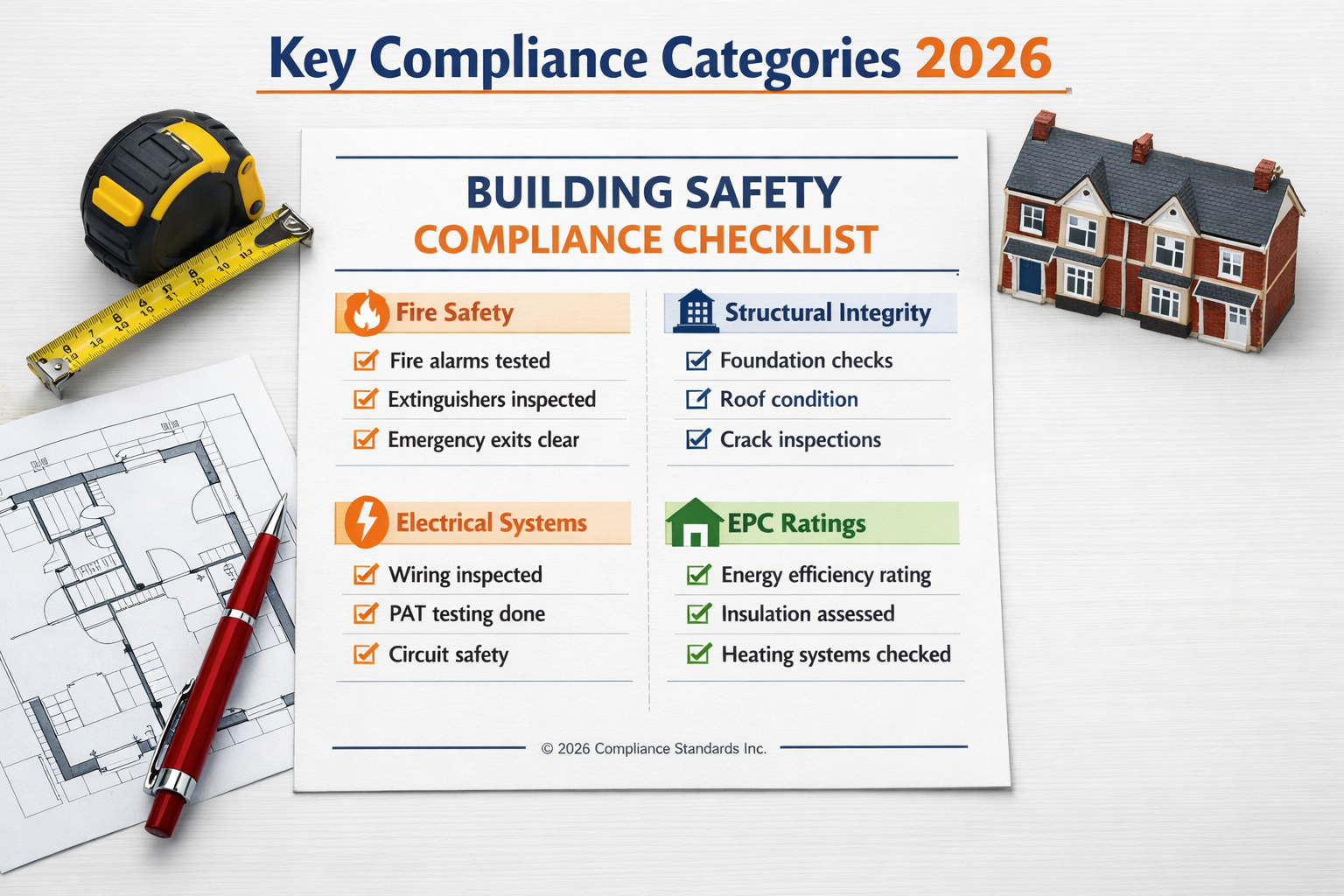
🔥 1. Fire Safety Assessment
Fire safety is no longer exclusively a high-rise concern. Even single-family homes and low-rise blocks must demonstrate:
| Checklist Item | Standard Required |
|---|---|
| Smoke and heat detector placement | Interlinked alarms on every storey |
| Fire door integrity (flats/HMOs) | FD30 minimum, self-closing mechanisms |
| Compartmentation checks | No breaches in floors, walls, or service penetrations |
| Means of escape | Clear, unobstructed routes from all habitable rooms |
| Combustible cladding (if any) | Documented and remediation plan in place |
For blocks of flats, even those below 11 metres, fire risk assessments must be current and accessible to residents.
⚡ 2. Electrical Systems
The 2026 National Electrical Code introduces specific compliance traps that surveyors must flag, particularly regarding outdoor HVAC units and their associated wiring requirements [2]. Key inspection points include:
- Consumer unit (fuse board) age and condition — metal-clad units required in rental properties
- RCD protection on all circuits
- Outdoor socket and HVAC wiring compliance with 2026 NEC provisions [2]
- Evidence of a valid Electrical Installation Condition Report (EICR)
- Earthing and bonding adequacy
🏗️ 3. Structural Integrity
Structural defects in lower-risk properties are among the most commonly under-reported issues. Surveyors should assess:
- Foundation movement — differential settlement, subsidence indicators
- Roof structure — rafter spread, ridge deterioration, sagging
- Wall ties — particularly in cavity wall construction from the 1930s–1980s
- Lintels — cracking above openings, inadequate bearing
- Damp and timber decay — rising damp, penetrating damp, wet rot, dry rot
A detailed building survey remains the gold standard for identifying structural concerns before purchase or during ownership.
🌡️ 4. Energy Performance and MEES Compliance
Energy performance is now a compliance issue, not merely a marketing consideration. The Minimum Energy Efficiency Standards (MEES) continue to tighten, with implications for landlords and sellers alike. Surveyors should check:
- Current EPC rating and its expiry date
- Insulation levels (loft, cavity wall, solid wall)
- Heating system efficiency and controls
- Window glazing standards
- Renewable energy installations and their condition
For a deeper understanding of how EPC ratings intersect with building survey findings, the EPC, MEES, and building survey guide provides valuable context.
🚰 5. Drainage, Plumbing, and Water Safety
- Drainage — condition of gutters, downpipes, underground drainage
- Hot water systems — Legionella risk assessment for HMOs and larger blocks
- Water pressure — adequate supply pressure and flow rates
- Lead pipework — identification and remediation planning in pre-1970 properties
Emerging Compliance Challenges: What's New in 2026
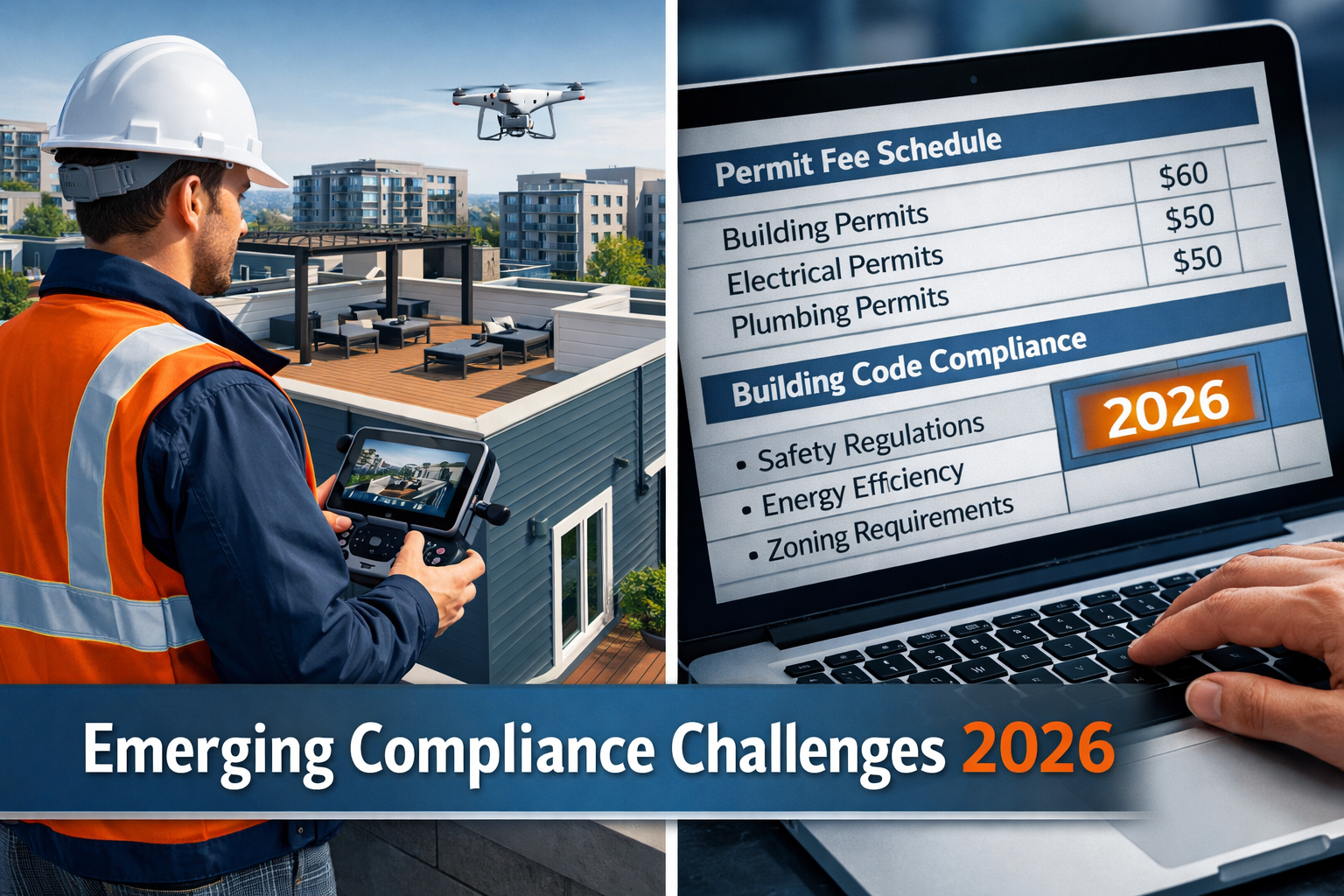
🏠 Roof Deck Reclassification — A Hidden Compliance Trap
One of the most significant emerging issues for lower-risk residential properties in 2026 is the reclassification of accessible roof decks as additional storeys [2]. Under updated code interpretations being adopted in multiple jurisdictions:
- A property previously classified as 3 storeys with an accessible roof deck may now be treated as a 4-storey structure
- This reclassification can trigger commercial-grade requirements for fire safety, structural loading, and means of escape
- Surveyors must specifically identify and flag accessible roof decks in their reports
This is particularly relevant for converted loft spaces and urban terraces where roof terraces have been added without formal planning or building control sign-off.
🌿 Wildfire Resiliency and Renewable Energy Standards
Cities adopting 2026 building codes — such as Arvada, Colorado — are incorporating wildfire resiliency standards and renewable energy requirements into residential compliance frameworks [3]. While this is most immediately relevant in high-risk geographic areas, the principle is spreading:
- Construction materials must meet updated fire-resistance ratings in designated zones [3]
- Solar-ready provisions are increasingly required in new builds and major refurbishments [3]
- Defensible space requirements are being written into local planning conditions
🔍 Permit Transparency and Its Impact on Surveys
The new requirement for cities to publish permit fee schedules online and provide plan-check timeframes [1] creates a more transparent environment — but also raises the bar for surveyors. Clients now have easier access to permit histories, making it simpler to identify:
- Unauthorised works carried out without building regulation approval
- Lapsed or incomplete building control sign-offs
- Discrepancies between permitted and actual construction
Surveyors should cross-reference their site observations against publicly available permit records as a standard part of the inspection process.
Building Safety Compliance in Lower-Risk Residential Properties: Surveyor Checklists Beyond High-Rise in 2026 — Reporting Best Practice
A technically thorough inspection is only as valuable as the report that communicates its findings. In 2026, best-practice reporting for lower-risk residential properties should follow these principles:
📝 Report Structure
- Executive summary — key risks and urgent actions in plain language
- Condition ratings — standardised 1–3 scale (satisfactory / requires monitoring / requires action)
- Photographic evidence — geo-tagged images linked to specific defects
- Regulatory compliance section — explicit reference to applicable codes and standards
- Prioritised action plan — immediate, short-term, and long-term recommendations
- Cost guidance — indicative repair cost ranges where possible
🎯 Audience-Specific Reporting
Different clients need different emphasis:
| Client Type | Priority Focus |
|---|---|
| Homebuyer | Defects affecting value, safety, and mortgageability |
| Landlord | MEES compliance, EICR, fire safety, HMO licensing |
| Leaseholder | Service charge obligations, major works exposure |
| Developer | Building regulation compliance, sign-off status |
For buyers unsure which level of survey is appropriate, the guide on which building survey you need offers clear, practical guidance.
🛸 Technology in Modern Surveys
Drone technology is increasingly being used to inspect areas that are difficult or dangerous to access — particularly roofs, high parapets, and rear elevations of terraced properties. Premium drone surveys allow surveyors to capture detailed imagery of roof conditions, chimney stacks, and guttering without the need for scaffolding, reducing both cost and risk.
Special Considerations: New Builds and Snagging
New-build properties present a distinct compliance challenge. While they are constructed to current building regulations, defects are common — and buyers often assume that a new home is defect-free. In 2026, with tighter inspection timelines [1], the window for identifying and reporting snagging issues is narrowing.
Key new-build compliance checks include:
- Thermal bridging at junctions — a frequent energy performance failure
- Ventilation systems — mechanical ventilation with heat recovery (MVHR) commissioning
- Fire stopping around service penetrations
- Drainage falls — inadequate gradients causing blockage and damp
Understanding what house snagging involves and when a snagging survey is necessary can save new-build buyers significant remediation costs.
For those purchasing new-build properties and questioning whether a survey is even necessary, the evidence is clear — as explored in this guide on whether you need a survey on a new build.
Common Defects Surveyors Encounter in Lower-Risk Properties
The most frequently identified issues in lower-risk residential properties during 2026 inspections include:
- 🧱 Spalling brickwork and failed pointing
- 💧 Damp penetration through defective flashings and gutters
- 🪵 Timber decay in roof structures and ground floors
- 🔌 Outdated wiring — particularly in pre-1990 properties
- 🏚️ Subsidence indicators — diagonal cracking at openings
- 🌫️ Inadequate ventilation leading to condensation and mould
A detailed review of 11 common defects in older homes provides surveyors and homeowners with a practical reference for what to look for.
Conclusion: Actionable Next Steps for 2026 Compliance
Building Safety Compliance in Lower-Risk Residential Properties: Surveyor Checklists Beyond High-Rise in 2026 demands a proactive, structured, and technically current approach from every surveyor working in the residential sector. The regulatory landscape is moving quickly — tighter inspection timelines, new code adoptions, and emerging issues like roof deck reclassification mean that yesterday's checklist may not be adequate today.
✅ Actionable Next Steps
- Review and update your surveyor checklist to incorporate 2026 code changes, including NEC electrical provisions and roof deck classification rules [2].
- Cross-reference permit records as a standard part of every inspection, taking advantage of new fee schedule transparency requirements [1].
- Invest in drone inspection capability or partner with providers who offer it — roof and parapet inspections are increasingly non-negotiable.
- Educate clients on the difference between regulatory tiers: lower-risk does not mean no risk.
- Ensure EPC and MEES compliance is explicitly addressed in every report for rental properties.
- Flag accessible roof decks in all reports and advise clients on potential reclassification implications [2].
- Stay current with local code adoptions — municipalities are rolling out 2026 building codes at different speeds, and wildfire resiliency standards are spreading beyond traditional risk zones [3].
The properties that dominate the housing stock — terraces, semis, low-rise flats — deserve the same rigour of compliance assessment as the high-rises that dominate the headlines. In 2026, surveyors who deliver that rigour will be the professionals that clients trust, regulators respect, and the market rewards.
References
[1] New 2026 Laws Impacting Building Permits For New Housing – bwslaw.com
[2] Watch – youtube.com
[3] Watch – youtube.com