

A single disputed boundary strip measuring less than two metres wide recently became the subject of a six-figure valuation argument between neighbours in Greater Manchester — not because the land itself was extraordinary, but because the regional price trajectory made every square metre of buildable land a contested asset. This kind of case sits at the heart of boundary dispute valuations in regional price divergences: RICS strategies for 2026 North-South markets, where the gap between northern growth and southern cooling has made standard valuation assumptions dangerously unreliable.
RICS February 2026 survey data confirmed what many chartered surveyors had already observed on the ground: sentiment in London and the South East had collapsed by nearly 49 percentage points on a 12-month outlook, while the North West maintained positive current sentiment and a stable growth trajectory [3]. For boundary disputes, this divergence is not merely academic. It directly determines whether a contested strip of land adds meaningful value to a property, and by how much — a question that courts, tribunals, and mediators increasingly expect surveyors to answer with precision and transparency.
Key Takeaways
- RICS February 2026 data confirms a sharp North-South sentiment divergence, requiring region-specific comparable selection windows and risk adjustment frameworks for boundary dispute valuations.
- In cooling southern markets, surveyors should provide valuation ranges (±5-8%) rather than single-point estimates, and weight recent transactions within three months more heavily.
- Affordability stress testing, rental market cross-validation, and ESG adjustments are now embedded best practices under updated RICS standards effective from April 2026.
- RICS Expert Witness Accreditation Service (EWAS) credentials are increasingly decisive in contested boundary valuations brought before courts and tribunals.
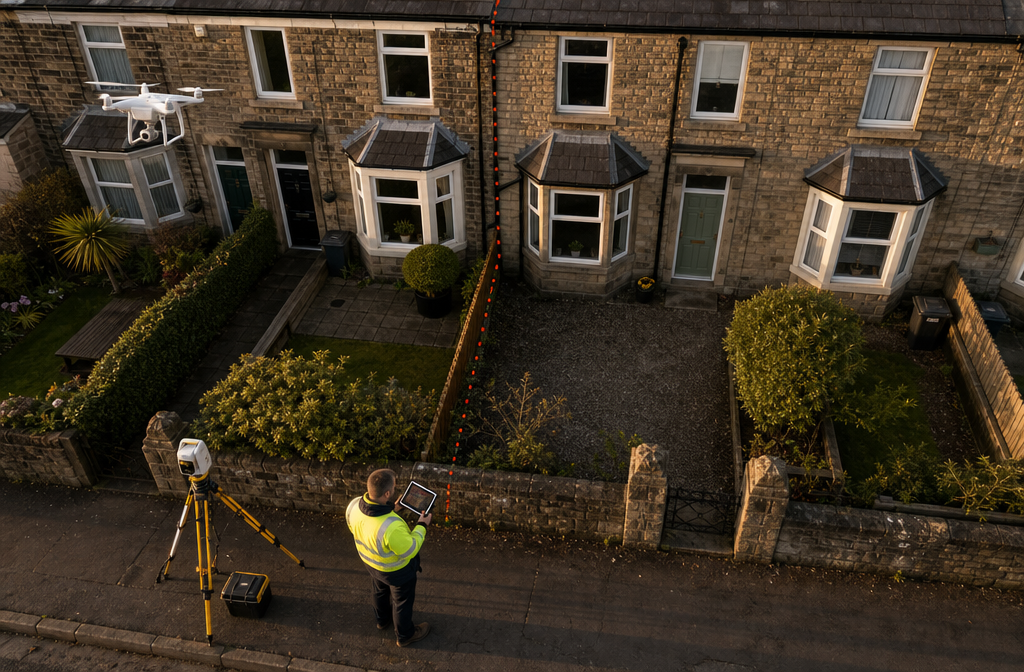
- Drone technology and digital boundary mapping are transforming how chartered surveyors gather and present evidence in regional disputes.
Why the North-South Divide Is Reshaping Boundary Dispute Valuations
The concept of a uniform national property market has never been entirely accurate, but 2026 has made the fiction impossible to sustain. Boundary dispute valuations in regional price divergences: RICS strategies for 2026 North-South markets must now account for the fact that a two-metre encroachment in Salford carries a fundamentally different financial consequence than the same encroachment in Sevenoaks — even if the physical characteristics of the land are identical.
The February 2026 Sentiment Data in Context
RICS survey data from February 2026 revealed that London and the South East were experiencing a -40% current sentiment reading alongside a sharply deteriorating 12-month outlook. Manchester, Leeds, and other northern cities showed the opposite picture: positive current sentiment and a stable forward view [1]. For boundary dispute valuations, this creates a two-speed evidential landscape.
In northern markets, a disputed strip of garden land adjacent to a development plot may genuinely represent a premium asset. In southern markets, the same strip may carry diminished marginal value because buyer demand has softened and development viability has contracted. A surveyor who applies a single national methodology to both scenarios risks producing a valuation that neither reflects market reality nor withstands scrutiny in legal proceedings.
Comparable Selection: Timing Is Everything
RICS guidance now emphasises that comparable selection must be calibrated to regional market velocity [1]. The practical implications are significant:
| Market Condition | Recommended Comparable Window | Adjustment Approach |
|---|---|---|
| Southern cooling (London, South East) | Within 3 months | Prioritise recent sales; weight downward adjustments heavily |
| Northern growth (Manchester, Leeds) | Within 3-6 months | Stable comparables acceptable; moderate adjustments |
| Transitional markets (Midlands) | Within 4 months | Case-by-case; disclose assumptions clearly |
For boundary disputes specifically, this means that a comparable sale used to support a land value claim in a northern market may be entirely inappropriate as evidence in a southern dispute — even if the properties appear superficially similar. Surveyors presenting expert evidence must be prepared to justify their comparable window selection explicitly.
Affordability Stress Testing as a Valuation Tool
One of the more significant methodological advances embedded in current RICS best practice is the formal inclusion of affordability stress testing in valuation work [1]. For boundary disputes involving residential land, this involves:
- Calculating the median household income for the relevant postcode area
- Applying a standard 4.5x income mortgage multiplier
- Adding a 15% deposit assumption
- Comparing the resulting figure to the subject valuation to generate an affordability index
In southern markets where the affordability gap is most acute, this index often reveals that headline comparable values are not genuinely achievable for the majority of buyers in that postcode. This matters in boundary disputes because it directly challenges inflated land value claims based on older or cherry-picked comparables.
RICS Strategies for Adjusting Valuations Across Divergent Regional Markets

Applying boundary dispute valuations in regional price divergences: RICS strategies for 2026 North-South markets requires more than selecting the right comparables. It demands a layered methodology that accounts for market volatility, rental cross-validation, ESG factors, and transparent risk disclosure.
Differential Risk Adjustment Frameworks
The volatility differential between regions demands distinct risk adjustment approaches. Consider a property valued in February 2026 for a boundary dispute resolution scheduled for completion in June 2026. In London, with a -40% current sentiment reading and a deteriorating 12-month outlook, the surveyor must account for the possibility that market conditions will worsen further between the valuation date and the resolution date [1]. In Manchester, with stable positive sentiment, the same forward-looking adjustment is far less material.
RICS professionals are now advised to provide valuation ranges rather than single-point estimates in highly volatile markets [3]. In cooling southern markets, a range of ±5-8% with a conservative bias gives courts and tribunals a more honest picture of market uncertainty than a single figure that implies false precision. This approach also protects the surveyor's credibility under cross-examination, where opposing counsel will invariably probe the assumptions behind a point estimate.
"In divergent markets, a single-figure valuation without a disclosed range is not precision — it is a misrepresentation of the evidence."
Rental Market Cross-Validation
Given the volatility in sales markets, the rental sector has emerged as a more stable anchor for valuation cross-validation. Tenant demand edged higher in the three months to January 2026, with landlord supply remaining constrained and rental prices continuing to rise across most regions [1]. For boundary dispute valuations involving residential property, applying a gross yield cross-check against rental evidence provides an independent test of whether a sales-based valuation is credible.
This technique is particularly valuable in southern markets where sales transaction volumes have fallen, reducing the pool of reliable comparables. If a valuation implies a gross yield significantly below the prevailing market yield for the postcode, that is a signal that the figure may be inflated — a point that opposing experts will not hesitate to raise. For properties where leasehold extension or enfranchisement valuations are also in play, rental cross-validation becomes doubly important.
ESG Adjustments Under the April 2026 RICS Standard
Effective from April 30, 2026, RICS published the fourth edition of its global professional standard on ESG and sustainability in commercial property valuation [2]. While primarily directed at commercial assets, the framework has clear implications for residential boundary disputes involving development land. Properties with poor energy performance ratings, flood risk exposure, or contamination history now require explicit ESG adjustments in the valuation methodology.
In boundary disputes, this matters because a disputed strip of land adjacent to a flood plain carries a materially different value from one adjacent to a well-drained, energy-efficient development site. Surveyors who fail to account for ESG factors in their valuation methodology risk producing reports that are successfully challenged on the grounds of incomplete analysis.
For those working on property development valuations, integrating ESG adjustments into boundary dispute evidence is no longer optional — it is an expected component of a robust, court-ready report.
Drone Technology and Digital Boundary Mapping
One of the most significant practical advances in 2026 boundary dispute work is the adoption of drone-based survey technology. Drones equipped with LiDAR and photogrammetry capabilities can produce millimetre-accurate boundary maps that are far more defensible in legal proceedings than traditional tape-measure surveys. This technology is particularly valuable in northern markets where boundary disputes often involve larger plots, agricultural land, or properties with irregular boundaries.
Key advantages of drone-assisted boundary mapping include:
- Objective evidence: Digital point-cloud data is difficult to challenge on accuracy grounds
- Speed: A drone survey can cover complex boundaries in a fraction of the time required for manual measurement
- Visual clarity: 3D models and orthophotographs make boundary positions immediately comprehensible to non-specialist judges and mediators
- Audit trail: Timestamped digital records provide a clear chain of evidence
When combined with expert witness reports prepared by RICS-accredited professionals, drone survey evidence significantly strengthens the credibility of a boundary dispute valuation in both northern and southern markets.
Defending Boundary Valuations in Court: Expert Witness Protocols and Red Book Compliance

The courtroom is the ultimate test of any boundary dispute valuation, and the standards applied there are more demanding than those in any other professional context. Boundary dispute valuations in regional price divergences: RICS strategies for 2026 North-South markets must therefore be constructed with litigation resilience as a primary design criterion.
RICS Expert Witness Accreditation Service (EWAS)
RICS accreditation through the Expert Witness Accreditation Service is increasingly decisive in contested boundary valuations [5]. EWAS-accredited surveyors demonstrate training in legal procedure, familiarity with the Civil Procedure Rules Part 35, and a clear understanding of the overriding duty to the court rather than to the instructing party. Courts and tribunals are increasingly sceptical of expert evidence from surveyors who lack this credential, and opposing counsel will routinely challenge the qualifications of unaccredited experts during cross-examination.
For surveyors working in both northern and southern markets, EWAS accreditation is no longer a differentiator — it is a baseline expectation in any dispute likely to reach tribunal or court. The credential is particularly important when the valuation involves complex regional adjustments, because the expert must be able to explain and defend those adjustments under sustained questioning.
Red Book Compliance in Divergent Markets
RICS Red Book compliance remains non-negotiable regardless of regional market conditions [4]. In divergent markets, this means:
- Clearly stating the basis of value: Market value, hope value, or existing use value must be defined and justified for the specific regional context
- Demonstrating due diligence in comparable selection: The surveyor must be able to show why specific comparables were chosen and others rejected, with reference to the regional market conditions
- Disclosing assumptions about future regional performance: Any forward-looking adjustment must be explicitly stated as an assumption, not a certainty
A common failure in boundary dispute valuations is the use of pre-2025 comparables in southern markets without adequate adjustment for the subsequent cooling. Opposing experts will identify this immediately, and a judge who is presented with two conflicting valuations will often prefer the one that most transparently accounts for current market conditions.
For those who have received a home valuation that is less than an offer, the same principle applies: understanding why a valuation diverges from expectations requires exactly the kind of regional market analysis that boundary dispute experts must now deploy routinely.
Methodology Transparency as a Litigation Shield
Courts expect experts to explain not just what their valuation figure is, but how they arrived at it [5]. In divergent markets, this means the report must walk the reader through:
- The regional market context at the valuation date
- The comparable selection methodology and the rationale for the chosen time window
- Any adjustments made for market conditions, ESG factors, or affordability constraints
- The risk adjustment framework applied, including any valuation range
- The cross-validation method used (rental yield, affordability index, or both)
This level of transparency is not merely good practice — it is a litigation shield. A report that clearly documents every step of the methodology is far harder to undermine in cross-examination than one that presents a conclusion without a visible analytical pathway.
Surveyors working across the North-South divide should also be aware that capital gains tax valuations arising from boundary dispute resolutions may require a separate, equally rigorous valuation exercise — particularly where the resolution involves a transfer of land at a value that differs from the original acquisition cost.
Case Study: Defending a Northern Boundary Valuation
A boundary dispute in a northern city suburb in early 2026 illustrates the methodology in practice. The disputed area was a 1.8-metre strip running along the rear of two semi-detached properties. The claimant's surveyor valued the strip at a significant premium based on its potential contribution to a side-extension scheme, using comparables from 2024.
The defending surveyor, using RICS-aligned methodology, challenged this on three grounds:
- The 2024 comparables predated the regional sentiment data and did not reflect the current positive-but-stabilising northern market
- The affordability stress test showed that the implied development uplift was not achievable at current mortgage multipliers in the postcode
- Drone survey data revealed that the strip was partially within a drainage easement, reducing its buildable area by approximately 40%
The tribunal preferred the defending surveyor's evidence, citing the transparency of the methodology and the use of current regional data. The outcome was a valuation approximately 35% below the claimant's figure.
For anyone navigating similar disputes in North London or other contested urban markets, the lesson is clear: methodology transparency and current regional data are the two most powerful tools available.
Conclusion
The North-South price divergence of 2026 has fundamentally changed what a credible boundary dispute valuation looks like. Surveyors who continue to apply uniform national methodologies risk producing reports that are not only inaccurate but actively harmful to their clients' legal positions.
Actionable next steps for property owners and surveyors involved in boundary disputes:
- Commission a valuation from an RICS-accredited surveyor with EWAS credentials and demonstrable experience in the specific regional market
- Insist on a valuation range rather than a single-point estimate in any cooling or volatile market
- Request explicit disclosure of the comparable selection window and the rationale for any regional adjustments
- Consider drone-based boundary mapping as a standard component of the evidence package, not an optional extra
- Ensure ESG factors, affordability stress testing, and rental cross-validation are all addressed in the report
- If the dispute involves development land, obtain a separate assessment of any planning or hope value component under current regional market conditions
The gap between northern and southern markets is not closing quickly. For as long as that divergence persists, boundary dispute valuations in regional price divergences: RICS strategies for 2026 North-South markets will require the kind of rigorous, transparent, and regionally calibrated analysis that distinguishes genuinely expert evidence from opinion dressed up as fact.
References
[1] Valuation Challenges In Regional House Price Divides Rics Strategies For North South Disparities In 2026 – wimbledonsurveyors.com
[2] Rics Publishes Updated Global Standard Esg Sustainability Commercial Property Valuation – rics.org
[3] Regional Valuation Strategies Post Rics February 2026 Survey North West Growth Vs London Price Cooling – wimbledonsurveyors.com
[4] Valuation Precision For Regional Price Divergence 2026 Rics Strategies For Northern Growth Vs Southern Stagnation – wimbledonsurveyors.com
[5] Valuation Divergence Post Rics February 2026 Expert Witness Strategies For Regional Disputes – canterburysurveyors.com