

Over 3 million households in England live in homes with a serious damp problem — yet until the Hazards in Social Housing (Prescribed Requirements) Regulations 2025 came into force, no single piece of legislation imposed strict, time-bound duties on landlords to act. That changed with Awaab's Law. For chartered building surveyors, the new framework is not just a landlord compliance issue — it fundamentally reshapes what must be inspected, how findings must be recorded, and what language belongs in a professional report.
Awaab's Law in Practice: What Chartered Building Surveyors Must Now Report on Damp, Mould and Indoor Conditions in Social and PRS Stock sits at the intersection of housing law, public health, and professional surveying standards. This article unpacks the regulatory requirements, the expanded inspection scope, the precise reporting language surveyors must now use, and the knock-on effects for those advising private landlords and PRS investors in 2026.
Key Takeaways 📋
- Awaab's Law (Hazards in Social Housing (Prescribed Requirements) Regulations 2025) mandates strict investigation and repair timelines for damp, mould and hazardous indoor conditions in social housing — with PRS implications rapidly following.
- Chartered building surveyors must now adopt a broader inspection scope, covering ventilation adequacy, thermal performance, and moisture pathways — not just visible mould.
- Reporting language must be precise, evidence-based, and reference specific hazard categories to withstand regulatory and legal scrutiny.
- The law creates direct liability exposure for social landlords and indirect risk for PRS investors who rely on survey reports to demonstrate compliance.
- Surveyors advising PRS clients should treat Awaab's Law standards as the de facto benchmark for indoor condition reporting, even where not yet legally mandated.
The Regulatory Trigger: What Awaab's Law Actually Requires
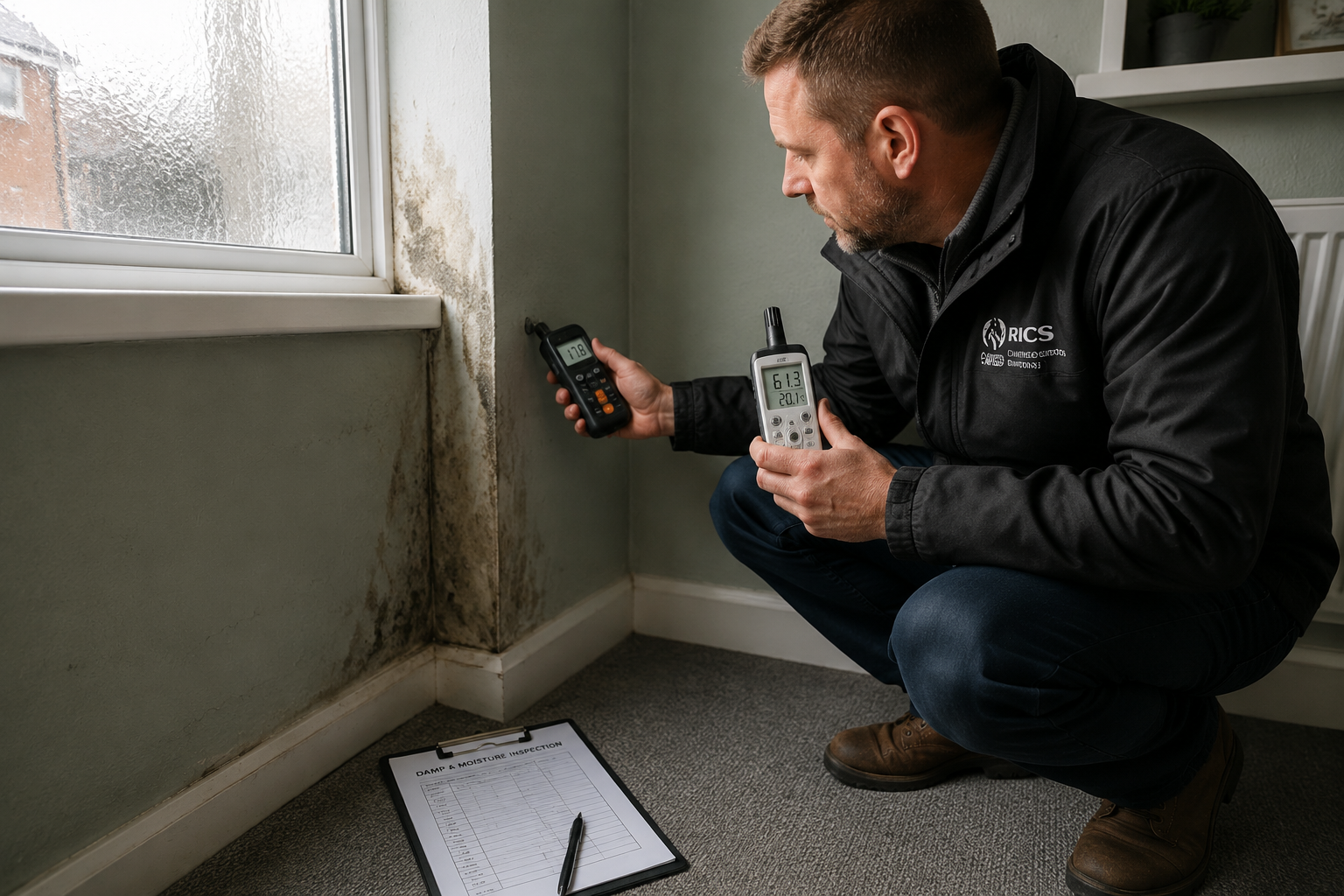
The Hazards in Social Housing (Prescribed Requirements) Regulations 2025 — universally known as Awaab's Law — were enacted following the inquest into the death of two-year-old Awaab Ishak in Rochdale, whose life was cut short by prolonged exposure to black mould in a social housing flat. The regulations amend the Social Housing (Regulation) Act 2023 and impose mandatory timelines on registered social landlords (RSLs).
The Core Timeline Requirements
| Trigger | Required Action | Deadline |
|---|---|---|
| Tenant reports damp/mould hazard | Investigate and assess | Within 14 days |
| Hazard confirmed as serious | Begin repair works | Within 7 days of investigation |
| Emergency hazard identified | Emergency repair | Within 24 hours |
| Non-emergency repair | Complete works | Within a reasonable period (defined by regulation) |
💬 "The law does not merely encourage landlords to act — it compels them to act within defined windows, with professional evidence to back every decision."
These timelines place enormous pressure on RSLs to have qualified professional assessments in place rapidly. A surveyor's report is no longer a discretionary document — it is the evidential backbone of a landlord's compliance position.
How Awaab's Law in Practice Changes the Surveyor's Inspection Scope
The traditional approach to damp and mould in a building survey often focused on visible symptoms: tide marks, mould patches, peeling paint, and elevated moisture readings at specific points. Awaab's Law in Practice: What Chartered Building Surveyors Must Now Report on Damp, Mould and Indoor Conditions in Social and PRS Stock demands a fundamentally more systematic approach.
What Must Now Be Assessed
1. Moisture Source Identification — Not Just Symptom Recording
Surveyors must distinguish between:
- Rising damp (capillary action from ground moisture)
- Penetrating damp (rainwater ingress through fabric defects)
- Condensation (moisture-laden air depositing on cold surfaces)
- Interstitial condensation (moisture within the building fabric itself)
Each source carries a different remediation pathway and a different urgency level under the regulations. Recording "damp present" without source attribution is no longer professionally adequate.
Understanding what causes moisture in buildings is foundational to this expanded scope — surveyors must now trace moisture pathways systematically rather than simply noting their effects.
2. Ventilation Adequacy
The regulations explicitly link poor ventilation to hazardous indoor conditions. Surveyors must now assess:
- Presence and functionality of mechanical extract ventilation (MEV) in kitchens and bathrooms
- Adequacy of background ventilation (trickle vents, air bricks)
- Whether thermal upgrades (insulation, draught-proofing) have inadvertently reduced air exchange rates
- Evidence of condensation pathways created by occupant behaviour combined with inadequate ventilation design
3. Thermal Performance and Cold Surface Risk
Cold surfaces below the dew point of internal air create condensation. Surveyors must now consider:
- U-values of external walls, particularly in pre-1980 solid-wall construction
- Cold bridging at reveals, lintels, and floor/wall junctions
- Whether EPC ratings reflect actual thermal performance or theoretical models
For context on how energy performance intersects with damp risk, the relationship between EPC ratings and building survey findings is increasingly relevant to compliance assessments.
4. Indoor Air Quality Indicators
While full air quality testing remains specialist territory, surveyors should now note:
- Visible fungal growth species (where identifiable)
- Evidence of volatile organic compounds (VOCs) from remediation products
- Occupant health complaints documented in the property history
Reporting Language and Evidence Standards: The New Professional Benchmark
Awaab's Law in Practice: What Chartered Building Surveyors Must Now Report on Damp, Mould and Indoor Conditions in Social and PRS Stock creates a new evidentiary standard. Reports that previously satisfied professional duty may now fall short of what is required to support a landlord's legal compliance position — or to protect a surveyor's own professional indemnity.
The Language Shift: From Descriptive to Diagnostic
❌ Old approach: "Mould growth noted to north-facing bedroom wall. Monitor and ventilate."
✅ New approach: "Black mould (likely Cladosporium or Stachybotrys species) covering approximately 0.8m² of the north-facing bedroom wall at high-level junction. Moisture readings of 28% WME recorded at 300mm above skirting. Probable cause: interstitial condensation exacerbated by inadequate background ventilation — no trickle vents observed in window frames. This constitutes a Category 1 Hazard under HHSRS criteria. Urgent investigation of ventilation provision and thermal bridging at wall/ceiling junction is recommended within the Awaab's Law 14-day assessment window."
The difference is not stylistic — it is legally material.
Key Reporting Elements Surveyors Must Now Include
🔍 Quantified extent — area of mould growth in m², moisture readings at multiple points with instrument calibration noted
🔍 Probable source attribution — not just "damp present" but a reasoned diagnosis of the moisture pathway
🔍 HHSRS hazard category — Category 1 or Category 2, with brief rationale
🔍 Awaab's Law timeline flag — explicit note where findings trigger the 14-day, 7-day, or 24-hour response obligations
🔍 Photographic evidence — timestamped, geolocated where possible, with scale reference
🔍 Areas requiring further investigation — specialist hygienist, structural engineer, or mechanical ventilation engineer referrals
For surveyors conducting Level 3 Full Building Surveys, the areas requiring further investigation section has become one of the most legally significant parts of the report.
Instrument Standards
Surveyors should now document:
- Protimeter or equivalent moisture meter readings (WME %)
- Hygrometer relative humidity and temperature readings (to calculate dew point)
- Thermal imaging camera findings (where used) with emissivity settings noted
- Borescope findings where concealed voids are accessed
Knock-On Effects for PRS Landlords and Investors
The Hazards in Social Housing (Prescribed Requirements) Regulations 2025 apply directly to registered social landlords. However, the private rented sector (PRS) is not insulated from the changes. Several forces are converging to make Awaab's Law standards the effective benchmark across all tenures.
The Renters' Rights Bill and PRS Convergence
The Renters' Rights Bill, progressing through Parliament in 2026, is expected to extend Awaab's Law-equivalent provisions to the PRS. Surveyors advising private landlords should treat the social housing standards as the floor, not the ceiling, of what will soon be required across all rented stock.
Survey Reports as Due Diligence Evidence
PRS investors acquiring social housing stock — or mixed-tenure blocks — increasingly require survey reports that demonstrate Awaab's Law compliance readiness. A report that fails to address damp, mould, and ventilation to the new standard creates a gap in the investor's due diligence trail.
Surveyors working in areas with significant social and PRS housing stock — including East London, Islington, and Essex — are already seeing increased instruction volumes from landlords seeking pre-compliance assessments.
Valuation Implications
Damp, mould, and ventilation defects identified under the new reporting standards have direct valuation consequences. Properties with unresolved Category 1 HHSRS hazards face:
- Reduced market value (often 5–15% depending on severity)
- Mortgage lender restrictions
- Potential prohibition orders from local housing authorities
For investors, understanding the budgeting implications of damp and structural repairs is now inseparable from any acquisition appraisal.
Practical Guidance: Adapting Survey Practice for Awaab's Law
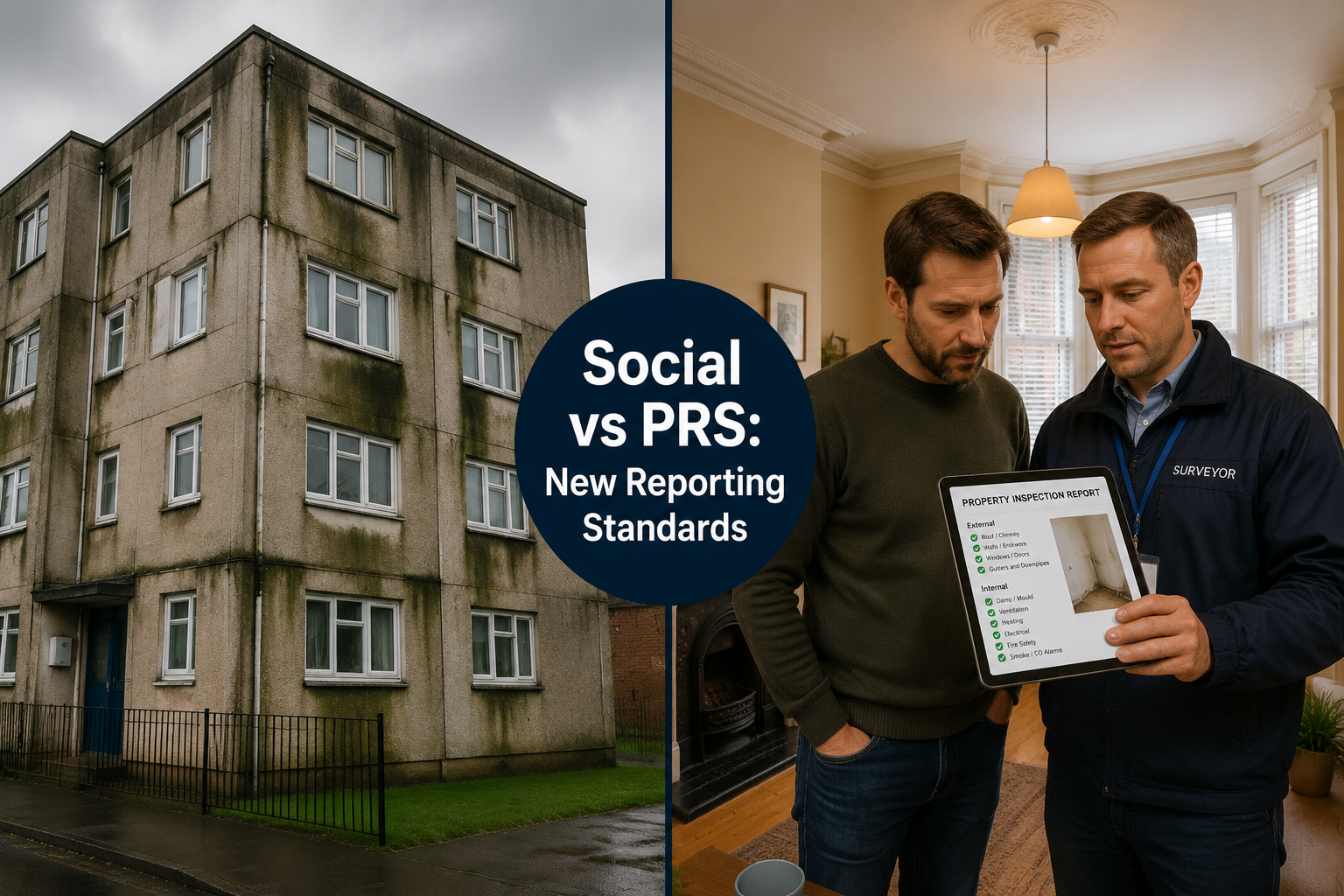
Pre-Inspection Preparation
Before attending a social or PRS property, surveyors should:
- Review any tenant complaint history provided by the landlord (RSLs are now required to maintain records)
- Check EPC data for thermal performance indicators
- Identify construction type (pre-1919 solid wall, cavity wall, system-built) to anticipate likely moisture pathways
- Confirm instrument calibration records are current
On-Site Protocol
A structured room-by-room protocol should now include:
- Photograph every room before detailed inspection begins
- Moisture meter readings at all external walls, floor/wall junctions, and around window reveals — minimum three readings per wall
- Hygrometer readings in each habitable room, recorded with time and external temperature
- Ventilation check in every kitchen and bathroom — test extract fans, inspect trickle vents
- Roof space and subfloor inspection where accessible — these are primary moisture ingress routes
- Note occupancy patterns where disclosed — overcrowding significantly increases condensation risk
For surveyors new to the expanded scope, understanding how long a building survey takes under these enhanced requirements is important for client expectation management — thorough damp and ventilation assessment adds meaningful time to the inspection.
Reporting Structure
Reports should now include a dedicated Damp, Mould and Indoor Conditions section that:
- Summarises findings against the HHSRS hazard framework
- Explicitly flags any Awaab's Law timeline triggers
- Distinguishes between hazards requiring emergency action, urgent repair, and monitoring
- Provides a photographic appendix with annotated images
- Recommends specialist referrals where the surveyor's scope is exceeded
Where urgent or dangerous building issues are identified, the report must make the urgency unambiguous — vague language creates professional indemnity exposure.
Professional Indemnity Considerations
Surveyors should review their PI cover in light of the new standards. Reports produced for RSLs that fail to identify a Category 1 hazard — which subsequently results in tenant harm — now carry a materially higher litigation risk than pre-2025. RICS guidance on professional competence in damp and mould assessment should be treated as a minimum standard, not a target.
What Landlords and Managing Agents Need to Understand
Chartered building surveyors are increasingly being asked to advise landlords and managing agents on what the new framework means operationally. Key messages for clients include:
- A visual inspection by maintenance staff is not sufficient — Awaab's Law requires professional assessment with documented evidence
- Tenant reports must be logged and timestamped — the 14-day clock starts from the date of report, not the date of acknowledgement
- Remediation must address the cause, not just the symptom — painting over mould without fixing the moisture source will not satisfy the regulations
- Block management operations must integrate Awaab's Law protocols into routine property inspection schedules
For landlords managing multiple properties across areas such as North London or Hampshire, establishing a systematic survey and reporting protocol — rather than responding reactively to complaints — is now both a compliance necessity and a risk management imperative.
Conclusion: Actionable Next Steps for Surveyors and Landlords in 2026
Awaab's Law has permanently raised the bar for how damp, mould, and indoor conditions must be assessed and reported in social housing — and the PRS is following closely behind. For chartered building surveyors, the professional response is clear.
Immediate Actions ✅
- Audit your current report templates — does your damp and mould section meet the new diagnostic and evidential standards? If not, update it now.
- Calibrate and document your instruments — moisture meters, hygrometers, and thermal cameras must have current calibration records attached to reports.
- Adopt HHSRS hazard categorisation language in all reports involving rented residential stock, social or private.
- Flag Awaab's Law timeline triggers explicitly — do not leave it to the client to interpret urgency.
- Review your PI cover with your insurer in light of the expanded liability landscape.
- Advise PRS clients proactively — the Renters' Rights Bill will extend these obligations to the private sector. Clients who act now avoid costly reactive compliance later.
- Build specialist referral networks — hygienists, mechanical ventilation engineers, and thermal imaging specialists are now core to the expanded inspection ecosystem.
The tragic circumstances that gave rise to Awaab's Law serve as a stark reminder that building defects are not merely technical problems — they are public health issues with human consequences. Chartered building surveyors are uniquely positioned to be the professional bridge between regulatory obligation and practical remediation. In 2026, that role has never carried more weight.