

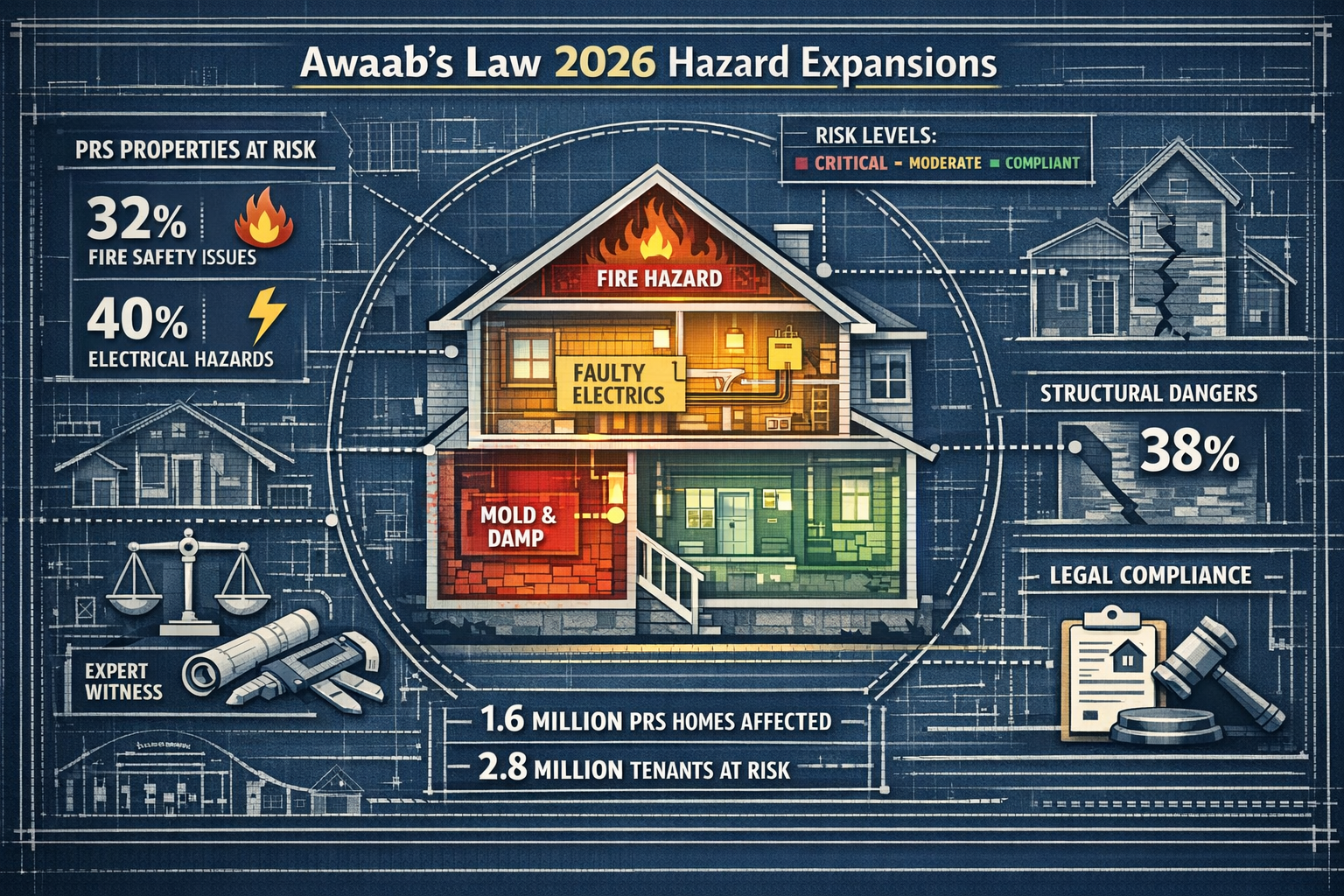
The tragic death of two-year-old Awaab Ishak from prolonged mould exposure in 2020 catalysed one of the most significant shifts in UK housing law this decade. By 2026, what began as emergency legislation targeting damp and mould has evolved into a comprehensive regulatory framework encompassing fire safety, electrical hazards, and structural collapse risks—creating unprecedented demand for expert witness testimony in private rented sector (PRS) disputes. With industry analysis predicting a 40% increase in landlord-tenant disputes following the 2026 hazard expansions[5], understanding expert witness strategies for Awaab's Law 2026 Hazard Expansions: Expert Witness Strategies for Fire, Electrical, and Structural Risks in PRS Disputes has become essential for surveyors, legal professionals, and property stakeholders.
The 2026 expansion introduces five new hazard categories with strict statutory repair deadlines: 24-hour response for emergency hazards, 10 working days for investigation, 3 working days for written tenant summaries, and 5 working days to begin remedial works[4]. These compressed timelines, combined with the law's "person-centred" assessment approach, fundamentally reshape how expert witnesses evaluate landlord liability and compliance.
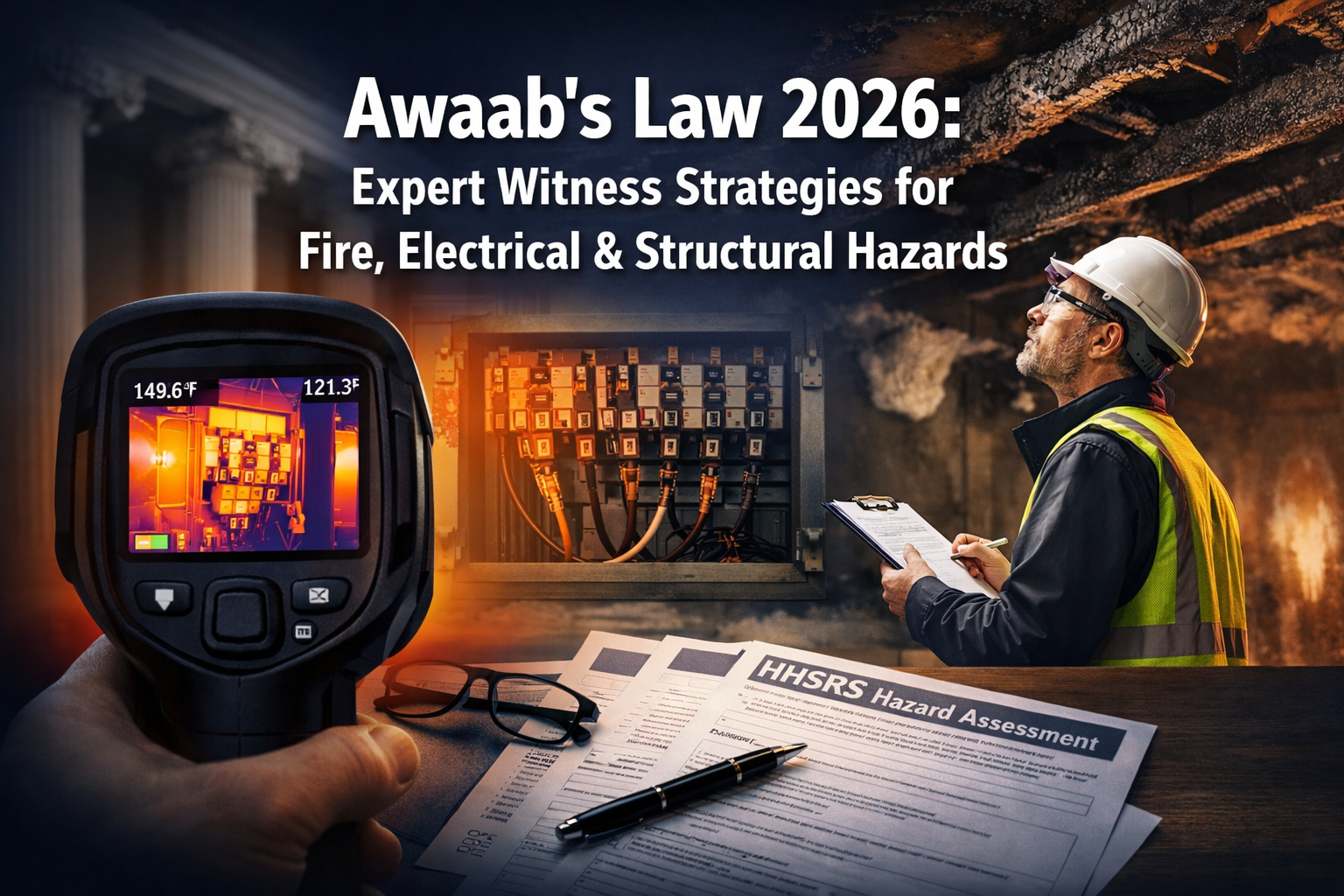
Key Takeaways
✅ 2026 hazard expansions now cover fire safety, electrical hazards, excess cold, excess heat, and structural collapse with mandatory 24-hour emergency response deadlines
✅ Person-centred assessment requires expert witnesses to evaluate hazards based on tenant-specific vulnerabilities and landlord's "relevant knowledge" rather than generic HHSRS scoring alone
✅ Fire Safety Regulations 2025 integration demands coordination between fire risk assessments, Personal Emergency Evacuation Plans (PEEPs), and Awaab's Law compliance timelines
✅ Documentation of decision-making history has become critical evidence in disputes—experts must analyze who made what call, when, and on what evidence basis
✅ Expert witness preparation must address expanded liability exposure including enforcement orders, tenant compensation, legal cost coverage, and rent loss from uninhabitable properties
Understanding the 2026 Hazard Expansion Framework
The Legislative Evolution from Damp to Comprehensive Hazards
Awaab's Law became legally enforceable in October 2025, initially targeting damp and mould hazards in social housing[3]. However, the Phase 2 expansion effective in 2026 extends mandatory repair deadlines to five additional hazard categories: excess cold, excess heat, fire safety, electrical hazards, and structural collapse[2]. The expansion also covers falls associated with baths, level surfaces, stairs, and between levels, plus domestic hygiene and food safety concerns[4].
This phased approach reflects the government's recognition that housing hazards operate as interconnected systems rather than isolated defects. For expert witnesses preparing testimony on Awaab's Law 2026 Hazard Expansions: Expert Witness Strategies for Fire, Electrical, and Structural Risks in PRS Disputes, this interconnection demands holistic assessment methodologies that evaluate cascading risks.
The legislation mandates specific statutory timelines that create critical benchmarks for expert witness evaluations:
| Hazard Response Stage | Statutory Deadline | Expert Witness Implication |
|---|---|---|
| Emergency hazard response | 24 hours | Establishes baseline for "reasonable" landlord action |
| Significant hazard investigation | 10 working days | Defines investigation adequacy standards |
| Written tenant summary | 3 working days | Creates documentation requirements for compliance |
| Remedial works commencement | 5 working days | Sets liability threshold for delay claims |
The Person-Centred Assessment Paradigm
Awaab's Law introduces a fundamental shift from traditional Housing Health and Safety Rating System (HHSRS) methodology to a "person-centred" approach[2]. A hazard is now "in scope" if it presents a significant risk of harm based on the tenant's specific circumstances and health conditions[4], rather than relying solely on statistical probability scoring.
This paradigm shift creates substantial implications for expert witness testimony. The assessment standard hinges on "relevant knowledge"—defined as knowledge a "reasonable lessor" has or reasonably ought to have about the occupier's health and circumstances[4]. Expert witnesses must therefore evaluate not just the physical hazard itself, but the landlord's knowledge acquisition processes, tenant communication records, and reasonable foreseeability of tenant-specific vulnerabilities.
For structural engineering professionals serving as expert witnesses, this means assessing whether landlords conducted adequate inquiries about tenant mobility limitations when evaluating structural collapse risks, or whether electrical hazard assessments considered disclosed medical equipment dependencies.
Fire Safety Hazards: Expert Witness Assessment Strategies
Integration with Fire Safety (Residential Evacuation Plans) Regulations 2025
The Fire Safety (Residential Evacuation Plans) Regulations 2025 (PEEPs) took effect on April 6, 2026, requiring responsible persons to identify vulnerable residents and conduct person-centred fire risk assessments through direct conversations with residents[4]. This regulatory convergence creates complex intersection points for expert witnesses evaluating fire hazard compliance under Awaab's Law.
Expert witnesses must assess whether landlords fulfilled their ongoing duty to review person-centred fire risk assessments and building emergency evacuation plans[4]. This includes evaluating:
🔥 Vulnerable resident identification processes – Did the landlord implement systematic methods to identify tenants with mobility impairments, cognitive conditions, or sensory disabilities affecting fire evacuation capability?
🔥 Person-centred conversation documentation – Are there records of meaningful discussions with tenants about their specific fire evacuation needs and concerns?
🔥 Assessment update frequency – Does the review schedule align with tenant turnover, building modifications, and changes in resident circumstances?
🔥 Evacuation plan specificity – Do PEEPs address individual tenant needs rather than generic building-wide procedures?
Fire Hazard Evidence Collection and Analysis
When preparing expert witness testimony for fire safety disputes under Awaab's Law 2026 Hazard Expansions: Expert Witness Strategies for Fire, Electrical, and Structural Risks in PRS Disputes, comprehensive evidence collection must address both physical hazards and procedural compliance:
Physical fire safety evidence:
- Fire door integrity assessments including self-closing mechanisms, intumescent strips, and smoke seal condition
- Smoke detector functionality testing with maintenance records review
- Emergency lighting operation verification and battery backup testing
- Fire escape route obstruction documentation through photographic evidence
- Combustible material storage in common areas
- Electrical appliance safety certificates and PAT testing records
Procedural compliance evidence:
- Tenant communication logs regarding fire safety concerns
- Fire risk assessment update schedules and revision histories
- Vulnerable resident identification questionnaires and responses
- PEEP development timelines and resident consultation records
- Fire Safety Order compliance certificates
- Contractor qualifications for fire safety works
Expert witnesses should cross-reference these evidence streams to identify gaps between physical hazard presence and landlord knowledge. For example, if smoke detectors failed inspection in March 2026 but tenant complaints about detector malfunctions date to December 2025, this timeline establishes potential liability for delayed response.
Electrical Hazards: Technical Assessment and Liability Standards
Electrical Safety Standards Under Awaab's Law
The 2026 hazard expansion brings electrical hazards under the same compressed statutory deadlines as fire and structural risks. Expert witnesses must evaluate compliance against multiple regulatory frameworks simultaneously:
- Electrical Safety Standards in the Private Rented Sector (England) Regulations 2020 requiring five-yearly electrical installation condition reports
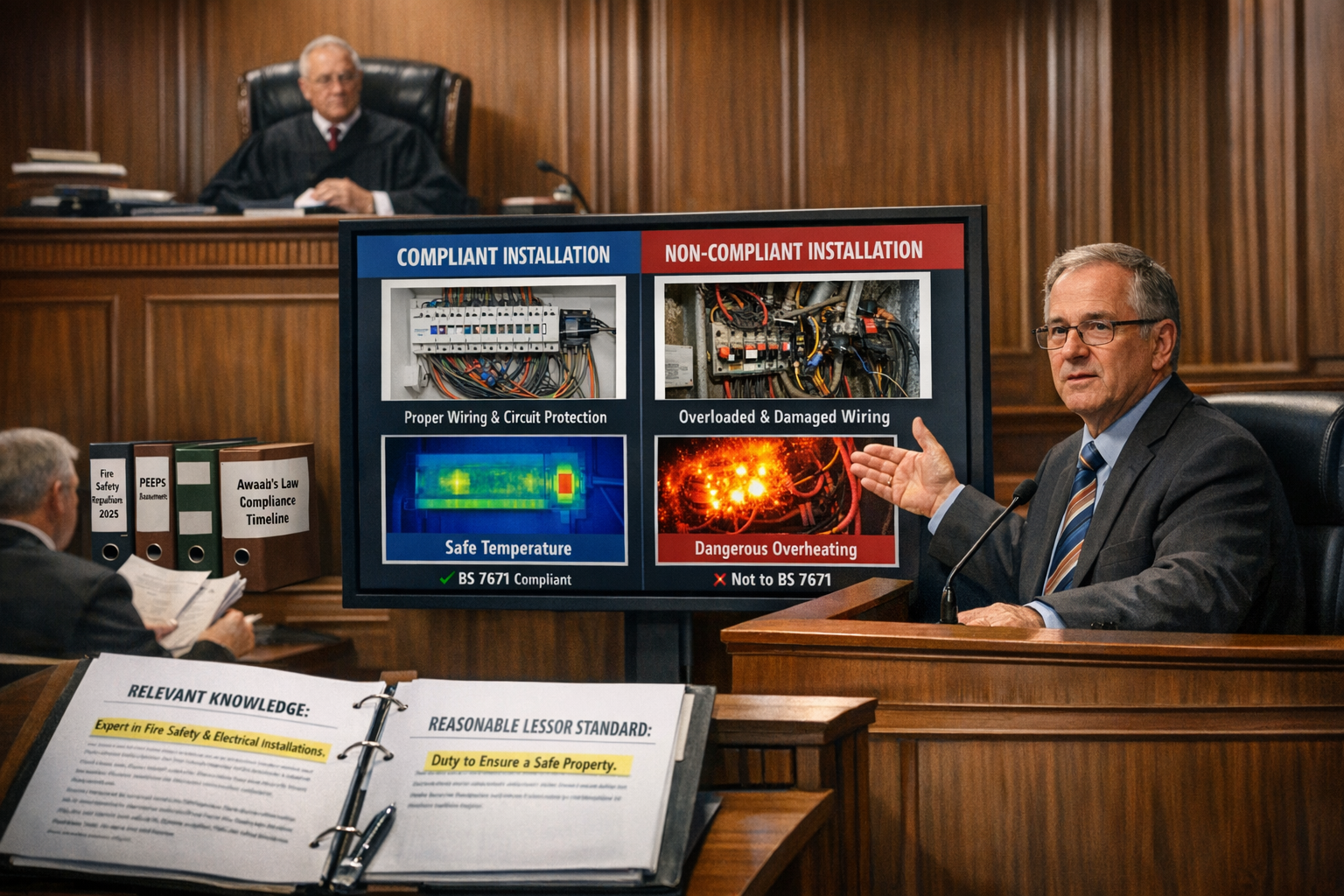
- BS 7671 (IET Wiring Regulations) establishing technical standards for electrical installations
- Awaab's Law person-centred assessment requirements evaluating tenant-specific electrical hazard vulnerabilities
For expert witnesses, this regulatory convergence creates assessment complexity. A landlord might possess a valid Electrical Installation Condition Report (EICR) showing satisfactory condition, yet still face Awaab's Law liability if they failed to address tenant-specific vulnerabilities—such as exposed wiring accessible to a tenant with cognitive impairments, or inadequate socket provision forcing a tenant with medical equipment to use dangerous extension cord configurations.
Expert Witness Evaluation Framework for Electrical Disputes
When preparing testimony on electrical hazards in Awaab's Law disputes, expert witnesses should apply a structured evaluation framework:
1. Hazard Identification Phase
- Conduct comprehensive electrical installation inspection documenting deviations from BS 7671 standards
- Identify immediate danger conditions requiring 24-hour emergency response
- Assess significant hazards requiring 10-day investigation timeline
- Document minor defects for context but distinguish from Awaab's Law threshold hazards
2. Tenant Vulnerability Assessment
- Review tenant medical disclosures and accessibility requirements
- Evaluate electrical demand from medical equipment, mobility aids, or assistive technology
- Assess tenant capacity to identify and report electrical hazards based on age, cognitive ability, or language barriers
- Document landlord knowledge of these vulnerability factors through communication records
3. Reasonable Lessor Standard Application
- Determine what electrical hazards a reasonable landlord should have identified through routine inspections
- Assess whether investigation timelines met statutory 10-day requirements
- Evaluate adequacy of remedial works scope and implementation timeline
- Compare landlord actions against industry best practices and building survey standards
4. Causation and Harm Analysis
- Establish causal links between electrical hazards and tenant harm or risk exposure
- Quantify harm severity using medical evidence, incident reports, and expert medical testimony
- Assess whether timely compliance would have prevented the harm
- Calculate reasonable compensation ranges based on harm severity and duration
Professional surveyors should recognize that electrical hazard disputes often involve urgent or dangerous building issues requiring immediate expert assessment to preserve evidence and prevent further tenant harm.
Structural Collapse Risks: Engineering Expert Testimony Strategies
Structural Hazard Assessment Under Person-Centred Framework
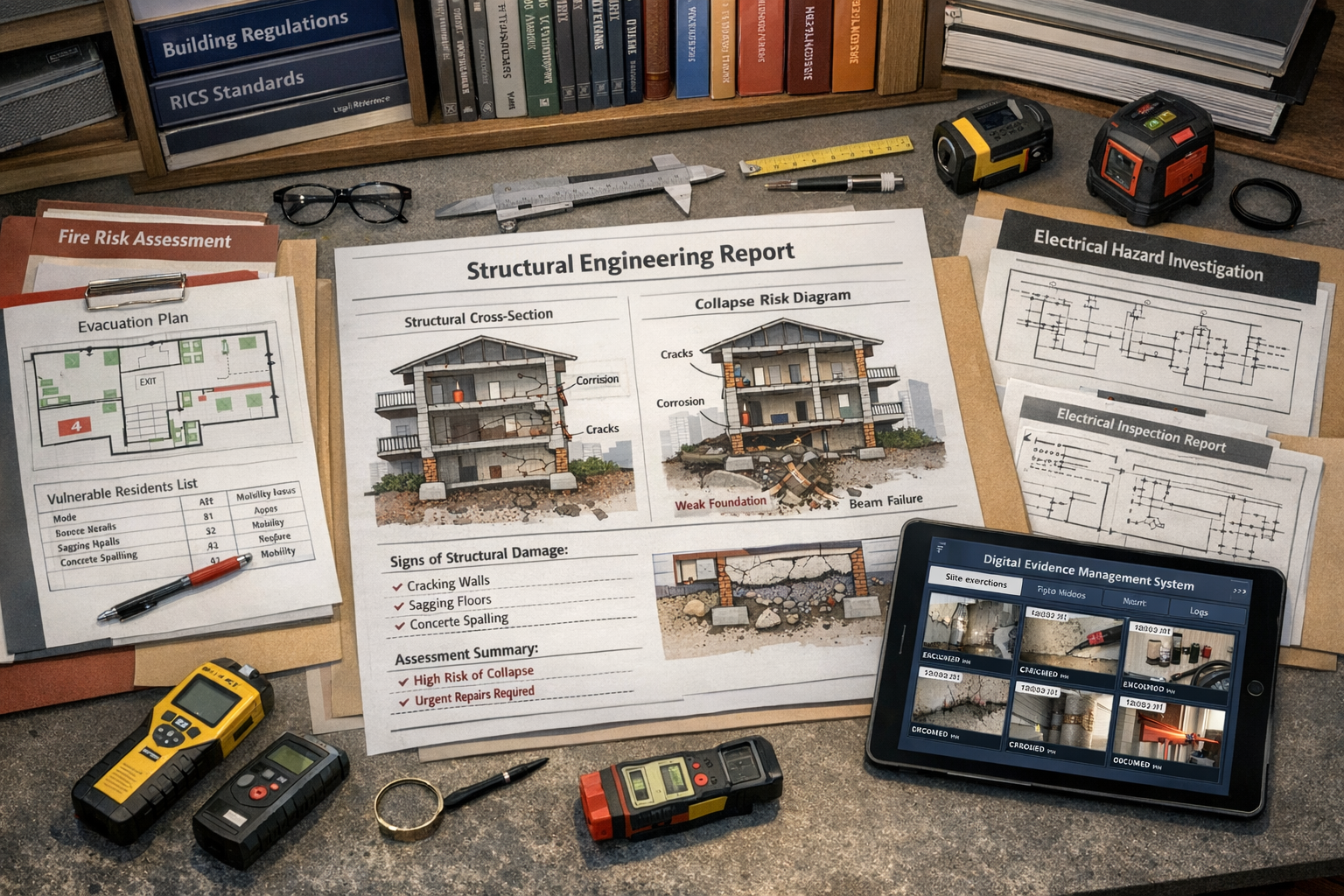
Structural collapse risks represent the highest-severity hazard category under Awaab's Law, triggering immediate 24-hour emergency response obligations when identified[4]. Expert witnesses specializing in structural engineering must evaluate both the technical severity of structural defects and the landlord's knowledge and response adequacy.
The person-centred assessment framework adds complexity to structural evaluations. A ceiling crack that poses minimal risk to able-bodied adults might constitute a significant hazard for a tenant with mobility impairments who cannot quickly evacuate if collapse occurs. Expert witnesses must therefore evaluate:
Structural defect severity factors:
- Load-bearing capacity degradation and safety factor margins
- Progressive failure potential and cascading collapse risk
- Occupancy patterns and exposure duration in affected areas
- Environmental factors accelerating deterioration (water ingress, foundation movement, material degradation)
Tenant-specific vulnerability factors:
- Mobility limitations affecting evacuation capability
- Occupancy of affected areas during sleeping hours
- Presence of children or elderly residents with reduced hazard awareness
- Medical conditions increasing injury severity from structural failure
Evidence Preservation and Documentation Standards
Structural collapse disputes under Awaab's Law 2026 Hazard Expansions: Expert Witness Strategies for Fire, Electrical, and Structural Risks in PRS Disputes demand rigorous evidence preservation. Expert witnesses should implement systematic documentation protocols:
📋 Photographic evidence standards
- High-resolution images with scale references and measurement annotations
- Multiple angles documenting defect extent and surrounding context
- Time-stamped images establishing deterioration progression
- Comparative images showing pre-repair and post-repair conditions
📋 Technical measurement documentation
- Crack width measurements using precision gauges
- Deflection measurements against British Standards tolerances
- Load testing results for suspect structural elements
- Non-destructive testing data (ground-penetrating radar, ultrasonic testing, thermography)
📋 Historical evidence compilation
- Previous survey reports identifying structural concerns
- Maintenance records showing repair history or neglect
- Tenant complaint logs with dates and landlord responses
- Building modification records affecting structural integrity
Expert witnesses should coordinate with legal counsel to ensure evidence collection complies with Civil Procedure Rules disclosure requirements while maintaining technical rigor. Understanding party wall disputes can provide valuable context for structural issues affecting adjoining properties.
Establishing Landlord Liability Through "Relevant Knowledge" Standard
The "relevant knowledge" standard creates the central battleground in structural collapse liability disputes. Expert witnesses must evaluate whether landlords possessed or reasonably should have possessed knowledge of structural hazards triggering Awaab's Law obligations.
Knowledge acquisition assessment factors:
✓ Routine inspection adequacy – Did inspection frequency and scope meet reasonable landlord standards for the property type, age, and condition?
✓ Tenant communication response – Were structural concerns reported by tenants investigated within statutory timelines?
✓ Professional advice engagement – Did landlords engage qualified structural engineers when non-specialist inspections identified potential concerns?
✓ Industry standard awareness – Should landlords have recognized structural defects based on common knowledge within the property management profession?
Expert witnesses strengthen testimony by referencing industry guidance documents, professional body standards (RICS, Structural Engineers Association), and comparable case precedents establishing reasonable landlord knowledge expectations.
For properties with common defects in older homes, expert witnesses should assess whether landlords implemented appropriate monitoring regimes for known age-related structural issues.
Decision-Making History Documentation: The Expert Witness Discovery Advantage
The Critical Importance of Decision-Making Records
Awaab's Law compliance now requires documenting not just the repair itself, but the associated decision-making history—who made what call, when, and on what evidence[6]. This documentation requirement creates significant discovery opportunities for expert witnesses preparing testimony.
Expert witnesses should request and analyze:
Decision-making documentation:
- Internal communications between property managers, maintenance staff, and senior management regarding hazard reports
- Risk assessment matrices and prioritization decisions
- Budget approval processes for remedial works
- Contractor selection and specification development records
- Timeline extension justifications and delay explanations
Knowledge transfer documentation:
- Tenant complaint intake forms and triage decisions
- Inspection scheduling and scope determination
- Hazard severity classification rationale
- Vulnerable resident identification processes
- Communication logs with tenants regarding investigation progress
This documentation reveals whether landlords implemented systematic hazard management processes or responded reactively to crises. Expert witnesses can identify patterns of neglect, inadequate resource allocation, or systemic failures in hazard identification and response.
Expert Witness Analysis of Compliance Gaps
When evaluating decision-making documentation, expert witnesses should apply a structured gap analysis framework:
| Compliance Requirement | Evidence Indicators | Gap Identification |
|---|---|---|
| 24-hour emergency response | Timestamped hazard notification and response initiation records | Response delays exceeding statutory deadline |
| 10-day investigation completion | Investigation scope documents, inspection reports, contractor quotes | Investigation inadequacy or timeline violations |
| 3-day tenant communication | Written summaries to tenants with findings and action plans | Missing communications or delayed notifications |
| 5-day remedial works commencement | Work orders, contractor mobilization records, site access arrangements | Works delays or inadequate remediation scope |
Expert witnesses should distinguish between unavoidable delays (contractor availability during emergency periods, access restrictions, specialist equipment procurement) and inexcusable delays (administrative inefficiency, budget disputes, neglect).
Understanding how often rental units should be inspected provides context for evaluating whether landlords implemented adequate hazard monitoring systems.
Expert Witness Preparation: Practical Strategies for Awaab's Law Disputes
Pre-Engagement Assessment and Scope Definition
Before accepting expert witness engagements for Awaab's Law 2026 Hazard Expansions: Expert Witness Strategies for Fire, Electrical, and Structural Risks in PRS Disputes, professionals should conduct thorough pre-engagement assessments:
Conflict checking:
- Verify no prior professional relationships with parties that could compromise independence
- Confirm no previous involvement in the property that could create bias perceptions
- Assess whether expertise scope aligns with dispute technical requirements
Scope definition:
- Clarify whether engagement covers single hazard category or comprehensive multi-hazard assessment
- Establish whether retrospective compliance evaluation or prospective remediation recommendations are required
- Define geographic scope for multi-property portfolio disputes
- Confirm timeline expectations for report delivery and court availability
Resource requirements:
- Determine whether specialist sub-consultants are needed (fire safety engineers, electrical engineers, structural engineers)
- Assess whether laboratory testing or specialist equipment is required
- Confirm access arrangements to properties and relevant documentation
Report Structure and Content Standards
Expert witness reports for Awaab's Law disputes should follow structured formats addressing both technical and legal compliance elements:
Executive summary section:
- Concise statement of instructions received
- Summary of key findings and opinions
- Clear statement of compliance or non-compliance with Awaab's Law requirements
Methodology section:
- Description of inspection procedures and standards applied
- Explanation of person-centred assessment approach
- Documentation of evidence reviewed and sources consulted
Technical findings section:
- Detailed hazard identification and classification
- Severity assessment using HHSRS and person-centred criteria
- Photographic evidence with annotations and explanations
- Technical measurements and testing results
Compliance analysis section:
- Evaluation of landlord knowledge and response timelines
- Assessment against statutory deadlines and reasonable lessor standards
- Identification of procedural compliance gaps
- Analysis of decision-making adequacy
Causation and harm section:
- Establishment of causal links between hazards and tenant harm
- Quantification of harm severity and duration
- Assessment of preventability through timely compliance
Remediation recommendations section:
- Specification of required remedial works
- Timeline and sequencing for multi-phase remediation
- Cost estimates for compliance works
- Ongoing monitoring and maintenance recommendations
Expert witnesses should ensure reports comply with Civil Procedure Rule Part 35 requirements, including statements of truth and acknowledgment of overriding duty to the court.
Cross-Examination Preparation Techniques
Effective cross-examination preparation distinguishes competent expert witnesses from exceptional ones. For Awaab's Law disputes, preparation should address:
Technical challenge preparation:
- Anticipate opposing expert disagreements on hazard severity classification
- Prepare technical justifications for assessment methodologies chosen
- Develop clear explanations of complex technical concepts for lay audiences
- Practice responding to hypothetical scenarios testing opinion boundaries
Regulatory interpretation challenges:
- Prepare for disputes over "reasonable lessor" standard application
- Develop responses to alternative interpretations of "relevant knowledge"
- Anticipate challenges to person-centred assessment conclusions
- Prepare explanations of regulatory framework interactions (Awaab's Law, Fire Safety Regulations, Electrical Safety Standards)
Documentation challenges:
- Anticipate questions about evidence gaps or limitations
- Prepare explanations for reliance on specific sources over others
- Develop responses to document authenticity or interpretation disputes
- Practice explaining decision-making history analysis methodology
Credibility maintenance:
- Prepare concise CV summary emphasizing relevant expertise
- Develop clear statements of independence and objectivity
- Practice acknowledging opinion limitations and uncertainty
- Prepare responses to potential bias allegations
Professionals should recognize that building surveyor access issues may arise during evidence collection, requiring clear documentation of any inspection limitations.
Non-Compliance Consequences and Liability Exposure Assessment
Financial and Legal Consequences of Awaab's Law Violations
Expert witnesses must understand the full spectrum of consequences landlords face for non-compliance to properly assess liability exposure:
Direct financial consequences:
- Enforcement orders requiring specific remedial actions with court oversight
- Tenant compensation payments for harm suffered due to hazard exposure
- Tenant legal cost coverage for successful Awaab's Law claims
- Rent loss if properties become uninhabitable pending remediation[4]
Indirect financial consequences:
- Increased insurance premiums following compliance failures
- Reputational damage affecting tenant acquisition and retention
- Property value diminution from publicized hazard issues
- Regulatory scrutiny increasing inspection frequency and compliance costs
Criminal and regulatory sanctions:
- Prosecution under Housing Act 2004 for serious hazard management failures
- Rent repayment orders requiring refund of rent paid during non-compliance periods
- Banning orders preventing individuals from property management activities
- Financial penalties under local authority enforcement powers
Expert witnesses should quantify these consequences when assessing damages in disputes, providing courts with comprehensive liability exposure analysis.
Risk Mitigation Strategies for Landlords
While expert witnesses maintain independence and objectivity, understanding effective risk mitigation strategies enhances the quality of remediation recommendations:
Proactive hazard management systems:
- Implement digital inspection systems with automated hazard tracking and deadline monitoring[6]
- Establish clear triage protocols for emergency versus significant hazard classification
- Develop standardized tenant communication templates ensuring statutory timeline compliance
- Create decision-making documentation systems capturing rationale and approvals
Tenant vulnerability identification processes:
- Implement systematic tenant onboarding questionnaires addressing health conditions, mobility limitations, and accessibility needs
- Establish regular check-in protocols for vulnerable tenant circumstances changes
- Train property management staff on person-centred assessment principles
- Develop secure systems for storing and accessing sensitive tenant health information
Professional expertise engagement:
- Establish relationships with qualified surveyors, engineers, and specialists for rapid response to complex hazards
- Implement regular building survey programs identifying hazards before tenant complaints
- Engage legal counsel for compliance framework development and dispute early resolution
- Participate in industry training programs on Awaab's Law compliance
Understanding 5 things every homeowner should know about their property can help landlords develop better tenant education programs reducing hazard exposure.
Future Expansion: Phase 3 and Beyond
The 2027 Hazard Expansion Scope
Expert witnesses preparing for Awaab's Law disputes should anticipate Phase 3 expansion from 2027 covering nearly all remaining HHSRS hazards, including asbestos, biocides, and carbon monoxide, excluding only overcrowding[3]. This continued expansion indicates ongoing complexity for future expert witness engagements.
The phased expansion creates strategic considerations for current dispute resolution:
Settlement negotiation implications:
- Landlords facing current disputes may seek comprehensive remediation addressing future expansion hazards to avoid subsequent claims
- Expert witnesses should identify Phase 3 hazards during current assessments to inform settlement discussions
- Remediation specifications should consider future compliance requirements to avoid redundant works
Precedent development:
- Current cases establish interpretive precedents for "relevant knowledge" and "reasonable lessor" standards applicable to future hazard categories
- Expert witness testimony quality in current disputes influences future engagement opportunities
- Documentation standards established in early cases become industry benchmarks
Professional development requirements:
- Expert witnesses must maintain current knowledge across expanding hazard categories
- Specialist expertise in Phase 3 hazards (asbestos management, carbon monoxide detection, biocide exposure) will command premium fees
- Cross-disciplinary collaboration becomes increasingly important for comprehensive assessments
Understanding what is asbestos and UK regulations prepares expert witnesses for Phase 3 expansion challenges.
Technology Integration for Compliance and Evidence Management
Digital tools increasingly support Awaab's Law compliance and expert witness evidence management:
Inspection and documentation technology:
- Thermal imaging cameras for electrical hazard and excess cold/heat identification
- Moisture meters with cloud-based data logging for damp tracking
- Digital inspection apps with photo annotation and automatic report generation
- Drone surveys for external structural hazard assessment in difficult-access properties
Compliance management systems:
- Automated deadline tracking with escalation alerts for statutory timeline compliance
- Centralized document repositories ensuring decision-making history preservation
- Tenant communication platforms with read receipts and response tracking
- Integration with contractor management systems for works scheduling and completion verification
Expert witnesses should familiarize themselves with these technologies to effectively evaluate landlord compliance systems and identify documentation gaps. Understanding premium drone surveys capabilities enhances structural hazard assessment methodologies.
Conclusion
Awaab's Law 2026 Hazard Expansions: Expert Witness Strategies for Fire, Electrical, and Structural Risks in PRS Disputes represents a fundamental transformation in UK housing regulation, creating unprecedented demand for expert witness services across fire safety, electrical hazards, and structural collapse risks. The law's person-centred assessment framework, compressed statutory deadlines, and "relevant knowledge" liability standard require expert witnesses to evaluate not just physical hazards but landlord knowledge, decision-making processes, and tenant-specific vulnerabilities.
Successful expert witness preparation demands comprehensive technical expertise, rigorous evidence documentation, and deep understanding of regulatory framework interactions between Awaab's Law, Fire Safety Regulations 2025, and Electrical Safety Standards. The 40% predicted increase in landlord-tenant disputes following the 2026 expansions[5] underscores the critical importance of professional expert witness services in achieving fair dispute resolution.
Actionable Next Steps
For surveyors and professionals preparing for expert witness engagements:
-
Develop specialized expertise in the five 2026 expansion hazard categories through professional development programs and certification courses
-
Implement systematic evidence collection protocols ensuring compliance with Civil Procedure Rules and preservation of decision-making history documentation
-
Establish professional networks with fire safety engineers, electrical engineers, and structural specialists for collaborative assessments
-
Invest in technology including thermal imaging, moisture detection, and digital documentation systems enhancing assessment quality
-
Monitor case law development tracking judicial interpretations of "relevant knowledge" and "reasonable lessor" standards
-
Prepare for Phase 3 expansion by developing expertise in asbestos, biocides, and carbon monoxide hazards ahead of 2027 implementation
The complexity and high stakes of Awaab's Law disputes demand expert witnesses who combine technical excellence with clear communication, regulatory expertise, and unwavering professional independence. Those who master these competencies will find themselves at the forefront of one of the most significant developments in UK housing law this decade.
References
[1] Building Surveys And Awaabs Law 2026 Extensions Identifying Electrical Fire And Temperature Hazards In Prs Properties – nottinghillsurveyors.com
[2] Awaabs Law Is Here The Surveyors Guide For Compliance – surventrix.com
[3] Preparing For Awaabs Law A Practical Guide To Uk Social Housing Compliance – netcall.com
[4] Awaabs Law Comes Into Force What Does It Mean For Construction – trowers.com
[5] Expert Witness Preparation For Awaabs Law Expansion Disputes 2026 Hazard Assessments In Rental Valuations – nottinghillsurveyors.com
[6] How Digital Tools Help Social Landlords Meet Awaabs Law – trimble.com