

{"cover":"Professional landscape format (1536×1024) hero image featuring bold text overlay 'AI-Driven Occupier Demand: Assessing Tech-Sector Properties in London, Manchester & Birmingham' in extra large 72pt white sans-serif font with dark shadow and semi-transparent navy overlay box, positioned in upper third. Background shows split-screen composition: left side displays modern glass office building in London tech district with digital overlay of AI circuit patterns, right side shows building surveyor with tablet conducting property assessment. Color scheme: deep blue, white, electric cyan accents. High contrast, magazine cover quality, editorial style with futuristic professional aesthetic, rule of thirds composition","content":["Landscape format (1536×1024) detailed infographic showing UK map with London, Manchester, and Birmingham highlighted in glowing cyan markers, connected by digital network lines. Each city features data visualization bubbles displaying tech-sector growth statistics, office space demand percentages, and AI company concentration metrics. Modern flat design with dark blue background, white text annotations, bar charts showing comparative occupier demand trends 2024-2026, isometric building icons representing commercial properties, professional business intelligence aesthetic with clean typography and gradient accents","Landscape format (1536×1024) interior scene of modern commercial office space mid-building survey assessment. Professional chartered surveyor in business attire using digital tablet with AI analysis software overlay, examining exposed ceiling infrastructure showing fiber optic cabling, HVAC systems, and electrical capacity. Foreground shows checklist hologram displaying tech-sector requirements: power density levels, cooling capacity, floor loading specifications. Background features large windows overlooking Manchester cityscape. Clean architectural photography style with technical annotation callouts, blueprint-style measurement indicators, professional lighting, contemporary workspace aesthetic","Landscape format (1536×1024) comparative side-by-side visualization showing three distinct property assessment scenarios across London, Manchester, and Birmingham. Left panel: Georgian conversion building with structural limitation indicators in red. Center panel: modern purpose-built tech office with green checkmarks for AI-ready infrastructure. Right panel: industrial warehouse conversion showing mixed assessment ratings. Each panel includes detailed specification overlays: power capacity meters, connectivity infrastructure diagrams, floor space efficiency ratings. Professional architectural rendering style with technical documentation aesthetic, color-coded rating systems, measurement annotations, clean modern design with city skyline silhouettes in background"]"}

The UK's tech sector is reshaping commercial property requirements in unprecedented ways. As artificial intelligence transforms how businesses operate, building surveyors face a critical challenge: assessing properties that meet the complex infrastructure demands of AI-driven companies. AI-Driven Occupier Demand and Building Surveys: Assessing Properties for Tech-Sector Tenants in London, Manchester, and Birmingham represents a specialized field where traditional surveying meets cutting-edge technology requirements.
In 2026, tech-sector tenants are no longer satisfied with standard office specifications. They require robust power infrastructure, advanced cooling systems, and structural capacity to support server rooms and data processing equipment. Understanding these requirements is essential for surveyors working across the UK's three major tech hubs.

Key Takeaways
- 🏢 Tech-sector tenants require specialized building infrastructure including enhanced power capacity (minimum 50-70 watts per square foot), advanced HVAC systems, and robust connectivity infrastructure
- 📊 AI adoption in property management has reached critical mass, with 96% accuracy in property valuations and widespread deployment of AI agents for tenant screening and maintenance optimization[3][5]
- 🌆 London, Manchester, and Birmingham each offer distinct advantages for tech occupiers, requiring different assessment criteria based on building stock, infrastructure maturity, and conversion potential
- 🔍 Building surveys must now incorporate tech-readiness assessments beyond traditional structural analysis, including power density calculations, fiber connectivity verification, and floor loading capacity
- 💡 Future-proofing properties for AI-driven businesses requires understanding evolving requirements including quantum computing preparation, edge computing infrastructure, and sustainability metrics
Understanding AI-Driven Occupier Demand in UK Tech Hubs
The landscape of commercial property demand has shifted dramatically as AI companies expand across the UK. Tech-sector occupiers now represent a sophisticated tenant class with specific, non-negotiable requirements that traditional office spaces often cannot meet.
The Rise of Tech-Sector Property Requirements
AI-driven businesses operate differently from conventional office tenants. Their space requirements extend far beyond desks and meeting rooms. These companies need infrastructure that supports intensive computational workloads, continuous operations, and rapid scalability.
According to recent industry analysis, AI adoption in UK real estate has accelerated significantly, with property professionals increasingly deploying AI agents for various management functions[2]. This technological shift extends to how tech companies themselves evaluate and occupy commercial space.
Key infrastructure demands include:
- Power density: 50-70 watts per square foot (compared to 20-30 for traditional offices)
- Cooling capacity: Advanced HVAC systems capable of handling heat loads from server equipment
- Connectivity: Multiple fiber providers with redundant connections
- Floor loading: Reinforced floors supporting 150+ pounds per square foot for equipment racks
- Security: Enhanced physical and digital security infrastructure
- Ceiling height: Minimum 2.7-3 meters for proper ventilation and cabling
London's Dominance in AI and Tech Property
London remains the UK's premier destination for AI companies, with concentrated tech districts in Shoreditch, King's Cross, and the emerging Paddington tech quarter. The capital offers unparalleled access to venture capital, talent pools, and established tech ecosystems.
However, London's property market presents unique challenges. Historic buildings dominate many desirable areas, requiring careful assessment of conversion feasibility. A comprehensive building survey becomes essential when evaluating older structures for tech-sector adaptation.
Georgian and Victorian conversions may offer character and location advantages but often lack the infrastructure backbone tech tenants require. Surveyors must assess:
- Electrical capacity and upgrade potential
- Structural modifications needed for equipment installation
- Building regulation compliance for commercial tech use
- Listed building restrictions that may limit modifications
Manchester's Growing Tech Ecosystem
Manchester has emerged as a formidable challenger to London's tech dominance. The city offers lower occupancy costs combined with strong university partnerships and a growing talent pipeline from institutions like the University of Manchester, which recently demonstrated 96% accuracy in AI-powered property valuations[3].
The city's property stock includes a healthy mix of modern purpose-built offices and converted industrial spaces. Former textile mills and warehouses provide generous floor plates and ceiling heights ideal for tech operations, though they require thorough structural assessment.
Manchester's tech corridor around Spinningfields and the Innovation District near Oxford Road offers properties with varying levels of tech-readiness. Surveyors should prioritize:
- Structural integrity of converted industrial buildings
- Existing mechanical and electrical infrastructure
- Proximity to fiber network hubs
- Transport links for employee accessibility
Birmingham's Emerging Opportunity
Birmingham represents the UK's fastest-growing tech ecosystem outside London. The city's central location, extensive regeneration projects, and competitive property costs make it increasingly attractive to AI-driven businesses seeking expansion opportunities.
Recent developments in the Digbeth and Gun Quarter areas have transformed former industrial zones into tech-friendly commercial spaces. Birmingham's advantage lies in its newer building stock and ongoing infrastructure investment, including the HS2 rail connection that will further enhance connectivity.
For surveyors assessing Birmingham properties, considerations include:
- Age and condition of building infrastructure
- Scalability potential for growing tech companies
- Regeneration area development timelines
- Future infrastructure improvements affecting property value
Building Survey Essentials for AI-Driven Occupier Demand
Traditional building surveys focus on structural integrity, damp issues, and general property condition. However, AI-Driven Occupier Demand and Building Surveys: Assessing Properties for Tech-Sector Tenants in London, Manchester, and Birmingham require an expanded assessment framework that addresses technology infrastructure alongside conventional surveying concerns.

Electrical Infrastructure Assessment
Power capacity represents the single most critical factor for tech-sector tenants. AI companies running machine learning operations, data processing, or cloud services require substantial electrical capacity that exceeds standard office provisions.
A comprehensive electrical assessment should include:
| Assessment Area | Standard Office | Tech-Sector Requirement |
|---|---|---|
| Power Density | 20-30 W/sq ft | 50-70 W/sq ft |
| Backup Power | Optional | Essential (UPS + generator) |
| Circuit Redundancy | Single feed | Dual-feed minimum |
| Panel Capacity | 100-200 amps | 400+ amps |
| Voltage Options | Single-phase | Three-phase required |
Surveyors must verify not only current capacity but also upgrade potential. This includes assessing:
- Distance to electrical substations
- Available capacity from local grid infrastructure
- Space for additional distribution panels
- Conduit pathways for new cabling
- Cost implications of electrical upgrades
Properties in older buildings may face significant challenges. A Level 3 full building survey should explicitly address electrical infrastructure limitations and upgrade feasibility.
Mechanical Systems and Cooling Capacity
Tech equipment generates substantial heat that must be effectively managed. Inadequate cooling capacity can lead to equipment failure, service disruptions, and tenant dissatisfaction.
Modern AI operations require precision cooling systems that maintain consistent temperatures and humidity levels. Surveyors should evaluate:
- HVAC system capacity: Can existing systems handle increased heat loads?
- Distribution efficiency: Are cooling systems properly zoned for equipment areas?
- Redundancy: Do backup cooling systems exist for critical areas?
- Energy efficiency: Will cooling costs be sustainable for tenants?
- Upgrade pathways: Can additional cooling be added without major structural modifications?
Manchester's converted industrial buildings often feature high ceilings and large windows that aid natural ventilation but may lack modern HVAC infrastructure. Birmingham's newer developments typically include contemporary systems, while London's period properties may require complete mechanical system replacement.
Structural Considerations for Tech Equipment
Server racks, networking equipment, and specialized AI hardware create concentrated floor loads that exceed typical office furniture weights. Floor loading capacity must be verified through structural calculations, not assumptions.
A thorough construction and condition survey should include:
- Floor slab thickness and reinforcement assessment
- Load-bearing capacity calculations for equipment areas
- Vibration sensitivity analysis (critical for precision equipment)
- Floor-to-floor height measurements for raised floor installation
- Structural modification potential for equipment rooms
Older buildings in London and Manchester may have floor loading capacities of only 50-75 pounds per square foot, insufficient for dense equipment installations. Modern buildings typically support 100+ pounds per square foot, but tech-sector tenants often require 150+ pounds per square foot in designated equipment areas.
Connectivity and Telecommunications Infrastructure
In 2026, fiber connectivity is non-negotiable for tech-sector tenants. AI companies require high-bandwidth, low-latency connections with built-in redundancy to support cloud operations, remote teams, and data-intensive applications.
Surveyors should document:
- Number of fiber providers serving the building
- Entry point locations and pathway diversity
- Internal telecommunications infrastructure (risers, conduits)
- Mobile signal strength (increasingly important for IoT applications)
- 5G coverage and small cell infrastructure
Properties in established tech districts typically enjoy superior connectivity options. However, buildings in emerging areas may have limited fiber access, requiring costly infrastructure investment. Understanding the timeline for building surveys helps coordinate connectivity assessments with other survey activities.
Energy Performance and Sustainability
Tech-sector tenants increasingly prioritize sustainability, both for corporate responsibility and operational cost management. Energy-intensive AI operations make efficiency metrics particularly important.
Modern surveying must incorporate:
- Current Energy Performance Certificate (EPC) ratings
- Potential for renewable energy installation (solar, heat pumps)
- Smart building management systems
- Energy submetering capabilities
- Compliance with Minimum Energy Efficiency Standards (MEES)
The relationship between EPC ratings, MEES, and building surveys has become increasingly important as regulatory requirements tighten. Properties with poor energy performance face both regulatory risks and reduced tenant appeal.
Comparative Analysis: London vs Manchester vs Birmingham for Tech Tenants
Understanding the distinct characteristics of each city's property market enables surveyors to provide more relevant assessments for AI-Driven Occupier Demand and Building Surveys: Assessing Properties for Tech-Sector Tenants in London, Manchester, and Birmingham.
Property Stock and Building Characteristics
London offers the most diverse property stock, ranging from Georgian townhouses to ultra-modern developments like The Scalpel and 22 Bishopsgate. This diversity creates assessment complexity:
- Historic buildings require sensitive conversion approaches
- Modern developments often include tech-ready specifications
- Competition for prime tech space drives premium pricing
- Planning restrictions in conservation areas limit modifications
Manchester benefits from extensive Victorian and Edwardian industrial architecture that translates well to tech use:
- Large floor plates accommodate open-plan tech operations
- High ceilings facilitate modern HVAC installation
- Structural robustness supports equipment loads
- Lower acquisition costs enable infrastructure investment
Birmingham presents the newest average building stock among the three cities:
- Purpose-built modern offices dominate recent development
- Infrastructure specifications often meet tech requirements
- Regeneration areas offer ground-up development opportunities
- Competitive pricing attracts cost-conscious tech companies
Infrastructure Maturity and Tech-Readiness
Infrastructure maturity varies significantly across the three cities, affecting property suitability for tech-sector tenants.
London's infrastructure advantages:
- Extensive fiber network coverage across tech districts
- Multiple carrier options providing competitive pricing
- Established data center ecosystems nearby
- Mature power grid with substantial capacity
Manchester's infrastructure evolution:
- Rapid fiber deployment in tech corridors
- Growing data center presence in Greater Manchester
- Ongoing electrical infrastructure upgrades
- Strong connectivity to national networks
Birmingham's infrastructure development:
- Newer fiber infrastructure with modern specifications
- Strategic data center investments underway
- HS2 connectivity enhancing appeal
- Electrical grid modernization in regeneration zones
Cost Considerations and Value Assessment
Property costs vary dramatically across the three cities, influencing tenant decisions and survey scope:
| City | Average Office Rent | Fit-Out Costs | Infrastructure Premium |
|---|---|---|---|
| London | £60-90/sq ft | £80-120/sq ft | 15-25% |
| Manchester | £25-40/sq ft | £60-90/sq ft | 10-15% |
| Birmingham | £20-35/sq ft | £50-80/sq ft | 8-12% |
These cost differences affect survey priorities. In London, maximizing existing infrastructure becomes critical due to high modification costs. In Manchester and Birmingham, more extensive renovations may be economically viable.
Regulatory and Planning Considerations
Each city presents distinct regulatory environments affecting property modifications:
London maintains strict planning controls, particularly in historic areas. Surveyors must assess:
- Listed building restrictions
- Conservation area limitations
- Article 4 directions affecting permitted development
- Local authority tech-sector policies
Manchester offers relatively flexible planning frameworks encouraging tech development:
- Supportive policies for industrial conversions
- Streamlined processes in designated innovation districts
- Collaborative approach to infrastructure upgrades
Birmingham actively promotes tech-sector growth through planning policy:
- Enterprise zones with simplified planning
- Infrastructure investment commitments
- Regeneration area incentives
Implementing AI Tools in Building Survey Processes
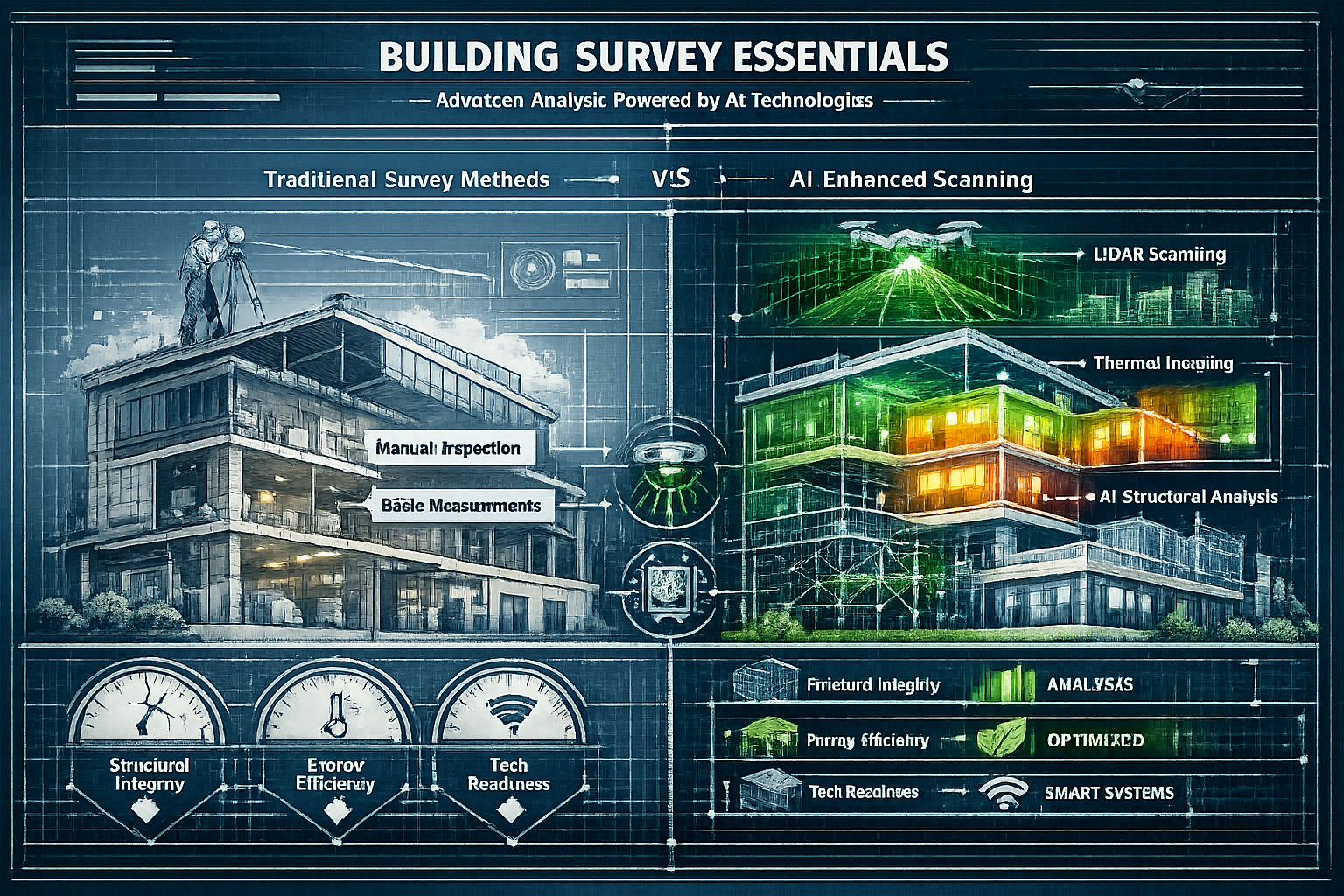
The surveying profession itself is being transformed by AI technology. AI-driven tools now enhance property assessment accuracy, efficiency, and comprehensiveness[3][5].
AI-Enhanced Property Analysis
Modern surveying increasingly incorporates AI-powered analysis tools that complement traditional assessment methods. Research indicates that AI property valuation systems now achieve 96% accuracy[3], demonstrating the technology's maturity.
AI applications in building surveys include:
- Automated defect detection: Image recognition algorithms identify structural issues, damp patterns, and material deterioration
- Predictive maintenance modeling: AI systems forecast maintenance requirements based on building age, condition, and usage patterns
- Energy performance optimization: Machine learning models recommend efficiency improvements with cost-benefit analysis
- Space utilization analysis: AI tools assess layout efficiency for tech-sector requirements
These tools don't replace professional surveyor judgment but enhance assessment capabilities. Premium drone surveys combined with AI image analysis provide comprehensive roof and facade assessments without scaffolding costs.
Data-Driven Tenant Matching
AI systems increasingly support property-tenant matching by analyzing compatibility factors beyond basic specifications. These platforms consider:
- Infrastructure requirements vs. available capacity
- Growth trajectory vs. expansion potential
- Sustainability goals vs. building performance
- Budget constraints vs. modification costs
Property managers report that AI-powered tenant screening and property management tools significantly improve matching accuracy and reduce vacancy periods[5]. Surveyors providing detailed technical assessments enable these AI systems to make more accurate recommendations.
Digital Survey Reporting and Integration
Modern building surveys increasingly deliver digital, data-rich reports that integrate with property management systems and AI analysis platforms. This evolution includes:
- Structured data formats: Machine-readable survey outputs enable AI analysis
- 3D modeling integration: Building Information Modeling (BIM) compatibility
- Interactive dashboards: Dynamic reporting with filterable findings
- API connectivity: Direct integration with property management platforms
Understanding what measured building surveys entail helps surveyors incorporate appropriate measurement technologies that support digital integration.
Future-Proofing Properties for Evolving Tech-Sector Demands
AI technology continues evolving rapidly, and property requirements will shift accordingly. Forward-thinking building surveys should assess not only current suitability but also adaptation potential for emerging technologies.
Quantum Computing Preparation
While still nascent, quantum computing will eventually require specialized property infrastructure:
- Ultra-stable environments with minimal vibration
- Extremely precise temperature and humidity control
- Enhanced electromagnetic shielding
- Specialized power conditioning systems
Properties with basement or ground-floor spaces offering natural stability advantages may command premiums as quantum computing commercializes.
Edge Computing Infrastructure
The proliferation of edge computing—processing data closer to its source rather than in distant data centers—creates new property requirements:
- Distributed equipment rooms throughout buildings
- Enhanced fiber connectivity to support edge nodes
- Modular infrastructure supporting rapid reconfiguration
- Resilient power and cooling for distributed systems
Surveyors should assess buildings' capacity to accommodate distributed technical infrastructure rather than centralized server rooms alone.
Sustainability and Net-Zero Commitments
Tech companies increasingly commit to aggressive sustainability targets. By 2030, many major tech firms aim for carbon-neutral operations, driving property selection criteria:
- On-site renewable energy generation potential
- Heat recovery systems capturing equipment waste heat
- Smart building management systems optimizing consumption
- Green building certifications (BREEAM, LEED)
Properties with poor sustainability profiles face declining tenant appeal regardless of other attributes. Surveyors should explicitly address sustainability improvement pathways in assessments.
Flexible and Adaptive Spaces
The pandemic accelerated hybrid working models that persist in 2026. Tech companies now require flexible spaces accommodating variable occupancy while maintaining infrastructure for intensive computational work:
- Modular infrastructure supporting rapid reconfiguration
- Scalable power and cooling systems
- Collaboration spaces with advanced AV technology
- Wellness amenities supporting hybrid workforce needs
Building surveys should assess adaptation potential, not just current configuration suitability.
Practical Guidance for Surveyors and Property Professionals
Successfully navigating AI-Driven Occupier Demand and Building Surveys: Assessing Properties for Tech-Sector Tenants in London, Manchester, and Birmingham requires practical approaches that balance technical requirements with commercial realities.
Developing Tech-Sector Survey Checklists
Create specialized assessment checklists addressing tech-specific requirements alongside traditional survey elements:
Infrastructure Assessment Checklist:
✅ Electrical capacity (current and upgrade potential)
✅ HVAC system capability and redundancy
✅ Floor loading capacity with calculations
✅ Fiber connectivity options and providers
✅ Backup power systems (UPS, generator)
✅ Security infrastructure (physical and digital)
✅ Ceiling height and equipment clearances
✅ Equipment room locations and specifications
Future-Readiness Assessment:
✅ Renewable energy installation potential
✅ EPC rating and improvement pathways
✅ Structural modification flexibility
✅ Scalability for growth scenarios
✅ Smart building technology integration
Collaborating with Specialist Consultants
Tech-sector property assessments often require specialist expertise beyond traditional surveying:
- Electrical engineers: For detailed power system analysis and upgrade design
- Mechanical engineers: For HVAC capacity modeling and cooling solutions
- Structural engineers: For floor loading calculations and modification feasibility
- Telecommunications consultants: For connectivity assessment and fiber deployment planning
- Sustainability advisors: For energy performance optimization and certification pathways
Knowing when to source extra advice ensures comprehensive assessments without overstepping professional competencies.
Understanding Tenant Priorities
Different tech-sector tenants prioritize different property attributes:
AI/ML Companies: Maximum power density, advanced cooling, robust connectivity
Software Development Firms: Flexible spaces, collaboration areas, good transport links
Data Analytics Businesses: Secure environments, reliable infrastructure, scalability
Tech Startups: Cost efficiency, short-term flexibility, growth potential
Tailoring survey focus to specific tenant types increases assessment relevance and value.
Communicating Technical Findings Effectively
Tech-sector clients often possess sophisticated technical knowledge. Survey reports should:
- Use precise technical specifications rather than general descriptions
- Provide quantified assessments (power capacity in watts, floor loading in PSF)
- Include visual documentation (photos, diagrams, thermal imaging)
- Offer clear upgrade pathways with cost implications
- Highlight deal-breakers vs. manageable limitations
Understanding the difference between Level 2 and Level 3 surveys helps recommend appropriate survey depth for different property scenarios.
Conclusion
AI-Driven Occupier Demand and Building Surveys: Assessing Properties for Tech-Sector Tenants in London, Manchester, and Birmingham represents a specialized and growing field within commercial property surveying. As AI technology reshapes business operations, property requirements evolve correspondingly, demanding enhanced surveyor expertise and expanded assessment frameworks.
The key success factors include:
🔧 Technical competency in assessing infrastructure beyond traditional building elements—power systems, cooling capacity, connectivity, and structural considerations specific to tech operations
🌍 Market knowledge of how London, Manchester, and Birmingham differ in property stock, infrastructure maturity, costs, and regulatory environments
🤖 Technology adoption by surveyors themselves, incorporating AI-powered analysis tools, digital reporting, and data integration capabilities
🔮 Forward-thinking assessment that evaluates not only current suitability but also adaptation potential for emerging technologies and evolving tenant requirements
The commercial property landscape continues transforming as tech-sector occupiers expand across UK cities. Surveyors who develop specialized expertise in assessing properties for AI-driven businesses position themselves as invaluable advisors in this dynamic market.
Actionable Next Steps
For surveyors and property professionals looking to capitalize on this opportunity:
- Enhance technical knowledge through continuing education in building systems, particularly electrical and mechanical infrastructure
- Develop specialist networks including engineers, connectivity consultants, and sustainability advisors for collaborative assessments
- Invest in technology tools including thermal imaging, drone surveys, and digital reporting platforms that enhance assessment capabilities
- Build market intelligence on tech-sector requirements, tenant priorities, and infrastructure developments across key UK cities
- Create specialized service offerings explicitly addressing tech-sector property assessments with tailored reporting and analysis
The intersection of AI technology and commercial property creates substantial opportunities for surveyors who adapt their practices to meet evolving market demands. By understanding both traditional building assessment and modern technology requirements, property professionals can deliver exceptional value to tech-sector clients navigating the complex landscape of AI-Driven Occupier Demand and Building Surveys: Assessing Properties for Tech-Sector Tenants in London, Manchester, and Birmingham.
References
[2] Ai Agents Uk Real Estate Proptech – https://toptenaiagents.co.uk/blog/ai-agents-uk-real-estate-proptech.html
[3] How Ai Is Transforming Property Valuations In 2026 – https://tkpg.co.uk/how-ai-is-transforming-property-valuations-in-2026/
[5] How Ai Is Transforming Property Search Investment Management And Maintenance – https://lendlord.io/how-ai-is-transforming-property-search-investment-management-and-maintenance