

The property surveying industry stands at a pivotal transformation point. Imagine analyzing 700 properties in just 72 hours—a task that would traditionally take weeks or even months. This isn't science fiction; it's the reality of AI and Machine Learning Revolutionizing Property Survey Data Analysis in 2026. Advanced algorithms now process massive datasets at unprecedented speeds, predict environmental risks with remarkable accuracy, and integrate seamlessly with reality capture technologies to deliver real-time insights that were unimaginable just a few years ago.
For chartered surveyors, property investors, and real estate professionals, understanding how artificial intelligence is reshaping survey data analysis has become essential. The technology doesn't just speed up existing processes—it fundamentally changes what's possible, from identifying hidden structural risks to forecasting market trends with precision that surpasses traditional methods. As we navigate through 2026, the integration of AI and machine learning into property surveys represents not merely an upgrade to existing tools, but a complete reimagining of how professionals assess, value, and understand properties.
Key Takeaways
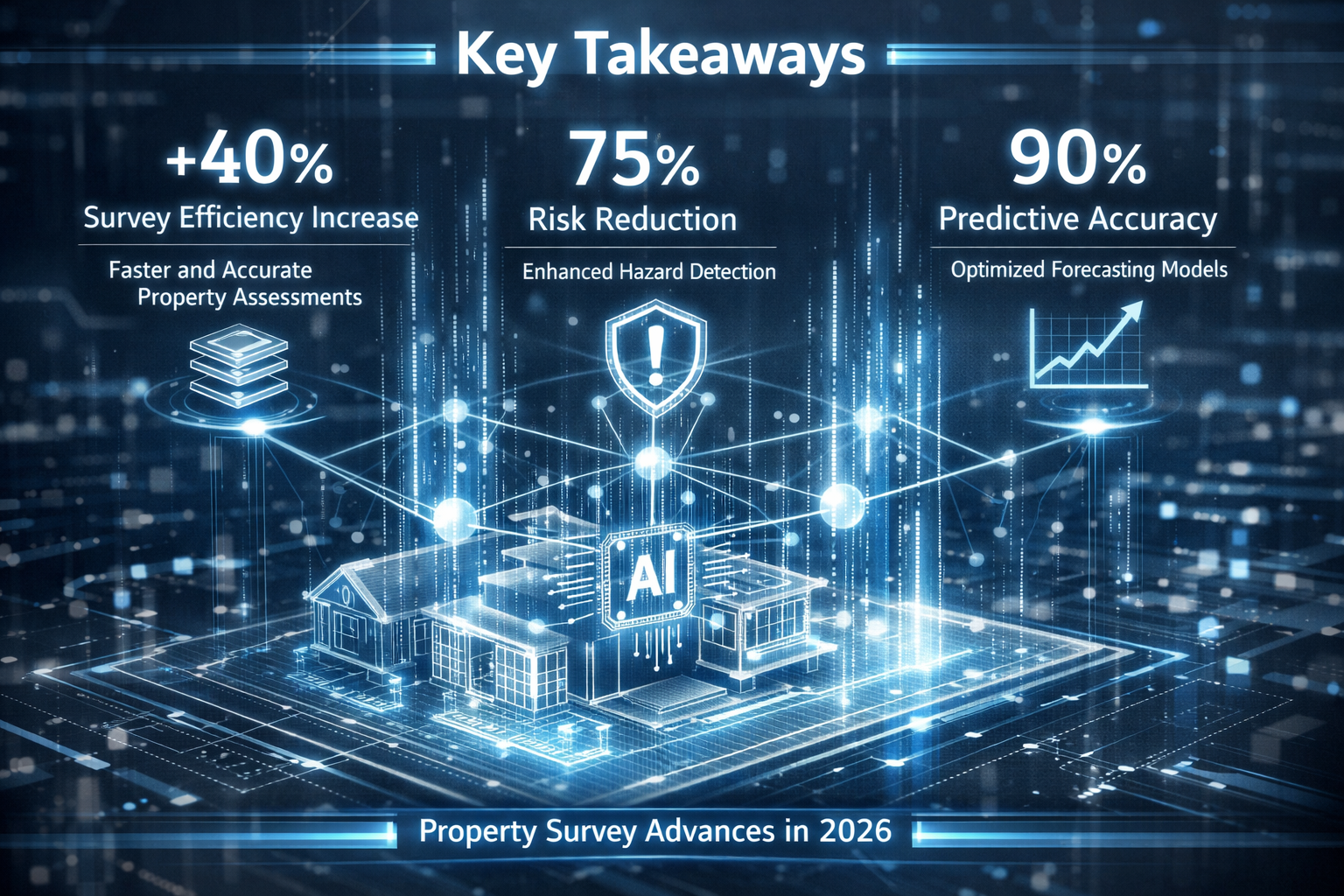
- 🚀 Speed Revolution: AI processes property survey data 60% faster than traditional methods, analyzing over 700 sites in just 72 hours while reducing due diligence timelines by more than 60%
- 🎯 Accuracy Enhancement: Automated Valuation Models (AVMs) demonstrate approximately 8% improvement in overall accuracy compared to conventional approaches, with rent data falling within 3-4% of actual leased rents
- 🔮 Predictive Power: Advanced AI systems analyze thousands of data points—including satellite imagery, environmental factors, and social media sentiment—to forecast property values and identify risks months before they become apparent
- ⚡ Efficiency Gains: Market analysis time drops by 98% compared to traditional approaches, with rent survey time reduced by over 80% and comparables generated in under one minute
- 🤖 Human Error Elimination: AI virtually eliminates manual data entry mistakes, flags inconsistencies that humans might overlook, and reduces bias in valuations through algorithmic objectivity
Understanding the Foundation: How AI and Machine Learning Work in Property Surveys
The Technology Behind the Transformation
Artificial intelligence and machine learning represent fundamentally different approaches to data analysis compared to traditional surveying methods. While conventional property surveys rely heavily on human expertise, manual measurements, and subjective assessments, AI systems learn from vast datasets to identify patterns, make predictions, and generate insights automatically.
Machine learning algorithms operate through several key mechanisms:
- Supervised Learning: Systems train on labeled property data (known values, conditions, risks) to predict outcomes for new properties
- Unsupervised Learning: Algorithms discover hidden patterns in unlabeled data, identifying property clusters and anomalies without prior categorization
- Deep Learning: Neural networks with multiple layers process complex visual data from photographs, drone imagery, and satellite feeds to extract detailed property characteristics
- Natural Language Processing (NLP): AI interprets written survey reports, planning documents, and legal descriptions to extract structured information
The practical application of these technologies in property surveys creates a powerful analytical engine. For instance, when conducting a Level 3 full building survey, AI systems can now process thousands of historical survey reports to identify common defect patterns in similar property types, alerting surveyors to potential issues before physical inspection even begins.
Data Sources Powering AI Analysis
The effectiveness of AI and Machine Learning Revolutionizing Property Survey Data Analysis in 2026 depends heavily on the quality and diversity of data inputs. Modern AI platforms integrate information from multiple sources simultaneously:
| Data Source | Information Provided | AI Application |
|---|---|---|
| Satellite Imagery | Property boundaries, structural changes, environmental features | Change detection, risk assessment, valuation adjustments |
| Drone Surveys | High-resolution roof conditions, facade details, site topography | Defect identification, measurement verification, 3D modeling |
| Historical Sales Data | Transaction prices, market trends, comparable properties | Automated valuations, market forecasting, investment analysis |
| Environmental Databases | Flood zones, soil conditions, contamination records | Risk prediction, insurance assessment, development feasibility |
| Municipal Records | Planning permissions, building regulations, tax assessments | Compliance verification, development potential, legal due diligence |
| Social Media & Reviews | Neighborhood sentiment, amenity ratings, community feedback | Location scoring, demand forecasting, investment targeting |
This multidimensional data incorporation allows AI systems to analyze economic indicators (interest rates, employment rates), environmental factors (flood risk, urban development patterns), and neighborhood metrics (school ratings, crime statistics) simultaneously, uncovering correlations that human analysts might miss[1].
The Speed Revolution: Processing Massive Datasets in Record Time
Quantifying the Performance Gains
The most immediately apparent benefit of AI and Machine Learning Revolutionizing Property Survey Data Analysis in 2026 is the dramatic acceleration of data processing. Traditional property analysis methods require surveyors to manually gather information, cross-reference multiple sources, and compile findings—a time-intensive process prone to bottlenecks.
AI systems deliver transformative speed improvements:
- 60% faster processing compared to traditional methods, with capability to analyze over 700 sites in just 72 hours[3]
- 98% reduction in market analysis time compared to conventional approaches[4]
- 80% decrease in rent survey time, generating comprehensive rent comparables in under one minute[4]
- 60% reduction in due diligence timelines while simultaneously improving accuracy[2]
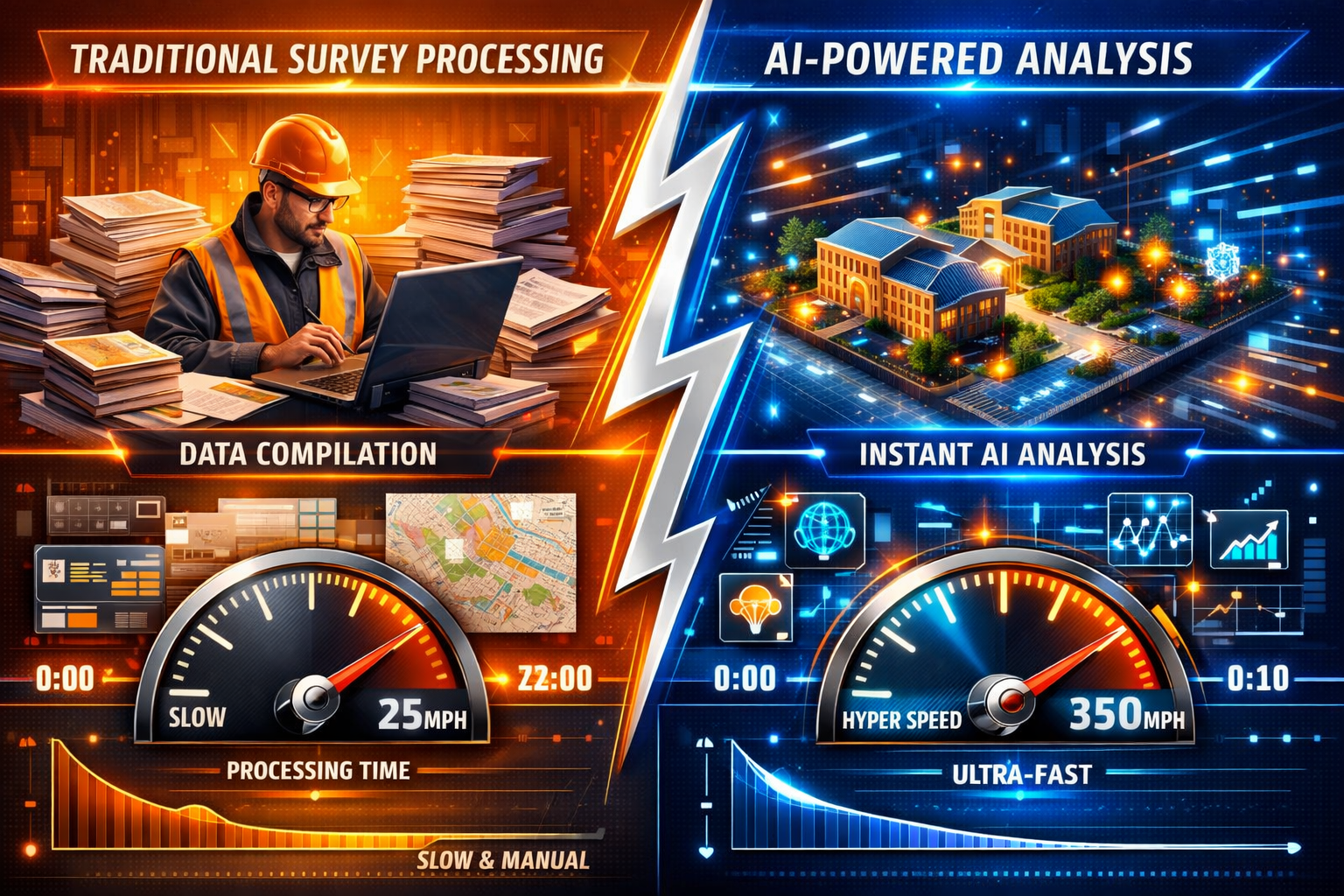
These aren't marginal improvements—they represent a fundamental shift in operational capacity. A surveying firm that previously required a full week to compile market analysis for a single commercial property can now generate the same insights in less than an hour, freeing professionals to focus on interpretation, client consultation, and strategic recommendations rather than data compilation.
Real-World Application: From Days to Minutes
Consider the practical workflow transformation for a typical property investment analysis. Traditionally, a surveyor would spend:
- 4-6 hours researching comparable sales
- 3-4 hours reviewing planning and zoning records
- 2-3 hours analyzing neighborhood demographics
- 2-3 hours compiling environmental risk assessments
- 4-5 hours creating valuation models and reports
Total traditional timeline: 15-21 hours of professional time
With AI-powered analysis, this same process now takes:
- 5 minutes for AI to identify and rank comparable properties from databases covering 2.2 million properties nationwide[4]
- 3 minutes for automated extraction and summary of relevant planning documents
- 2 minutes for demographic analysis and trend identification
- 4 minutes for comprehensive environmental risk scoring
- 30 minutes for surveyor review, interpretation, and report customization
Total AI-enhanced timeline: Approximately 45 minutes
This efficiency gain doesn't eliminate the surveyor's role—it elevates it. Professionals spend less time on data gathering and more time applying expertise, judgment, and client-specific insights that AI cannot replicate. For those wondering how long a building survey takes, AI integration significantly reduces the analytical component while maintaining thorough physical inspection standards.
Scaling Without Proportional Resource Growth
Perhaps the most strategically significant aspect of AI's speed advantage is scalability. Traditional surveying operations face linear constraints—doubling the workload typically requires doubling the workforce. AI systems break this limitation.
Modern AI platforms can assess millions of properties without increasing headcount[2]. A surveying firm can expand from analyzing 50 properties monthly to 500 properties monthly without hiring proportionally more staff. This scalability advantage creates competitive differentiation for firms that embrace the technology early, allowing them to serve more clients, enter new markets, and undertake larger portfolio assessments that would be impractical with traditional methods.
Predictive Analytics: Forecasting Risks and Values with Unprecedented Accuracy
Environmental Risk Prediction
One of the most valuable applications of AI and Machine Learning Revolutionizing Property Survey Data Analysis in 2026 is predictive risk assessment. Environmental hazards—particularly flooding, subsidence, and contamination—represent significant concerns for property buyers, lenders, and insurers. Traditional risk assessment relies on historical records and static flood maps that may not account for climate change, urban development, or infrastructure modifications.
AI-powered environmental risk prediction operates differently:
🌊 Flood Risk Modeling: Advanced algorithms analyze historical flood events, topographical data, drainage infrastructure, climate projections, and real-time weather patterns to generate dynamic flood risk scores. Unlike static flood zone maps, AI models update continuously as conditions change, identifying emerging risks months before traditional assessments would flag them[3].
🏗️ Structural Vulnerability Assessment: Machine learning systems trained on thousands of building failures can identify structural risk factors by analyzing building age, construction materials, maintenance history, and environmental exposure. When integrated with drone survey data, AI can detect subtle indicators of structural stress invisible to casual inspection.
🌱 Contamination and Soil Analysis: AI cross-references property locations with historical land use databases, industrial activity records, and environmental monitoring data to assess contamination probability. This proves particularly valuable for brownfield development projects where traditional assessment methods might miss historical industrial activities.
The practical impact is substantial. Property investors using AI risk prediction can identify and avoid high-risk acquisitions, negotiate better insurance terms based on accurate risk profiles, and make informed decisions about risk mitigation investments. For surveyors conducting property inspections, AI-generated risk alerts provide valuable guidance on areas requiring detailed investigation.
Automated Valuation Models (AVMs) and Accuracy Improvements
Automated Valuation Models represent one of the most mature applications of AI in property analysis. AVMs use machine learning algorithms to estimate property values based on comparable sales, property characteristics, location factors, and market trends.
2026 AVM Performance Metrics:
- 8% improvement in overall accuracy compared to traditional valuation methods[2]
- Significantly reduced outlier errors, with fewer extreme over- or under-valuations
- Daily updates covering over 35 million units nationwide, ensuring valuations reflect current market conditions[4]
- 3-4% accuracy range for rent estimates compared to actual leased rents[4]
The accuracy advantage stems from AI's ability to analyze thousands of variables simultaneously. While a human appraiser might consider 10-20 comparable properties and adjust for major differences, AI systems can evaluate hundreds of comparables, weight them by relevance, and adjust for dozens of property-specific factors including:
- Precise location coordinates (not just neighborhood)
- Detailed property condition from image analysis
- Micro-market trends at the street level
- Seasonal market fluctuations
- Buyer sentiment indicators from online activity
- Future development plans affecting the area
Objectivity and Bias Reduction
An often-overlooked benefit of algorithmic analysis is the reduction of human bias and emotion in property valuations. Traditional appraisals can be influenced by appraiser fatigue, unconscious bias, or anchoring to initial price expectations. AI systems produce more consistent and robust financial modeling by applying the same analytical framework to every property[2].
This objectivity proves particularly valuable in:
- Matrimonial valuations where impartiality is essential (learn more about matrimonial valuations)
- Portfolio assessments requiring consistent methodology across hundreds of properties
- Dispute resolution where independent, data-driven valuations carry greater credibility
- Investment analysis where emotion-free assessment supports better decision-making
Integration with Reality Capture: Real-Time Insights from Physical Data
Drone Technology and AI Synergy
The combination of drone-based reality capture and AI analysis represents a powerful synergy that exemplifies how AI and Machine Learning Revolutionizing Property Survey Data Analysis in 2026 extends beyond pure data processing. Drones equipped with high-resolution cameras, LiDAR sensors, and thermal imaging devices capture detailed physical property data, while AI algorithms extract meaningful insights from this information.
Key applications include:
📸 Automated Defect Detection: AI trained on thousands of building images can identify roof damage, facade cracks, vegetation encroachment, and structural anomalies from drone photography with accuracy matching or exceeding human inspectors. The system flags potential issues for surveyor review, ensuring nothing gets overlooked.
📏 Precise Measurement Extraction: Machine learning algorithms process drone imagery and LiDAR point clouds to generate accurate measurements of roof areas, building heights, site boundaries, and volumetric calculations—all without physical access to difficult-to-reach areas.
🌡️ Thermal Anomaly Identification: AI analysis of thermal imaging data identifies heat loss patterns, moisture infiltration, insulation deficiencies, and electrical hotspots, providing insights into building performance and maintenance needs.
🗺️ 3D Model Generation: Advanced photogrammetry algorithms automatically convert drone imagery into detailed 3D models, enabling virtual property tours, renovation planning, and historical condition documentation.
For professionals offering premium drone surveys, AI integration transforms raw aerial data into actionable intelligence, delivering comprehensive analysis that would require days of manual processing in mere minutes.
LiDAR and Point Cloud Analysis
Light Detection and Ranging (LiDAR) technology creates highly detailed three-dimensional representations of properties and sites through millions of precise distance measurements. The resulting "point clouds" contain extraordinary detail but require sophisticated analysis to extract useful information—a perfect application for AI.
AI-powered point cloud analysis enables:
- Automated feature extraction: Algorithms identify walls, floors, ceilings, doors, windows, and structural elements without manual annotation
- Change detection: Comparing point clouds from different dates reveals structural movement, settlement, or unauthorized modifications
- As-built verification: AI compares actual construction against approved plans, identifying deviations and compliance issues
- Volume calculations: Automated measurement of excavations, material stockpiles, or building capacities
- Accessibility assessment: Identification of barriers and evaluation of compliance with accessibility standards
The integration of LiDAR data with AI analysis proves particularly valuable for building materials assessments, where precise dimensional data combined with material identification algorithms can estimate quantities, assess condition, and flag potential hazards like asbestos-containing materials.
Mobile Scanning and Indoor Mapping
Beyond aerial capture, handheld and mobile scanning devices equipped with simultaneous localization and mapping (SLAM) technology enable rapid indoor surveying. AI processes this data to create detailed floor plans, identify room functions, measure ceiling heights, and document existing conditions.
Practical applications include:
- Rapid condition surveys for large commercial or residential portfolios
- Pre-acquisition assessments providing detailed property intelligence before purchase
- Renovation planning with accurate as-built documentation
- Space utilization analysis for commercial property optimization
- Maintenance tracking documenting condition changes over time
When combined with AI analysis, mobile scanning transforms from simple documentation into predictive maintenance planning. Algorithms can identify wear patterns, predict component failure timelines, and prioritize maintenance interventions based on condition deterioration rates.
Unconventional Data Sources: Discovering Hidden Market Signals

Satellite Imagery Analysis
While satellite imagery might seem like an unconventional data source for property surveys, AI and Machine Learning Revolutionizing Property Survey Data Analysis in 2026 demonstrates how this information provides unique market intelligence. Advanced algorithms analyze satellite data to identify subtle signals that traditional analysis methods miss entirely.
Satellite-derived insights include:
🚗 Parking Lot Occupancy: AI tracks vehicle counts in retail and commercial property parking areas over time, providing objective measures of business activity and tenant performance—valuable intelligence for commercial property investors assessing lease risk.
🏗️ Construction Activity Monitoring: Automated detection of construction equipment, material stockpiles, and site changes reveals development activity that may impact nearby property values or create investment opportunities.
🌳 Vegetation and Landscaping Changes: Algorithms track property maintenance levels, landscape improvements, or neglect—indicators of property management quality and neighborhood trajectory.
📦 Supply Chain Activity: For industrial and logistics properties, AI analysis of truck traffic patterns and loading dock activity provides objective operational performance metrics.
🏘️ Urban Development Patterns: Large-scale analysis identifies emerging neighborhoods, infrastructure improvements, and development trends months before they appear in traditional market reports.
These unconventional data sources help investors and surveyors identify emerging opportunities and risks before competitors, creating information advantages that translate directly into better investment decisions and more accurate valuations[2].
Foot Traffic and Mobility Data
Anonymized mobile device location data provides unprecedented insights into foot traffic patterns, visitor demographics, and commercial area vitality. AI systems process this information to generate actionable property intelligence:
- Retail location scoring: Quantifying foot traffic volumes, visitor dwell times, and demographic profiles for retail site selection
- Mixed-use development analysis: Understanding usage patterns across different times of day and week
- Competitive analysis: Comparing traffic between competing locations or properties
- Catchment area definition: Mapping actual visitor origins rather than relying on theoretical radius-based catchments
For surveyors assessing commercial properties or advising on planning considerations, foot traffic data provides objective evidence of location quality that complements traditional accessibility and visibility assessments.
Social Media Sentiment and Online Reviews
Natural Language Processing algorithms analyze social media posts, online reviews, and community forums to gauge neighborhood sentiment, identify emerging issues, and assess location desirability. This qualitative information, when processed at scale, becomes quantitative intelligence:
- Neighborhood reputation scoring: Aggregating sentiment across thousands of posts and reviews
- Amenity quality assessment: Understanding resident satisfaction with schools, parks, transportation, and services
- Issue identification: Early detection of problems like crime trends, infrastructure failures, or environmental concerns
- Demand forecasting: Identifying neighborhoods gaining popularity before price appreciation occurs
While individual social media posts carry little weight, AI analysis of thousands of data points reveals meaningful patterns. This information complements traditional survey approaches, providing context that enriches property market analysis and investment decision-making.
Practical Implementation: How Surveyors Can Adopt AI Technology
Assessing Organizational Readiness
For surveying firms considering AI adoption, successful implementation begins with honest assessment of current capabilities and readiness. The technology offers tremendous benefits, but realizing them requires appropriate foundation and planning.
Key readiness factors include:
✅ Data Infrastructure: AI systems require quality data inputs. Firms should evaluate their current data collection, storage, and management practices. Inconsistent, incomplete, or poorly organized data will limit AI effectiveness regardless of algorithm sophistication.
✅ Technical Expertise: While AI platforms increasingly offer user-friendly interfaces, some technical knowledge remains essential. Firms should assess whether current staff possess necessary skills or if training/hiring will be required.
✅ Financial Investment: AI implementation involves costs for software licenses, hardware infrastructure, training, and potential consulting support. Understanding total cost of ownership helps set realistic expectations and secure appropriate budget.
✅ Cultural Readiness: Perhaps most importantly, successful AI adoption requires organizational willingness to change established workflows and trust algorithmic recommendations. Resistance to change can undermine even technically sound implementations.
Selecting Appropriate AI Tools and Platforms
The AI and property technology landscape offers numerous solutions, from comprehensive enterprise platforms to specialized point solutions. Selecting appropriate tools requires matching capabilities to specific organizational needs.
Platform categories to consider:
| Platform Type | Best For | Key Features | Considerations |
|---|---|---|---|
| Comprehensive AVM Platforms | Valuation-focused firms, mortgage lenders | Automated valuations, comparable selection, market analysis | Subscription costs, data coverage limitations |
| Property Intelligence Platforms | Investment analysis, portfolio management | Multi-source data integration, risk scoring, market forecasting | Learning curve, customization requirements |
| Reality Capture + AI | Building surveyors, condition assessors | Drone/scan data processing, defect detection, measurement extraction | Hardware investment, technical training needs |
| Specialized Risk Tools | Due diligence, insurance assessment | Environmental risk, structural analysis, compliance checking | Integration with existing workflows |
| Document Processing AI | High-volume survey operations | Automated report generation, data extraction from documents | Accuracy verification requirements |
For firms conducting traditional Level 2 and Level 3 surveys, reality capture and defect detection AI offers the most immediate value, while investment-focused practices may prioritize valuation and market analysis platforms.
Phased Implementation Strategy
Rather than attempting comprehensive AI transformation overnight, successful firms typically adopt phased implementation approaches:
Phase 1: Pilot Testing (3-6 months)
- Select one specific use case (e.g., comparable property selection or defect detection)
- Implement AI solution for limited subset of projects
- Compare AI-assisted results against traditional methods
- Gather user feedback and identify refinement needs
- Calculate actual time savings and accuracy improvements
Phase 2: Expanded Deployment (6-12 months)
- Roll out successful pilot applications to broader team
- Provide comprehensive training for all users
- Develop standard operating procedures incorporating AI tools
- Implement quality control processes for AI-generated outputs
- Begin exploring additional AI applications
Phase 3: Advanced Integration (12+ months)
- Integrate multiple AI tools into seamless workflow
- Customize platforms to firm-specific requirements
- Develop proprietary AI models using firm's historical data
- Establish AI-enhanced service offerings as competitive differentiators
- Continuously optimize based on performance metrics
Training and Skill Development
Maximizing AI value requires appropriate training investments. Staff need to understand not only how to operate AI tools but also how to interpret results, identify limitations, and apply professional judgment to algorithmic recommendations.
Essential training components include:
📚 Technical Operation: Hands-on training with specific AI platforms and tools being implemented
🧠 AI Fundamentals: Basic understanding of how machine learning works, what AI can and cannot do, and common limitations
⚖️ Critical Evaluation: Skills to assess AI recommendations, identify potential errors, and determine when human judgment should override algorithmic suggestions
🔄 Workflow Integration: Practical guidance on incorporating AI tools into existing survey processes efficiently
📊 Data Quality Management: Understanding how data quality affects AI performance and best practices for data collection and organization
Many AI platform providers offer training resources, but firms should supplement vendor training with internal knowledge sharing, mentoring programs, and ongoing skill development to build sustainable AI competency.
Quality Control and Professional Responsibility in AI-Assisted Surveys
Maintaining Professional Standards
As AI and Machine Learning Revolutionizing Property Survey Data Analysis in 2026 becomes increasingly prevalent, maintaining professional standards and ethical practice remains paramount. AI tools enhance surveyor capabilities but don't eliminate professional responsibility for accuracy, completeness, and client service.
Key professional considerations include:
🎯 Verification Requirements: AI-generated findings should be verified against professional knowledge and experience. Algorithms can make errors, particularly when encountering unusual property characteristics or market conditions outside their training data.
📋 Disclosure Obligations: Clients should understand when AI tools contribute to survey findings and valuations. Transparency about methodology builds trust and manages expectations appropriately.
⚖️ Liability Considerations: Professional indemnity insurance may require disclosure of AI tool usage. Surveyors remain professionally responsible for all conclusions regardless of AI assistance.
📜 Regulatory Compliance: RICS and other professional bodies continue developing guidance on AI usage. Staying current with evolving standards ensures compliant practice.
🔒 Data Protection: AI platforms often process sensitive property and client information. Ensuring GDPR compliance and appropriate data security measures is essential.
For firms providing construction law advice or dealing with statutory considerations, understanding the legal implications of AI-assisted analysis proves particularly important.
Identifying AI Limitations and Errors
While AI systems demonstrate impressive capabilities, they have inherent limitations that professional surveyors must recognize:
Common AI limitations include:
❌ Training Data Gaps: AI performs poorly on property types, locations, or conditions underrepresented in training data. Unusual properties may generate unreliable AI recommendations.
❌ Contextual Understanding: Algorithms lack human understanding of local market nuances, planning politics, or community dynamics that influence property values and risks.
❌ Causation vs. Correlation: AI identifies patterns but doesn't understand underlying causes. Recommendations may be based on spurious correlations rather than genuine causal relationships.
❌ Rapid Market Changes: AI models trained on historical data may lag during market disruptions or unprecedented conditions (as demonstrated during pandemic-related market volatility).
❌ Adversarial Vulnerabilities: AI systems can be fooled by deliberately manipulated inputs or unusual data combinations.
Professional surveyors add value by recognizing these limitations, applying contextual knowledge AI lacks, and exercising judgment about when to rely on algorithmic recommendations versus traditional analysis methods.
Hybrid Approaches: Combining AI Efficiency with Human Expertise
The most effective property survey practices in 2026 don't choose between AI and human expertise—they strategically combine both. This hybrid approach leverages AI's speed and pattern recognition capabilities while preserving human judgment, contextual understanding, and client relationship skills.
Effective hybrid workflows include:
🤖 AI Handles: Data gathering, comparable property identification, measurement extraction, initial defect detection, standard report sections, routine calculations
👤 Humans Handle: Complex judgment calls, unusual property characteristics, client consultation, contextual interpretation, strategic recommendations, relationship management
This division of labor allows surveyors to work at the "top of their license," focusing professional expertise where it adds most value while delegating routine tasks to AI systems. The result is faster turnaround times, more comprehensive analysis, and better client service than either AI or human-only approaches could achieve.
The Competitive Landscape: AI Adoption and Market Differentiation
Early Adopter Advantages
Surveying firms embracing AI and Machine Learning Revolutionizing Property Survey Data Analysis in 2026 gain significant competitive advantages over slower-moving competitors. These advantages compound over time, creating widening performance gaps.
Key competitive benefits include:
⚡ Speed-to-Market: Faster turnaround times attract time-sensitive clients and enable firms to handle more projects with existing resources
🎯 Enhanced Accuracy: Superior valuation and risk assessment accuracy builds client trust and reduces professional liability exposure
💰 Cost Efficiency: Lower per-project costs enable competitive pricing while maintaining margins, or premium pricing justified by superior service
📈 Scalability: Ability to serve larger clients and handle portfolio-scale projects inaccessible to traditional competitors
🔬 Innovation Reputation: Early AI adoption positions firms as forward-thinking industry leaders, attracting top talent and sophisticated clients
For chartered surveyors serving markets like London, Surrey, or Essex, AI capabilities increasingly differentiate premium service providers from commodity competitors.
Client Expectations and Service Evolution
As AI capabilities become more widely known, client expectations evolve accordingly. Property buyers, investors, and lenders increasingly expect faster turnaround times, more comprehensive analysis, and data-driven insights that AI makes possible.
Emerging client expectations include:
- Same-day preliminary assessments for initial property screening
- Predictive maintenance forecasts rather than just current condition reports
- Investment scenario modeling showing multiple outcome possibilities
- Interactive digital deliverables rather than static PDF reports
- Ongoing monitoring services providing alerts about condition changes or market shifts
Firms unable to meet these evolving expectations risk losing market share to AI-enabled competitors. However, those who successfully integrate AI while maintaining the personal service and professional judgment clients value will thrive in the transformed market landscape.
Future-Proofing Your Surveying Practice
Looking beyond 2026, AI capabilities will continue advancing rapidly. Surveying firms should consider not just current AI applications but how to position themselves for ongoing technological evolution.
Future-proofing strategies include:
🔮 Continuous Learning Culture: Establish organizational commitment to ongoing technology education and adaptation
🔧 Flexible Technology Stack: Choose platforms and tools that integrate well with other systems and can evolve as capabilities advance
📊 Data Asset Development: Systematically collect and organize proprietary data that can train custom AI models specific to your practice areas
🤝 Strategic Partnerships: Develop relationships with technology providers, research institutions, and innovative clients driving industry advancement
👥 Talent Strategy: Recruit and retain professionals comfortable with technology and capable of working effectively in AI-augmented environments
The firms that view AI adoption as an ongoing journey rather than a one-time project will maintain competitive advantages as technology continues evolving.
Case Studies: Real-World AI Implementation Success Stories
Portfolio Due Diligence Transformation
A commercial property investment firm managing a £500 million portfolio traditionally required 4-6 weeks to complete due diligence on potential acquisitions, limiting their ability to act on time-sensitive opportunities. After implementing AI-powered property analysis platforms, their process transformed dramatically.
Results achieved:
- Due diligence timeline reduced from 4-6 weeks to 10-12 days (60%+ reduction)[2]
- Comprehensive risk assessment covering environmental, structural, and market factors generated automatically
- Comparable property analysis expanded from 10-15 manually selected properties to 200+ algorithmically ranked matches
- Market trend analysis incorporating satellite imagery revealing development activity not visible in traditional reports
- Investment decision confidence improved through objective, data-driven valuations
The firm now competes successfully for off-market opportunities requiring rapid response, gaining access to deals previously impossible given their traditional due diligence timeline constraints.
Residential Survey Efficiency Enhancement
A residential surveying practice conducting approximately 300 Level 3 surveys annually implemented AI-powered defect detection and report generation tools integrated with their drone survey capabilities.
Implementation outcomes:
- Report preparation time reduced from 8-10 hours to 3-4 hours per survey
- Defect detection consistency improved, with AI flagging potential issues for surveyor verification
- Client satisfaction increased due to faster turnaround (5-7 days vs. previous 10-14 days)
- Capacity increased by 40% without additional surveyor hiring
- Competitive differentiation through drone-enhanced surveys with AI-generated 3D models
The practice repositioned as a premium provider offering comprehensive digital deliverables, commanding 15-20% price premium over traditional competitors while maintaining faster delivery.
Rental Market Analysis Acceleration
A property management company overseeing 2,000+ rental units across multiple markets struggled with accurate, timely rent setting. Traditional comparable rent analysis required 2-3 hours per property and quickly became outdated in dynamic markets.
AI implementation results:
- Rent comparable generation time reduced from 2-3 hours to under 1 minute[4]
- Rent recommendations within 3-4% of actual market rents[4]
- Daily updates ensuring recommendations reflect current market conditions
- Market analysis time reduced by 98% compared to traditional approaches[4]
- Revenue optimization through more accurate, responsive pricing
The company now adjusts rents quarterly rather than annually, capturing market appreciation more effectively and improving portfolio returns by an estimated 3-5% annually.
Addressing Common Concerns and Misconceptions
"Will AI Replace Surveyors?"
Perhaps the most common concern about AI and Machine Learning Revolutionizing Property Survey Data Analysis in 2026 is whether technology will eliminate surveying jobs. The evidence suggests a more nuanced reality.
Why AI complements rather than replaces surveyors:
✅ Professional Judgment: AI cannot replicate the contextual understanding, ethical reasoning, and complex judgment that experienced surveyors provide
✅ Client Relationships: Property transactions involve significant financial and emotional stakes; clients value trusted advisor relationships that AI cannot provide
✅ Liability and Accountability: Professional responsibility and liability rest with qualified individuals, not algorithms
✅ Unusual Situations: AI performs well on typical properties but struggles with unusual characteristics requiring human expertise
✅ Regulatory Requirements: Many surveying functions require professional qualifications that AI tools cannot satisfy
Rather than replacing surveyors, AI eliminates routine tasks and enhances capabilities, allowing professionals to focus on higher-value activities. The role evolves from data gatherer and report compiler to strategic advisor and insight interpreter—a more rewarding and better-compensated position.
"Is AI Accurate Enough for Professional Use?"
Concerns about AI accuracy are legitimate and important. However, the evidence demonstrates that properly implemented AI systems achieve accuracy levels matching or exceeding traditional methods in many applications.
Accuracy considerations:
- AVMs demonstrate approximately 8% improvement in overall accuracy compared to traditional methods[2]
- Rent estimates fall within 3-4% of actual leased rents[4]
- Significantly reduced outlier errors compared to human-only approaches[2]
- Objectivity reduces bias and emotion-driven errors[2]
The key is understanding that AI accuracy depends heavily on data quality, appropriate application, and professional oversight. When used within appropriate scope and verified by qualified professionals, AI-assisted analysis often exceeds traditional accuracy while delivering results far faster.
"What About Data Privacy and Security?"
Property data often includes sensitive financial, personal, and commercial information. Legitimate concerns exist about data privacy and security when using AI platforms that process this information.
Addressing privacy and security concerns:
🔒 Platform Selection: Choose AI providers with robust security credentials, GDPR compliance, and clear data handling policies
📜 Contractual Protections: Ensure service agreements specify data ownership, usage limitations, and deletion requirements
🛡️ Data Minimization: Only share information necessary for AI analysis; avoid uploading unnecessary sensitive details
🔐 Access Controls: Implement appropriate user permissions and authentication for AI platforms
📊 Audit Trails: Maintain records of what data was processed by AI systems and for what purposes
When properly managed, AI platforms can actually enhance data security compared to traditional methods involving email attachments, physical document transport, and manual handling by multiple individuals.
The Road Ahead: Future Developments in AI-Powered Property Analysis
Emerging Technologies on the Horizon
While AI and Machine Learning Revolutionizing Property Survey Data Analysis in 2026 represents a significant transformation, the technology continues evolving rapidly. Several emerging developments will further reshape property surveying in coming years.
Technologies to watch:
🤖 Autonomous Inspection Robots: Mobile robots equipped with sensors and AI will conduct routine property inspections, climbing stairs, navigating rooms, and documenting conditions with minimal human supervision
🥽 Augmented Reality Integration: AR glasses will overlay AI-generated property insights, defect locations, and measurement data directly onto surveyor field of view during physical inspections
🧬 Generative AI for Scenario Planning: Advanced AI will generate multiple property development scenarios, renovation options, or investment strategies based on property characteristics and client objectives
🌐 Blockchain and AI Integration: Combining blockchain property records with AI analysis will create tamper-proof audit trails and enable automated transaction processes
📡 IoT Sensor Integration: Continuous monitoring from building sensors will feed AI systems providing real-time condition tracking and predictive maintenance forecasting
Regulatory Evolution and Professional Standards
As AI becomes increasingly central to property surveying, regulatory frameworks and professional standards will evolve to address new challenges and opportunities.
Expected regulatory developments:
- AI Disclosure Requirements: Mandatory disclosure when AI contributes to valuations or survey findings
- Algorithm Auditing Standards: Requirements for transparency about AI methodology and validation
- Data Quality Standards: Specifications for minimum data quality and coverage for AI-powered analysis
- Professional Competency Requirements: Updated qualification standards incorporating AI literacy and oversight skills
- Liability Frameworks: Clarification of professional responsibility when using AI tools
Surveyors should engage proactively with professional bodies like RICS as these standards develop, contributing expertise to ensure regulations support innovation while protecting public interest.
Sustainability and Environmental Assessment
Climate change and sustainability considerations increasingly influence property values, risks, and regulatory requirements. AI systems are evolving to incorporate environmental performance analysis into standard property assessments.
Emerging sustainability applications:
🌱 Carbon Footprint Calculation: AI analyzing building characteristics, energy systems, and usage patterns to estimate carbon emissions and improvement opportunities
☀️ Renewable Energy Potential: Automated assessment of solar panel viability, heat pump suitability, and other renewable technology opportunities
💧 Water Efficiency Analysis: AI-powered evaluation of water consumption, leak risks, and conservation opportunities
🌡️ Climate Risk Assessment: Long-term climate change impact modeling for flooding, extreme weather, and temperature changes affecting property viability
♻️ Circular Economy Opportunities: Identification of material reuse potential and sustainable renovation approaches
For surveyors addressing EPC and MEES considerations, AI tools will increasingly automate energy performance assessment and improvement recommendations.
Conclusion: Embracing the AI Revolution in Property Surveying
The transformation represented by AI and Machine Learning Revolutionizing Property Survey Data Analysis in 2026 is not a distant future possibility—it's today's reality. Surveying firms and property professionals face a clear choice: embrace these powerful technologies to enhance capabilities, improve accuracy, and deliver superior client value, or risk competitive obsolescence as AI-enabled competitors capture market share.
The evidence is compelling. AI processes property data 60% faster than traditional methods, reduces due diligence timelines by over 60%, and improves valuation accuracy by approximately 8% while virtually eliminating manual errors[2][3]. These aren't marginal improvements—they represent fundamental capability enhancements that transform what's possible in property analysis.
Yet technology alone doesn't guarantee success. The most effective approach combines AI's speed, scalability, and pattern recognition with human expertise, judgment, and relationship skills. Surveyors who position themselves as strategic advisors leveraging AI tools to deliver deeper insights, faster turnaround, and more comprehensive analysis will thrive in this transformed landscape.
Actionable Next Steps for Surveyors
For firms ready to begin their AI journey:
-
Assess Current State: Evaluate your data infrastructure, technical capabilities, and organizational readiness for AI adoption
-
Identify Priority Use Cases: Select one or two specific applications where AI could deliver immediate value (e.g., comparable property selection, defect detection, or market analysis)
-
Research Available Solutions: Investigate AI platforms and tools serving your chosen use cases, requesting demonstrations and trial access
-
Start Small: Implement a focused pilot project testing AI tools on a limited subset of work, measuring results against traditional methods
-
Invest in Training: Ensure team members understand AI fundamentals, tool operation, and how to integrate technology into existing workflows
-
Establish Quality Controls: Develop verification processes ensuring AI-generated outputs meet professional standards before client delivery
-
Scale Gradually: Expand successful applications to broader team and explore additional AI use cases based on pilot learning
-
Stay Informed: Monitor industry developments, regulatory evolution, and emerging AI capabilities to maintain competitive positioning
For property professionals working with surveyors:
- Ask surveying firms about their AI capabilities and how technology enhances their service delivery
- Expect faster turnaround times, more comprehensive analysis, and data-driven insights from AI-enabled providers
- Understand that AI-assisted surveys should cost less or deliver more value than traditional approaches
- Verify that professional oversight and verification accompanies AI-generated findings
The revolution in property survey data analysis is well underway. Those who embrace AI thoughtfully—combining technological capability with professional expertise and ethical practice—will lead the industry's next chapter, delivering unprecedented value to clients while building sustainable competitive advantages. The future of property surveying is intelligent, data-driven, and remarkably exciting for professionals ready to evolve with the technology.
Whether you're seeking chartered surveyors in Battersea, Watford, or anywhere across the UK, the question to ask is no longer whether a firm uses AI, but how effectively they integrate these powerful tools to deliver superior results. The transformation is here—and the opportunities for those who embrace it are extraordinary. 🚀
References
[1] How Ai And Machine Learning Are Reshaping Property Valuations In 2026 – thepaintedhinge.com
[2] Ai Property Analysis – growthfactor.ai
[3] Revolutionizing Property Surveys How Ai And Machine Learning Are Predicting Risks In 2026 – nottinghillsurveyors.com
[4] Best Ai Tools For Real Estate – v7labs.com
[5] Strat Re Na Real Estate In The Age Of Ai – mandg.com
[6] The Best Real Estate Data Providers 2026 – forage.ai
[7] Five Trends In Ai And Data Science For 2026 – sloanreview.mit.edu
[8] Ai Powered Surveying The Future Of Data Analysis In Land And Hydrographic Surveys – arcsurveyors.com