

The property surveying profession stands at a technological crossroads in 2026. Imagine a surveyor who can predict flood risks months before they materialize, detect subtle terrain shifts invisible to the human eye, and process years of property data in mere seconds. This isn't science fiction—it's the reality of AI and Machine Learning in Property Surveying: Predicting Risks and Automating Data Analysis. As the Royal Institution of Chartered Surveyors (RICS) launches the world's first global professional standard for responsible AI use in surveying practice this March, the industry is witnessing a fundamental transformation in how professionals assess, analyze, and protect property assets.
The convergence of artificial intelligence, machine learning algorithms, and traditional surveying expertise is revolutionizing how professionals detect structural defects, predict environmental hazards, and deliver actionable insights to clients. With AI investment across industries expected to more than double in 2026, reaching approximately 1.7% of revenue [7], property surveying firms face mounting pressure to adopt these technologies or risk obsolescence in an increasingly competitive marketplace.
Key Takeaways
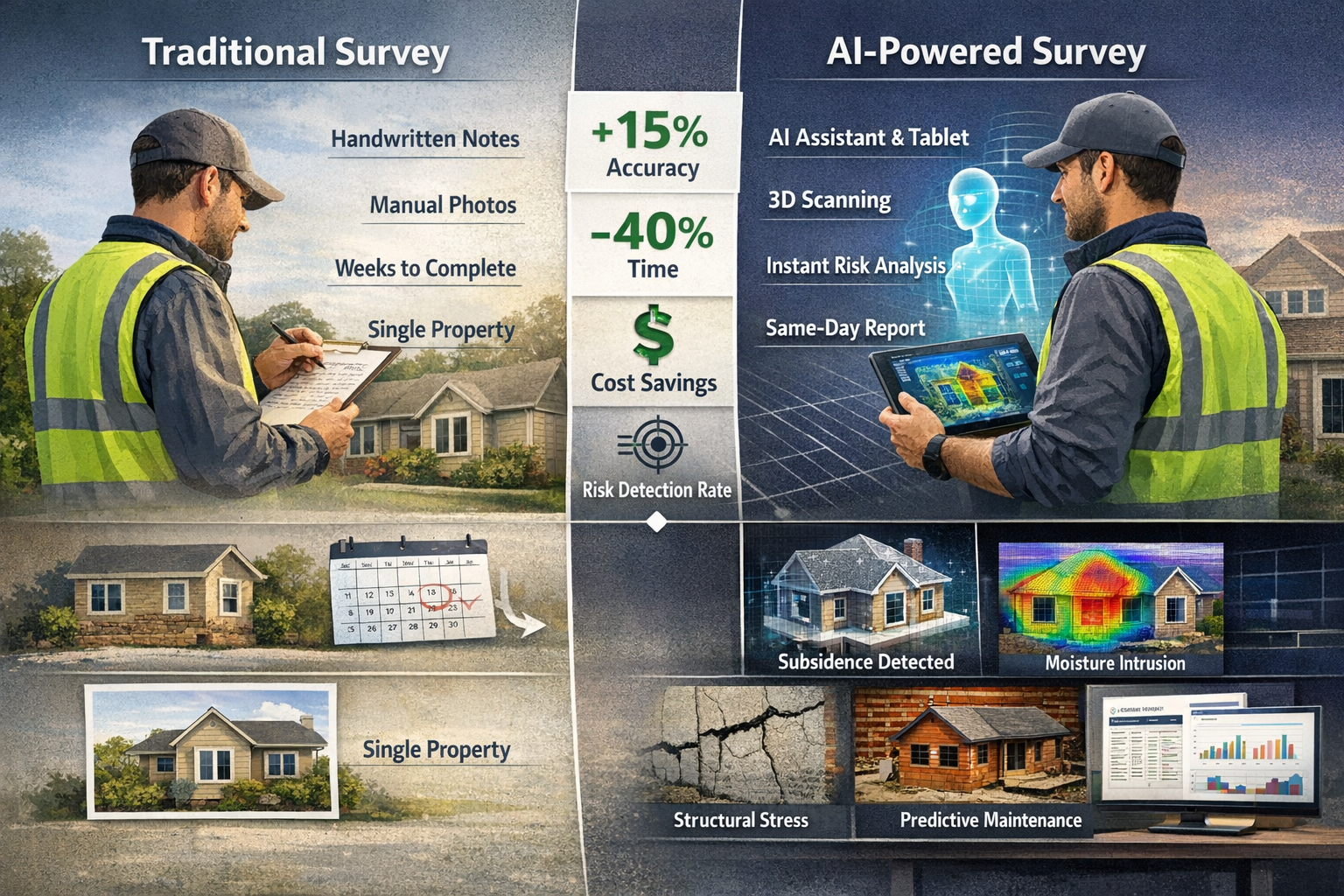
- 🎯 AI reduces property valuation errors by up to 15% compared to traditional manual appraisal methods, with real-time pricing adjustments replacing months-long valuation cycles [1]
- 🌊 Machine learning algorithms process massive datasets to predict terrain changes, flood risks, and landslide probabilities with unprecedented accuracy through hyper-local data analysis
- ⚡ Transaction workflow automation cuts deal cycles by 40% through intelligent lead orchestration and real-time buyer intent tracking [1]
- 🔍 Human expertise remains irreplaceable despite AI advances—professional interpretation, risk assessment, and tailored advice require surveyor judgment that cannot be automated [3]
- 📊 RICS global AI standard takes effect March 9, 2026, establishing mandatory requirements for responsible AI use across valuation, construction, infrastructure, and land services [2]
Understanding AI and Machine Learning in Property Surveying: Predicting Risks and Automating Data Analysis
What Makes AI Different from Traditional Surveying Methods
Traditional property surveying relies heavily on manual inspection, human observation, and subjective professional judgment. A surveyor physically visits a property, examines visible elements, takes measurements, and produces a report based on their training and experience. While this approach has served the industry well for decades, it faces inherent limitations in processing speed, data volume capacity, and predictive capability.
Artificial intelligence and machine learning fundamentally change this paradigm by introducing computational power that can analyze thousands of data points simultaneously. Machine learning algorithms learn from historical patterns, identifying correlations between property characteristics and risk factors that might escape human notice. These systems continuously improve their accuracy as they process more data, creating a feedback loop of enhanced performance.
The key distinction lies in scale and pattern recognition. While an experienced surveyor might inspect dozens of properties annually, an AI system can analyze thousands of comparable properties, weather patterns, geological surveys, and historical maintenance records within minutes. This capability proves particularly valuable when assessing risks that develop slowly over time or require analysis of multiple interconnected variables.
Core Technologies Powering Modern Property Surveying
Several technological components work together to enable AI-driven property surveying:
Computer Vision and Image Recognition: Advanced algorithms analyze photographs, drone footage, and thermal imaging to detect structural anomalies, moisture intrusion, and material degradation. These systems can identify subtle discoloration patterns indicating water damage or recognize crack formations suggesting foundation settlement.
Natural Language Processing (NLP): AI systems extract relevant information from property documents, planning permissions, building regulations, and historical records. However, recent testing revealed significant limitations—AI-generated document summaries can overlook important provisions, requiring qualified surveyors to conduct thorough reviews [3].
Predictive Analytics: Machine learning models analyze historical data to forecast future conditions. These algorithms consider variables like soil composition, drainage patterns, weather trends, and construction materials to predict risks such as subsidence, flooding, or structural failure.
IoT Sensor Integration: Internet of Things devices continuously monitor property conditions, feeding real-time data into AI systems. Moisture sensors, structural stress monitors, and environmental detectors provide ongoing surveillance that alerts surveyors to emerging issues before they become critical problems.
Geographic Information Systems (GIS): AI-enhanced mapping technologies overlay multiple data layers—topography, hydrology, land use, infrastructure—to create comprehensive risk profiles for specific locations. These systems excel at identifying area-wide patterns that affect property values and safety.
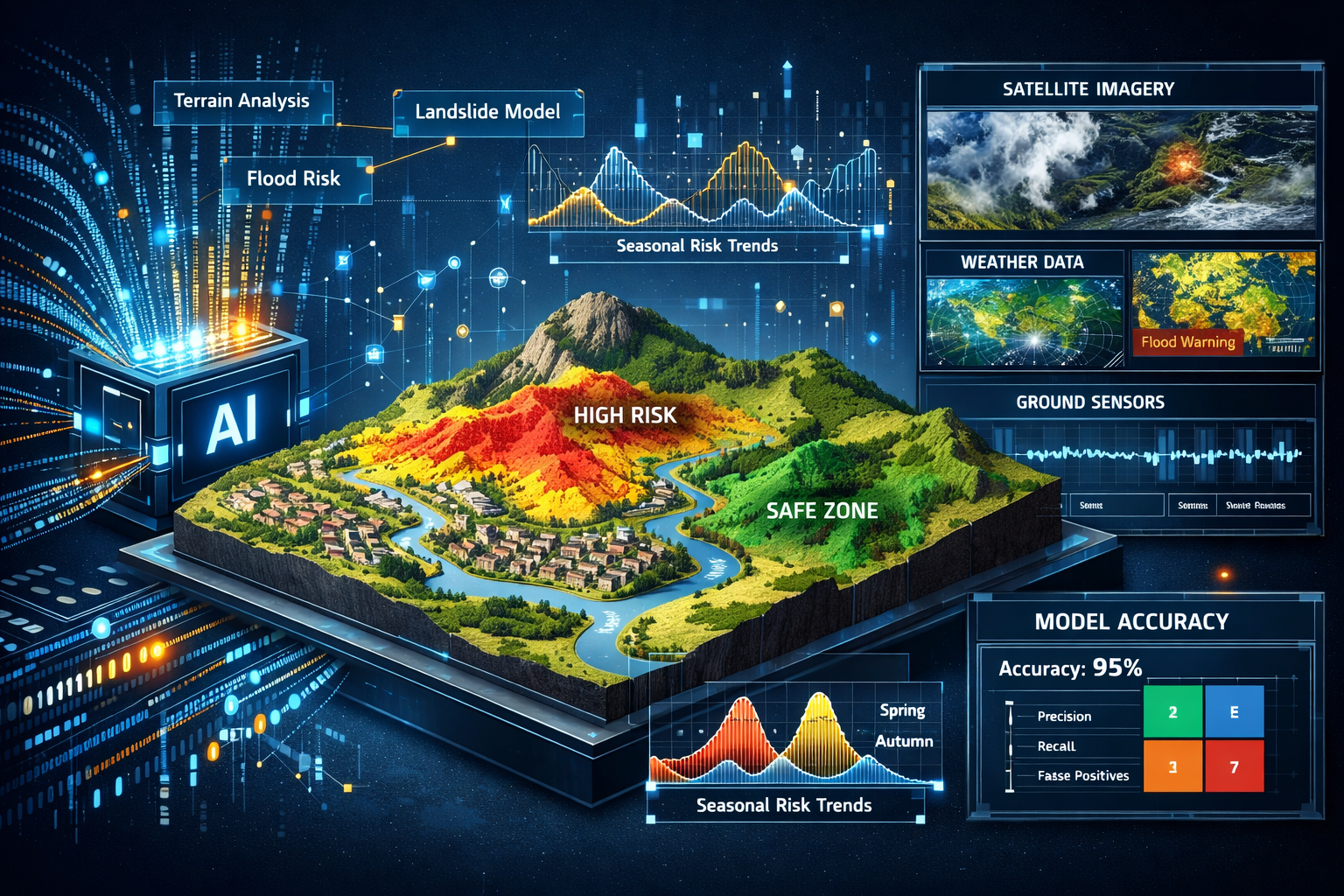
How AI Processes Massive Datasets to Detect Terrain Changes and Environmental Risks
Terrain Change Detection and Geological Risk Assessment
One of the most powerful applications of AI and Machine Learning in Property Surveying: Predicting Risks and Automating Data Analysis involves monitoring subtle terrain shifts that signal potential structural problems. Traditional surveying methods might miss millimeter-level ground movements that accumulate into serious subsidence issues over months or years.
LiDAR (Light Detection and Ranging) technology combined with machine learning creates detailed three-dimensional terrain models with centimeter-level accuracy. AI algorithms compare sequential LiDAR scans to detect ground movement, identifying subsidence patterns, soil erosion, and geological instability. This proves particularly valuable in areas with clay soils, mining history, or underground water flow.
The technology works by:
- Baseline Establishment: Initial high-resolution scans create reference terrain models
- Continuous Monitoring: Periodic rescanning captures terrain changes over time
- Pattern Recognition: AI algorithms identify movement patterns and acceleration rates
- Risk Classification: Machine learning models compare detected changes against historical failure data to assess severity
- Predictive Modeling: Systems forecast future movement trajectories based on current trends
When conducting a Level 3 full building survey, surveyors can now supplement traditional inspection methods with AI-powered terrain analysis, providing clients with both current condition assessments and future risk predictions.
Flood Risk Prediction and Hydrological Analysis
Flood risk assessment represents another area where AI dramatically outperforms traditional methods. Machine learning models integrate multiple data sources to create sophisticated flood probability models:
| Data Source | AI Application | Risk Insight Provided |
|---|---|---|
| Historical rainfall patterns | Trend analysis and seasonal forecasting | Probability of extreme weather events |
| Topographic mapping | Water flow modeling | Drainage pathway identification |
| Soil permeability data | Absorption capacity calculation | Surface water accumulation zones |
| River gauge measurements | Real-time monitoring and alerts | Immediate flood warnings |
| Climate change projections | Long-term risk modeling | Future vulnerability assessment |
| Urban development plans | Drainage impact analysis | Infrastructure change effects |
Hyper-local data analysis has proven particularly effective in urban environments. JLL reports that tracking micro-signals such as permit filings, infrastructure changes, and local development patterns has increased investor returns by 8 to 12 percent in urban residential projects [1]. This granular approach identifies properties at risk from changes in surrounding areas—new construction that alters drainage patterns, infrastructure projects that affect water flow, or climate-related shifts in precipitation intensity.
AI systems can process decades of weather data, geological surveys, and flood event records to identify properties in zones that traditional flood maps might classify as low-risk but which face emerging threats from changing environmental conditions. This capability proves invaluable when advising clients on property investment decisions where long-term environmental risks significantly impact value and insurability.
Landslide and Slope Stability Prediction
For properties on or near slopes, landslide prediction using AI provides critical safety information. Machine learning algorithms analyze:
- Slope angle and composition: Geological surveys combined with soil testing data
- Vegetation cover: Satellite imagery tracking plant root systems that stabilize soil
- Rainfall intensity: Weather pattern analysis identifying saturation thresholds
- Historical movement: Ground-penetrating radar detecting previous instability
- Seismic activity: Earthquake data revealing ground stress patterns
These systems assign probability scores to landslide risk, updating continuously as conditions change. During heavy rainfall periods, AI models recalculate risk levels in real-time, potentially alerting property owners and surveyors to evacuate or implement emergency stabilization measures.
The predictive capability extends beyond immediate risks. AI models forecast how slope stability will change over 5, 10, or 20-year periods based on climate projections, vegetation changes, and development patterns. This long-term perspective proves essential when assessing properties for budgeting repairs and restoration or evaluating whether remediation investments make financial sense.
Streamlining Workflows: Practical Integration of AI Tools in Daily Surveying Operations
Automating Data Collection and Initial Analysis
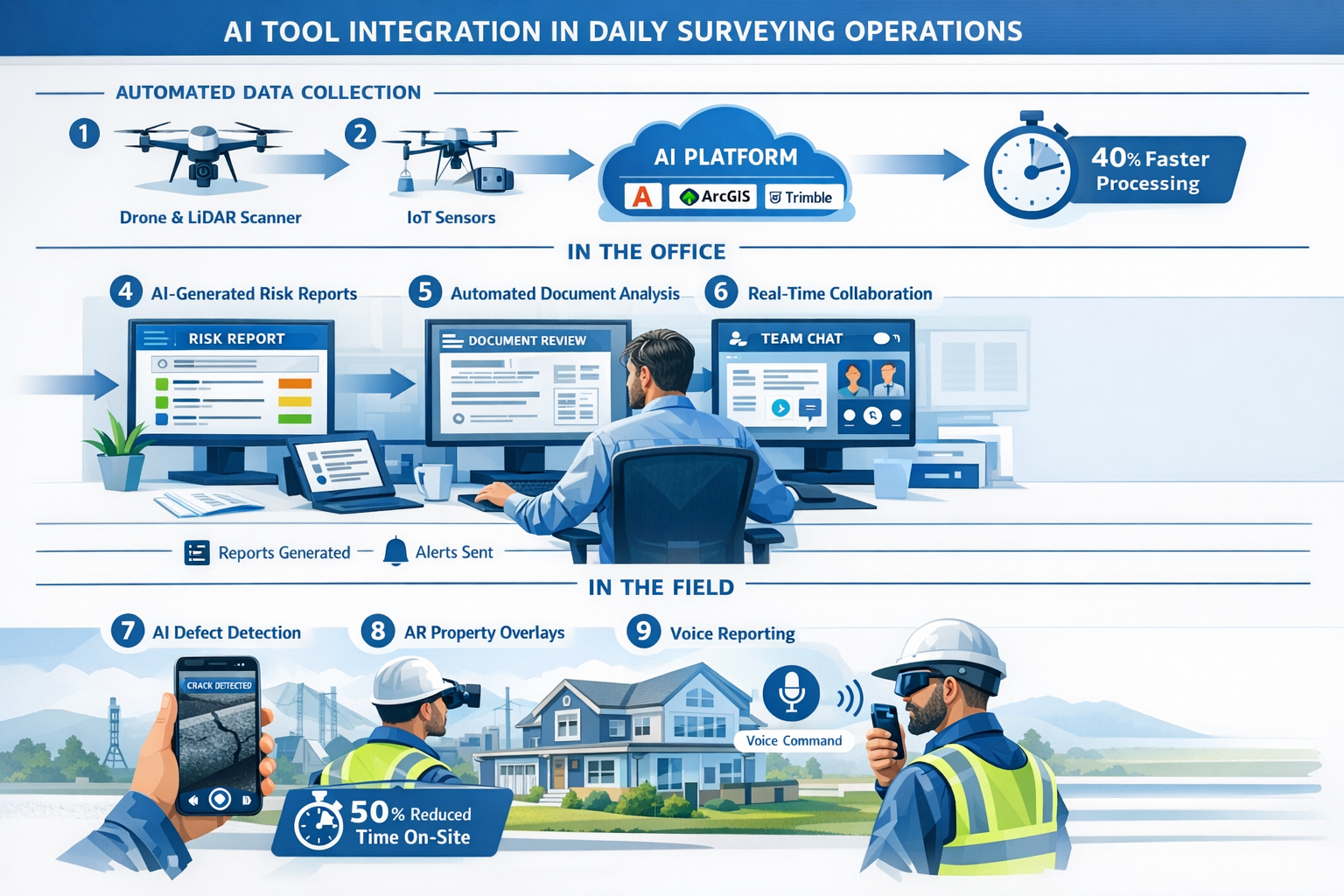
The surveying workflow traditionally begins with extensive manual data gathering—measuring dimensions, photographing defects, noting observations, and collecting property documents. AI automation transforms this labor-intensive process into a streamlined operation that frees surveyors to focus on interpretation and client advisory services.
Drone-based property inspection equipped with AI-powered image analysis can survey roof conditions, chimney structures, and building exteriors in minutes rather than hours. These systems automatically:
- Identify and classify defects (cracked tiles, damaged flashing, deteriorated mortar)
- Measure roof dimensions and calculate replacement material quantities
- Detect thermal anomalies indicating insulation problems or moisture intrusion
- Generate preliminary condition reports with photographic evidence
Mobile AI applications enable real-time defect detection during site visits. Surveyors photograph structural elements, and machine learning algorithms immediately flag potential issues—cracks suggesting movement, staining patterns indicating damp problems, or material deterioration requiring specialist investigation. Understanding how long a building survey takes becomes less predictable with AI assistance, as technology accelerates certain tasks while enabling more comprehensive analysis.
Document Processing and Regulatory Compliance
Property transactions involve extensive documentation—title deeds, planning permissions, building regulation certificates, previous survey reports, and maintenance records. Natural language processing automates document review, extracting relevant information and identifying potential issues.
However, critical limitations exist. Testing by building consultancy teams revealed that AI-generated lease summaries and document reviews, while appearing comprehensive, significantly overlooked important provisions in original documentation [3]. This finding underscores a fundamental principle: AI serves as a powerful assistant but cannot replace qualified professional review.
Best practice involves using AI for:
✅ Initial document screening: Identifying relevant sections requiring detailed review
✅ Information extraction: Pulling key dates, parties, and terms into structured formats
✅ Cross-reference checking: Comparing current conditions against historical records
✅ Anomaly flagging: Highlighting unusual clauses or missing standard provisions
Professional surveyors must then:
🔍 Verify AI findings: Confirm extracted information accuracy
🔍 Interpret context: Understand implications of contractual terms
🔍 Identify gaps: Recognize what AI systems missed
🔍 Provide judgment: Advise clients on significance and recommended actions
When assessing building regulation compliance, AI tools can quickly compare current property conditions against regulatory requirements, but surveyors must interpret whether deviations constitute actionable defects or acceptable variations.
Automated Report Generation and Client Communication
AI-assisted report writing represents one of the most time-saving applications in modern surveying practice. Machine learning systems trained on thousands of survey reports can:
- Generate standardized descriptions of common defects
- Organize findings into logical report structures
- Suggest appropriate recommendations based on defect severity
- Create visual presentations with annotated photographs
- Produce executive summaries highlighting critical issues
The European Central Bank has highlighted AI-backed appraisal checks as a method to reduce lending risk exposure in real estate portfolios, with banks and regulators increasingly favoring traceable, transparent AI-verified appraisals over subjective manual reports [1]. This regulatory recognition creates additional incentive for surveyors to adopt AI tools that enhance report credibility and auditability.
However, the human element remains essential. While AI can draft initial report sections, professional surveyors must:
- Customize recommendations to specific client circumstances
- Apply professional judgment to risk prioritization
- Communicate findings in accessible language appropriate to client sophistication
- Provide context and interpretation beyond standardized descriptions
When clients need to negotiate house prices down based on survey findings, the surveyor's ability to explain defect significance and cost implications carries far more weight than AI-generated text.
Workflow Integration: Practical Implementation Steps
For surveying firms seeking to integrate AI tools into daily operations, a phased approach minimizes disruption while building competency:
Phase 1: Assessment and Planning (Months 1-2)
- Audit current workflows identifying time-intensive manual tasks
- Research AI tools addressing specific pain points
- Evaluate vendor solutions against firm requirements
- Develop implementation timeline and budget
- Identify staff champions for technology adoption
Phase 2: Pilot Implementation (Months 3-4)
- Deploy AI tools for limited use cases (e.g., drone roof inspections only)
- Train selected staff on new systems
- Run parallel processes (AI-assisted alongside traditional methods)
- Compare outputs for accuracy and efficiency
- Gather user feedback and identify refinement needs
Phase 3: Scaled Deployment (Months 5-8)
- Expand AI tool usage across additional workflow areas
- Train broader staff population
- Integrate AI systems with existing software platforms
- Establish quality control protocols
- Monitor performance metrics (time savings, error rates, client satisfaction)
Phase 4: Optimization and Expansion (Months 9-12)
- Refine workflows based on performance data
- Explore advanced AI capabilities
- Develop firm-specific AI training datasets
- Create best practice guidelines
- Plan next-generation technology investments
The surveyor's role paradoxically becomes more critical as AI deployment increases, because these systems require relevant and accurate datasets—poor input data directly undermines AI tool effectiveness [5]. Professional expertise ensures AI systems receive quality information and that outputs undergo appropriate validation.
The Human-AI Partnership: Why Professional Expertise Remains Essential
Limitations of AI in Complex Property Assessment
Despite impressive capabilities, AI systems face fundamental limitations that preserve the central importance of qualified surveyors. Machine learning algorithms excel at pattern recognition within their training data but struggle with novel situations, contextual nuances, and ethical judgments.
Scenario-based limitations include:
🏚️ Historic buildings with unique construction: AI trained on modern construction may misinterpret traditional building techniques, flagging acceptable historic features as defects or missing genuine problems specific to period properties. Understanding common defects in older homes requires knowledge of historical building practices that AI systems may lack.
🔧 Complex multi-factor problems: When multiple defects interact—for example, roof damage causing water penetration that leads to timber decay affecting structural stability—AI may identify individual issues without recognizing the causal chain requiring coordinated remediation.
📋 Regulatory interpretation: Building regulations often contain subjective terms like "reasonable," "adequate," or "appropriate." AI cannot apply professional judgment to determine whether specific conditions meet these standards in context.
💰 Cost-benefit analysis: Recommending whether to repair, replace, or accept a defect requires understanding client priorities, budget constraints, and risk tolerance—human factors beyond AI capability.
The RICS Global Standard for Responsible AI Use
Recognizing both AI's potential and its limitations, RICS published the first global professional standard for responsible AI use in surveying practice, taking effect March 9, 2026 [2]. This landmark guidance establishes mandatory requirements and best practice expectations for members and regulated firms worldwide across valuation, construction, infrastructure, and land services.
Key provisions include:
Transparency Requirements: Surveyors must disclose when AI tools contribute to assessments, explaining their role and limitations to clients.
Validation Obligations: AI-generated outputs require professional verification before inclusion in client deliverables.
Data Quality Standards: Firms must ensure AI training datasets represent appropriate property types, conditions, and geographic contexts.
Bias Mitigation: Regular auditing of AI systems to identify and correct biases that might affect certain property types, locations, or client groups.
Competency Expectations: Surveyors using AI tools must understand their functionality, limitations, and appropriate applications.
Accountability Framework: Professional responsibility remains with the surveyor, not the AI system—technology serves as a tool, not a decision-maker.
This regulatory framework reflects the profession's recognition that AI functions as enhancement rather than replacement for human expertise. When conducting property valuations, surveyors must apply professional judgment that considers local market nuances, property-specific features, and contextual factors that AI systems cannot fully appreciate.
Building AI Literacy Among Surveying Professionals
LinkedIn data shows a 37 percent rise in demand for AI-literate real estate roles year over year [1], yet surveying professionals trained in both property markets and AI systems remain relatively scarce. This skills gap creates both challenges and opportunities for the profession.
Essential AI competencies for modern surveyors include:
📚 Understanding AI fundamentals: Basic knowledge of how machine learning works, what it can and cannot do, and how to interpret AI-generated outputs
🔧 Tool proficiency: Practical skills operating AI-powered surveying equipment, software platforms, and analysis tools
📊 Data literacy: Ability to evaluate data quality, recognize dataset limitations, and understand how input data affects AI performance
⚖️ Critical evaluation: Capacity to assess AI recommendations, identify potential errors, and determine when human override is necessary
🤝 Client communication: Skills explaining AI's role in assessments to clients who may lack technical understanding
Professional development programs increasingly incorporate AI training, recognizing that surveyors who combine traditional expertise with technological proficiency will lead the industry's future. Firms investing in staff AI education position themselves competitively while maintaining the professional standards clients expect.
Real-World Applications and Measurable Benefits
Valuation Accuracy and Market Analysis
Property valuation represents one area where AI demonstrates clear, measurable advantages. PwC's Global Real Estate Technology Survey found that AI-led valuation tools can cut pricing errors by up to 15 percent compared to manual appraisal methods [1]. Cities like Dubai and Singapore already use AI-based pricing engines that adjust prices weekly based on demand signals instead of the months-long cycles of traditional methods.
These systems analyze:
- Comparable property sales data across extensive geographic areas
- Real-time market demand indicators (search activity, viewing requests, offer rates)
- Economic factors (employment trends, interest rates, development plans)
- Property-specific characteristics (condition, features, location attributes)
- Seasonal variations and market cycle positions
The speed advantage proves particularly valuable in volatile markets. Traditional valuations may become outdated during the weeks or months between assessment and transaction completion. AI-powered systems provide current valuations reflecting latest market movements, reducing the risk of over- or under-pricing that costs buyers and sellers thousands of pounds.
For professionals determining whether to recommend a Level 2 or Level 3 survey, AI-enhanced property analysis can identify risk factors suggesting the need for more comprehensive investigation, ensuring clients receive appropriate service recommendations.
Transaction Efficiency and Deal Flow Optimization
McKinsey research indicates that AI-driven transaction workflows reduce deal cycle time by up to 40 percent through automated lead orchestration systems that track buyer intent in real time and trigger outreach when interest peaks [1]. This acceleration benefits all transaction participants—buyers complete purchases faster, sellers reduce holding costs, and surveyors process more clients efficiently.
Automated workflow components include:
⚡ Intelligent scheduling: AI systems coordinate surveyor availability, client calendars, and property access to minimize delays
📧 Communication automation: Template-based updates keep clients informed throughout the process while flagging messages requiring personal attention
📋 Document management: Automated collection, organization, and distribution of required paperwork
🔔 Progress tracking: Real-time dashboards showing transaction status and identifying bottlenecks
💡 Proactive issue resolution: Early warning systems alerting teams to potential delays before they impact timelines
The cumulative effect of these improvements transforms surveying from a reactive service (responding to client requests) into a proactive partnership (anticipating needs and preventing problems). Firms adopting these technologies report higher client satisfaction scores and increased referral rates.
Risk Management and Insurance Applications
Insurance companies and lenders increasingly recognize AI-backed property assessments as superior risk management tools. The European Central Bank highlighted these systems as methods to reduce lending risk exposure in real estate portfolios [1], creating market pressure for AI-enhanced surveying services.
Predictive risk modeling enables:
🏦 More accurate lending decisions: Banks can price mortgages based on comprehensive risk profiles rather than broad property categories
🛡️ Targeted insurance coverage: Insurers offer customized policies reflecting specific property vulnerabilities
📉 Proactive maintenance: Property owners receive early warnings enabling preventive action before minor issues become expensive claims
📊 Portfolio management: Investors monitor risk across multiple properties, identifying assets requiring attention or divestment
When surveyors identify areas requiring further investigation, AI-enhanced risk scoring helps prioritize which issues demand immediate specialist assessment versus those suitable for ongoing monitoring.
Environmental Monitoring and Climate Adaptation
Climate change creates new challenges for property surveying—risks that were historically rare become increasingly common, and long-term property planning must account for changing environmental conditions. AI systems excel at analyzing climate projection models and translating abstract forecasts into property-specific risk assessments.
Climate adaptation applications include:
🌡️ Heat stress analysis: Identifying properties vulnerable to extreme temperature events requiring cooling system upgrades or insulation improvements
💧 Water scarcity planning: Assessing properties in areas facing future water restrictions affecting landscaping, pools, or agricultural uses
🌊 Coastal erosion modeling: Predicting shoreline changes affecting coastal properties over 20-50 year timeframes
🌪️ Extreme weather resilience: Evaluating building envelope integrity against projected increases in storm frequency and intensity
These assessments inform long-term property strategies, helping owners decide whether to invest in resilience improvements, adjust insurance coverage, or reconsider property holdings in high-risk areas. The ability to quantify future risks transforms abstract climate concerns into concrete financial planning factors.
Challenges and Considerations for AI Adoption
Data Privacy and Security Concerns
Property data contains sensitive information—ownership details, financial valuations, security vulnerabilities, and personal circumstances. AI systems require access to extensive datasets for effective operation, creating potential privacy and security risks.
Protection measures must address:
🔒 Data encryption: Secure storage and transmission of property information
👤 Access controls: Limiting AI system access to authorized personnel only
📜 Regulatory compliance: Adhering to GDPR and other data protection regulations
🗑️ Retention policies: Appropriate deletion of data after legitimate use periods
⚠️ Breach protocols: Response plans for potential security incidents
Surveying firms adopting AI tools must implement robust data governance frameworks ensuring client information receives appropriate protection. This responsibility extends to third-party AI vendors—firms must verify that external service providers maintain adequate security standards before sharing client data.
Cost Considerations and Return on Investment
AI implementation requires significant investment—software licenses, hardware upgrades, staff training, and ongoing maintenance costs. Smaller surveying practices may struggle to justify these expenses, potentially creating competitive disadvantages against larger firms with greater resources.
Investment categories include:
| Cost Category | Typical Range | Considerations |
|---|---|---|
| AI software platforms | £5,000-£50,000 annually | Subscription vs. perpetual licensing |
| Hardware (drones, sensors, workstations) | £10,000-£100,000 | Equipment lifespan and obsolescence |
| Staff training | £2,000-£10,000 per person | Ongoing education requirements |
| Data infrastructure | £5,000-£25,000 | Cloud vs. on-premise storage |
| Integration services | £10,000-£50,000 | Connecting AI tools with existing systems |
| Maintenance and updates | 15-20% of initial cost annually | Technical support and software updates |
Return on investment calculations must consider both direct revenue impacts (increased client capacity, premium pricing for AI-enhanced services) and indirect benefits (improved accuracy reducing liability exposure, competitive positioning, staff satisfaction).
Industry data suggests that average AI investment across industries is expected to more than double in 2026, reaching roughly 1.7% of revenue [7]. Surveying firms should benchmark their technology spending against these norms while recognizing that early adopters may require higher initial investments that decrease as technologies mature.
Resistance to Change and Cultural Adaptation
Human factors often present greater implementation challenges than technical issues. Experienced surveyors may resist AI adoption, viewing it as threatening their expertise or questioning its reliability based on traditional practice methods.
Common resistance patterns include:
😟 Competency concerns: Fear that inability to master new technologies will diminish professional standing
🤔 Quality skepticism: Doubting AI accuracy based on occasional errors or misunderstanding of how systems work
⏰ Workflow disruption: Frustration with learning curves that temporarily reduce productivity
👥 Job security anxiety: Worrying that automation will eliminate surveying positions
Successful AI adoption requires change management strategies addressing these concerns:
✅ Transparent communication: Explaining AI's role as enhancement tool rather than replacement
✅ Inclusive planning: Involving staff in technology selection and implementation decisions
✅ Comprehensive training: Providing adequate education and support during transition periods
✅ Quick wins: Demonstrating early benefits that build confidence and enthusiasm
✅ Recognition systems: Celebrating staff who effectively incorporate AI into their practice
Leadership commitment proves essential—when senior surveyors model AI adoption and share positive experiences, junior staff follow more readily. Firms should identify technology champions who can mentor colleagues and troubleshoot common challenges.
The Future of AI and Machine Learning in Property Surveying
Emerging Technologies on the Horizon
The surveying profession entered 2026 amid accelerating digital transformation driven by pressure to deliver faster, more accurate results [6]. Several emerging technologies promise to further revolutionize property assessment:
Quantum Computing Applications: As quantum computers become commercially viable, they will enable vastly more complex risk modeling—simultaneously analyzing thousands of variables to predict property performance under multiple future scenarios.
Advanced Robotics: Autonomous inspection robots will access dangerous or difficult areas (unstable roofs, confined spaces, contaminated environments) collecting data without risking human safety.
Augmented Reality Integration: Surveyors wearing AR glasses will see AI-generated overlays highlighting defects, displaying historical property data, and suggesting investigation priorities during site visits.
Blockchain Verification: Distributed ledger technology will create tamper-proof records of property conditions, survey findings, and maintenance histories, increasing transparency and reducing fraud.
Predictive Maintenance AI: Systems will forecast specific component failure dates (roof replacement needed in 3.2 years, boiler failure likely within 18 months) enabling precise maintenance planning and budgeting.
These technologies will complement rather than replace current AI applications, creating increasingly sophisticated tools that enhance surveyor capabilities while raising professional practice standards.
Industry Transformation and Competitive Dynamics
Industry adoption remains in early stages—as recently as three years ago (2023), only 5 percent of real estate companies were testing AI solutions [8]. This creates a competitive window for forward-thinking surveying firms to establish technological leadership before AI becomes industry standard.
Market segmentation will likely emerge:
🏆 Premium AI-enhanced services: Firms offering cutting-edge technology commanding higher fees from clients valuing innovation and accuracy
⚖️ Hybrid practices: Balanced approaches combining traditional methods with selective AI adoption for specific applications
📋 Traditional specialists: Niche providers focusing on property types or services where human expertise provides greatest value (historic buildings, complex commercial properties)
💰 Budget automation: Low-cost services relying heavily on AI to minimize human involvement, suitable for straightforward residential properties
Understanding why property owners hire surveyors helps firms position their AI capabilities appropriately—clients seeking comprehensive risk assessment value AI-enhanced analysis, while those requiring specialist interpretation prioritize human expertise.
Regulatory Evolution and Professional Standards
The RICS global AI standard represents just the beginning of regulatory framework development. As AI adoption increases, additional guidance will address:
📜 Liability allocation: Determining responsibility when AI systems contribute to errors or omissions
⚖️ Professional indemnity insurance: Adjusting coverage requirements for AI-assisted surveying practices
🎓 Qualification standards: Establishing minimum AI competency requirements for chartered surveyors
🔍 Quality assurance: Creating audit protocols verifying appropriate AI use and output validation
🌍 International harmonization: Coordinating standards across jurisdictions as property markets globalize
Professional bodies will balance innovation encouragement against consumer protection, ensuring AI adoption enhances rather than compromises surveying service quality. Surveyors must stay informed about evolving requirements while participating in standard-setting discussions that shape the profession's future.
Conclusion
AI and Machine Learning in Property Surveying: Predicting Risks and Automating Data Analysis represents far more than technological novelty—it constitutes a fundamental evolution in how professionals protect property assets, serve clients, and deliver value. The evidence is compelling: AI reduces valuation errors by 15%, cuts transaction cycles by 40%, and enables risk predictions impossible through traditional methods [1]. Yet the technology's greatest strength lies not in replacing human expertise but in amplifying it, freeing surveyors from time-consuming data processing to focus on interpretation, judgment, and client advisory services where professional experience proves irreplaceable.
The RICS global standard taking effect in March 2026 [2] establishes the framework for responsible AI adoption, ensuring technology serves the profession's core mission of protecting public interest through accurate, reliable property assessment. As the industry navigates this transformation, success will belong to firms and professionals who embrace a human-AI partnership model—leveraging computational power for data analysis while maintaining the professional judgment, contextual understanding, and ethical responsibility that define chartered surveying.
Actionable Next Steps
For surveying professionals and firms seeking to integrate AI capabilities:
Immediate Actions (Next 30 Days)
- Audit current workflows identifying manual tasks consuming significant time that AI might automate
- Review the RICS AI standard to understand compliance requirements before the March 9, 2026 effective date
- Research AI tools specifically designed for property surveying applications relevant to your practice areas
- Assess staff AI literacy through surveys or discussions identifying training needs
Short-Term Initiatives (3-6 Months)
- Pilot one AI application in a limited scope (e.g., automated drone roof inspections) to build experience and demonstrate value
- Invest in professional development through AI training courses, webinars, or industry conferences
- Establish data governance protocols ensuring client information protection and regulatory compliance
- Develop client communication materials explaining how AI enhances your surveying services
Long-Term Strategy (6-12 Months)
- Create comprehensive AI integration roadmap with phased implementation across all service areas
- Build strategic partnerships with technology vendors offering surveying-specific AI solutions
- Develop specialized AI-enhanced service offerings that differentiate your practice in competitive markets
- Contribute to professional discourse by sharing experiences, participating in industry forums, and helping shape best practices
The transformation is underway, and the competitive advantages will accrue to those who act decisively while maintaining the professional standards that have always defined exceptional surveying practice. Whether assessing building materials, evaluating structural concerns, or advising on property investment, AI-enhanced capabilities will increasingly separate industry leaders from those left behind by technological progress.
The future of property surveying is not human or machine—it's human and machine, combining the best of both to deliver unprecedented accuracy, efficiency, and client value. The question is not whether to adopt AI, but how quickly and effectively your practice will integrate these transformative tools while preserving the professional expertise that remains essential to protecting property interests.
References
[1] Why 2026 Could Be The Year Ai Beats Traditional Real Estate Practices – https://www.aicerts.ai/blog/why-2026-could-be-the-year-ai-beats-traditional-real-estate-practices/
[2] Rics Launches Landmark Global Standard On Responsible Use Of Ai In Surveying – https://www.rics.org/news-insights/rics-launches-landmark-global-standard-on-responsible-use-of-ai-in-surveying
[3] How Ai Is Changing Building Surveying Opportunities And Limitations – https://www.eddisons.com/insights/how-ai-is-changing-building-surveying-opportunities-and-limitations
[5] How Ai Is Changing The Role Of The Surveyor In Aec – https://www.gim-international.com/content/article/how-ai-is-changing-the-role-of-the-surveyor-in-aec
[6] Doubling Down On Digital – https://amerisurv.com/2026/02/01/doubling-down-on-digital/
[7] This Month In Ai January 2026 Leading With Ai – https://www.rapidcanvas.ai/blogs/this-month-in-ai-january-2026-leading-with-ai
[8] Real Estate Ai Success Depends On People – https://www.weforum.org/stories/2026/01/real-estate-ai-success-depends-on-people/