

Roughly one in five people in the UK lives with a disability — yet a significant proportion of the country's existing building stock was constructed before modern accessibility legislation existed. That gap between physical reality and legal obligation is now closing fast, and the consequences for property owners, landlords, and buyers who ignore it are growing more serious by the year. Accessibility Standards Compliance in Building Surveys: RICS Protocols for Assessing Disability Access and Future Retrofit Feasibility in 2026 has moved from a niche specialism to a core component of professional surveying practice, driven by tightening regulation, heightened liability exposure, and a cultural shift toward inclusive design.
This article explores what RICS-qualified surveyors must assess, how the regulatory landscape has evolved, and what property stakeholders need to know to manage risk and plan for the future.
Key Takeaways 📋
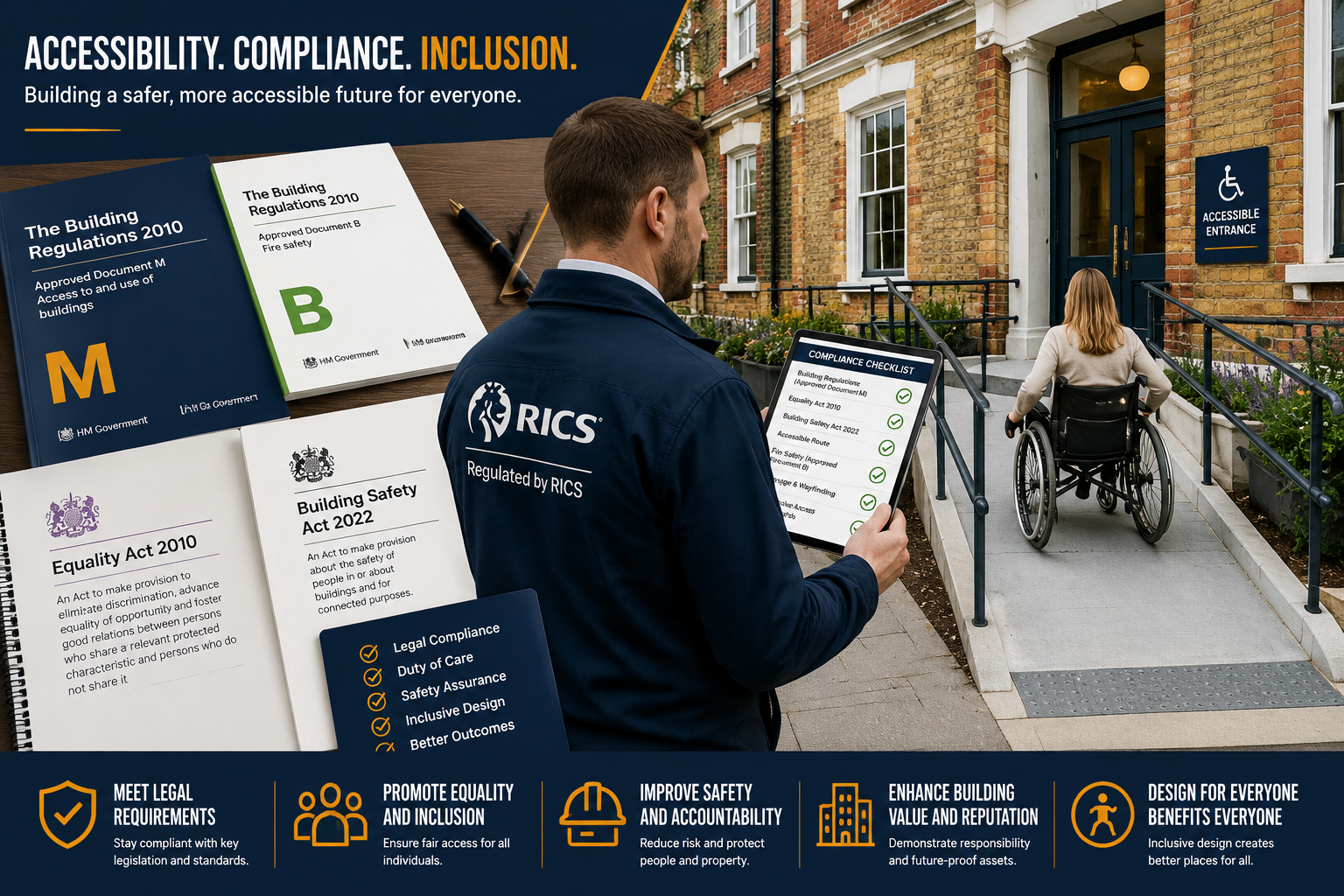
- Accessibility compliance is a legal obligation, not an optional upgrade — the Equality Act 2010, Building Regulations Part M, and the Building Safety Act 2022 all create enforceable duties.
- RICS Level 3 Building Surveys are the most appropriate tool for assessing existing accessibility shortfalls and retrofit feasibility in complex or older properties.
- Digital accessibility requirements are also tightening in 2026, with ADA Title II mandating WCAG 2.1 Level AA compliance for public building information online [1].
- Retrofit feasibility assessments must consider structural constraints, cost, planning restrictions, and proportionality under the Equality Act.
- Early assessment reduces liability — surveyors who identify access deficiencies at the point of purchase or lease give clients the information needed to negotiate, plan, and comply.
The Regulatory Framework Driving Accessibility Compliance in 2026
Equality Act 2010: The Baseline Duty
The Equality Act 2010 remains the cornerstone of disability access law in England, Wales, and Scotland. It places a reasonable adjustment duty on service providers, employers, and those managing premises — requiring them to remove physical barriers that put disabled people at a substantial disadvantage. Critically, this duty is anticipatory: organisations cannot wait until a disabled person is disadvantaged before acting.
For surveyors, this means that a building survey must go beyond describing what exists and begin evaluating whether what exists is lawful. A step at an entrance, a narrow corridor, or a toilet that cannot accommodate a wheelchair user are not merely physical defects — they are potential Equality Act liabilities.
Building Regulations Part M: Minimum Standards
Approved Document M of the Building Regulations sets out minimum requirements for access to and use of buildings. Part M applies to:
- New dwellings (Part M4 — three categories of accessibility provision)
- Non-domestic buildings (requiring accessible entrances, sanitary facilities, and circulation routes)
- Material changes of use (which can trigger Part M compliance requirements)
A key issue for surveyors in 2026 is that many existing buildings were constructed under older versions of Part M — or before it existed at all. Assessing compliance therefore requires knowledge of which version of the regulations applied at the time of construction, and whether subsequent alterations have triggered update obligations. For a deeper understanding of how building regulations interact with survey findings, see this guide to building regulation compliance testing.
Building Safety Act 2022: Raising the Stakes
The Building Safety Act 2022 introduced a more rigorous accountability framework for higher-risk buildings — broadly those above 18 metres or seven storeys with residential use. While its primary focus is fire and structural safety, the Act's broader principle of dutyholder accountability has raised expectations across all aspects of building compliance, including accessibility. Building owners and managers are now expected to maintain comprehensive records of compliance status and to demonstrate ongoing management of safety and access obligations.
Digital Accessibility: A 2026 Milestone 🌐
An often-overlooked dimension of accessibility compliance concerns how building information is communicated digitally. In 2026, ADA Title II in the United States requires state and local government entities serving populations over 50,000 to meet WCAG 2.1 Level AA standards for digital content — including online information about building accessibility features [1][7]. While this is a US requirement, it signals a global direction of travel. The UK's Public Sector Bodies Accessibility Regulations already impose similar standards on public bodies.
💬 "The DOJ's final rule represents the first time the federal government has adopted specific technical standards for digital content accessibility — setting a precedent for standardised accessibility documentation across sectors." [2]
For UK surveyors working with public sector clients, educational institutions, or organisations with US operations, digital accessibility of building records and facility information is increasingly part of the compliance picture [8].
RICS Protocols for Assessing Disability Access and Future Retrofit Feasibility in 2026
Choosing the Right Survey Level
Not all surveys are created equal when it comes to accessibility assessment. A basic mortgage valuation will not identify access shortfalls. A RICS Level 2 HomeBuyer Report provides limited commentary on visible defects but lacks the depth needed for complex compliance analysis. For meaningful accessibility assessment — particularly in older, converted, or commercial properties — a RICS Level 3 Full Building Survey is the appropriate instrument.
The Level 3 Full Building Survey provides a thorough inspection of all accessible parts of a building, with detailed commentary on condition, compliance risk, and recommended remediation. It is the survey format best equipped to identify accessibility deficiencies and assess their legal and financial implications. Understanding the difference between survey levels is important — this comparison of Level 2 and Level 3 surveys explains when each is appropriate.
Key Accessibility Elements a Surveyor Must Assess
A competent RICS surveyor conducting an accessibility-focused inspection should evaluate the following:
| Element | Key Standards | Common Issues |
|---|---|---|
| Entrance & approach | Part M, BS 8300 | Steps, no dropped kerb, poor surface |
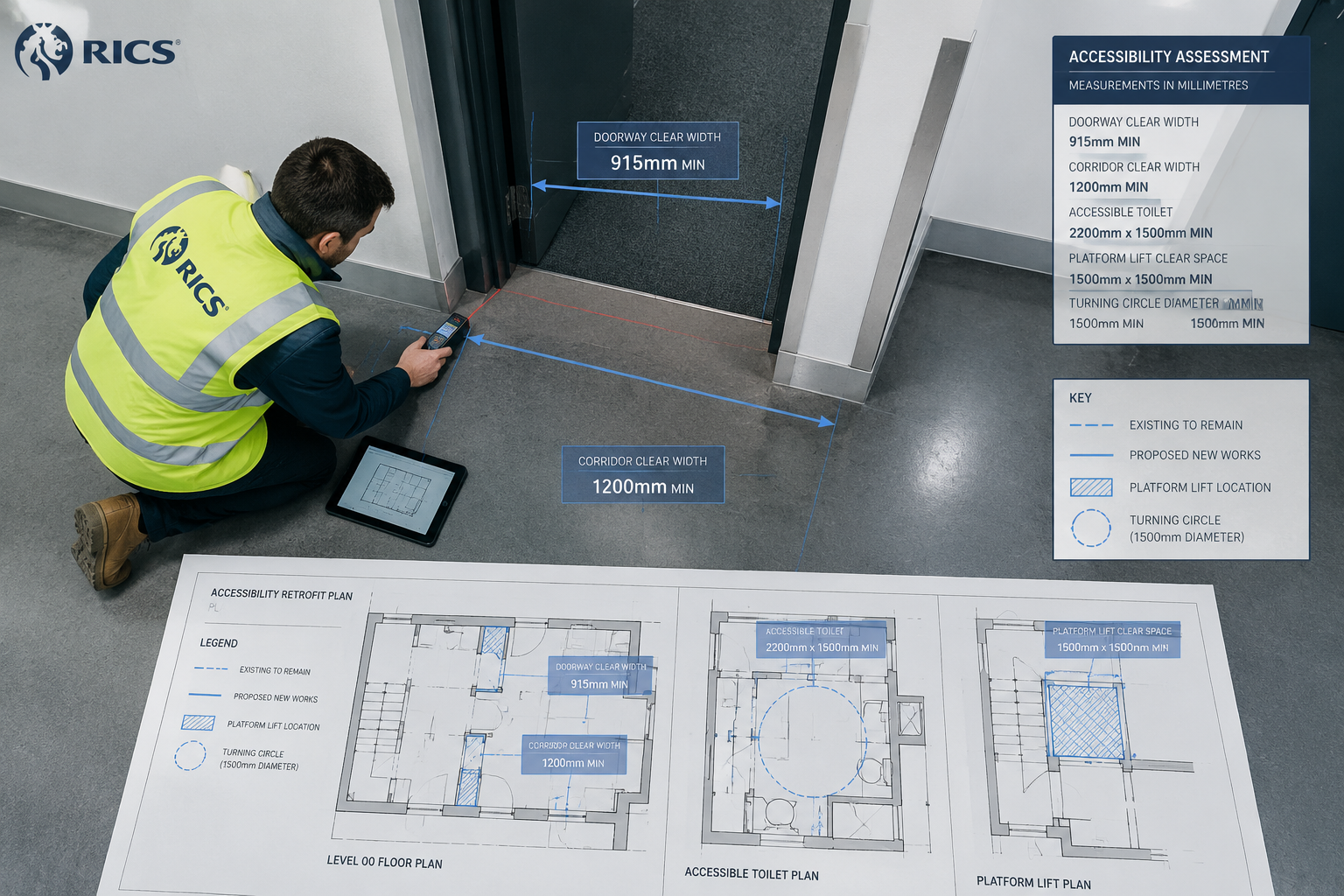
| Doorways | Min. 775mm clear width | Narrow frames, heavy closers |
| Corridors & circulation | Min. 1200mm width | Obstructions, tight turns |
| Vertical circulation | Lifts, ramps, platform lifts | No lift, steep ramps |
| Sanitary facilities | Part M, BS 8300 | No accessible WC, wrong layout |
| Signage & wayfinding | BS 8300 | Poor contrast, no tactile indicators |
| Parking | Part M | No designated bays, poor surface |
| Emergency egress | BS 9999 | No refuge areas, inaccessible escape routes |
BS 8300:2018 — the British Standard for the design of an accessible and inclusive built environment — provides the technical benchmarks that surveyors use alongside Part M. It covers everything from door handle heights to the gradient of ramps and the dimensions of accessible toilet cubicles.
Assessing Retrofit Feasibility: A Structured Approach
Identifying a deficiency is only half the job. The more complex professional task is assessing whether — and how — a building can be adapted to meet modern standards. This is where retrofit feasibility assessment becomes critical.
A structured retrofit feasibility assessment should consider:
- Structural constraints — Can the building accommodate a platform lift or ramp without compromising structural integrity? This may require input from a structural engineer.
- Planning and heritage restrictions — Listed buildings and conservation areas impose limits on external alterations. A ramp that would be straightforward on a modern building may require listed building consent on a Georgian terrace.
- Proportionality — The Equality Act's "reasonable adjustment" test is not absolute. Cost, practicality, and the nature of the service all factor in. Surveyors should document the proportionality analysis.
- Cost estimation — Clients need realistic figures. Linking accessibility improvements to a broader budgeting for repairs and restoration exercise helps integrate access upgrades into planned maintenance programmes.
- Phasing — Not all improvements need to happen at once. A phased access improvement plan can demonstrate good faith compliance while managing cash flow.
The Liability Dimension
Surveyors who fail to identify significant accessibility deficiencies — particularly where those deficiencies create legal exposure for a buyer or tenant — face professional liability claims. The standard of care expected of a RICS-qualified surveyor in 2026 includes awareness of the Equality Act duty, Part M requirements, and the implications of the Building Safety Act framework.
Equally, property owners who receive a survey report that documents access shortfalls and take no action face escalating risk. An Equality Act claim, a regulatory enforcement notice, or reputational damage from being publicly identified as non-compliant can all follow. For those dealing with commercial leases, understanding how dilapidation protocols interact with access improvement obligations is an important related consideration.
Practical Guidance for Property Owners, Buyers, and Managers
What to Request from Your Surveyor
When commissioning a survey with accessibility compliance in mind, clients should specifically request:
- ✅ A review of compliance with Approved Document Part M (current and applicable version)
- ✅ Assessment against BS 8300:2018 benchmarks
- ✅ Identification of Equality Act reasonable adjustment obligations
- ✅ A retrofit feasibility commentary for any identified deficiencies
- ✅ Indicative cost ranges for remediation works
- ✅ Flagging of any planning or heritage constraints on adaptation
Not all standard survey reports will include this level of detail by default. It is worth discussing the scope explicitly with the surveyor before instruction. For those new to the survey process, this overview of why a RICS building survey is essential for home buyers provides useful context.
Special Considerations for Older and Historic Buildings 🏛️
Older buildings present the greatest challenges for accessibility compliance. Pre-1900 terraced housing, Victorian commercial premises, and Georgian townhouses were designed with no reference to modern access standards. Common issues include:
- Raised ground floor entrances with no space for a ramp
- Narrow Victorian doorways (often 650–700mm clear width)
- No lift provision in multi-storey buildings
- Listed building constraints limiting external modifications
- Uneven floor surfaces and changes in level throughout
Surveyors working on older properties should consult guidance on common defects in older homes alongside accessibility standards, as structural and access issues frequently intersect. The building problems and solutions resource is also valuable for understanding how physical defects and compliance gaps interact.
New Builds: Compliance from Day One
New build properties are subject to the current version of Part M from the outset — but compliance is not always guaranteed. Snagging surveys on new builds regularly identify Part M deficiencies, including:
- Accessible threshold heights not achieved
- Incorrect door clear widths
- Missing or incorrectly positioned accessible sanitary fittings
- Inadequate turning circles in accessible WCs
A thorough snagging survey should include a Part M compliance check as standard, particularly for properties marketed as accessible or adaptable.
RICS and the Global Accessibility Agenda
RICS has been active in developing professional guidance on inclusive environments. The institution's training and events programme includes dedicated content on global accessibility and inclusive environments, examining challenges, standards, and practice in the built environment [9]. This reflects a growing recognition within the profession that disability access is not a peripheral concern — it is central to the value, usability, and legal compliance of built assets.
The convergence of physical and digital accessibility requirements in 2026 — with WCAG 2.1 Level AA now mandated for public sector digital content describing building facilities [3][10] — means that surveyors increasingly need to consider how their reports and the information they document will be accessed and used across digital platforms.
Conclusion: Actionable Next Steps for 2026 and Beyond
Accessibility standards compliance in building surveys is no longer a specialist add-on — it is a professional expectation and a legal necessity. The regulatory environment in 2026 is more demanding than ever, and the consequences of non-compliance — financial, legal, and reputational — are real and growing.
Here are the key actions stakeholders should take:
- Commission a RICS Level 3 Building Survey with an explicit accessibility compliance scope for any commercial, older residential, or multi-occupancy property purchase or lease renewal.
- Request a retrofit feasibility assessment as part of the survey, with indicative costs and phasing recommendations.
- Engage a structural engineer where significant adaptations — lifts, ramp construction, structural openings — are being considered.
- Review digital accessibility of any online building information or facility documentation, particularly for public sector or educational organisations facing 2026 compliance deadlines [1][8].
- Integrate access improvements into planned maintenance and capital expenditure budgets rather than treating them as reactive costs.
- Seek specialist legal advice where Equality Act obligations are unclear, particularly in relation to the proportionality of reasonable adjustments.
The built environment serves everyone — and in 2026, the expectation that it should be accessible to everyone has the weight of law behind it. Surveyors who embed accessibility assessment into their professional practice, and property owners who act on their findings, are not just managing risk. They are contributing to a more inclusive built environment for the long term.
References
[1] Ada Compliance In 2026 Accessibility That Drives Growth – briskventures.us
[2] New Digital Accessibility Requirements In 2026 – bbklaw.com
[3] New Rules For Digital Accessibility – wandke.com
[4] Watch – youtube.com
[5] 2024 03 08 Web Rule – ada.gov
[6] Ada Compliance Website Checklist Wcag 2 0 Website Accessibility Checker – rev.com
[7] The Dojs 2026 Digital Accessibility Deadline What It Means For Your Facilities Software – goassetworks.com
[8] New Federal Requirement Digital Accessibility Compliance By 2026 – accessibility.isr.umich.edu
[9] Global Accessibility And Inclusive Environments Challenges Standards And Practice In The Built Environment Webinar – rics.org
[10] Final Rule Web Accessibility – crtc.wwu.edu