

Nearly 60% of all UK housing stock was built between 1960 and 1990 — and a significant proportion of those homes carry hidden structural defects that standard mortgage valuations simply will not catch. With the spring 2026 property market seeing a notable surge in first-time buyer activity and competitive bidding on post-war stock, the stakes for skipping a thorough inspection have never been higher.
This guide to 10 Common Structural Defects in 1960s-1990s UK Homes: Level 3 Building Survey Checklists for Spring 2026 Buyers walks through the most critical issues surveyors flag in this era of housing — updated for current RICS protocols — so buyers can negotiate with confidence, budget accurately for repairs, and avoid costly surprises after completion.
Key Takeaways 🔑
- Post-war UK homes (1960–1990) carry era-specific defects that only a Level 3 Building Survey is designed to fully investigate.
- Cavity wall tie failure, concrete cancer, and rising damp are among the costliest hidden defects in this housing era.
- Roof coverings on many 1970s–1980s homes exceeded their design life over a decade ago and likely need full replacement.
- A Level 3 survey can unlock significant price reductions after survey, often saving buyers thousands.
- Spring 2026 buyers in competitive markets should commission surveys before making final offers wherever possible.
Why 1960s–1990s UK Homes Need Specialist Scrutiny in Spring 2026
The post-war building boom produced homes quickly — and often with materials and methods that are now well past their intended lifespan. Unlike Victorian or Edwardian properties, which buyers routinely treat with caution, mid-to-late 20th century homes can appear deceptively modern while concealing serious structural problems beneath the surface [3].
The 2026 spring market uptick has brought renewed pressure on buyers to move fast. But speed and structural safety rarely mix well. Understanding the 10 Common Structural Defects in 1960s-1990s UK Homes: Level 3 Building Survey Checklists for Spring 2026 Buyers is the first step toward making an informed purchase.
💬 "A Level 3 Building Survey is not a luxury for older homes — it is the minimum due diligence a buyer should undertake on any property built before 1990."
For buyers weighing their options, the comparison between a Level 2 and Level 3 survey is essential reading before instructing a surveyor.
The 10 Common Structural Defects: A Level 3 Building Survey Checklist
1. 🧱 Cavity Wall Tie Failure
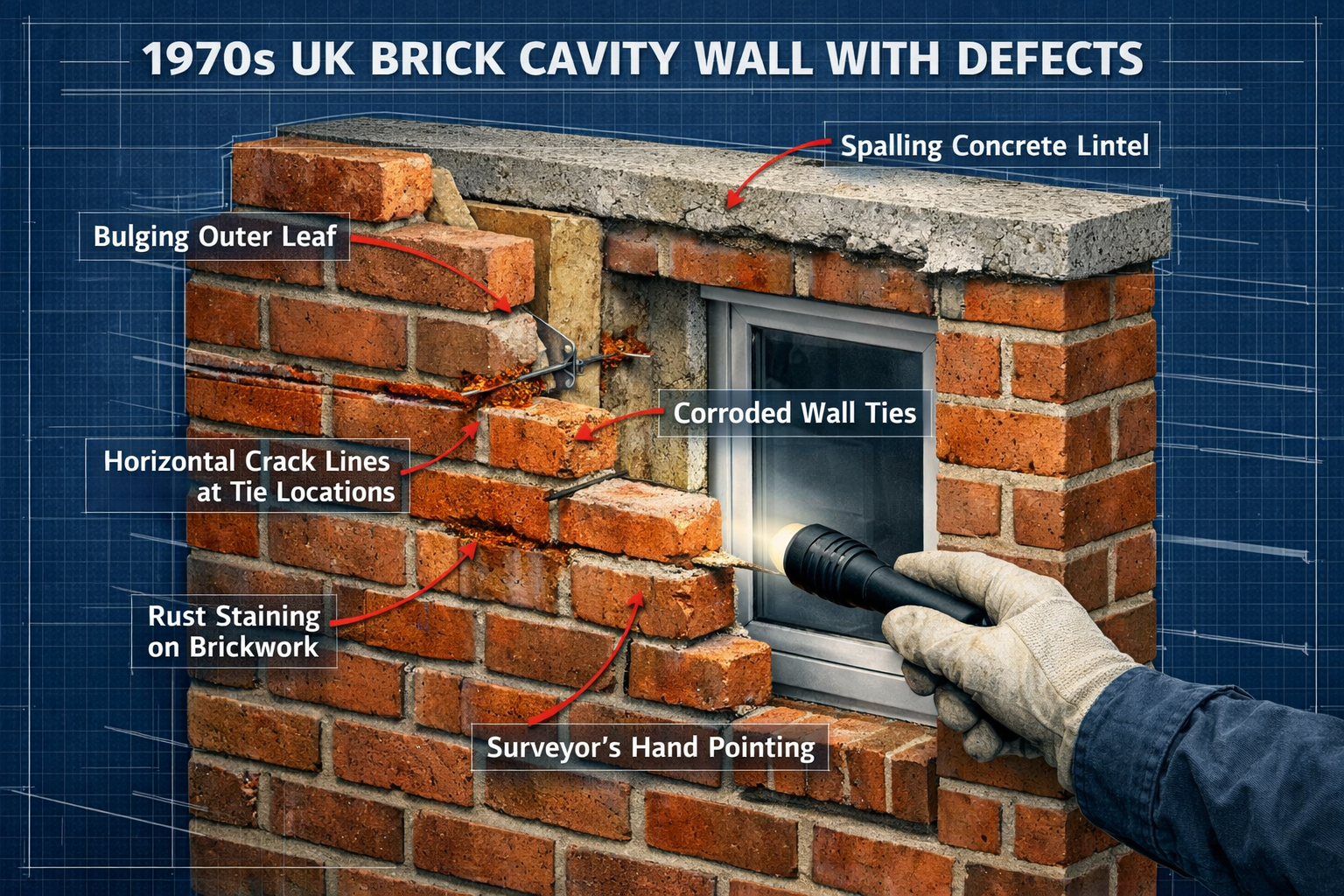
What it is: Metal ties connecting the inner and outer wall leaves corrode over time, causing the outer leaf to separate, bulge, and — in severe cases — collapse [6].
Visual signs:
- Horizontal cracking at regular intervals (following tie spacing)
- Rust staining on external brickwork
- Visible bulging of the outer wall
Remediation cost: £3,000–£12,000 depending on extent
Level 3 checklist action: Surveyor should use a borescope camera to inspect cavity ties directly.
2. 🏗️ Concrete Cancer (Carbonation & Reinforcement Corrosion)
What it is: Carbon dioxide penetrates concrete over decades, enabling steel reinforcement to corrode. The expanding rust causes cracking and spalling — a process known as "concrete cancer" [6].
Common in: Flat-roofed 1960s–1970s blocks, concrete-framed homes, and garages.
Remediation cost: £5,000–£30,000 depending on severity [6]
Level 3 checklist action: Look for map cracking, rust staining, and surface spalling on any exposed concrete elements.
3. 🪵 Trussed Rafter Roof Instability
What it is: 1960s–1970s trussed rafter roofs commonly suffer from lateral (sideways) bending — sometimes called an "S-bend" — in rafter members. This occurs because UK builders did not adopt the plywood deck stabilisation method used in US construction [1].
Visual signs:
- Uneven overhang at gable ends
- Sagging or wavy roof line visible from street level
- Cracked or displaced ridge tiles
Level 3 checklist action: Full roof space access and inspection is mandatory. Any modification to truss members without structural engineer sign-off is a red flag. Learn more about what roof surveyors look for during a detailed inspection.
4. 💧 Rising Damp & Failed Damp-Proof Membranes
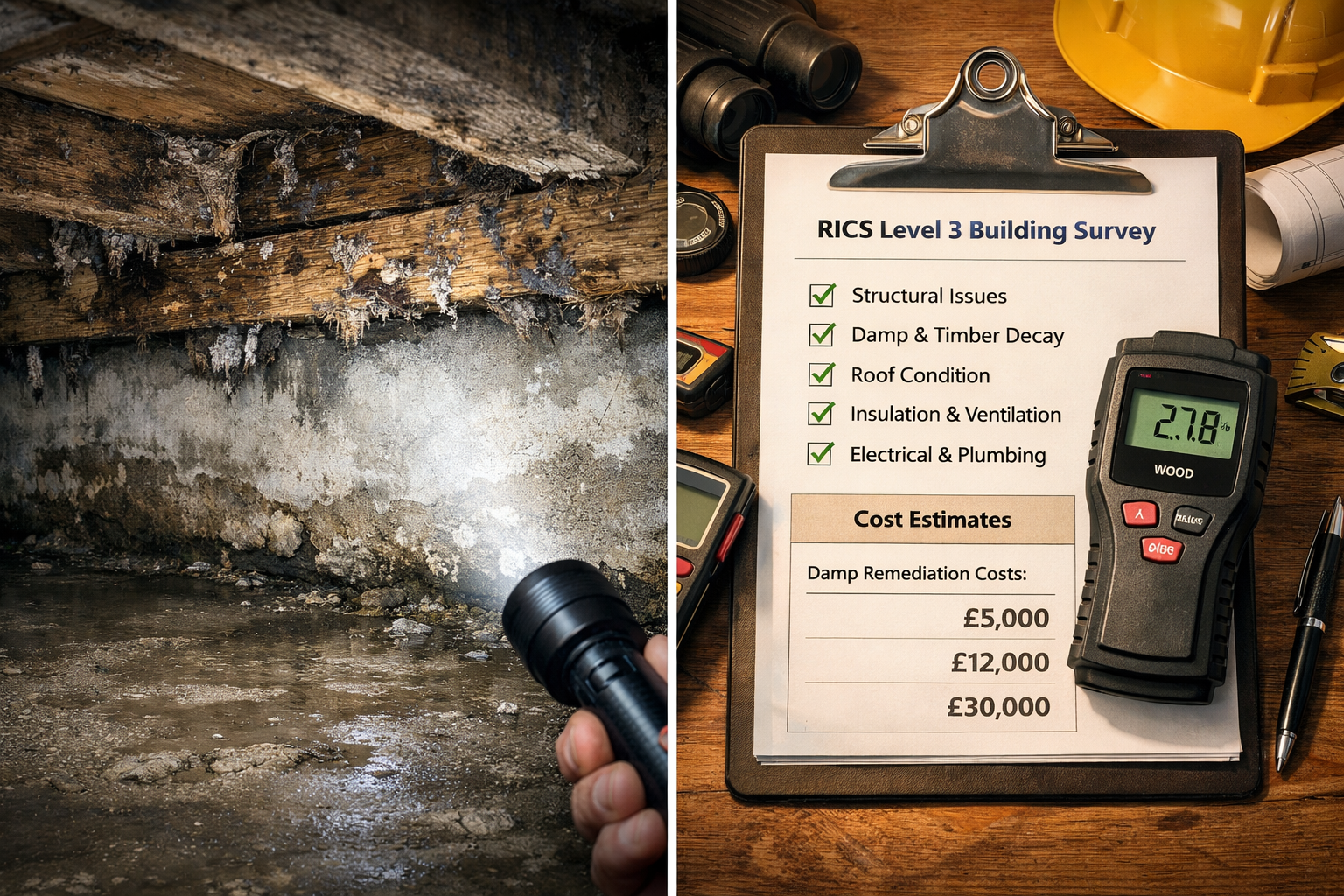
What it is: Many homes built in the late 1950s and 1960s were constructed without effective damp-proof membranes (DPMs). Solid concrete ground floors in this era wick moisture upward into walls [5].
Visual signs:
- Tide marks on lower walls
- Peeling plaster or wallpaper at skirting level
- Musty odour in ground floor rooms
Remediation cost: £2,000–£8,000 for chemical DPC injection and replastering
Level 3 checklist action: Moisture meter readings at multiple points across ground floor walls; check for bridging of existing DPC by raised external ground levels.
5. 🪨 Heaving & Settlement in Solid Concrete Ground Floors
What it is: Early 1960s solid concrete slabs were often laid over poorly compacted hardcore — sometimes using waste materials from power generation and mining industries. These materials react with moisture and sulphates, causing the slab to heave or settle unevenly [1].
Visual signs:
- Uneven or cracked floor surfaces
- Doors and windows sticking at ground floor level
- Gaps between skirting boards and floor
Remediation cost: £8,000–£25,000 for full slab replacement
Level 3 checklist action: Check for sulphate attack in floor screeds; request any available building history documentation.
6. 🔩 Steel Lintel Corrosion
What it is: Poorly protected steel angles used as lintels corrode and expand, causing cracking in exterior walls. "Boot lintels" — common in 1970s–1980s cavity wall construction — can rotate under eccentric loading if construction was not carefully executed [1].
Visual signs:
- Diagonal cracks radiating from window and door corners
- Rust staining directly above openings
- Visible deflection of the lintel
Level 3 checklist action: Probe mortar joints above all openings; note any cracking pattern consistent with lintel rotation or corrosion expansion.
7. 🌿 Poorly Ventilated Cavity Walls & Timber Decay
What it is: Ventilation openings in cavity walls are often sealed or blocked — either accidentally or during retrofitted insulation works. This traps moisture, leading to condensation within the cavity [2]. Wooden floor beams bearing into damp cavities can rot or develop fungal growth.
Visual signs:
- Blocked or missing weep holes in external brickwork
- Evidence of condensation on internal walls
- Soft or springy timber floors near external walls
Level 3 checklist action: Check all weep holes and air bricks; inspect accessible floor void with a torch for signs of rot or fungal growth. Understanding EPC ratings and MEES compliance is also relevant here, as cavity wall insulation upgrades can inadvertently create moisture problems if not properly specified.
8. 🏠 Age-Expired Roof Coverings
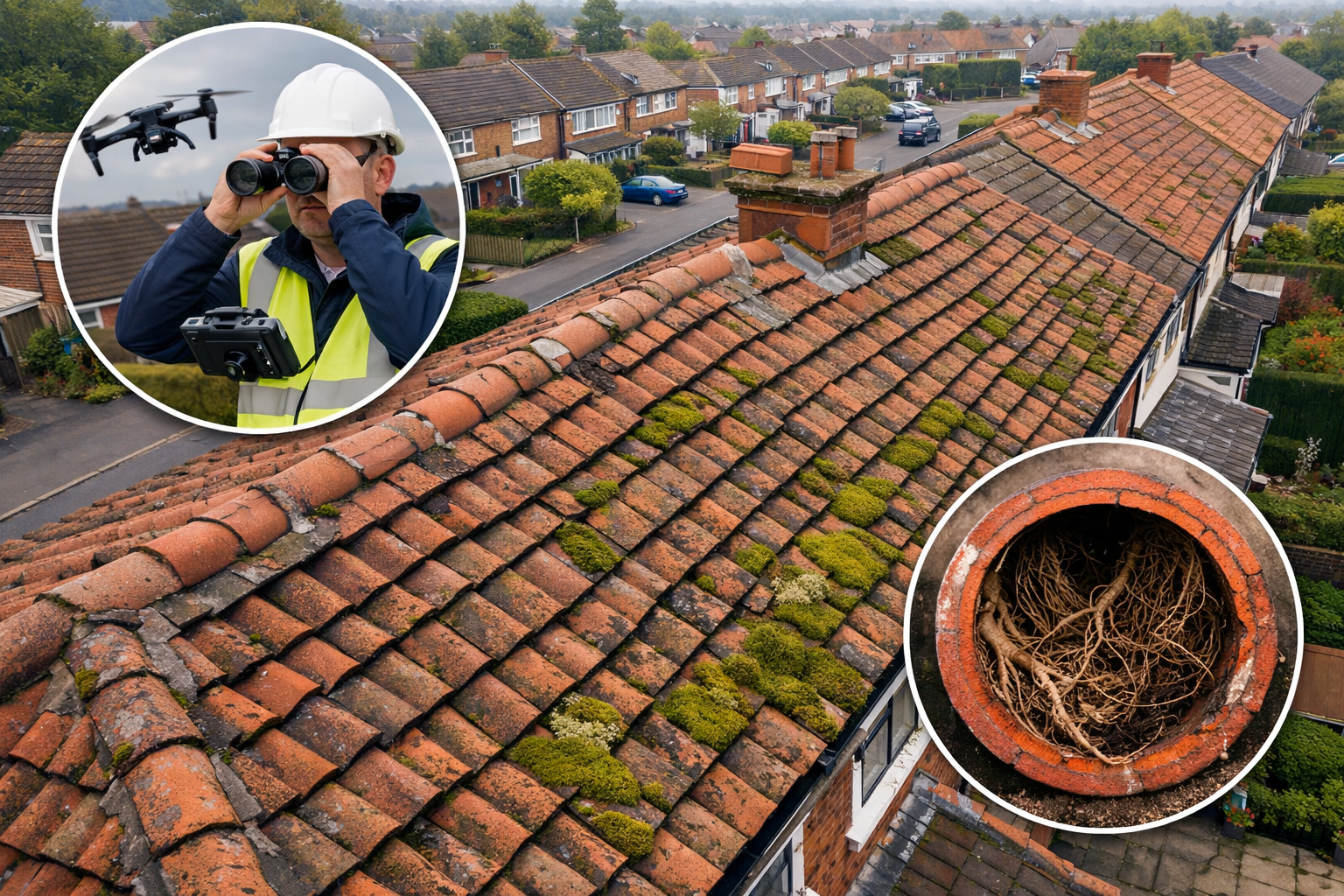
What it is: Many 1970s–1980s properties had roof coverings with a design life of 25–30 years. Most of these coverings reached end-of-life between 2005 and 2010 [5]. In 2026, a roof that has not been replaced is likely to be well beyond its serviceable life.
Visual signs:
- Missing, cracked, or slipped tiles/slates
- Moss and lichen growth indicating moisture retention
- Sagging felt visible in roof space
Remediation cost: £6,000–£18,000 for full re-roofing
Level 3 checklist action: Binocular inspection from ground level plus full roof void inspection. Flat roofs on extensions deserve particular attention — see common flat roof types and issues for what to look for.
9. 🚽 Deteriorating Vitrified Clay Pipe Sewer Systems
What it is: Vitrified clay pipes — standard in homes built before the 1980s — are brittle and susceptible to root intrusion, ground movement, and joint failure. Collapsed or blocked drains can cause subsidence and damp ingress at foundation level [3].
Visual signs:
- Slow drainage throughout the property
- Damp patches at low-level walls near drain runs
- Sunken or soft ground above drain lines
Remediation cost: £1,500–£10,000 depending on access and extent
Level 3 checklist action: CCTV drain survey strongly recommended as an additional instruction alongside the building survey.
10. 🧊 Asbestos-Containing Materials (ACMs)
What it is: Asbestos was widely used in UK construction until its full ban in 1999. Properties built or refurbished between 1960 and 1999 may contain ACMs in floor tiles, ceiling tiles, pipe lagging, roof sheets, and textured coatings (such as Artex) [8].
Visual signs:
- Textured ceilings in pre-1990 homes
- Corrugated roof sheets on outbuildings
- Pipe lagging in boiler rooms or roof spaces
Remediation cost: £500–£5,000+ for professional removal
Level 3 checklist action: Surveyor should flag suspected ACMs; specialist asbestos survey recommended before any renovation works.
Level 3 Survey Checklist: Quick-Reference Table
| # | Defect | Era Most Common | Estimated Repair Cost | Survey Action |
|---|---|---|---|---|
| 1 | Cavity wall tie failure | 1960s–1980s | £3,000–£12,000 | Borescope inspection |
| 2 | Concrete cancer | 1960s–1970s | £5,000–£30,000 | Visual + tap test |
| 3 | Trussed rafter instability | 1960s–1970s | £2,000–£8,000 | Roof void access |
| 4 | Rising damp | 1950s–1960s | £2,000–£8,000 | Moisture meter survey |
| 5 | Floor slab heave/settlement | 1960s | £8,000–£25,000 | Floor level check |
| 6 | Steel lintel corrosion | 1970s–1980s | £500–£3,000 per opening | Crack pattern analysis |
| 7 | Cavity ventilation/timber decay | 1970s–1990s | £1,500–£6,000 | Void inspection |
| 8 | Age-expired roof covering | 1970s–1980s | £6,000–£18,000 | Binocular + void inspection |
| 9 | Clay pipe drain failure | Pre-1980s | £1,500–£10,000 | CCTV drain survey |
| 10 | Asbestos-containing materials | Pre-1999 | £500–£5,000+ | Flag for specialist survey |
How Spring 2026 Buyers Should Use This Checklist
Commission the Right Survey First
For any property built between 1960 and 1990, a Level 3 Full Building Survey is the appropriate instruction — not a Level 2 HomeBuyer Report. The Level 3 format requires the surveyor to investigate concealed areas, comment on construction methods, and provide detailed repair recommendations. Understanding the full difference between a building survey and a homebuyer survey helps buyers make the right call from the outset.
Use Survey Findings to Negotiate
Survey findings are not just a risk register — they are a negotiating tool. Research consistently shows that buyers who commission surveys achieve meaningful price reductions after survey, often recovering the survey cost many times over. In a spring 2026 market where sellers are motivated, a well-documented defect schedule gives buyers genuine leverage.
Understand the Consequences of Not Acting
Proceeding without a survey — or ignoring its findings — carries serious financial risk. The consequences of failing to act on survey findings can include unexpected repair bills running into tens of thousands of pounds, difficulties reselling, and complications with buildings insurance.
💬 "The cost of a Level 3 survey is typically less than 0.2% of a property's purchase price — yet it can reveal defects worth 5–15% of that same price."
Conclusion: Protect Your Spring 2026 Purchase With the Right Checklist
The 10 Common Structural Defects in 1960s-1990s UK Homes: Level 3 Building Survey Checklists for Spring 2026 Buyers outlined in this guide represent the most financially significant risks in a housing era that still dominates the UK market. From corroded cavity wall ties to asbestos-containing materials and age-expired roof coverings, these defects share one common trait: they are invisible to the untrained eye but entirely detectable by a qualified chartered surveyor.
✅ Actionable Next Steps for Spring 2026 Buyers
- Instruct a RICS-regulated chartered surveyor for a Level 3 Building Survey on any 1960–1990 property.
- Request CCTV drain survey as an additional instruction — drainage defects are rarely included in standard surveys.
- Use the defect table above as a pre-survey briefing document to discuss specific concerns with your surveyor.
- Budget a contingency of 5–10% of the purchase price for remediation works on post-war stock.
- Never proceed on a mortgage valuation alone — valuations are for lenders, not buyers.
- Review EPC and insulation history carefully; retrofitted cavity wall insulation without proper specification can create new defects.
The spring 2026 market rewards prepared buyers. A thorough Level 3 survey is not an obstacle to purchase — it is the foundation of a sound investment.
References
[1] Defects Decade – localsurveyorsdirect.co.uk
[2] Structural Defects In Homes Built In The 1960s And 1970s – vkmakelaars.nl
[3] Building Survey Defects In 1960s 1980s Housing Stock Identifying Hidden Issues Before Purchase – nottinghillsurveyors.com
[4] Common Problems With Houses Built Between 1940 1960 – aboveboardbuildinginspections.com
[5] The Bestworst Quality Homes – blog.simmondscarpentry.co.uk
[6] Common Structural Issues Uk Homes Guide – homemove.com
[7] Common Structural Issues In Older Buildings How To Address Them – as-structuraleng.co.uk
[8] Housing Defects By Decade – brianmedia.co.uk
How Prince Surveyors can help: explore our Level 3 building surveys or learn about our Level 2 vs Level 3 guide.