

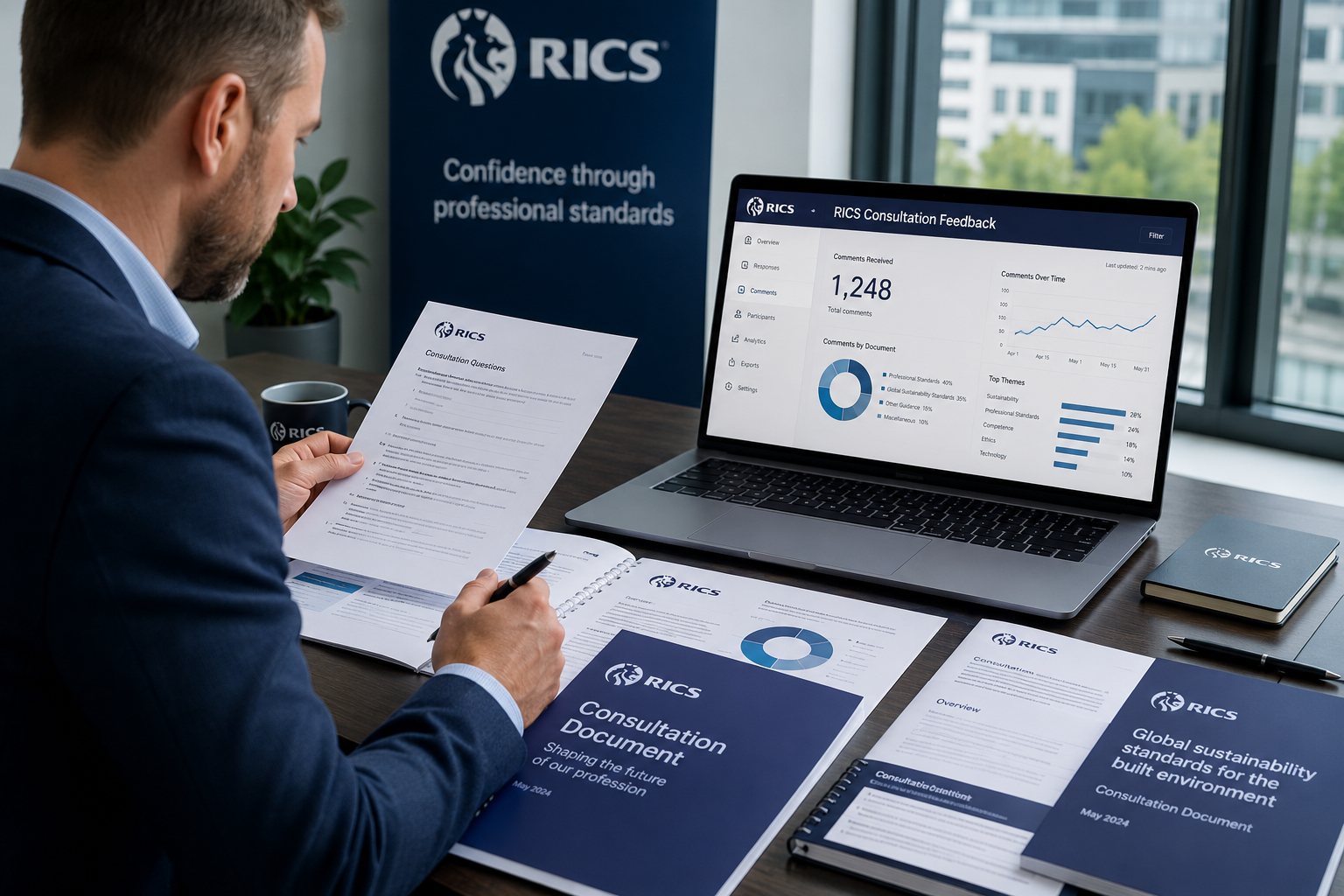
Over 1,400 homeowners and 325 RICS members provided feedback that is now actively reshaping how residential surveys are conducted, reported, and understood across England, Wales, and beyond. That scale of stakeholder input signals something important: the gap between what consumers expect from a building survey and what professionals currently deliver has grown wide enough to demand formal correction. The result is the second edition of the RICS Home Survey Standard, a document that addresses not only professional conduct but also the growing role of technology in property inspection. This article unpacks the RICS Home Survey Standards 2026: Technological Clarifications and Consumer Insights for Building Surveyors — examining what has changed, why it matters, and what building surveyors must do to stay ahead.
Key Takeaways
- RICS analysed more than 1,000 consultation responses to develop the second edition of the Home Survey Standard, with publication expected in 2026 [1]
- A new global RICS standard for the responsible use of AI in surveying became effective from 9 March 2026, directly influencing how technology is used during inspections [2]
- Consumer surveys involving over 1,400 homeowners revealed significant confusion about survey levels, prompting clearer definitions in the revised standard [3]
- The updated standard introduces explicit guidance on service checks, including operational verification of utilities such as gas connections [3]
- RICS is aligning the revised standard with UK government proposals for upfront property information, integrating professional surveyor advice into the home-buying reform agenda [1]
What the Consultation Process Revealed About the Current Standard
The public consultation ran from 19 August to 14 October 2025, inviting feedback from RICS members, firms, and wider property transaction stakeholders [4]. The volume and detail of responses — more than 1,000 individual comments — confirmed that the first edition of the Home Survey Standard, while a significant step forward, left meaningful gaps in clarity and consumer communication [1].
The Expert Group overseeing the revision, which now includes Giles Smith of SDL, has been working through this feedback systematically. Their task is not simply to update language but to fundamentally improve how the standard serves both the professional and the public [1].
Three recurring themes emerged from the consultation:
- Consumers could not reliably distinguish between survey levels before commissioning a survey
- Professionals lacked consistent guidance on how and when to incorporate new technology into inspections
- Reporting formats varied too widely, reducing the usefulness of survey outputs for decision-making
These findings align closely with what experienced practitioners have observed on the ground. For those working across building survey services, the lack of standardised consumer communication has long been a practical challenge, particularly when clients arrive at an inspection without understanding what they have commissioned.
"The second edition aims to clarify the purpose and scope of surveys, ensuring consumers are well-informed about the services they receive." — RICS Property Journal [5]
Clarifying Survey Levels: What the Revised Standard Proposes
One of the most significant structural changes in the revised RICS Home Survey Standard is the clearer delineation between survey levels. The updated framework uses three tiers — basic, intermediate, and advanced — with detailed descriptions of inspection scope and reporting requirements for each [3].
Why Level Clarity Matters for Consumers
The consumer survey data is unambiguous: homeowners frequently selected the wrong survey level for their property type, often choosing a lower-tier product for older or more complex buildings. This mismatch led to under-informed purchase decisions and, in some cases, costly post-purchase surprises.
The revised standard addresses this by:
- Providing plain-language descriptions of what each level covers
- Specifying which property types are appropriate for each level
- Requiring surveyors to advise clients on level suitability before accepting instructions
For buyers considering an older or non-standard property, understanding the difference between Level 2 and Level 3 surveys has never been more important. The revised standard reinforces this by making level guidance a formal professional obligation rather than an optional courtesy.
Service Checks: A New Area of Emphasis
Responding directly to consumer demand, the revised standard elaborates on service checks during inspections. It specifies that surveyors should perform operational checks — for example, verifying gas connections by operating gas hobs — to provide a clearer delineation between what each survey level covers [3].
| Survey Level | Service Check Requirement |
|---|---|
| Basic | Visual inspection only; no operational checks |
| Intermediate | Basic operational checks where safely accessible |
| Advanced | Full operational verification; documented findings |
This table illustrates the graduated approach. At the advanced level — equivalent to a Level 3 Full Building Survey — surveyors are expected to go beyond visual assessment and actively test services where safe and practicable to do so.
Technology Integration and AI Governance in the 2026 Standard
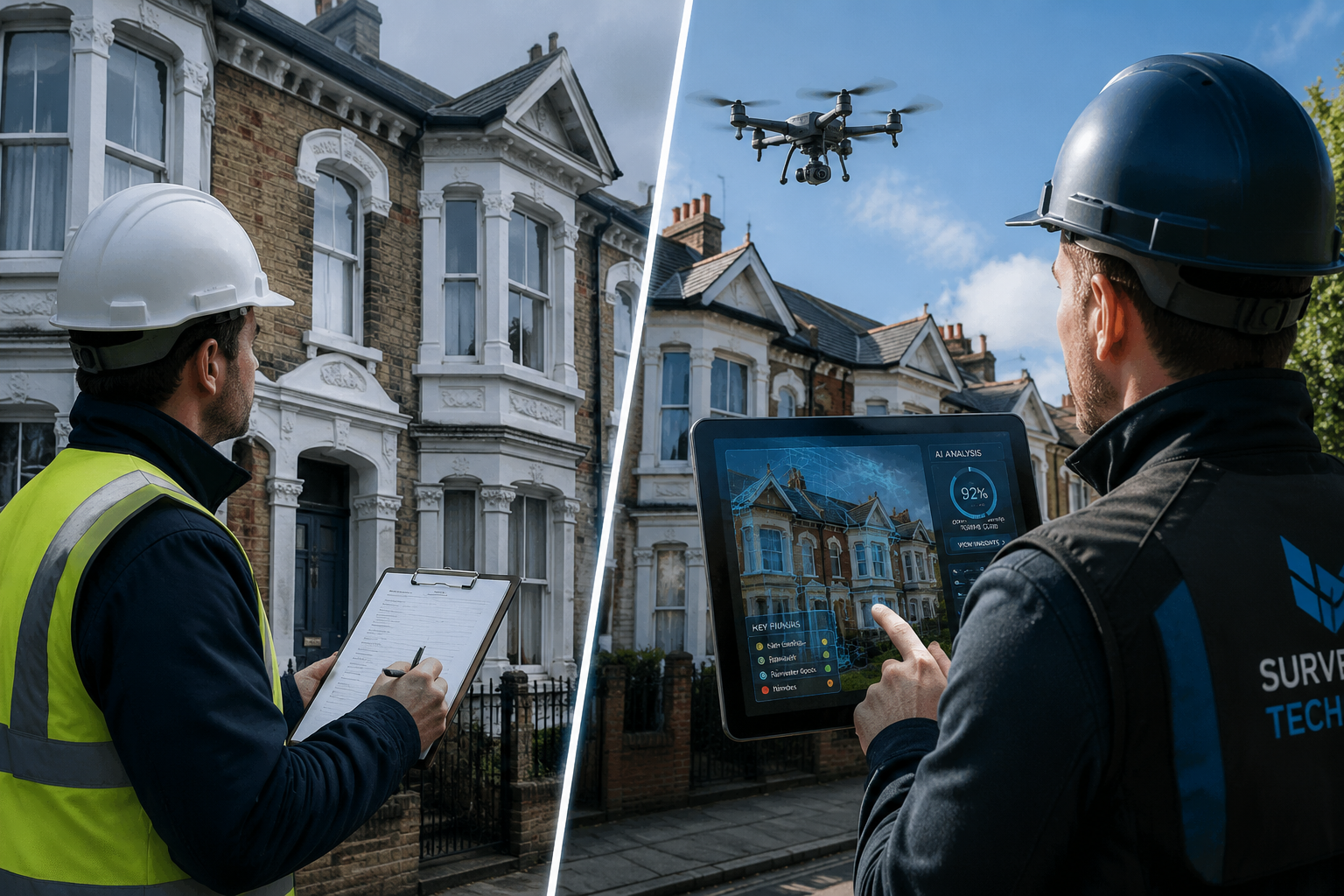
The most forward-looking aspect of the RICS Home Survey Standards 2026: Technological Clarifications and Consumer Insights for Building Surveyors is its treatment of technology. RICS launched a landmark global standard for the responsible use of artificial intelligence in surveying, effective from 9 March 2026 [2]. This standard does not exist in isolation — it feeds directly into how the revised Home Survey Standard addresses technological tools.
The New AI Standard: Core Requirements
The RICS AI standard mandates that firms operating in the surveying sector must establish:
- Clear data use policies — specifying what data AI tools can access and process during surveys
- AI system governance frameworks — defining accountability for AI-assisted outputs
- Risk management protocols — identifying and mitigating risks from AI errors or bias
- Professional judgment requirements — ensuring that AI tools support, not replace, qualified surveyor oversight [2]
This is a critical distinction. The standard does not prohibit AI; it regulates how AI is used to ensure professional accountability remains with the qualified surveyor. A drone-assisted roof inspection, for example, may generate automated defect-detection outputs, but the surveyor remains responsible for interpreting and reporting those findings.
Drones, AI Tools, and the Inspection Process
The revised Home Survey Standard considers the use of drones for inspections and AI tools for data analysis, providing guidance on their ethical and effective application [6]. This guidance is particularly relevant for surveyors working on properties where physical access to certain elements — steep roofs, high chimney stacks, inaccessible soffits — is impractical or unsafe.
Key technology applications now addressed in the standard include:
- Drone-based roof and elevation surveys
- Thermal imaging for moisture and heat loss detection
- AI-assisted defect recognition from photographic data
- Digital reporting platforms with structured condition ratings
For surveyors working on complex or historic properties, the ability to deploy technology responsibly — and to document that deployment within a compliant framework — is now a professional expectation rather than an optional enhancement. This is especially relevant when sourcing extra specialist advice for unusual defects identified through technology-assisted inspection.
Competence Obligations Remain Non-Negotiable
The revised standard reinforces a foundational principle: RICS members and firms must only accept instructions they are competent to carry out [1]. This applies equally to technology use. A surveyor who deploys a drone or AI tool without the necessary training to interpret its outputs is not compliant with the standard, regardless of the quality of the technology itself.
This competence requirement extends to understanding the limitations of technology. AI defect-recognition tools, for instance, may perform well on common defect types but struggle with unusual or context-specific conditions found in period properties. Surveyors must be able to identify when technology is insufficient and when additional specialist investigation is warranted.
Consumer Insights Driving the 2026 Revisions
The consumer research underpinning the RICS Home Survey Standards 2026: Technological Clarifications and Consumer Insights for Building Surveyors is unusually robust by industry standards. Surveys of over 1,400 homeowners provided granular data on how buyers and sellers perceive, use, and misunderstand home surveys [3].
What Homeowners Said They Needed
The research identified several consistent consumer pain points:
- Confusion about what surveys actually inspect — many homeowners assumed surveys covered legal title, planning history, and environmental risks as standard
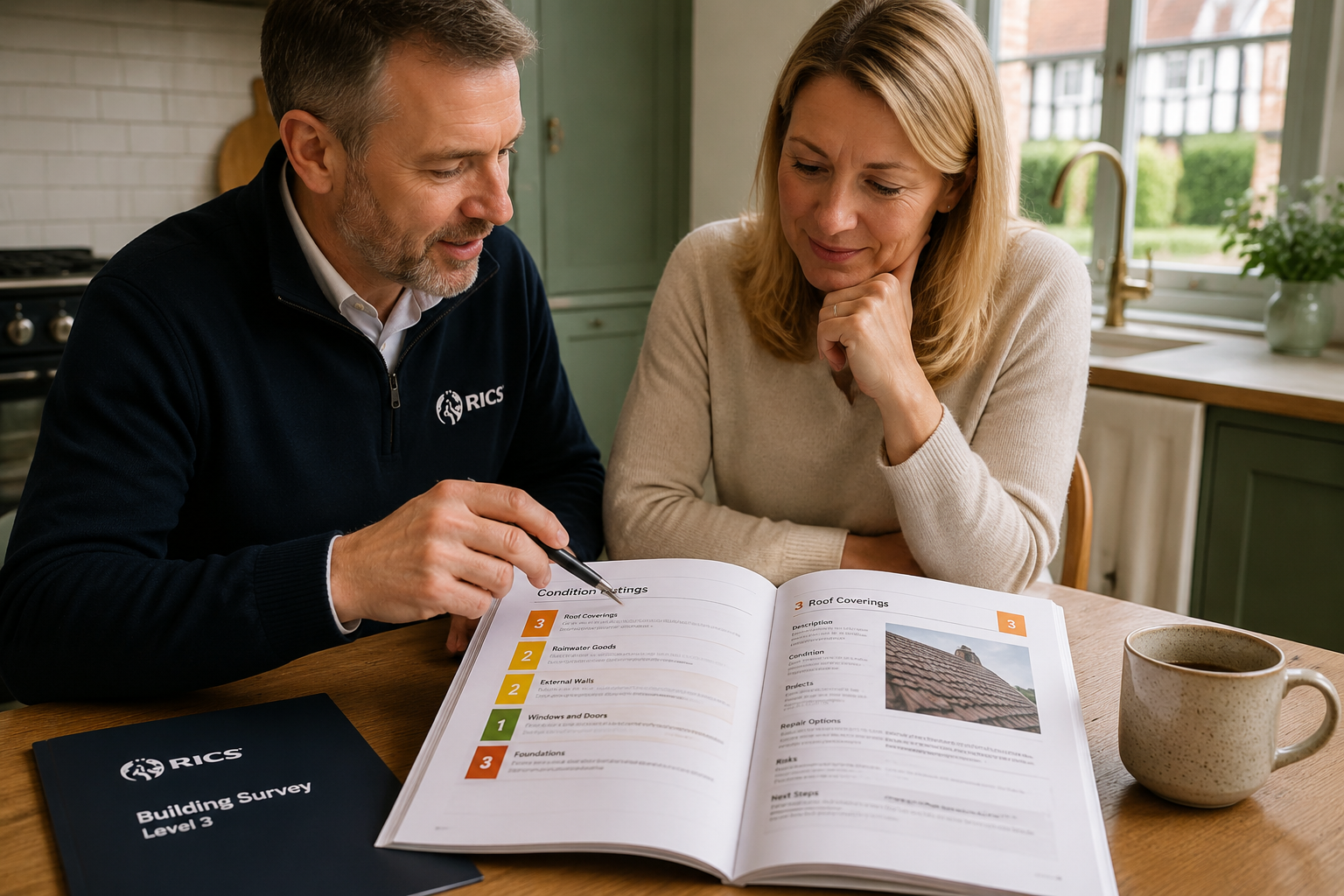
- Difficulty interpreting condition ratings — the traffic-light system used in current reports was not universally understood
- Uncertainty about next steps — consumers did not know how to act on survey findings, particularly regarding negotiation or specialist referral
These insights are directly shaping the reporting requirements in the second edition. The revised standard is expected to include clearer guidance on report structure, condition rating explanations, and recommended next steps for consumers [5].
For homeowners who receive a survey report identifying significant defects, knowing how to negotiate a house price down after a survey is a practical need that better-structured reports will help address.
Alignment with Government Upfront Information Reforms
RICS is actively engaging with UK government proposals to mandate upfront property information for purchasers [1]. These reforms aim to reduce transaction fall-through rates by ensuring buyers have access to material property information earlier in the process.
The revised Home Survey Standard positions professional surveyor advice as a central component of this upfront information ecosystem. Rather than surveys being commissioned reactively — after an offer has been accepted — the reformed framework envisions surveyor input as part of a more structured, transparent transaction process.
This alignment with government policy gives the revised standard additional weight. Building surveyors who understand and operate within this broader reform context will be better positioned to advise clients, particularly in active markets where transaction speed is a competitive factor.
Environmental and Planning Considerations
Consumer feedback also highlighted a desire for clearer information on environmental risks and planning constraints. The revised standard acknowledges that while these areas fall outside the core inspection scope for basic and intermediate surveys, advanced surveys should signpost relevant environmental issues and planning considerations where they are apparent during inspection [3].
For surveyors working on properties with potential environmental issues or complex planning histories, the revised standard provides clearer guidance on when and how to flag these matters within the survey report.
What Building Surveyors Must Do Now
The transition to the second edition of the Home Survey Standard is not simply an administrative update. It represents a meaningful shift in professional expectations across three dimensions: technology governance, consumer communication, and service scope definition.
Immediate actions for building surveyors in 2026:
- Review AI and technology use policies — ensure any AI tools or drone equipment used in inspections are governed by documented policies that comply with the new RICS AI standard [2]
- Audit client communication processes — verify that pre-instruction communications clearly explain survey level options and suitability for the property type in question
- Update service check procedures — align operational check protocols with the graduated requirements set out in the revised standard [3]
- Invest in competence development — complete relevant CPD on technology-assisted inspection methods before deploying new tools on client instructions [1]
- Engage with RICS updates — monitor RICS communications for the confirmed publication date and implementation timeline for the second edition
Surveyors operating across London, Surrey, and the South East should also be aware that local market conditions — including high transaction volumes, a significant proportion of period properties, and active buyer competition — make survey quality and clarity particularly important. Resources such as the complete review of building surveying in London provide useful context for practitioners operating in these markets.
Conclusion
The second edition of the RICS Home Survey Standard, informed by the largest stakeholder consultation in its history, marks a turning point for residential surveying in the United Kingdom. The RICS Home Survey Standards 2026: Technological Clarifications and Consumer Insights for Building Surveyors framework addresses three interconnected challenges: the need for clearer survey level definitions, the responsible integration of AI and technology into inspection practice, and the imperative to communicate survey findings in ways that genuinely serve consumer decision-making.
For building surveyors, the path forward is clear. Competence in technology use must be demonstrable and documented. Consumer communication must be proactive and plain-language. Service checks must follow the graduated framework now being formalised in the standard. And professional judgment — the irreplaceable human element — must remain at the centre of every inspection, regardless of the tools deployed.
Actionable next steps:
- Download and review the RICS AI standard (effective March 2026) and assess your firm's current compliance position
- Update your pre-instruction client communication templates to reflect the revised survey level descriptions
- Identify any technology tools currently in use that require formal governance documentation
- Monitor the RICS website for the confirmed publication date of the Home Survey Standard second edition
- Consider whether your current CPD portfolio adequately covers technology-assisted inspection methods
The surveyors who engage with these changes early — not as compliance obligations but as professional opportunities — will be best placed to serve clients well in a market that is changing faster than any previous generation of practitioners has experienced.
References
[1] Home Survey Standard 2nd Edition April 2026 Update – https://www.rics.org/news-insights/home-survey-standard-2nd-edition-april-2026-update?utm_source=openai
[2] RICS Launches Landmark Global Standard On Responsible Use Of AI In Surveying – https://www.rics.org/news-insights/rics-launches-landmark-global-standard-on-responsible-use-of-ai-in-surveying?utm_source=openai
[3] Understanding The RICS Home Survey Standard Proposal – https://www.rics.org/news-insights/understanding-the-rics-home-survey-standard-proposal?utm_source=openai
[4] RICS Launches Consultation Updated Home Survey Standard – https://www.rics.org/news-insights/rics-launches-consultation-updated-home-survey-standard?utm_source=openai
[5] The New Home Survey Standard – https://ww3.rics.org/uk/en/journals/property-journal/the-new-home-survey-standard.html?utm_source=openai
[6] Home Survey Standards – https://www.rics.org/profession-standards/rics-standards-and-guidance/sector-standards/building-surveying-standards/home-surveys/home-survey-standards?utm_source=openai