

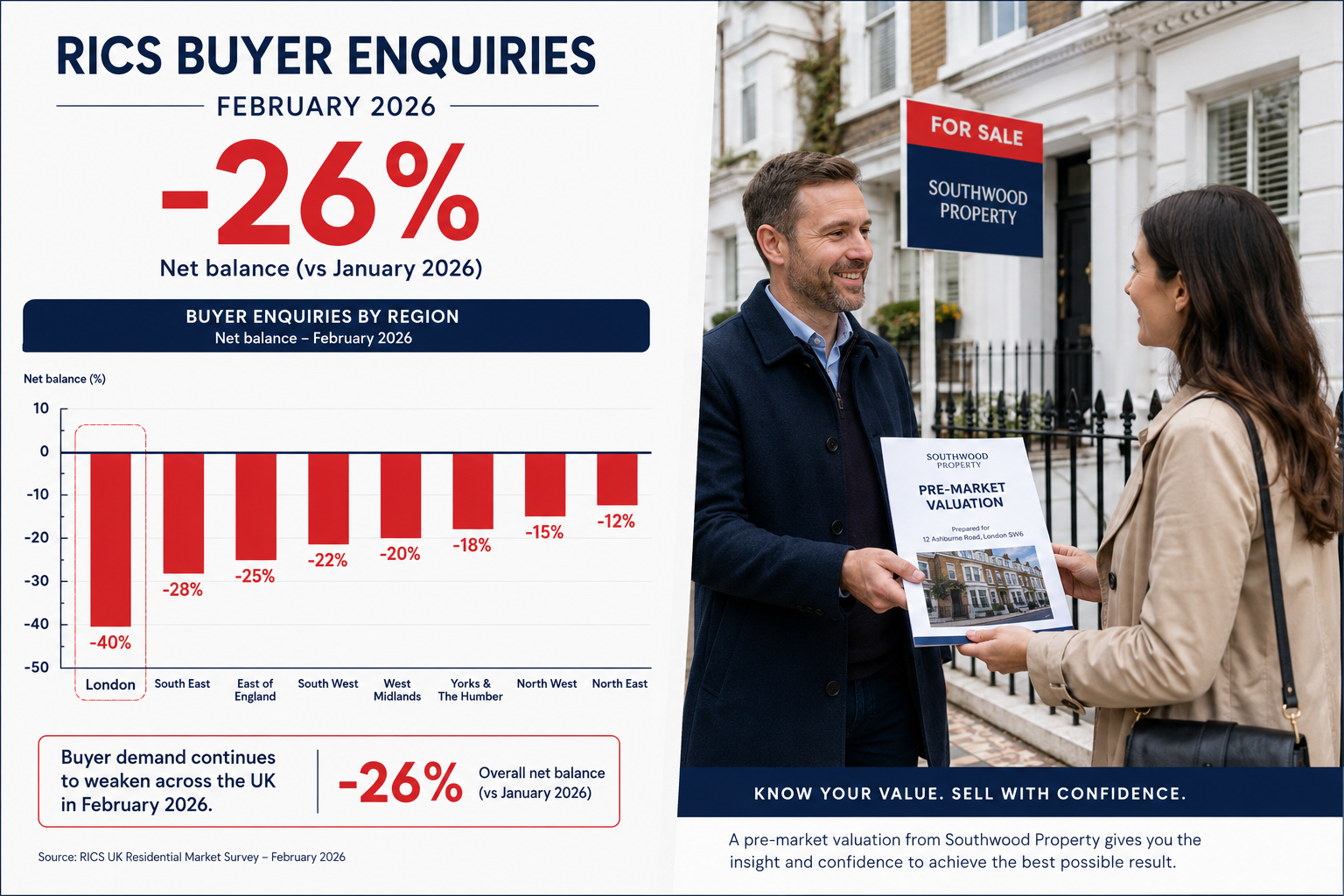
New buyer enquiries in the UK residential market collapsed to a net balance of -26% in February 2026, down sharply from -15% in January — the steepest single-month deterioration recorded in recent RICS survey cycles [1]. For sellers, estate agents, and chartered surveyors watching transaction pipelines stall, that number demands a direct response. Upfront Valuation Surveys for Transaction Certainty: Countering February 2026 RICS Slump with Seller-Led Insights is not simply a reactive strategy — it is a structural shift in how properties are brought to market, one that places verified, independent data at the front of the sales process rather than at the back.
Key Takeaways
- February 2026 RICS data shows buyer enquiries fell to -26% and agreed sales slipped to -12%, confirming a market under significant demand pressure.
- London recorded a regional price balance of -40%, while Northern Ireland, Scotland, and the North West held positive territory, making regional valuation precision critical.
- Upfront seller-led valuation surveys reduce renegotiation risk, shorten transaction timelines, and rebuild buyer confidence in uncertain conditions.
- A Level 3 building survey combined with a formal pre-market valuation delivers the most comprehensive evidence base for pricing decisions.
- Chartered surveyors who adapt their methodologies to reflect geopolitical volatility and regional divergences are best positioned to defend valuations under dispute.
Understanding the February 2026 RICS Slump and Its Transaction Impact
The February 2026 RICS Residential Market Survey painted a picture of a market losing momentum across multiple indicators simultaneously. Agreed sales edged lower to -12%, compared to -9% in January [1]. Short-term price expectations weakened to a net balance of -18%, down from -6% just one month earlier [2]. These are not isolated data points — they represent a compounding cycle of caution that feeds on itself.
What is driving the slump?
Geopolitical instability has played a measurable role. The escalation of conflict in the Middle East contributed to decreased buyer confidence, with concerns mounting over energy prices and the trajectory of mortgage rates [3]. When buyers face uncertainty about borrowing costs, their willingness to commit to a purchase — particularly at the asking price — diminishes sharply.
Regional divergences compound the challenge. London recorded a net price balance of -40%, reflecting acute pressure in the capital's already stretched affordability environment [2]. By contrast, Northern Ireland, Scotland, and the North West reported rising prices, underscoring that the UK market is not one market but many. A seller in Manchester faces a fundamentally different pricing environment than one in Kensington.
"Market confidence remains fragile, and the combination of geopolitical uncertainty and macroeconomic factors has created a cautious outlook that is unlikely to resolve quickly." [8]
The rental sector adds further context. While tenant demand held a modest net balance of +2%, new landlord instructions were deeply negative at -27% [4]. This supply squeeze in rental stock is pushing some prospective buyers back toward purchasing — but only where they can find transparent, trustworthy pricing signals.
The transaction certainty gap
When buyers cannot trust that an asking price reflects genuine market evidence, they delay, renegotiate, or withdraw. Fall-through rates rise. Chains collapse. The cost — financial and emotional — falls on all parties. This is precisely the gap that upfront valuation surveys are designed to close.
How Upfront Valuation Surveys for Transaction Certainty Counter the February 2026 RICS Slump
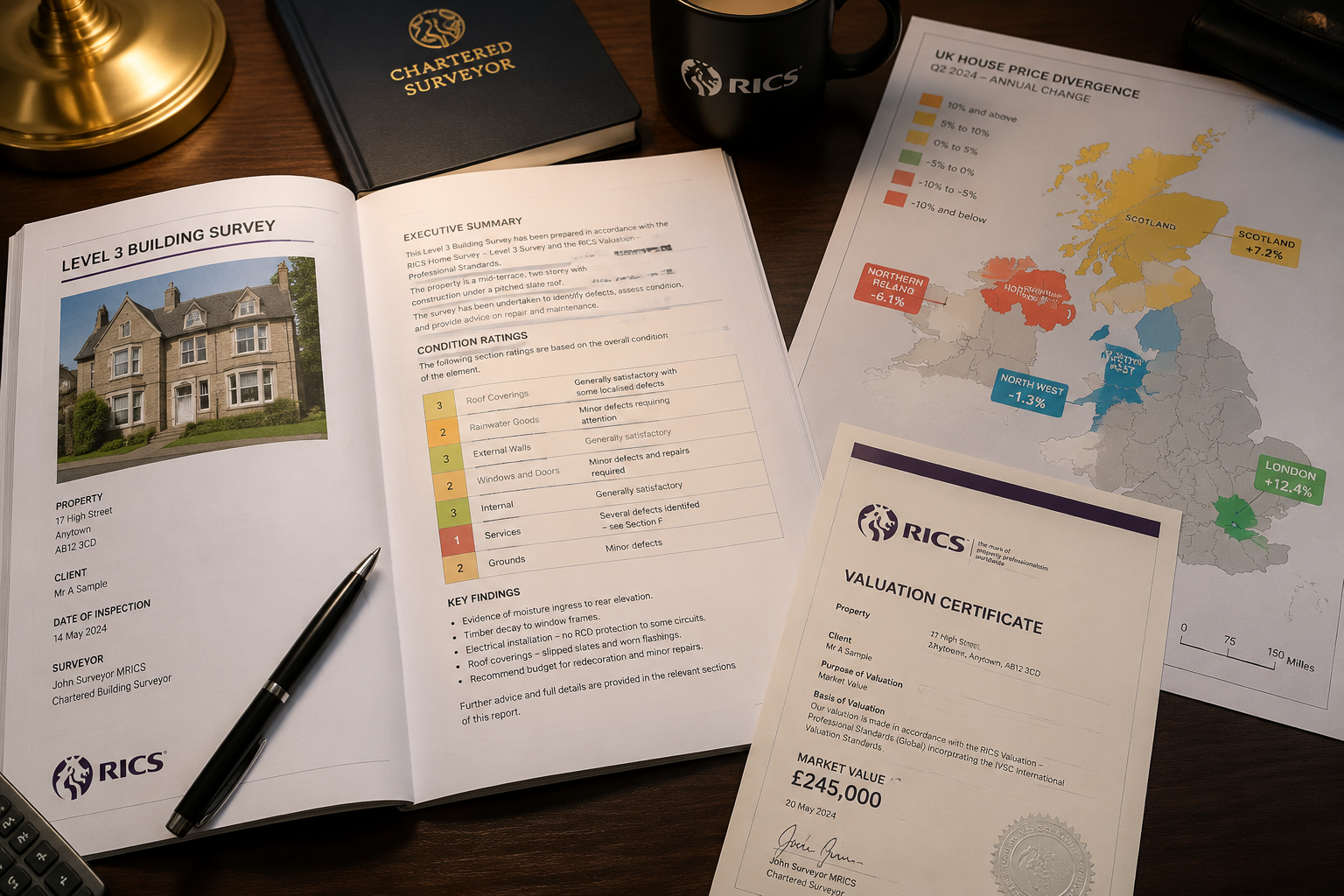
The core principle of seller-led upfront surveying is straightforward: commission an independent, RICS-compliant valuation and structural assessment before the property is listed, then make that evidence available to prospective buyers from day one. The effect on buyer confidence is significant and measurable.
What an Upfront Valuation Survey Includes
A robust pre-market valuation package typically combines two distinct but complementary elements:
| Element | Purpose | Output |
|---|---|---|
| Formal RICS Valuation | Establishes market value with comparable evidence | Written valuation report |
| Level 3 Building Survey | Identifies structural defects and condition issues | Condition and defect schedule |
| Environmental Assessment | Flags flood risk, contamination, subsidence | Risk summary |
| EPC and Compliance Check | Confirms energy performance and regulatory standing | EPC certificate |
Understanding what a Level 3 building survey covers is essential for sellers who want to present a complete evidence package. A Level 3 survey goes beyond surface-level inspection to assess structural integrity, roof condition, drainage, and any areas requiring further investigation — precisely the information a cautious February 2026 buyer needs before committing.
For sellers uncertain whether a Level 2 or Level 3 survey is appropriate for their property type, the difference between Level 2 and Level 3 surveys is an important starting point. Older properties, those with extensions, or homes with visible defects almost always warrant the more comprehensive Level 3 assessment.
Why Buyers Respond to Seller-Commissioned Evidence
In a falling-confidence market, information asymmetry is the enemy of transactions. When a buyer suspects that a seller knows something they do not — a hidden defect, an inflated asking price, a pending planning issue — they protect themselves through aggressive renegotiation or withdrawal. Upfront surveys eliminate that asymmetry.
Surveyors adapting their valuation methodologies to account for heightened volatility and regional price divergences have found that pre-market valuations carry greater weight with buyers when they explicitly address local comparable evidence [5]. A valuation that references specific comparable sales within a defined radius, adjusted for current market sentiment, is far harder to challenge than a figure derived from automated tools or estate agent appraisal alone.
The sharp decline in buyer enquiries has also led to an increase in valuation disputes, making robust documentation essential [6]. A formally commissioned RICS valuation provides the evidential foundation needed to defend a price if a buyer's surveyor returns a lower figure — a scenario that has become increasingly common in the current climate.
The Role of Building Pathology in Price Justification
One of the most effective seller-led strategies involves commissioning a building pathology assessment alongside the valuation. This specialist investigation identifies the root causes of defects rather than simply noting their existence. When a seller can demonstrate that a crack in a wall is the result of minor thermal movement rather than subsidence, the buyer's risk perception changes dramatically — and so does their willingness to proceed at the agreed price.
Similarly, identifying areas of further investigation before listing allows sellers to either address issues proactively or price them in transparently. Either approach is preferable to a buyer discovering problems mid-transaction and using them as leverage for a late-stage reduction.
Practical Strategies for Chartered Surveyors Delivering Pre-Market Valuations

Chartered surveyors are uniquely positioned to lead the shift toward upfront seller-led insights. The February 2026 data creates both the urgency and the commercial case for this service evolution. The following strategies reflect best practice for surveyors operating in the current environment.
Calibrating Valuations for Regional Divergence
The -40% price balance recorded in London versus positive readings in Northern Ireland, Scotland, and the North West [2] means that a single national methodology is inadequate. Surveyors must apply regionally calibrated comparable evidence, weighting recent sales more heavily than historical averages in rapidly shifting markets.
Key calibration steps include:
- Tightening the comparable search radius in volatile urban markets to ensure relevance
- Applying time adjustments to comparables older than three months given the pace of sentiment change
- Documenting market conditions explicitly within the valuation report so that buyers and their advisors understand the evidential basis
- Flagging regional supply constraints — particularly relevant given that new landlord instructions stood at -27% in February [4], which affects the investment buyer segment significantly
Integrating Environmental and Compliance Evidence
Buyers in uncertain markets scrutinise risk more carefully. A pre-market valuation that incorporates environmental risk factors — flood zones, ground contamination, proximity to industrial sites — addresses a common source of late-transaction anxiety. Similarly, confirming building regulation compliance for any extensions or alterations removes a frequent renegotiation trigger.
Energy performance is increasingly central to buyer decision-making. Understanding the relationship between EPC ratings and building survey findings helps surveyors present a coherent picture of a property's running costs and upgrade requirements — information that directly affects a buyer's affordability calculations in a high-interest-rate environment.
Structuring the Pre-Market Report for Maximum Buyer Impact
The format and presentation of an upfront valuation report matters as much as its content. Reports that are dense, technical, and poorly structured will not achieve the confidence-building effect that justifies the seller's investment. Best practice structuring includes:
- Executive summary — market value, key condition findings, and material risks on one page
- Valuation methodology section — comparable evidence table with addresses, sale dates, prices, and adjustments
- Condition schedule — traffic-light rating system for each element (structure, roof, services, drainage)
- Risk register — environmental, legal, and compliance flags with recommended actions
- Surveyor's declaration — RICS membership confirmation and professional indemnity statement
This structure mirrors the approach used in condition survey reports and gives buyers' solicitors and mortgage lenders a clear, navigable document that accelerates due diligence rather than prolonging it.
Addressing Valuation Disputes Proactively
The increase in valuation disputes noted in the wake of the February 2026 RICS data [6] reflects a market in which buyers' surveyors are applying greater caution to their own assessments. When a buyer's lender-instructed valuation comes in below the agreed purchase price, the transaction is at risk.
Sellers who hold an upfront RICS valuation are in a far stronger position to challenge a down-valuation. The pre-market report provides a contemporaneous, independently commissioned evidence base that can be presented to the lender or used in formal dispute resolution. Surveyors who understand what factors are examined during a property valuation can ensure their pre-market reports address precisely the criteria that lender valuers will apply, reducing the gap between seller and lender assessments.
Technology-Enhanced Inspection Methods
In a market where construction activity remains subdued [7] and access to specialist tradespeople for pre-sale remediation is constrained, surveyors who can deliver comprehensive inspections efficiently hold a competitive advantage. Drone survey technology enables detailed roof and upper-elevation inspections without scaffolding, reducing both cost and time — two factors that matter greatly to sellers preparing a property for market in a challenging environment.
The Commercial Case for Sellers: Return on Upfront Survey Investment
Sellers sometimes resist the upfront cost of commissioning a valuation and survey before listing. In a buoyant market, that resistance has some logic — buyers compete, prices hold, and surveys happen after offers are agreed. In February 2026's market, that logic is inverted.
The cost of not surveying upfront:
- Fall-throughs after survey typically cost sellers between £2,500 and £5,000 in abortive legal and survey fees, plus months of lost time
- Late-stage renegotiations — triggered by a buyer's survey finding defects the seller did not disclose — average reductions of 2-5% of the agreed price
- Extended time on market in a falling-sentiment environment increases the risk of further price deterioration
The return on upfront surveying:
- Reduced renegotiation risk by providing buyers with pre-verified condition information
- Faster transaction timelines because buyers' solicitors can work from existing survey evidence
- Stronger negotiating position if a down-valuation is challenged
- Differentiation in a crowded market where most properties offer no pre-market transparency
For sellers of commercial properties, commercial valuation services provide the same pre-market certainty benefits, with the added complexity of lease structures, yield analysis, and tenant covenant strength factored into the evidential package.
Conclusion
The February 2026 RICS data is unambiguous: buyer confidence has deteriorated sharply, regional price divergences have widened, and the conditions for transaction failure have rarely been more pronounced. Upfront Valuation Surveys for Transaction Certainty: Countering February 2026 RICS Slump with Seller-Led Insights represents the most direct and evidence-based response available to sellers, chartered surveyors, and property professionals operating in this environment.
Actionable next steps for sellers:
- Commission a Level 3 building survey and formal RICS valuation before listing, not after an offer is received
- Request that the surveyor explicitly addresses regional comparable evidence and current market sentiment within the valuation report
- Ensure environmental, compliance, and EPC findings are included in the pre-market evidence package
- Make the full survey pack available to serious buyers and their solicitors from the point of first viewing
Actionable next steps for chartered surveyors:
- Develop a structured pre-market valuation product that combines condition assessment, formal valuation, and risk register in a single, buyer-facing document
- Calibrate comparable evidence to reflect the regional divergences highlighted by the February 2026 RICS data
- Invest in technology-enhanced inspection methods — including drone surveys — to deliver comprehensive assessments efficiently
- Position upfront survey services actively with estate agent partners as a transaction-acceleration tool
The market will not wait for confidence to return on its own. Sellers and surveyors who act now — placing verified, independent evidence at the centre of the sales process — will be the ones who close transactions while others watch their pipelines stall.
References
[1] Rics Residential Market Survey February 2026 – retaileconomics.co.uk
[2] tradingeconomics – tradingeconomics.com
[3] Uk Home Buyer Sentiment Hit By Worries Stemming From Middle East Conflict Rics Says 4555940 – investing.com
[4] Rics Update On The Rental Market February 2026 – oakwoodpropertyservices.co.uk
[5] Valuation Strategies Amid Rics February 2026 Residential Survey Responding To Geopolitical Uncertainty And Buyer Sentiment Slump – manchestersurveyors.com
[6] Valuation Challenges From Rics February 2026 Survey Expert Witness Strategies For 26 Buyer Enquiry Dip Disputes – wimbledonsurveyors.com
[7] Construction Activity Remains Flat But Infrastructure Does The Heavy Lifting Says Rics Report 05 02 2026 – constructionnews.co.uk
[8] Market Confidence Remains Fragile Rics – housingview.co.uk