

Only 8% of UK buildings with public-facing functions are estimated to be fully compliant with current disability access requirements — a figure that places enormous pressure on surveyors, legal teams, and courts when disputes arise over retrofit costs and diminished property value. The intersection of accessibility law, building surveying, and expert witness practice has never been more consequential. In 2026, with tightened regulatory frameworks on both sides of the Atlantic and an increasingly litigious environment around disability access, the discipline of Accessibility and Future-Proofing in Expert Witness Reports: Valuing Retrofit Feasibility Under 2026 Regulations demands a rigorous, evidence-based methodology that can withstand cross-examination.
This article guides chartered surveyors and legal professionals through the core principles of quantifying accessibility defects for litigation, structuring costed retrofit plans, and producing diminution assessments that align with RICS standards and current regulatory expectations.
Key Takeaways
- Expert witnesses must now address both physical and digital accessibility defects, with 2026 regulations expanding the scope of retrofit feasibility assessments.
- Costed retrofit plans must be itemised, phased, and benchmarked against current market rates to withstand cross-examination.
- Diminution in value caused by accessibility non-compliance is a distinct head of loss requiring its own methodology within expert witness reports.
- Courts and tribunals expect expert witnesses to address "undue burden" defences with quantified evidence, not opinion alone.
- Future-proofing provisions — anticipating regulatory changes beyond 2026 — are increasingly expected in high-value and commercial property disputes.
Why Accessibility Has Become a Central Issue in Property Litigation
The Equality Act 2010 placed a duty on service providers and employers to make "reasonable adjustments" to physical premises. However, what constitutes "reasonable" has never been static. As 2026 regulations tighten the baseline for compliance — particularly in the public sector and healthcare — the gap between what a building currently provides and what it must provide is becoming a measurable, quantifiable liability.
For expert witnesses, this shift is significant. Courts are no longer satisfied with general statements about accessibility deficiencies. They require costed, phased, and technically credible retrofit plans that address specific defects against a defined regulatory standard.
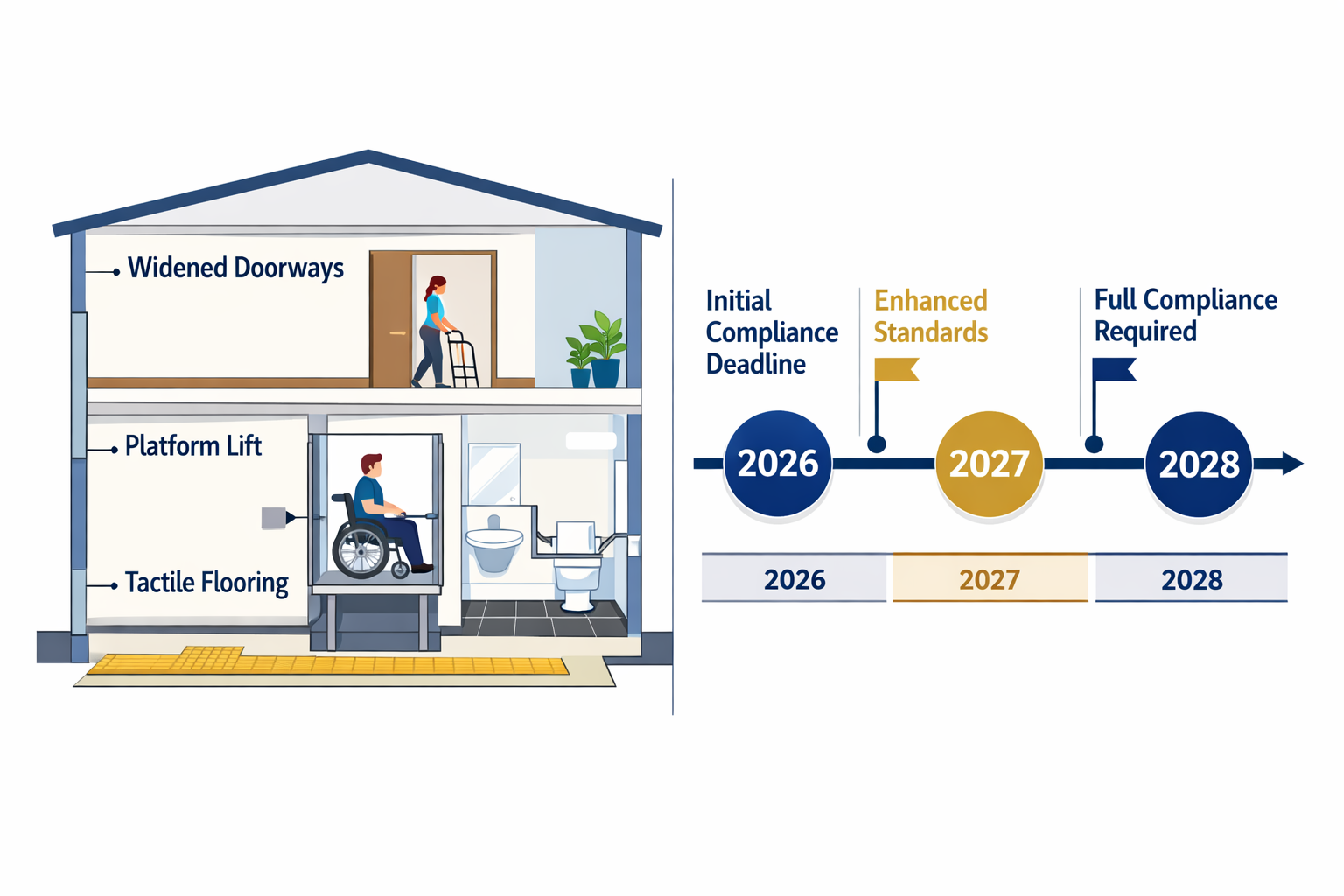
The regulatory landscape in 2026 reflects this evolution. In the United States, the Department of Justice issued an Interim Final Rule on 20 April 2026 extending ADA Title II digital accessibility compliance deadlines — to 26 April 2027 for entities serving 50,000 or more people, and 26 April 2028 for smaller entities and special districts [6]. While this is a US development, it signals a global direction of travel: regulators are phasing in higher standards, and expert witnesses must account for those future compliance obligations when assessing retrofit feasibility today.
In the UK, the Expert Witness Institute and the Academy of Experts have both emphasised in 2026 guidance that reports must be forward-looking, addressing not only current deficiencies but anticipated regulatory requirements within a reasonable planning horizon [5]. This directly affects how surveyors frame retrofit cost estimates and residual value assessments.
The EU's 2026 Rolling Plan for ICT Standardisation similarly reinforces that accessibility standards — including EN 301 549 — are being actively updated, with compliance obligations extending to built environment operators who provide digital interfaces for building access, booking, or management [2].
For surveyors engaged in expert witness reports, understanding this regulatory momentum is not optional — it is a professional duty.
The RICS Framework for Quantifying Accessibility Defects
Identifying and Categorising Defects
A robust expert witness report on accessibility begins with a systematic defect schedule. Each defect must be:
- Identified with reference to a specific regulatory standard (e.g., Part M of the Building Regulations, BS 8300:2018, or the Equality Act 2010 Schedule 4)
- Described in plain language accessible to a non-technical tribunal
- Photographed and cross-referenced to measured survey data
- Categorised by severity: critical (immediate barrier to access), significant (partial barrier), or minor (inconvenience without full exclusion)
RICS guidance on building surveys recommends a condition rating system that can be adapted for accessibility defects. A Level 3 full building survey provides the depth of inspection needed for litigation-grade reports. Surveyors should consider what a Level 3 survey covers when scoping instructions from solicitors.
Measured Survey Data as the Foundation
Accurate measurements are non-negotiable. Door clear opening widths, threshold heights, ramp gradients, turning circles, reach ranges, and sanitary facility dimensions must all be recorded with calibrated instruments. Where complex geometries are involved — such as listed building entrances or basement conversions — drone surveys and advanced measured survey techniques can provide the precision required.
Measured survey data also underpins the retrofit cost plan. Without accurate dimensions, cost estimates for ramp construction, door widening, or lift installation cannot be credibly defended under cross-examination.
Costed Retrofit Plans: Structure and Methodology
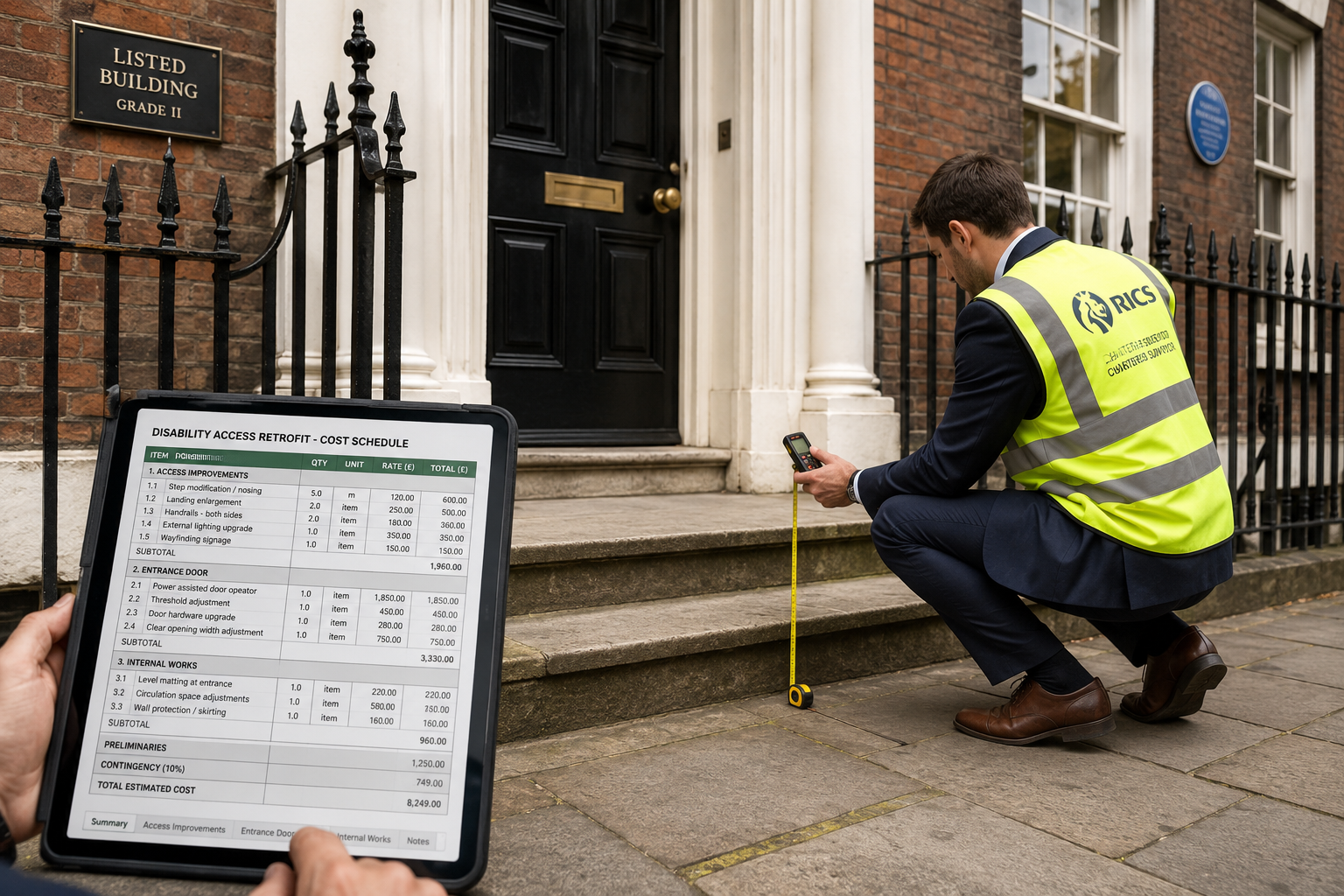
A costed retrofit plan for an expert witness report must contain the following elements:
| Element | Detail Required |
|---|---|
| Scope of works | Specific items per defect, referenced to regulatory standard |
| Specification | Materials, finishes, structural implications |
| Preliminaries | Contractor setup, temporary access, protection works |
| Contingency | Typically 10-15% for older or listed buildings |
| Professional fees | Design, planning, building control, CDM coordination |
| Phasing | Sequenced programme with regulatory milestones |
| Market benchmarking | Rates sourced from current published price books (e.g., BCIS, Spon's) |
Phasing is particularly important in 2026. Where regulations allow a staged compliance approach — as the DOJ's April 2026 Interim Final Rule does for digital accessibility [6] — expert witnesses must demonstrate whether a phased physical retrofit strategy is similarly defensible in the specific dispute context.
Courts have been warned that compliance extensions do not eliminate the need for near-term planning [6]. The same logic applies to physical building accessibility: a phased plan must show genuine progress milestones, not indefinite deferral.

Accessibility and Future-Proofing in Expert Witness Reports: Valuing Retrofit Feasibility Under 2026 Regulations in Practice
Diminution in Value: A Distinct Head of Loss
Diminution in value caused by accessibility non-compliance is one of the most contested areas in property litigation. It requires the expert witness to answer a specific question: by how much has the market value of the property been reduced as a result of the accessibility deficiency?
This is not the same as the cost of remediation. A tribunal in Larkfleet Ltd v Allison Homes Eastern Ltd [2016] confirmed that diminution and reinstatement cost are alternative measures of loss, and the court will apply whichever is appropriate to the facts. Expert witnesses must therefore address both heads and explain the relationship between them.
For accessibility disputes, the diminution approach typically involves:
- Establishing the "as is" value — the current open market value of the property with its accessibility deficiencies
- Establishing the "as if" value — the value the property would achieve if fully compliant with 2026 regulatory standards
- Calculating the difference — expressed as a percentage and an absolute figure
- Adjusting for betterment — where retrofit works would improve the property beyond its pre-defect condition
Surveyors providing independent property valuations for litigation purposes must be able to demonstrate comparable evidence for both the "as is" and "as if" scenarios. In thin markets — such as specialist care facilities or listed commercial buildings — this requires careful analysis of adjusted comparables and, where necessary, the income approach.
Addressing the "Undue Burden" Defence
Defendants in accessibility disputes frequently argue that the cost of retrofit represents an "undue burden" — a defence available under both the Equality Act 2010 and ADA Title II. Expert witnesses are increasingly called upon to quantify and test this defence with evidence rather than accepting it at face value.
The National Center for State Courts' April 2026 briefing on digital accessibility compliance emphasised that entities must document "undue burden" assessments with specificity — inventorying assets, budgeting for multi-year remediation, and demonstrating genuine financial constraint [6]. The same evidentiary standard is being applied by UK tribunals to physical accessibility cases.
An expert witness report that addresses the undue burden defence should include:
- The total retrofit cost as a percentage of the property's market value
- The property owner's or occupier's financial capacity (drawn from disclosed documents)
- Alternative, lower-cost interim measures that could be implemented immediately
- The regulatory timeline for full compliance
This structured approach has been endorsed in recent FOIL and Academy of Experts guidance, which notes that expert witnesses in property and construction disputes must address proportionality arguments with quantified evidence [5].
Digital Accessibility as Part of the Expert Witness Scope
In 2026, the scope of accessibility expert witness reports is expanding beyond the physical built environment. Where a property dispute involves a landlord, service provider, or public body that operates digital interfaces — tenant portals, booking systems, public information kiosks — digital accessibility compliance is now a relevant consideration.
The EU's 2026 ICT accessibility standards update [2] and the DOJ's WCAG 2.1 Level AA requirement for public sector digital systems [6] both create retrofit obligations that carry measurable costs. Expert witnesses instructed in disputes involving mixed-use developments, healthcare facilities, or public sector landlords should consider whether digital accessibility remediation forms part of the overall retrofit cost plan.
New guidance for expert witnesses on AI and technology-assisted analysis [3] also highlights that courts are becoming more receptive to technology-based evidence gathering — including automated accessibility auditing tools — provided the methodology is transparent and the expert takes personal responsibility for the conclusions.
Future-Proofing: Anticipating the Next Regulatory Cycle
"A retrofit plan that only addresses today's standards may be obsolete before the works are complete."
This is the central challenge of future-proofing in expert witness reports. Regulatory standards for accessibility are not static. BS 8300 has been revised multiple times, Part M continues to evolve, and the EU's EN 301 549 standard is on a rolling update cycle [2]. An expert witness who scopes a retrofit plan solely against 2026 standards — without considering the foreseeable regulatory direction — risks producing a report that underestimates the true cost of compliance.
Best practice in 2026 requires expert witnesses to:
- State the regulatory baseline used for the assessment and its effective date
- Identify known forthcoming changes that will affect the property within a 5-10 year horizon
- Quantify the additional cost of future-proofing works where they can be specified
- Flag residual uncertainty where regulatory direction is unclear, with a reasoned range
For properties subject to new property management laws or property market legislation changes, the future-proofing analysis must also account for lease terms, service charge obligations, and the allocation of improvement costs between landlord and tenant.
Accessibility and Future-Proofing in Expert Witness Reports: Valuing Retrofit Feasibility Under 2026 Regulations — Common Pitfalls
Even experienced surveyors make avoidable errors when producing accessibility-focused expert witness reports. The most common pitfalls include:
1. Conflating regulatory compliance with best practice
Compliance with Part M or BS 8300 is the floor, not the ceiling. Courts have found that a property can be technically compliant yet still fail the reasonable adjustment duty under the Equality Act 2010 in specific circumstances. Expert witnesses must address both.
2. Omitting preliminaries and professional fees from cost plans
A retrofit cost plan that lists only materials and labour will routinely underestimate the true cost by 20-35%. Professional fees, planning applications, building control, and CDM coordination must all be included.
3. Failing to address listed building constraints
Many accessibility disputes involve older or listed buildings where retrofit options are constrained by planning and heritage considerations. Expert witnesses must engage with the planning authority's likely position and cost the approved solution — not the ideal solution. A condition survey report can provide the baseline data needed to navigate these constraints.
4. Ignoring the interaction between accessibility and other defects
Accessibility works frequently interact with other building defects — structural issues, drainage, fire compartmentation. A ramp installation may require underpinning; a lift shaft may require structural alterations. The expert witness must identify these interactions and cost them within the retrofit plan.
5. Presenting opinion as fact on "undue burden"
The undue burden defence must be tested with evidence. An expert witness who simply accepts or rejects the defence without quantified analysis risks having their report given little weight by the tribunal.
Structuring the Report for Court
The Civil Procedure Rules (CPR) Part 35 and the accompanying Practice Direction set out the formal requirements for expert witness reports in England and Wales. For accessibility and retrofit feasibility reports, the following structure is recommended:
- Instructions and scope — the precise questions the expert is asked to address
- Qualifications and independence statement — RICS membership, relevant experience, CPR 35.3 declaration
- Methodology — inspection approach, measurement tools, regulatory standards applied
- Defect schedule — itemised, categorised, and cross-referenced to photographs
- Retrofit cost plan — phased, fully costed, market-benchmarked
- Diminution assessment — "as is" vs "as if" valuation with comparable evidence
- Future-proofing analysis — regulatory horizon, additional cost estimates
- Undue burden analysis — proportionality assessment with financial context
- Summary of opinions — concise, numbered, directly answering the court's questions
- Statement of truth — as required by CPR 35.3
Recent FOIL guidance from May 2026 reinforces that expert witnesses in property disputes must ensure their reports are accessible to lay readers — including judges and lay tribunal members — without sacrificing technical rigour [5]. Plain English summaries of complex cost schedules are increasingly expected.
The Expert Witness Institute's access to public domain documents pilot, launched in January 2026, provides expert witnesses with improved access to comparable transaction data and regulatory guidance — a development that strengthens the evidential foundation of retrofit cost and valuation assessments [10].
For complex disputes involving multiple buildings or large residential blocks, block management expertise may be relevant to understanding the governance and financial framework within which retrofit decisions are made.
Conclusion
The role of the expert witness in accessibility and retrofit feasibility disputes has grown substantially more demanding in 2026. Regulators on both sides of the Atlantic are raising compliance standards, extending phased timelines, and expecting evidence-based justification for every remediation decision. Courts and tribunals are applying the same rigour to expert witness reports.
Actionable next steps for surveyors and legal professionals:
- Commission a full Level 3 building survey with an explicit accessibility defect schedule before any expert witness instruction is finalised.
- Ensure retrofit cost plans are fully itemised, include all professional fees and contingencies, and are benchmarked against current BCIS or Spon's rates.
- Address both the cost-of-remediation and diminution-in-value heads of loss in every accessibility dispute report.
- Engage with the future regulatory horizon — identify known forthcoming changes to Part M, BS 8300, and relevant EU standards, and quantify their cost implications.
- Test the undue burden defence with quantified financial evidence, not opinion.
- Review the Expert Witness Institute's January 2026 public domain documents pilot to strengthen the evidential base for comparable evidence.
Surveyors who invest in the technical and legal rigour required by Accessibility and Future-Proofing in Expert Witness Reports: Valuing Retrofit Feasibility Under 2026 Regulations will produce reports that carry genuine weight in court — and provide their instructing parties with the clearest possible path to resolution.
For specialist support with expert witness instructions involving accessibility and retrofit feasibility, contact Prince Chartered Surveyors for free initial advice.
References
[1] Expert Report Content Issue 4 Accessible – gov.uk
[2] Accessibility ICT Products and Services RP 2026 – interoperable-europe.ec.europa.eu
[3] New Guidance for Expert Witnesses on AI – simmons-simmons.com
[4] ESS 26-17 Accessibility Standards and Revised ADA Title II Regulations – cccco.edu
[5] FOIL Update Academy of Experts 5 May 2026 – foil.org.uk
[6] What Courts Need to Know About DOJ Digital Accessibility Rule Compliance Deadline – ncsc.org
[7] Irish Statutory Instrument 636/2023 – irishstatutebook.ie
[8] Expert Witnesses in Web Accessibility Cases Part 2 – convergeaccessibility.com
[9] CDR in 10 Issues April 2026 – tlt.com
[10] Access to Public Domain Documents Pilot Will Launch on 1st January 2026 – ewi.org.uk