

Fewer than one in three party wall surveyors operating in England and Wales had fully updated their award templates to reflect the post-Grenfell regulatory landscape by early 2026 — a gap that now carries serious professional liability consequences. The convergence of the Building Safety Act with the Party Wall etc. Act 1996 has created a new compliance framework that demands far more from surveyors than a standard schedule of condition and a set of working hours. Building Safety Act 2026 Compliance in Party Wall Awards: Surveyor Due Diligence for Fire and Structural Risks is no longer a specialist concern reserved for high-rise developers; it applies to terraced house extensions, basement excavations, and loft conversions alike.
This article examines the tightening regulatory requirements shaping party wall notices and awards in 2026, the specific due diligence protocols surveyors must follow for higher-risk buildings, and the practical strategies available to mitigate liability — particularly on retrofit and green-build projects.
Key Takeaways
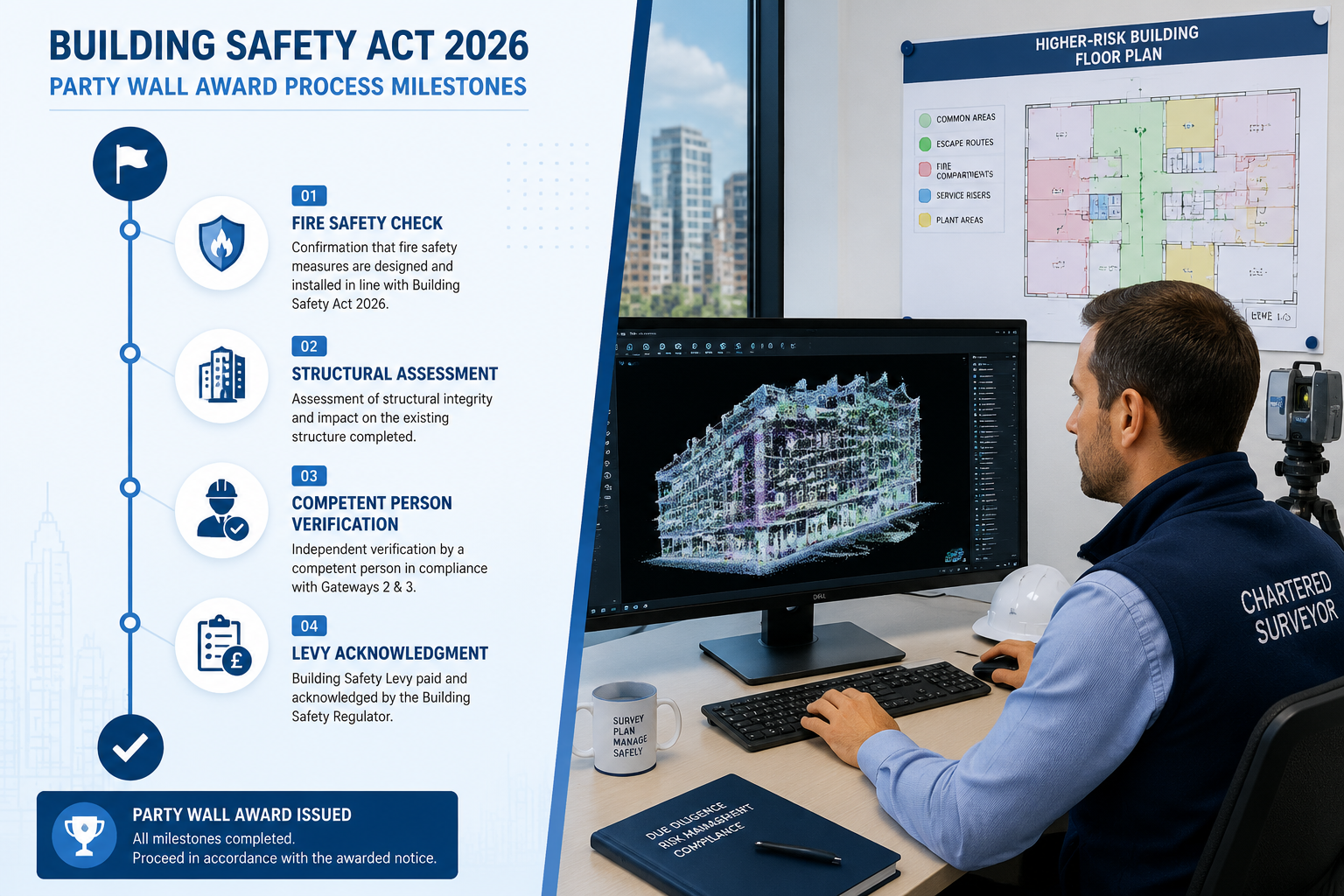
- Party wall awards must now include mandatory fire safety clauses, competent person requirements, and Building Safety Levy acknowledgments as standard practice in 2026.
- Schedules of condition have expanded beyond cosmetic recording to capture fire doors, smoke seals, structural elements, and photographic evidence with date/time stamps.
- Surveyors face heightened professional liability, with the Building Safety Regulator holding powers to investigate competence and issue improvement notices.
- Higher-risk building provisions can be triggered by seemingly routine works, requiring surveyors to assess this threshold before proceeding.
- Technologies such as BIM and 3D laser scanning are becoming standard tools for defensible, audit-ready party wall documentation.
How the Building Safety Act Has Reshaped Party Wall Awards
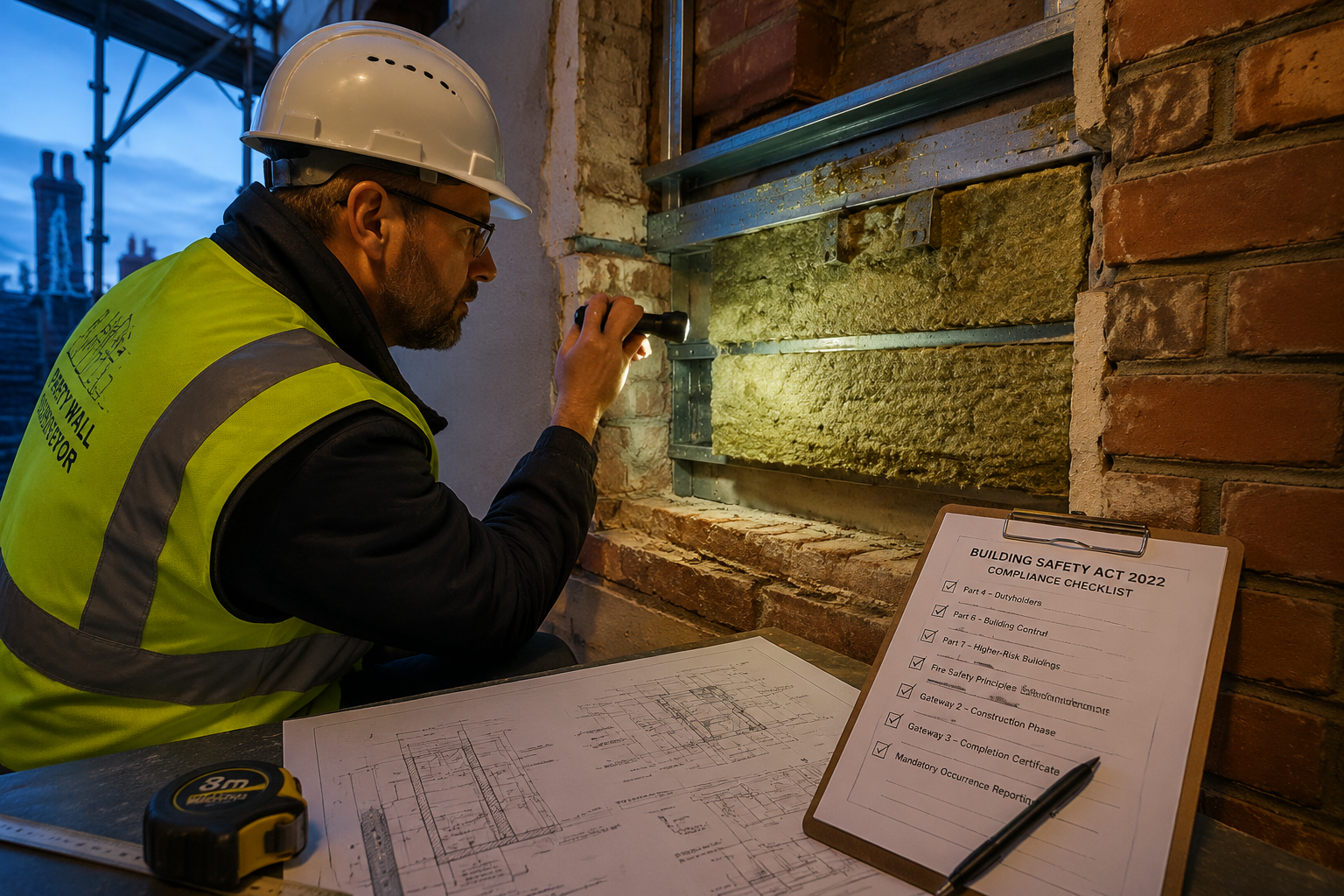
The Building Safety Act 2022 introduced a tiered regulatory system with the Building Safety Regulator (BSR) at its centre. By 2026, the secondary legislation and guidance flowing from that Act have materially altered what a legally sound party wall award must contain. Surveyors who continue to rely on pre-2022 award templates risk producing documents that are non-compliant, unenforceable, or — worse — that expose both building owners and adjoining owners to unmitigated fire and structural risk.
Mandatory Fire Safety Clauses
Awards must now include specific clauses addressing fire resistance in the party wall itself. These clauses are required to [1]:
- Specify fire-resistant materials meeting current British Standards (typically BS 476 or EN 13501 classifications)
- Detail the installation of fire stopping and cavity barriers at all relevant junctions
- Outline inspection protocols to be followed during construction, not just at completion
- Set post-completion certification requirements, including sign-off from a competent fire safety professional
This is not optional drafting. A party wall award that is silent on fire resistance in a project involving a shared wall or shared floor/ceiling assembly is now considered deficient. For surveyors working on party wall matters in converted buildings, basement schemes, or any project near an existing fire compartment boundary, these clauses are non-negotiable.
Building Safety Levy Acknowledgment
A less widely discussed but equally important change is the requirement for awards to formally acknowledge the Building Safety Levy. From April 2026, the levy applies to most new residential development in England. Party wall awards must now [1]:
| Requirement | Detail |
|---|---|
| Confirm levy obligation | Building owner must acknowledge the levy applies to the project |
| Separate cost clarification | Levy costs must be explicitly distinguished from party wall surveyor fees |
| Payment timeline | The award must establish when levy payment is due relative to project milestones |
Surveyors are not responsible for collecting the levy, but they are responsible for ensuring the award reflects the building owner's awareness of it. Failure to include this acknowledgment could expose the building owner to enforcement action and the surveyor to a negligence claim for inadequate advice.
Competent Person Requirements
The BSR's emphasis on professional competence throughout the construction supply chain has filtered directly into party wall practice. Awards must now specify that all contractors carrying out work affecting structural stability or fire safety hold appropriate qualifications [1]. This means the award should require the building owner to provide evidence of contractor competence before work begins — not after a problem arises.
This requirement connects directly to the broader duty on dutyholders under the Building Safety Act to ensure that those they appoint are competent. For surveyors, the practical implication is that a standard award clause stating "works to be carried out in a workmanlike manner" is no longer sufficient.
Surveyor Due Diligence Protocols for Fire and Structural Risks
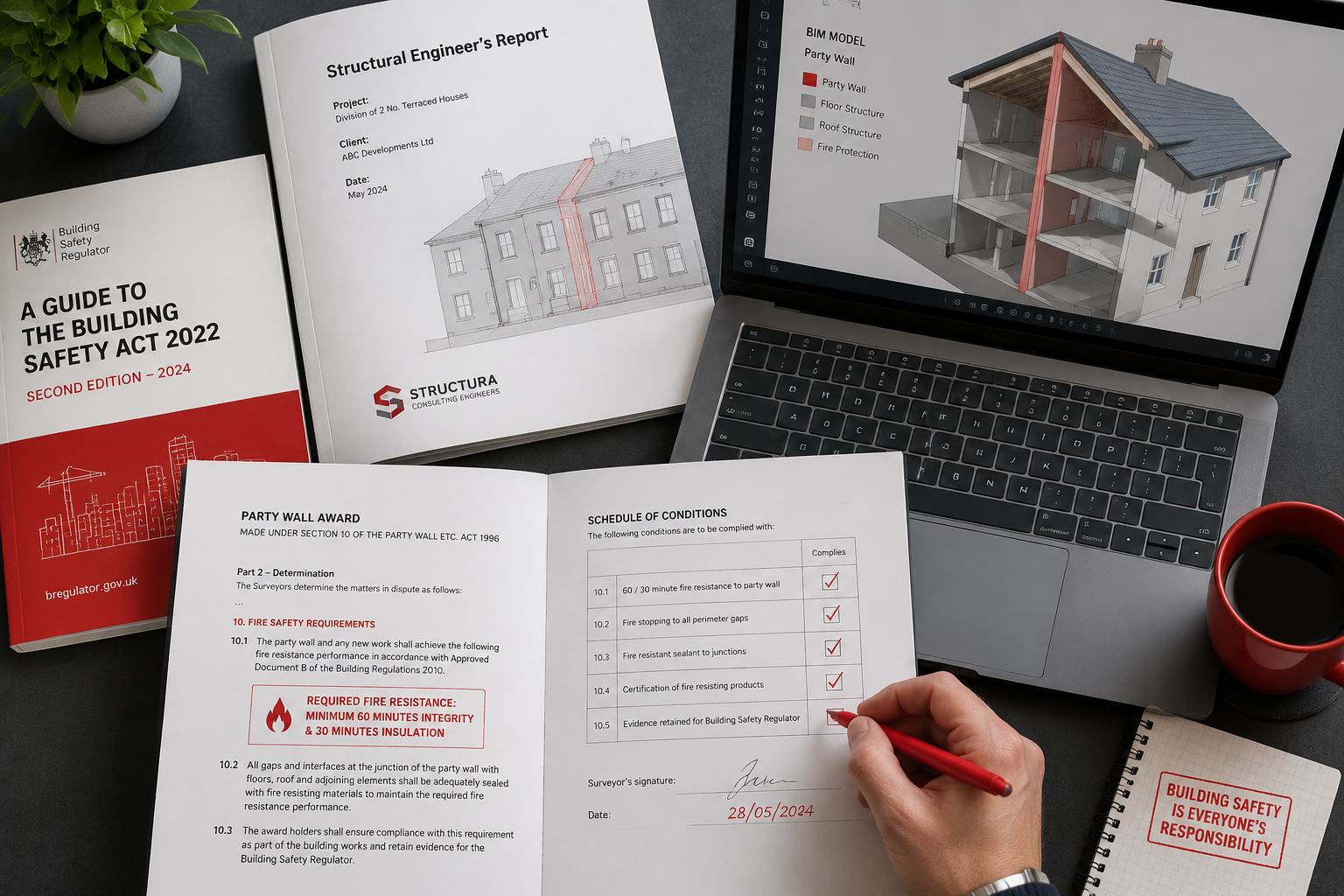
Building Safety Act 2026 Compliance in Party Wall Awards: Surveyor Due Diligence for Fire and Structural Risks demands a structured approach to pre-award investigation. The following protocols reflect current best practice and align with the BSR's expectations of professional competence.
Enhanced Schedules of Condition
The schedule of condition has historically been a photographic record of cosmetic finishes — cracks in plaster, condition of skirting boards, state of garden walls. In 2026, that function has been substantially expanded. A compliant schedule must now capture [1]:
- Fire safety features: fire doors (including intumescent strips and smoke seals), fire-rated glazing, compartmentation walls and floors
- Structural elements: condition of existing lintels, padstones, bearing points, and any structural members that the proposed works could affect
- Existing building safety defects: any Category 1 hazards under the Housing Health and Safety Rating System (HHSRS) that are already present and that the works might disturb or worsen
- Photographic evidence: all images must carry date and time stamps and be stored in a format suitable for regulatory audit
The last point matters more than it might appear. The Building Safety Regulator has enforcement powers that include the ability to request documentation from surveyors. A schedule of condition that cannot be verified as pre-works evidence — because images lack metadata or are stored on a personal device — is of limited evidential value.
Surveyors should also be familiar with the building regulation compliance testing requirements that interact with party wall works, particularly where fire compartmentation is being altered or reinstated.
Assessing the Higher-Risk Building Threshold
One of the most consequential due diligence steps a party wall surveyor must take in 2026 is assessing whether the proposed works trigger the higher-risk building (HRB) provisions. An HRB is currently defined as a building in England that is at least 18 metres in height or has at least 7 storeys, and contains at least 2 residential units.
However, the threshold question is not always straightforward. Works to a building that is close to the 18-metre threshold — or that involve adding a storey — require careful assessment. Where HRB provisions apply, the building must be registered with the BSR, and a full gateway process applies to design and construction. A party wall award issued without awareness of this regime could inadvertently authorise works that are not yet legally permissible [8].
Surveyors should [1]:
- Confirm that the building owner has obtained all necessary Building Control approvals before the award is issued
- Assess whether the works, in combination with any other recent or planned alterations, could push the building into HRB territory
- Maintain records of this assessment in the project file
- Coordinate with Building Control officers and, where necessary, fire safety engineers
For complex structural scenarios, understanding stresses in structural members of commercial buildings provides useful context for assessing risk at the party wall interface.
Personal Emergency Evacuation Plans and Accessibility
An area receiving growing attention in 2026 is the intersection of party wall works with Personal Emergency Evacuation Plans (PEEPs) and accessibility requirements. Where works affect a building in multiple occupation — particularly a block of flats — the surveyor must consider whether the works will temporarily or permanently compromise evacuation routes, fire doors, or accessible escape paths.
This is not merely a courtesy check. Phase 2 of Awaab's Law, scheduled for October 2026, expands the category of hazards that landlords must address to include fire risks and explosion risks [3]. Where a party wall project disturbs existing fire safety infrastructure in a tenanted building, the surveyor's award must address the protection of those features during construction and their reinstatement to at least the pre-works standard.
"Surveyors preparing party wall awards should be familiar with the Housing Health and Safety Rating System hazard scoring, particularly for Category 1 hazards that trigger mandatory local authority action." [3]
Coordination with Specialist Engineers
The days of a party wall surveyor operating in isolation are over. Current best practice — and, increasingly, regulatory expectation — requires active coordination with [1]:
- Structural engineers: to verify that the proposed works will not compromise the structural integrity of the party wall or the adjoining owner's building
- Fire safety engineers: particularly where works affect compartmentation or fire-rated assemblies
- Building Control officers: to confirm that the design has been approved and that the contractor's method statement aligns with the approved scheme
For surveyors who want to understand when a structural engineer's input becomes essential, the guidance on reasons to hire a structural engineer is a useful reference point.
Technology, Liability, and the New Regulatory Context
BIM and 3D Laser Scanning as Standard Practice
Building Information Modelling (BIM) and 3D laser scanning are no longer niche tools for large infrastructure projects. In 2026, they are becoming standard practice for party wall awards in deep excavation projects and any scheme where millimetre-level accuracy is required to establish pre-works condition [4].
The benefits are significant:
- Clash detection: BIM models can identify conflicts between proposed works and existing structural or fire safety elements before work begins
- Defensible evidence: time-stamped point cloud data provides an objective, court-ready record of pre-works condition
- Reduced disputes: precise baseline data reduces the scope for disagreement about whether damage was caused by the notifiable works
For surveyors working on basement schemes or underpinning projects, the measured building survey process integrates naturally with the 3D scanning workflow and can form part of the schedule of condition.
Increased Professional Liability
Building Safety Act 2026 Compliance in Party Wall Awards: Surveyor Due Diligence for Fire and Structural Risks carries direct implications for professional indemnity. The BSR has enforcement powers that extend to investigating the professional competence of surveyors and issuing improvement notices [1]. This is a significant departure from the pre-2022 position, where professional discipline was primarily a matter for RICS.
Key liability exposure points for party wall surveyors in 2026 include:
- Issuing an award without confirming Building Control approval: if works proceed without the necessary gateway sign-off, the surveyor who issued the award may share liability for enabling non-compliant construction
- Failing to identify HRB provisions: an award that authorises works on a higher-risk building without acknowledging the BSR's oversight role is vulnerable to challenge
- Inadequate schedules of condition: if an adjoining owner suffers damage and the schedule of condition does not provide a clear pre-works baseline, the surveyor may be found negligent
- Omitting fire safety clauses: a surveyor who issues an award without fire resistance specifications for a project affecting a fire compartment boundary faces a strong negligence claim if a fire safety failure subsequently occurs
Surveyors should review their professional indemnity cover in light of these expanded duties and ensure that their continuing professional development (CPD) includes building safety legislation updates [1].
Dispute Resolution Under the New Framework
When disputes arise under the new regulatory context, the role of the third surveyor has also evolved. Third surveyors must now consider [1]:
- Whether the award under dispute complies with Building Safety Regulator requirements
- Whether the building owner has demonstrated adequate competence and resources to carry out the works safely
- Whether the award, as drafted, provides sufficient protection to the adjoining owner from building safety risks
In some cases, third surveyors may recommend delaying works pending resolution of outstanding building safety compliance issues [1]. This is a significant power and one that reflects the elevated status of safety considerations in the party wall process.
The RICS 8th edition of Party Wall Legislation and Procedure, under consultation in April and May 2026, is expected to address gaps in how surveyor jurisdiction is established and maintained — gaps that recent case law has exposed [5]. Surveyors should monitor the outcome of this consultation closely, as it is likely to introduce procedural requirements that affect how awards are drafted and challenged.
Sustainability Clauses and Retrofit Projects
The RICS consultation launched in April 2026 also addresses sustainability clauses in party wall awards [2]. This is particularly relevant for retrofit projects involving external wall insulation (EWI), heat pumps, or solar panel installations — all of which can affect the fire performance of an external wall or the structural loading on a party wall.
For EWI projects specifically, the fire safety implications are acute. The Grenfell Tower Inquiry findings have made clear that external wall systems must be assessed holistically, and a party wall award that authorises the attachment of insulation to a shared wall without addressing the fire classification of the insulation system is deficient.
Surveyors working on retrofit projects should also be aware of the building materials assessments process, which can identify the fire performance characteristics of existing and proposed wall assemblies. For fire safety and cladding risks in building surveys more broadly, current risk assessment protocols for high-rise and converted properties provide a detailed compliance framework [6].
Practical Checklist for Surveyors in 2026
The following checklist summarises the core due diligence steps for a compliant party wall award under the current regulatory framework:
Pre-Award Stage
- Confirm Building Control approval is in place (or gateway application is progressing for HRBs)
- Assess whether the project triggers HRB provisions
- Identify any existing Category 1 HHSRS hazards in the adjoining owner's property
- Confirm contractor competence credentials for structural and fire safety works
- Coordinate with structural and fire safety engineers as appropriate
Schedule of Condition
- Record all fire safety features (fire doors, smoke seals, compartmentation walls)
- Document structural elements at risk from the proposed works
- Capture date/time-stamped photographs and store in an audit-ready format
- Consider 3D laser scanning for complex or high-value projects
Award Drafting
- Include mandatory fire safety clauses specifying materials and inspection protocols
- Include competent person requirements for all relevant contractors
- Include Building Safety Levy acknowledgment
- Address PEEP and accessibility implications where the building is in multiple occupation
- Include sustainability/fire performance clauses for retrofit or EWI projects
Post-Award
- Maintain comprehensive project records suitable for BSR audit
- Ensure CPD records reflect current building safety legislation
- Review professional indemnity cover annually
For those new to the party wall process, the top questions about party wall surveys provides a useful foundation before engaging with the more technical compliance requirements covered here.
Conclusion
The regulatory environment governing party wall awards has shifted decisively. Building Safety Act 2026 Compliance in Party Wall Awards: Surveyor Due Diligence for Fire and Structural Risks is now a core professional competence, not an optional add-on. Surveyors who treat the party wall process as a procedural formality — issuing standard-form awards without engaging with fire safety, structural risk, or higher-risk building provisions — are exposed to enforcement action, negligence claims, and reputational damage.
Actionable next steps for surveyors:
- Audit existing award templates against the mandatory clauses described in this article and update them before the next instruction is accepted.
- Establish a working relationship with a structural engineer and a fire safety engineer who can be engaged quickly when projects require specialist input.
- Invest in 3D laser scanning capability — either in-house or through a trusted subcontractor — for any project involving deep excavation or complex structural interfaces.
- Complete CPD on the Building Safety Act, the BSR's guidance on higher-risk buildings, and the RICS 8th edition consultation outcomes as soon as they are published.
- Review professional indemnity cover to ensure it reflects the expanded scope of surveyor duties in 2026.
For building owners and adjoining owners, the message is equally clear: engage a surveyor who understands this framework. A party wall award is only as protective as the due diligence behind it. Understanding when a party wall surveyor is needed and what a properly scoped instruction looks like is the first step toward a compliant, dispute-free project.
References
[1] Party Wall Act Updates Post 2026 Building Safety Reforms Key Changes Affecting Notices And Awards – partywallsurveyorlondon.uk
[2] Sustainability Clauses In Party Wall Awards 2026 Rics Guidance For Green Builds – partywallsurveyorlondon.uk
[3] Party Wall Awards Under Awaabs Law Extensions 2026 Checklists For Damp And Ventilation Disputes – wimbledonsurveyors.com
[4] Bim And 3d Laser Scanning For Party Wall Awards Enhancing Precision In 2026 Deep Excavation Projects – kingstonsurveyors.com
[5] Strengthening Party Wall Surveyor Jurisdiction Lessons From Recent Award Challenges And Rics 8th Edition Safeguards – manchestersurveyors.com
[6] Fire Safety And Cladding Compliance In Building Surveys 2026 Risk Assessment Protocols For High Rise And Converted Properties – Fire safety and cladding compliance in building surveys 2026 risk assessment protocols for high rise and converted properties
[8] Preparing Safety Case Reports For Higher Risk Buildings Hrbs Key Insights From New Istructe Guidance – beale-law.com