

Electrical faults are the leading cause of accidental house fires in England, responsible for approximately 20,000 fires each year according to government fire statistics. Yet for decades, electrical safety in the private rented sector (PRS) occupied a regulatory grey area that left millions of tenants exposed to preventable risk. That changes decisively in October 2026. Electrical Hazard Assessments in Building Surveys: Preparing for Awaab's Law PRS Extensions 2026 is no longer a forward-looking concern — it is an immediate operational priority for every building surveyor, landlord, and letting agent working in the PRS.
Phase 2 of Awaab's Law brings electrical hazards within the scope of statutory compliance deadlines for the first time, expanding far beyond the damp and mould provisions that defined Phase 1 [1]. For surveyors conducting Level 3 building surveys on older rental stock, the practical implications are significant. Reports must now be structured to withstand ombudsman scrutiny, and checklists must cover wiring defects that were previously treated as advisory observations rather than mandatory findings.
Key Takeaways
- Phase 2 of Awaab's Law, scheduled for October 2026, brings electrical hazards under statutory Housing Health and Safety Rating System (HHSRS) deadlines in the PRS for the first time [1].
- Building surveyors must now conduct structured visual electrical assessments as part of every PRS survey, with clear protocols for identifying Category 1 and Category 2 hazards [2].
- Electrical Installation Condition Reports (EICRs) remain a landlord obligation every five years, but surveyors must now flag the absence or inadequacy of a current EICR as a compliance deficiency [2].
- Survey reports must meet new documentation standards — including photographic evidence, hazard severity ratings, and remediation timelines — to satisfy both Awaab's Law and the Renters' Rights Act ombudsman framework [4].
- Phase 3, expected in October 2027, will extend statutory coverage to asbestos and carbon monoxide hazards, making robust survey protocols developed now a long-term investment [5].
What Awaab's Law Phase 2 Means for Electrical Safety in the PRS
Awaab's Law was enacted following the tragic death of two-year-old Awaab Ishak in 2020, caused by prolonged exposure to mould in a social housing property. The initial legislation focused on damp, mould, and excess cold in the social housing sector. Phase 2, taking effect in October 2026, extends the law's reach into the PRS and broadens the hazard categories covered to include electrical hazards, fire risks, and structural deficiencies [1].
Under the HHSRS framework, electrical hazards are assessed according to the likelihood of harm and the severity of potential injury. Electrical hazards that present an immediate risk of death or serious injury are classified as Category 1 — the highest level — and trigger mandatory remediation timelines that landlords cannot ignore [2].
What this means in practice:
- Landlords in the PRS must respond to identified Category 1 electrical hazards within defined statutory timeframes.
- Building surveyors are now the primary mechanism through which these hazards are formally identified and recorded.
- Survey reports that fail to address electrical safety adequately may be challenged through the new ombudsman structure introduced under the Renters' Rights Act.
For surveyors conducting Level 3 full building surveys on older PRS properties — particularly Victorian, Edwardian, and inter-war stock — this represents a fundamental shift in reporting scope and professional responsibility.
"The expansion of Awaab's Law into the PRS means that electrical hazard identification is no longer discretionary. It is a core deliverable of any compliant building survey."
Electrical Hazard Assessments in Building Surveys: Preparing for Awaab's Law PRS Extensions 2026 — The Visual Inspection Protocol
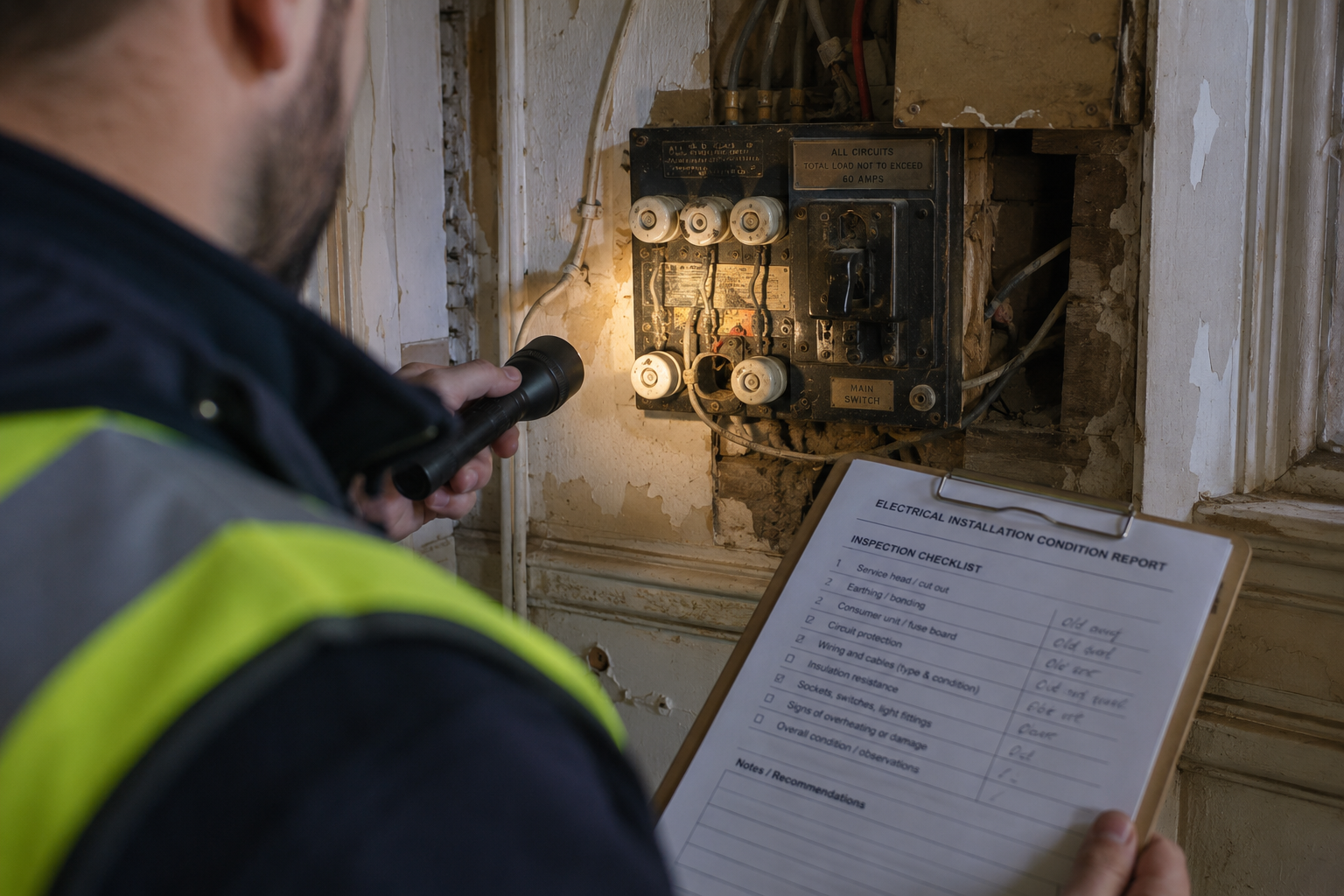
Building surveyors are not qualified electricians, and the law does not require them to conduct testing. However, surveyors are required to carry out a structured visual inspection of electrical systems and to recommend further specialist investigation where visible defects or risk indicators are present [2].
Consumer Unit Assessment
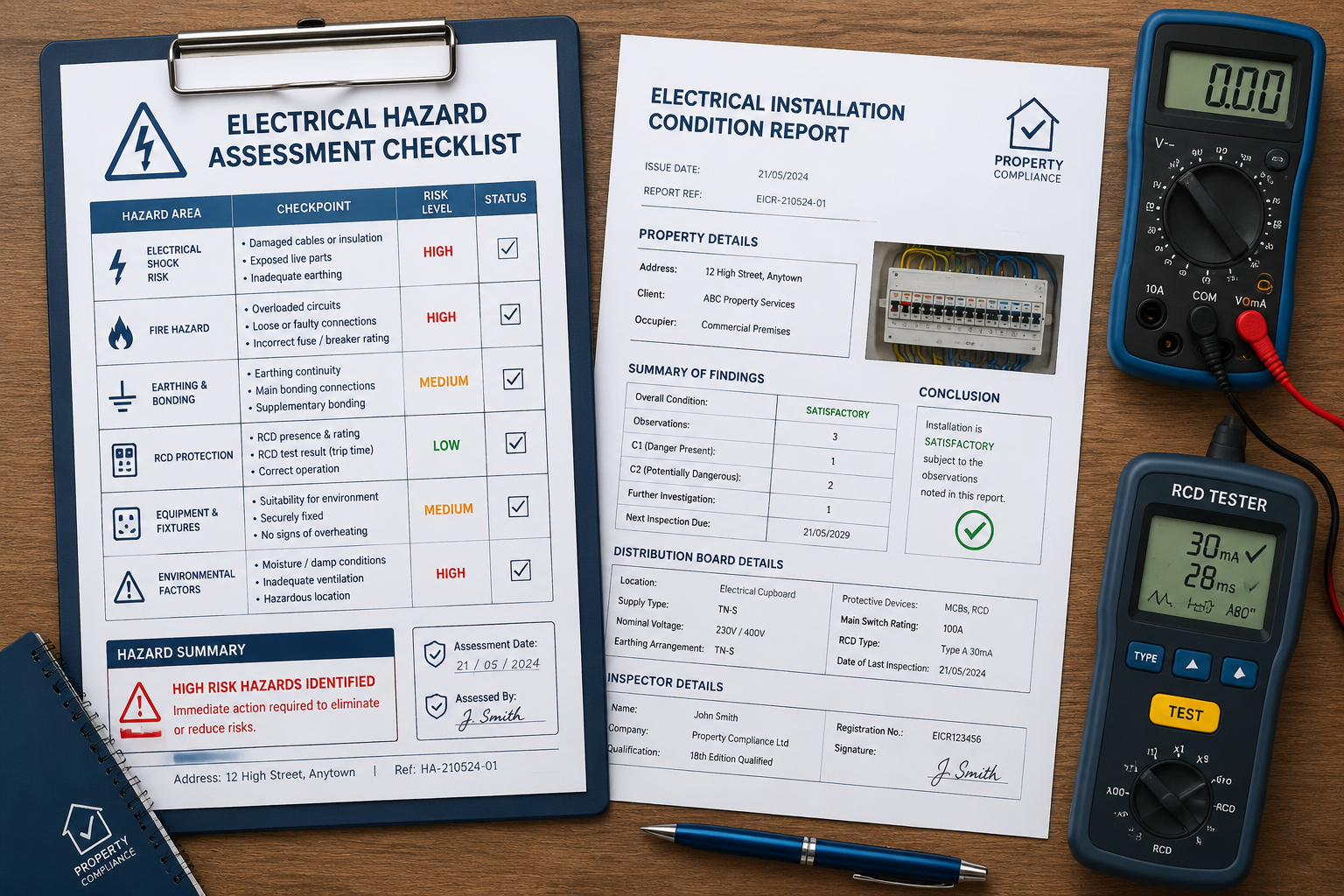
The consumer unit (fuse board) is the starting point for any electrical visual inspection. Surveyors should assess and record:
| Inspection Item | What to Look For | Risk Level |
|---|---|---|
| Age and type of consumer unit | Ceramic fuses, rewirable fuses, absence of RCD protection | High |
| Physical condition | Scorching, cracking, signs of overheating | Critical |
| RCD presence | Absence of Residual Current Device protection | High |
| Labelling | Unlabelled or incorrectly labelled circuits | Moderate |
| Accessibility | Consumer unit in unsafe or inaccessible location | Moderate |
Consumer units containing ceramic or rewirable fuses with no RCD protection are a strong indicator of an installation that has not been updated since the 1970s or earlier. This alone warrants an urgent EICR recommendation [2].
Wiring Condition and Insulation
Wiring materials provide important clues about the age and safety of an installation. Surveyors should look for:
- Rubber-insulated wiring (pre-1960s): The rubber degrades over time, becoming brittle and prone to cracking, which can expose live conductors.
- Lead-sheathed wiring: A sign of very old installations, typically pre-1950s, that are almost certainly non-compliant with current standards.
- Aluminium wiring (common in 1960s-70s properties): Can cause connection failures and overheating at termination points.
- PVC-insulated wiring: Generally acceptable if in good condition, but age and mechanical damage should still be assessed.
Any visible deterioration of wiring insulation, particularly in loft spaces, under floors, or in areas of high moisture, should be recorded as a defect requiring specialist investigation. Moisture and electrical wiring are a dangerous combination — surveyors should cross-reference findings with moisture assessment results when compiling their reports.
Sockets, Switches, and Accessories
Damaged, discoloured, or poorly fitted accessories are visible indicators of broader installation problems. The checklist should include:
- Cracked or broken socket faceplates
- Scorch marks or discolouration around sockets or switches
- Loose-fitting accessories that suggest poor installation or repeated interference
- Non-standard or non-BS-compliant accessories
- Absence of RCD-protected sockets in bathrooms or kitchens
Immediate Red Flags — Category 1 Indicators
Certain findings must be treated as Category 1 hazards requiring urgent action and explicit flagging in the survey report [2]:
- Exposed live conductors at any point in the installation
- Evidence of arcing — black marks, burning smells, or melted materials near electrical components
- Complete absence of RCD protection in any modern context
- Overloaded circuits evidenced by multiple adaptors, daisy-chained extension leads as permanent solutions
- DIY wiring that is visibly non-compliant with BS 7671 (the IET Wiring Regulations)
EICR Requirements, Reporting Standards, and Ombudsman-Proof Documentation
The EICR Obligation in the PRS
Since April 2021, all PRS landlords in England have been legally required to hold a valid Electrical Installation Condition Report, renewed every five years [2]. The EICR must be carried out by a qualified electrician and must classify the installation as satisfactory before the property is let.
Surveyors conducting building surveys must now:
- Request sight of the current EICR as part of their pre-survey documentation review.
- Record whether a valid EICR is in place, when it was issued, and its classification outcome.
- Recommend an urgent EICR if no current report exists, or if visual inspection reveals defects that suggest the installation's condition has deteriorated since the last report.
The absence of a valid EICR in a PRS property is itself a compliance failure that must be recorded in the survey report as a deficiency, separate from any physical hazards identified [2].
Surveyor Competency Requirements
Surveyors must be able to demonstrate competence in the following areas to satisfy the new requirements [3]:
- Basic electrical hazard recognition: Identifying the visual indicators described above without conducting testing.
- EICR interpretation: Understanding the classification system (Unsatisfactory, Satisfactory, Improvement Recommended) and what each means for the property's compliance status.
- Identification of non-compliant installations: Recognising wiring types, consumer unit configurations, and accessory conditions that indicate non-compliance with current regulations.
Firms should ensure their surveyors undertake appropriate continuing professional development (CPD) to meet these competency standards ahead of October 2026. The sourcing of specialist advice from qualified electricians remains an important part of the surveyor's toolkit where findings exceed the scope of visual inspection.
Documentation Standards for Awaab's Law Compliance
Survey reports submitted in the context of Awaab's Law PRS compliance must meet a higher documentation standard than traditional survey reports. The following elements are now expected [4]:
| Report Element | Requirement |
|---|---|
| Photographic evidence | Photographs of all identified electrical defects, clearly labelled |
| Hazard severity rating | HHSRS Category 1 or Category 2 classification for each hazard |
| Immediate action items | Clear list of defects requiring urgent remediation |
| Remediation specification | Description of the work required to address each defect |
| Cost estimates | Indicative cost ranges for remediation works |
| Timeline projections | Recommended timeframes for completing remediation |
| Compliance statement | Explicit statement on EICR status and any compliance gaps |
This level of detail is not optional for PRS surveys conducted under the new framework. Reports that lack this structure may be challenged through the ombudsman process established under the Renters' Rights Act, exposing both the surveyor and the landlord to significant liability.
For landlords and property managers seeking to understand their obligations more broadly, the new property management laws resource provides useful context on the regulatory landscape.
Electrical Hazard Assessments in Building Surveys: Preparing for Awaab's Law PRS Extensions 2026 — Practical Checklists for Older Rental Stock
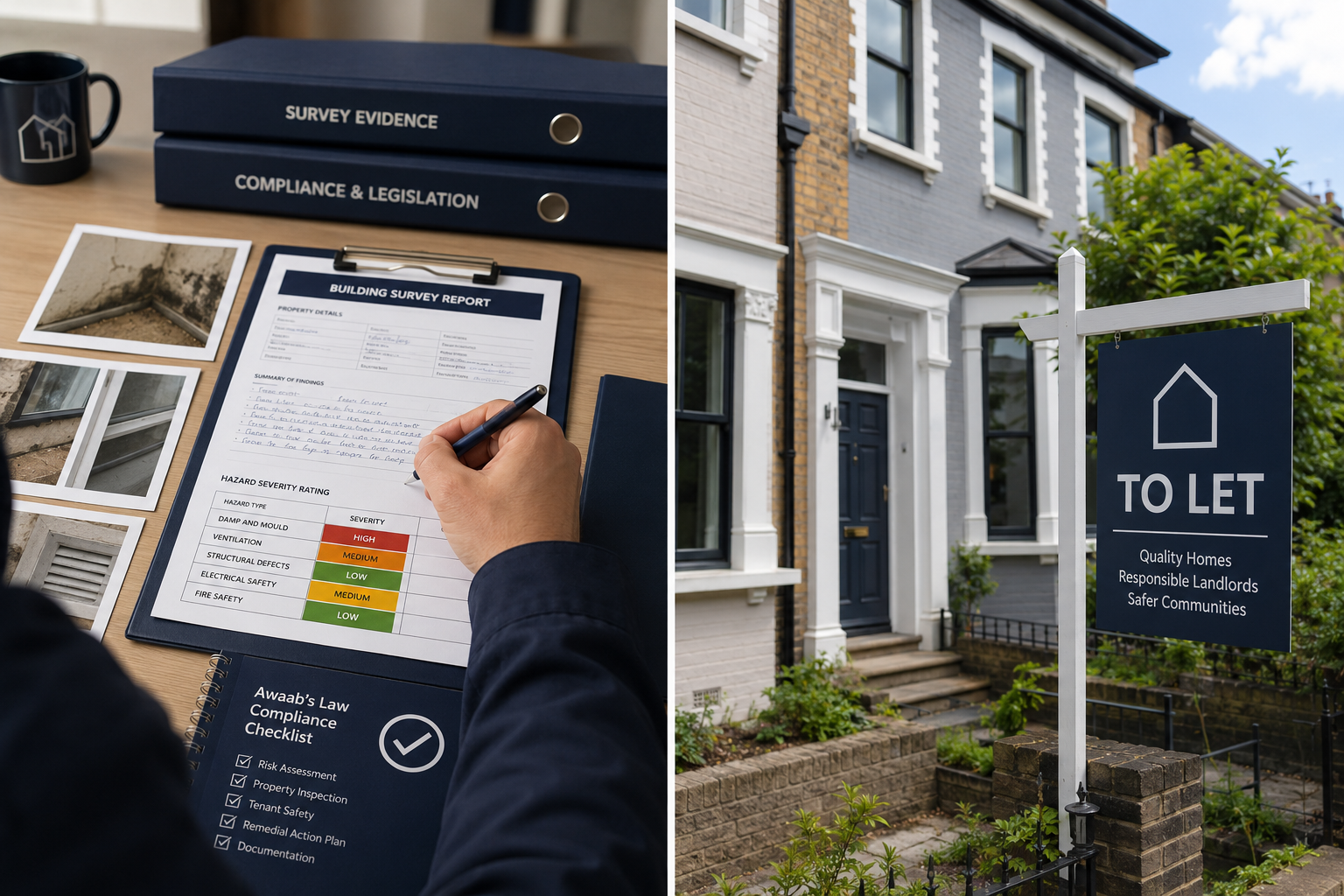
Older rental properties present the greatest electrical risk and the greatest compliance challenge. Properties built before 1970 are particularly likely to contain wiring and consumer unit configurations that are non-compliant with current standards. The following checklist is designed for use during Level 3 surveys of pre-1970s PRS properties.
Pre-Survey Documentation Checklist
- Valid EICR in place (issued within the last five years)
- EICR classification confirmed as Satisfactory
- Any remedial work recommended in the EICR completed and evidenced
- Building regulations certificates for any electrical work carried out since the last EICR
On-Site Visual Inspection Checklist
Consumer Unit
- Type identified (ceramic fuses / MCBs / RCBOs)
- RCD protection present and covering all circuits
- No visible scorching or damage
- Circuits clearly labelled
Wiring
- Wiring type identified where visible (rubber / lead / aluminium / PVC)
- No visible deterioration or exposed conductors
- Wiring routed safely and protected from mechanical damage
- No evidence of DIY alterations
Accessories
- Sockets and switches in good physical condition
- No scorch marks or discolouration
- Bathroom and kitchen sockets RCD-protected or shaver-socket type only
- No unapproved accessories fitted
General
- No evidence of arcing or burning smells
- No overloaded circuits or permanent use of extension leads
- Adequate number of sockets for the property size
- Smoke alarms and carbon monoxide alarms present and functional
This checklist integrates naturally with the broader survey scope covered in a full building survey, which already addresses structural, thermal, and moisture-related risks in detail. Understanding what is covered in a Level 3 survey helps both surveyors and landlords set appropriate expectations for the scope of assessment.
Integration with Fire Risk Assessment
Electrical hazards and fire risk are closely linked. Surveyors should cross-reference electrical findings with fire safety observations, particularly in HMOs and multi-occupancy properties. The fire risk assessment framework provides a complementary structure for properties where both assessments are required.
Planning for Phase 3 and Building Long-Term Compliance Protocols
Phase 2 of Awaab's Law is not the final step. Phase 3, expected in October 2027, will extend statutory coverage to additional HHSRS hazards including asbestos and carbon monoxide [5]. Organisations that develop robust survey protocols now — covering electrical hazards, fire safety, thermal comfort, and structural integrity — will be better positioned to absorb Phase 3 requirements without significant operational disruption.
Strategic actions for surveyors and property managers in 2026:
- Invest in CPD training covering electrical hazard recognition and EICR interpretation.
- Update survey report templates to include all required documentation elements under Awaab's Law.
- Establish referral networks with qualified electricians for urgent EICR recommendations.
- Review existing PRS property portfolios to identify properties most likely to carry electrical risk (pre-1970 stock, properties with no recent EICR, HMOs).
- Develop a phased remediation programme for properties with known electrical deficiencies.
Landlords who are proactive in addressing electrical hazards now will reduce their exposure to enforcement action, ombudsman complaints, and reputational damage when Phase 2 takes effect. For those considering the scope and cost of survey work, understanding the range of building survey options is a useful starting point.
The frequency of property inspections is also relevant — landlords should review how often rental units should be inspected to ensure that electrical condition is monitored on a regular basis, not only at the point of a formal survey.
Conclusion
Electrical Hazard Assessments in Building Surveys: Preparing for Awaab's Law PRS Extensions 2026 demands immediate action from surveyors, landlords, and property managers alike. The October 2026 deadline for Phase 2 implementation is firm, and the consequences of non-compliance — enforcement action, ombudsman findings, and potential civil liability — are substantial.
Actionable next steps:
- Commission a Level 3 building survey on any PRS property that has not been comprehensively assessed in the last three years, with explicit electrical hazard assessment included in the scope.
- Verify that a valid EICR is in place for every PRS property in the portfolio, and commission a new one immediately if not.
- Update survey report templates to meet the documentation standards required under Awaab's Law before October 2026.
- Engage qualified electricians to carry out urgent remediation on any properties where Category 1 electrical hazards are identified.
- Begin CPD planning now to ensure surveyor competency in electrical hazard recognition is demonstrable before the Phase 2 deadline.
The private rented sector is entering a period of sustained regulatory change. Surveyors who adapt their protocols now will not only meet their legal obligations — they will deliver genuinely better outcomes for the tenants who depend on safe, compliant homes.
References
[1] Awaabs Law Phase 2 Explained The New Hhsrs Hazards And Statutory Deadlines For 2026 – plentific.com
[2] Awaabs Law 2026 Extensions Building Surveyors Guide To Assessing Excess Cold Fire And Electrical Hazards In Prs Properties – canterburysurveyors.com
[3] Building Surveys And Awaabs Law 2026 Expansion Assessing New Hazard Categories Beyond Damp And Mould – wimbledonsurveyors.com
[4] Awaabs Law Extensions To Prs In 2026 Party Wall And Building Survey Protocols For New Hazard Categories – nottinghillsurveyors.com
[5] Building Survey Protocols For Excess Temperature And Falls Hazards Awaabs Law 2026 Expansion Beyond Damp And Mould – wimbledonsurveyors.com