

Roughly one in four new-build homeowners in the UK discovers a significant defect within the first two years of occupation — yet the majority of buyers skip a professional structural inspection entirely, relying instead on the developer's own completion sign-off. In a market where new-build properties in England now command an average premium of approximately 23.4% over resold homes [2], that decision carries serious financial consequences. Level 3 RICS Building Surveys for New-Build Defects: 2026 Protocols Amid 2-5% Price Growth represent the most rigorous tool available to buyers who want genuine protection in a market that is both recovering and repricing.
This article explains how the updated RICS Home Survey Standard applies to new-build inspections in 2026, what latent defects surveyors are trained to detect, how regional price growth shapes the risk landscape, and what actionable steps buyers and surveyors should take right now.
Key Takeaways
- New-build properties in England averaged £379,000 in January 2026, up 4.7% year-on-year, making pre-purchase defect detection more financially critical than ever [2].
- A Level 3 RICS Building Survey is the most comprehensive inspection available and can be applied to new builds where construction quality concerns exist [1].
- The 2026 RICS Home Survey Standard updates strengthen protocols around latent defect reporting, thermal performance, and drainage assessment.
- Survey costs of £600 to £1,500 are modest relative to the cost of undetected defects in properties priced well above the national average [1].
- Buyers who commission a Level 3 survey before legal completion gain documented leverage for snagging negotiations and warranty claims.
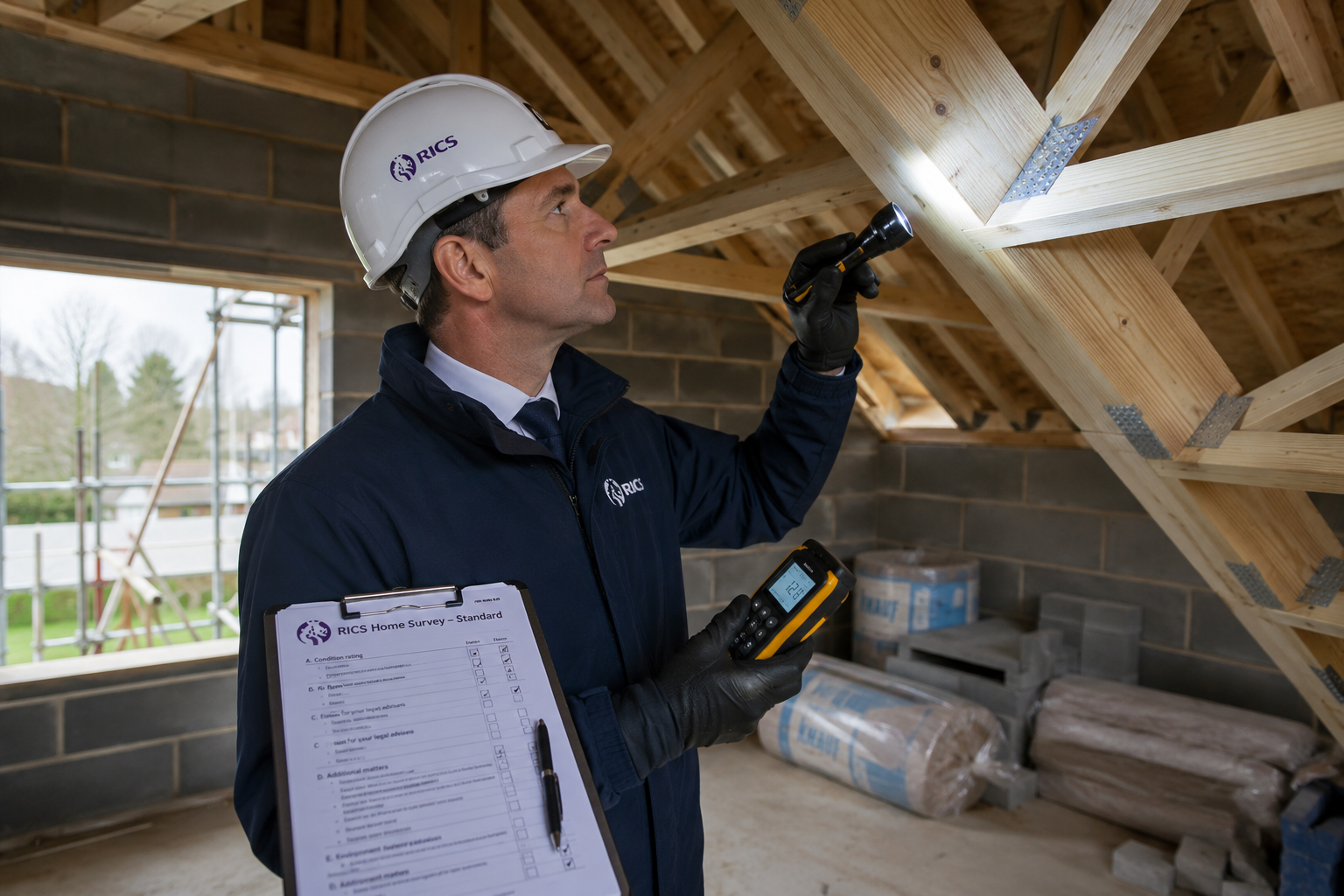
Why New Builds Are Not Defect-Free: The Case for Level 3 Inspection
The assumption that a newly constructed property is structurally sound is one of the most persistent and costly myths in the UK property market. Construction timelines have been compressed across many developments since 2022, driven by labour shortages, supply chain disruption, and developer pressure to meet housing targets. In Q4 2025, new home registrations rose by 14% year-on-year to approximately 42,500 units — the strongest final-quarter performance since 2021 [5]. Volume at that pace increases the statistical probability of workmanship errors slipping through.
Latent defects — those not immediately visible but present from the point of construction — are the central concern. Common examples include:
- Inadequate cavity wall insulation installation, creating cold bridging
- Poorly sealed roof junctions and flashings
- Substandard drainage falls leading to standing water
- Incorrect fixings in structural timber frames
- Thermal envelope failures that only become apparent in cold weather
A standard snagging survey identifies cosmetic and minor functional issues. It does not provide the depth of structural analysis, condition ratings, or repair cost guidance that a Level 3 building defects survey delivers. The Level 3 survey — formerly called the Full Building Survey or Full Structural Survey — covers construction materials, structural integrity, repair options, and maintenance planning in a single, comprehensive report [1].
For buyers of new builds, particularly those with concerns about the developer's track record or the speed of construction, the Level 3 survey provides a level of scrutiny that no other inspection product matches. To understand the full scope of what this survey involves, the guide to what a Level 3 building survey covers is a useful starting reference.
What the RICS Home Survey Standard Requires in 2026
The RICS Home Survey Standard, which governs how all Level 1, 2, and 3 surveys must be conducted, was updated to reflect evolving construction methods and buyer protection expectations. The 2026 protocols place particular emphasis on:
- Thermal performance reporting: Surveyors are expected to identify evidence of thermal bridging and inadequate insulation continuity, issues that are especially relevant in new builds claiming high energy ratings.
- Drainage and water management: Surface water drainage design in new developments must now be assessed against current Building Regulations Part H requirements, with any deviation flagged.
- Structural frame inspection: For timber frame and modular construction — both increasingly common in new builds — surveyors must document access limitations and recommend specialist follow-up where full inspection is not possible.
- Condition rating transparency: The three-tier condition rating system (1 = no repair needed, 2 = repair or replacement needed soon, 3 = urgent attention required) must be applied consistently, with written justification for each rating.
These updates align with the broader RICS commitment to raising consumer confidence in the survey process, particularly as buyers face higher purchase prices and greater financial exposure.
2026 Price Growth Context: Why Survey Investment Has Never Been More Justified
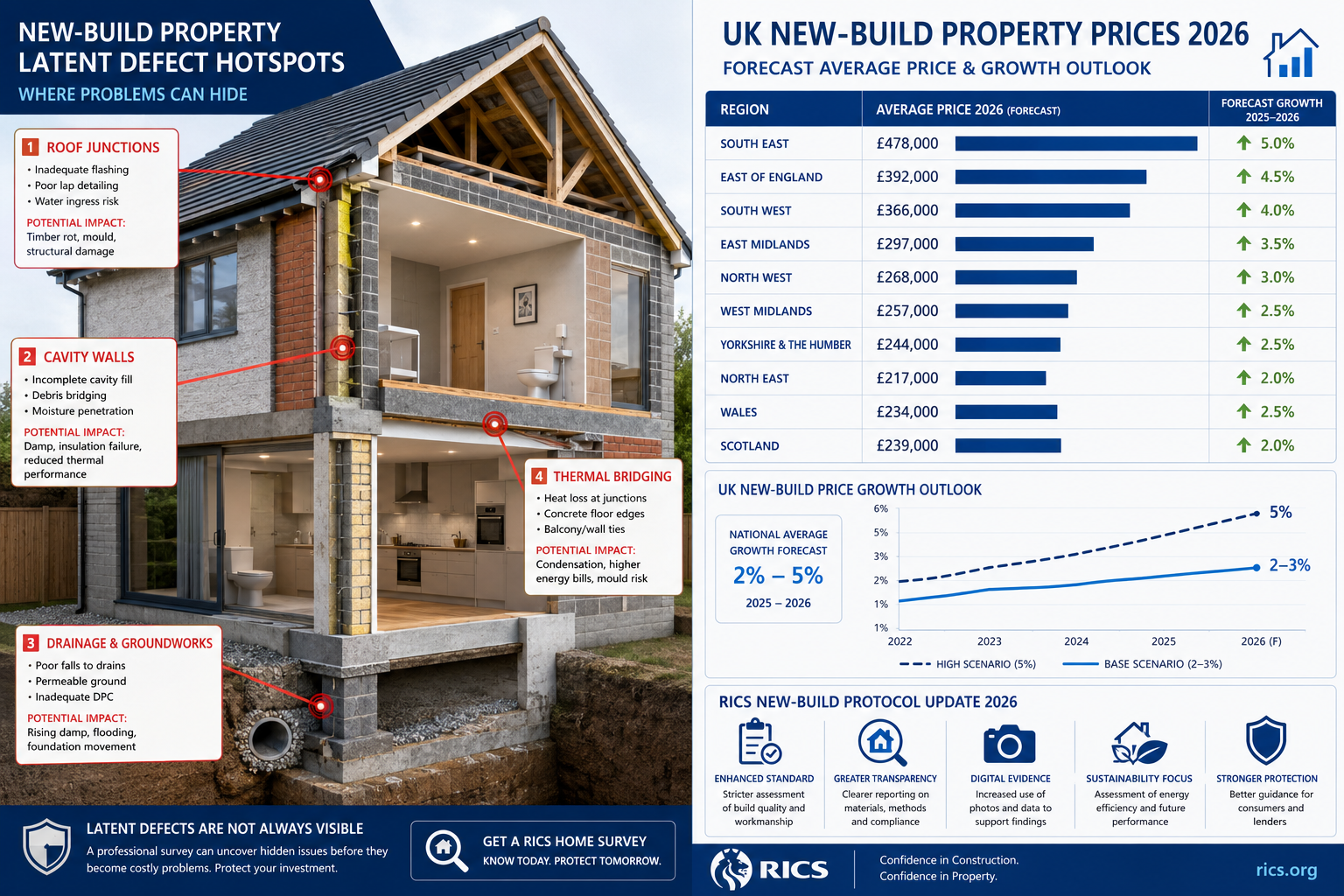
Understanding the market conditions that surround Level 3 RICS Building Surveys for New-Build Defects: 2026 Protocols Amid 2-5% Price Growth is essential for framing the financial logic of commissioning a thorough inspection.
National and Regional Price Data
As of January 2026, the average price of a new-build property in England stood at £379,000, representing a 4.7% annual increase [2]. However, the picture varies considerably by region:
| Region | Average New-Build Price (Jan 2026) | Annual Change |
|---|---|---|
| London | £479,109 | -6.6% |
| East Midlands | £349,667 | +0.7% |
| North East | £280,457 | +1.1% |
| England (national) | £379,000 | +4.7% |
Source: UK House Price Index, March 2026 [3]
Industry forecasts project new-build price growth of 2.5% to 3.5% across 2026, slightly ahead of the expected Consumer Price Index inflation range of 2.0% to 2.5% [4]. In practical terms, this means that a defect discovered after legal completion — rather than before — is a defect that must be remedied at the buyer's expense against a backdrop of rising material and labour costs.
The new-build premium of 23.4% over resold properties [2] is significant. Buyers are paying a substantial uplift on the assumption that a new property is in perfect condition. A Level 3 survey tests that assumption rigorously.
The Financial Logic of Survey Investment
A Level 3 survey typically costs between £600 and £1,500 depending on property size and location [1]. Against a purchase price of £379,000, that represents a cost of between 0.16% and 0.40% of the transaction value. If the survey identifies a structural defect requiring £15,000 in remediation — a realistic figure for drainage failures or roof junction issues — the return on that investment is immediate and substantial.
Beyond direct repair costs, there are secondary financial risks:
- Mortgage valuation impact: Lenders may down-value a property with documented defects, affecting the loan-to-value ratio.
- Resale difficulty: Undisclosed defects discovered by a future buyer's surveyor can collapse a sale or force a price reduction.
- Warranty claim complications: NHBC Buildmark and similar warranties have specific notification windows. A Level 3 survey report provides the documented evidence needed to make a timely and credible claim.
For buyers who want to understand how different survey types compare before committing, the resource on which building survey you need provides a clear framework.
2026 Protocols in Practice: How Level 3 Surveys Address New-Build Defects
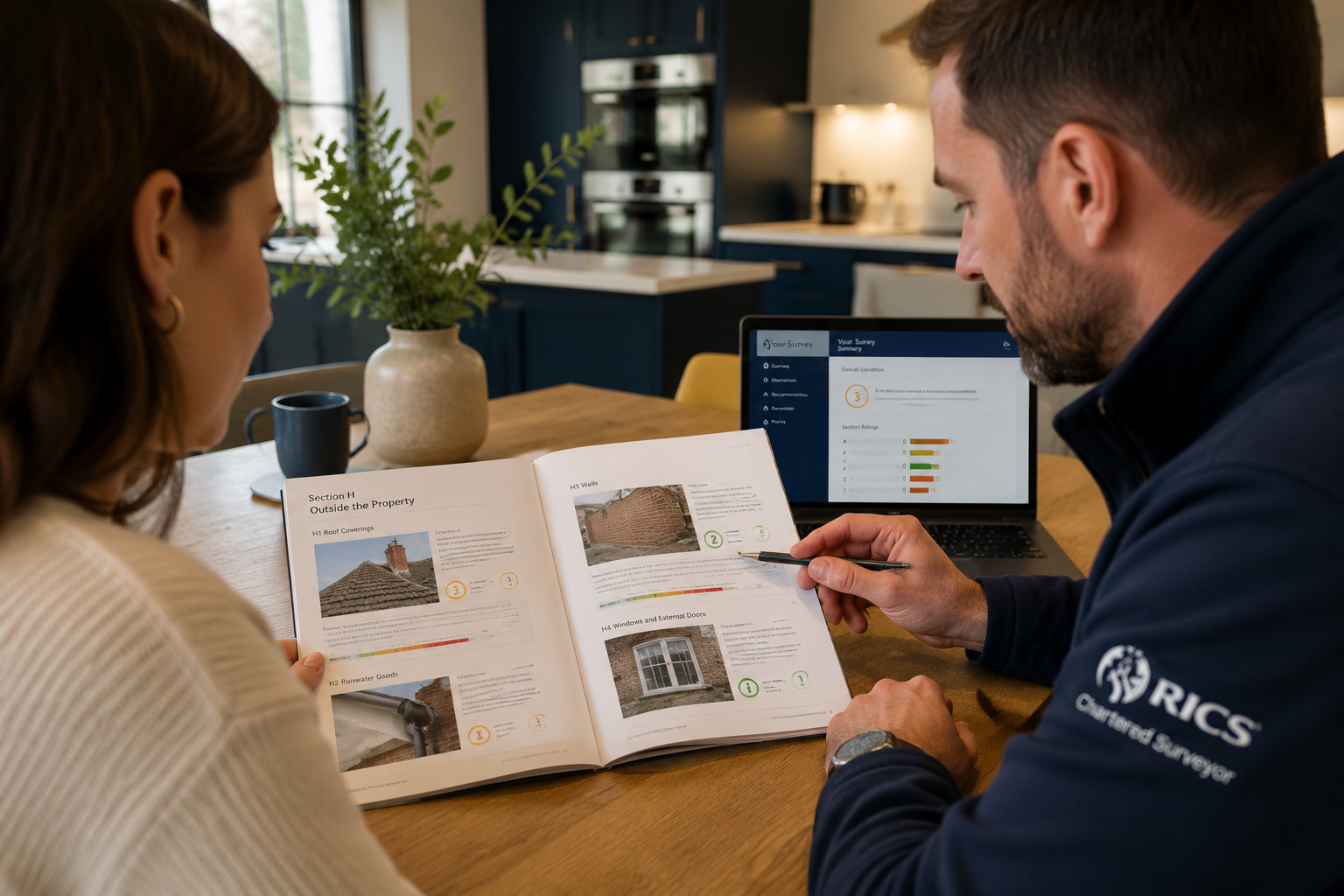
Level 3 RICS Building Surveys for New-Build Defects: 2026 Protocols Amid 2-5% Price Growth are not simply a box-ticking exercise. When applied to new-build properties, they follow a structured methodology that goes well beyond the visual inspection that most buyers assume constitutes a survey.
The Inspection Process
A Level 3 inspection of a new-build property typically takes between three and five hours on-site, depending on the size and complexity of the dwelling. The surveyor will assess:
- Roof structure and coverings: Including ridge, hips, valleys, flashings, and any flat roof sections. New builds frequently show poorly sealed junctions between pitched and flat roof elements.
- Walls, floors, and ceilings: Checking for cracking patterns, settlement, and any evidence of movement beyond expected initial shrinkage.
- Windows and external doors: Assessing installation quality, sealing, and compliance with thermal performance specifications.
- Services: A visual inspection of electrical, plumbing, and heating installations, with recommendations for specialist testing where appropriate.
- Drainage: Both above-ground waste systems and, where accessible, below-ground drainage connections.
- Insulation and ventilation: Particularly relevant in new builds where inadequate ventilation can cause condensation and mould growth within months of occupation.
For buyers who want to know what questions to raise with their surveyor during this process, the guide on questions to ask during a building survey is a practical resource.
Technology in 2026 Surveys
The 2026 protocols increasingly incorporate technology-assisted inspection methods. Drone surveys are now used by some RICS-accredited firms to inspect roof surfaces and upper-level elevations that are not safely accessible from ladders. Premium drone survey services allow surveyors to capture high-resolution imagery of areas that would otherwise require costly scaffold access, improving both the thoroughness and the evidential quality of the report.
Thermal imaging cameras, while not mandated by the RICS standard, are increasingly used to detect cold bridging and insulation gaps that are invisible to the naked eye. Where a surveyor uses thermal imaging, the findings must be reported within the standard condition rating framework.
The Relationship Between Snagging and Level 3 Surveys
It is important to distinguish between a snagging report and a Level 3 survey. A snagging survey identifies cosmetic deficiencies — paint runs, poorly fitted skirting boards, misaligned doors — and is typically conducted just before or immediately after legal completion. It is a valuable tool, but it does not provide structural analysis, condition ratings, or repair cost estimates.
A Level 3 survey, by contrast, is a professional assessment of the property's structural integrity and condition. The two are complementary rather than interchangeable. In cases where a buyer has genuine concerns about construction quality — for example, where the developer has a history of complaints or where the build programme was notably compressed — commissioning both a snagging survey and a Level 3 survey provides the most complete picture.
Consequences of Ignoring Survey Findings
The risks of proceeding without a thorough inspection are not abstract. Buyers who discover structural defects after completion face a difficult set of options: fund remediation themselves, pursue the developer through warranty or legal channels, or attempt to sell a property with a known defect. None of these outcomes is straightforward. The consequences of failing to act on survey findings are well documented and extend from financial loss to health and safety risks where damp, mould, or structural instability are involved.
For buyers who want to understand the full range of building survey types available before making a decision, a structured comparison helps clarify which product best fits the specific property and risk profile.
Practical Guidance for Buyers and Surveyors in 2026
For Buyers: Steps to Take Before Legal Completion
- Commission the survey before exchange of contracts where possible. This preserves the option to renegotiate or withdraw without financial penalty if serious defects are found.
- Select a RICS-accredited surveyor with specific experience in new-build inspections. Not all surveyors have equal familiarity with modern construction methods such as timber frame, structural insulated panels (SIPs), or modular construction.
- Request a Level 3 survey rather than a Level 2 if the property is a non-standard construction type, a high-value purchase, or if there are any concerns about the developer's quality controls.
- Use the survey report as a negotiation tool. Condition 3 defects (urgent attention required) identified in a pre-completion survey can be used to request remediation by the developer before handover, or a price reduction to reflect the cost of repair.
- Retain the report for warranty purposes. NHBC Buildmark cover runs for ten years. A Level 3 survey report dated before completion provides a baseline record of condition that is invaluable if a warranty claim becomes necessary later.
For Surveyors: Protocol Considerations in 2026
- Apply the RICS Home Survey Standard condition rating system consistently and document the reasoning behind each rating in writing.
- Flag all access limitations clearly, particularly in new builds where roof spaces, service voids, and drainage connections may not yet be fully accessible.
- Where thermal imaging is used, ensure findings are integrated into the main report rather than appended as a separate document, to avoid ambiguity in condition ratings.
- Advise clients explicitly on the distinction between defects covered by NHBC warranty and those that fall outside warranty scope, as this affects the buyer's remediation options.
Conclusion
The combination of rising new-build prices, compressed construction timelines, and updated RICS protocols makes 2026 a particularly important year for buyers to approach new-build purchases with rigorous professional scrutiny. Level 3 RICS Building Surveys for New-Build Defects: 2026 Protocols Amid 2-5% Price Growth are not an optional extra for cautious buyers — they are a proportionate response to the financial exposure that comes with purchasing a property at or above the national average of £379,000 [2].
The 2026 RICS Home Survey Standard updates strengthen the framework for latent defect detection, thermal performance reporting, and drainage assessment, giving buyers a more robust evidential base for warranty claims and developer negotiations. Survey costs of £600 to £1,500 [1] remain a fraction of the potential remediation costs associated with undetected structural or drainage defects.
Actionable next steps:
- Contact a RICS-accredited surveyor with new-build experience as early as possible in the purchase process — ideally before exchange of contracts.
- Clarify whether a Level 3 survey, a snagging survey, or both are appropriate for the specific property and developer.
- Review the RICS Home Survey Standard guidance to understand what the surveyor is required to report and how condition ratings should be interpreted.
- Use the completed survey report as a structured basis for any pre-completion negotiations with the developer.
Buyers who invest in a thorough Level 3 inspection before legal completion are not being overcautious. They are making a financially rational decision in a market where the premium for new construction is real, the risk of latent defects is statistically significant, and the cost of discovering problems after completion is almost always higher than the cost of finding them before.
References
[1] Rics Level 3 Building Survey What It Covers And Costs – legalclarity.org
[2] Uk House Price Index For February 2026 – gov.uk
[3] Uk House Price Index England March 2026 – gov.uk
[4] Inflation Affecting New Build Prices 2026 – new-builds.co.uk
[5] Uk New Build Market Outlook Spring 2026 – new-builds.co.uk