

By mid-2026, the UK housing market is doing something it has not managed convincingly since early 2022: showing genuine signs of stabilisation. Yet the national picture masks a striking internal divide. Southern regions — particularly London and the South East — are simultaneously among the most battered by the post-pandemic correction and the most likely to lead any sustained recovery. For surveyors, lenders and buyers navigating this environment, the challenge is not simply detecting that prices are levelling off. It is applying the right professional framework to value properties accurately when the market is neither falling sharply nor rising clearly. That is precisely where valuing stabilising southern markets: RICS techniques for London and South East price recovery in 2026 becomes a critical discipline.
Key Takeaways
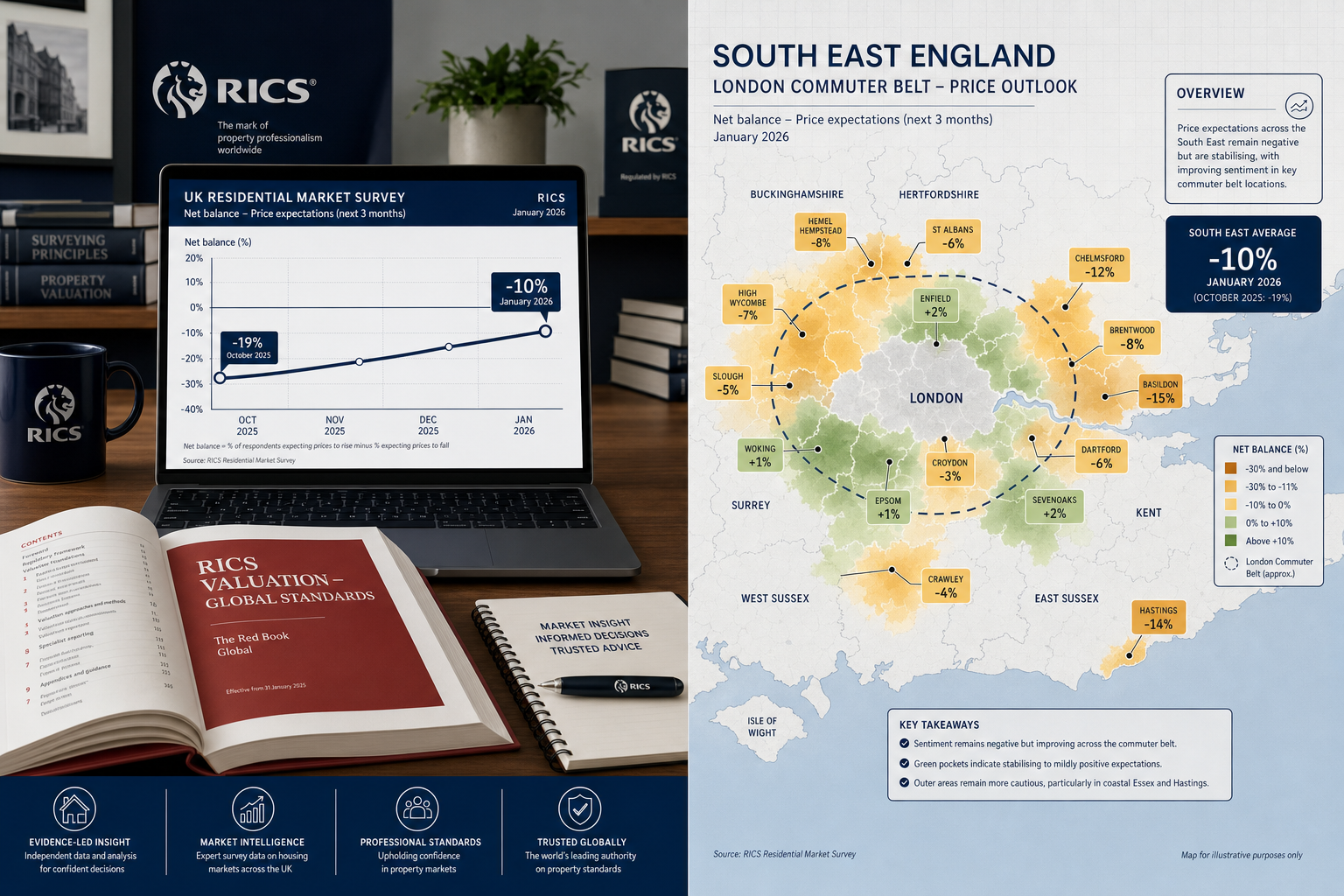
- RICS data from January and February 2026 show a clear moderation in the pace of price declines nationally, with the net balance improving from -19% in October 2025 to -10% by January 2026.
- A net +43% of RICS respondents expected prices to be higher in 12 months as of February 2026 — the most positive one-year outlook in over a year.
- London and the South East historically lead recovery cycles due to stronger employment fundamentals, transport connectivity and international demand.
- RICS Red Book standards and the monthly UK Residential Market Survey are the primary tools practitioners use to calibrate valuations during transitional market phases.
- Buyer enquiry upticks, comparable evidence weighting and adjusted yield models are the three core technical levers surveyors apply when markets are stabilising rather than clearly trending.
Why Southern Markets Are Diverging From the National Picture
The national housing market recovery narrative, while encouraging, is not uniform. RICS data published in early 2026 confirms that price falls are easing across the UK, but the pace and character of that easing differ markedly by region [4]. London and the South East present a specific paradox: these markets experienced some of the sharpest affordability-driven corrections between 2022 and 2025, yet they also carry the structural fundamentals — deep employment bases, international buyer pools, constrained land supply and strong transport infrastructure — that have historically driven them to recover earlier and more decisively than other regions [1].
The January 2026 RICS UK Residential Market Survey reported a net balance for national house price movements of -10%, a meaningful improvement from -19% recorded in October 2025 [4]. This trajectory signals that the market is moving from contraction toward equilibrium. Crucially, RICS commentary noted that buyer demand was firming, particularly in areas where employment and commuter connectivity are strongest — a description that maps squarely onto the London commuter belt and key South East submarkets such as Surrey, Kent and parts of Buckinghamshire [2][4].
By February 2026, the mood had shifted further. The net balance of respondents expecting higher prices over the next 12 months reached +43%, the most optimistic one-year price outlook recorded since February 2025 [9]. RICS noted that this positive expectation was concentrated in more resilient, higher-income regions — again, language that points toward the South East as a likely early mover [1][9].
This regional divergence creates a genuine valuation challenge. A surveyor working in Putney, Chiswick or Epsom in mid-2026 is operating in a market that is neither in freefall nor in clear upswing. Standard comparable evidence from 2024 and early 2025 may understate current values, while extrapolating from the most optimistic forward-looking indicators risks overstating them. The professional response requires a structured, RICS-grounded approach.
RICS Techniques for Valuing Stabilising Southern Markets in 2026
The Red Book Framework as the Foundation
The RICS Red Book — formally the RICS Valuation — Global Standards — remains the non-negotiable baseline for all professional valuations in the UK. In a stabilising market, its requirement for valuers to exercise independent, evidence-based judgment becomes especially demanding. The Red Book does not prescribe a single method for transitional markets; instead, it requires practitioners to select the most appropriate approach given the available evidence and to document their reasoning transparently.
For residential properties across London and the South East in 2026, the sales comparison approach remains dominant. However, the weighting given to different comparable transactions must be adjusted carefully. Comparable sales from Q3 and Q4 2025 — when the market was at or near its most depressed — may need upward adjustment to reflect the improved sentiment evidenced in the January and February 2026 RICS surveys [4][9]. Conversely, relying too heavily on pre-correction 2022 comparables would produce inflated figures that do not reflect the current market reality.
Surveyors working with professional chartered surveyor valuations in this environment are applying a layered comparable analysis: identifying the most recent transactions, assessing whether those transactions occurred during peak pessimism or during the current stabilisation phase, and adjusting accordingly with explicit commentary on the market conditions prevailing at the time of each comparable sale.
Reading Buyer Enquiry Upticks as a Leading Indicator
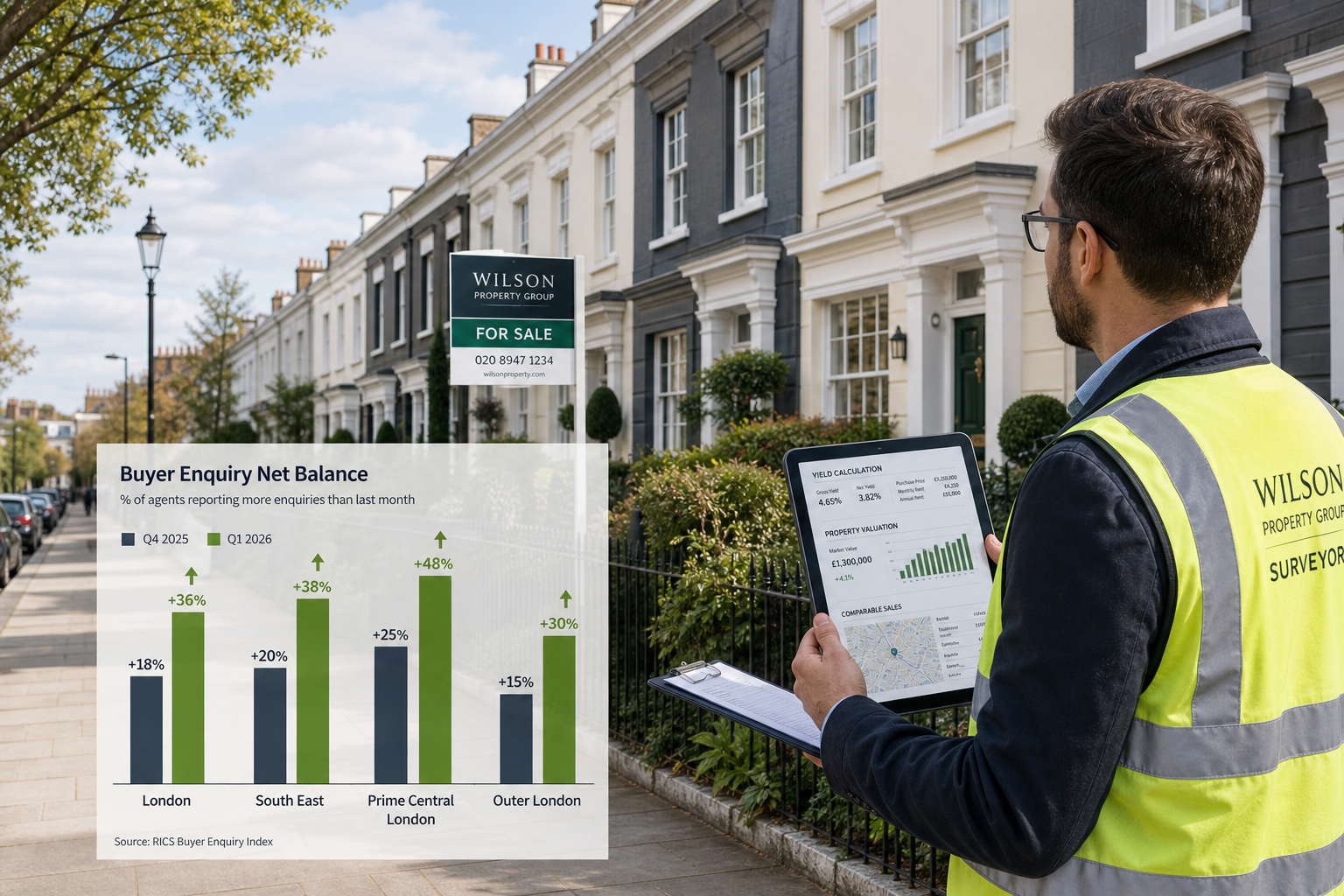
One of the most important signals in the RICS monthly survey data is the net balance for new buyer enquiries. This metric tends to lead price movements by several months: when more surveyors report rising enquiries than falling ones, price stabilisation and then recovery typically follow. The January and February 2026 surveys both recorded improvements in this metric, with RICS describing "firmer buyer demand" in southern England [2][4].
For valuers, this enquiry data is not merely background noise. It is a legitimate input into the valuation narrative. When a surveyor can demonstrate — using RICS survey data — that buyer demand in a specific submarket has been rising for two or three consecutive months, this supports a market conditions adjustment that moves comparable evidence toward the upper end of a reasonable range rather than the lower end.
This is particularly relevant for chartered surveyors operating across South East London and neighbouring commuter zones, where the combination of improved mortgage availability (following the Bank of England's rate adjustments in late 2025 and early 2026) and pent-up demand from buyers who paused during the correction is creating measurable upward pressure on enquiry volumes.
Adjusted Yield Models for Investment-Grade Properties
The South East residential market includes a substantial proportion of buy-to-let, purpose-built rental and mixed-tenure stock. For these properties, the income capitalisation approach — applying a yield to the achievable rental income — is either the primary or a cross-check valuation method. In a stabilising market, the appropriate yield to apply is itself a moving target.
During the peak correction of 2024-2025, yields in many South East markets widened as capital values fell faster than rents. As stabilisation takes hold in 2026, there is evidence that yields are beginning to compress again in higher-demand areas, reflecting improved investor confidence [1][6]. Surveyors applying adjusted yield models must therefore draw on current transaction evidence and RICS survey sentiment data together, rather than relying on yield benchmarks derived from the correction period alone.
For those considering property investment strategies in the South East, understanding how surveyors are recalibrating these yield assumptions is essential. A property valued on a 5.5% yield in Q4 2025 may legitimately support a 5.0-5.2% yield assumption by mid-2026 if the comparable evidence and enquiry data support that compression — and the Red Book requires the surveyor to justify that shift explicitly.
Applying RICS Survey Data to Local Submarket Analysis
The RICS UK Residential Market Survey is a national instrument, but its value for local practitioners lies in how its directional signals are interpreted against granular local evidence. Valuing stabilising southern markets: RICS techniques for London and South East price recovery in 2026 is ultimately a local exercise, conducted postcode by postcode, using national sentiment data as a calibrating framework rather than a direct input.
| RICS Metric | Late 2025 Reading | Early 2026 Reading | Implication for Valuers |
|---|---|---|---|
| National price net balance | -19% (Oct 2025) | -10% (Jan 2026) | Correction easing; adjust comparable weighting |
| 12-month price expectations | Negative/flat | +43% positive (Feb 2026) | Support upper-range comparable selection |
| Buyer enquiries net balance | Weakly negative | Improving/positive | Use as leading indicator in market commentary |
| Sales volumes | Subdued | Subdued but stabilising | Limited comparable pool; widen search radius carefully |
Source: RICS UK Residential Market Survey, January and February 2026 [4][9]
Submarket Prioritisation: Where Recovery Signals Are Strongest
Not all South East submarkets are recovering at the same pace. RICS commentary consistently highlights that better-connected, higher-income areas tend to show recovery signals first [1][10]. For practical valuation purposes, this means surveyors should differentiate between:
Prime commuter towns (e.g., areas with fast rail links to central London under 40 minutes): These markets are showing the clearest uptick in enquiries and the most supportive comparable evidence for modest upward adjustments.
Secondary commuter zones (30-60 minute rail journeys, less frequent services): Stabilisation is occurring but more slowly; comparable adjustments should be conservative and well-documented.
Outer South East markets (beyond the traditional commuter belt): These areas may still be experiencing price softness and should be treated with caution when selecting comparables.
Surveyors covering areas such as Surrey, Buckinghamshire and Hampshire are applying exactly this kind of tiered analysis, using local transaction data cross-referenced against the RICS survey's regional commentary to position their valuations appropriately.
The Role of Condition and Building Quality in Stabilising Markets
In a market where buyers have become more selective — a characteristic feature of stabilisation phases — property condition plays a heightened role in valuation outcomes. Buyers who paused during the correction period have had time to research thoroughly and are less willing to absorb significant remediation costs without price concessions. This means that defects identified during a survey — whether structural issues, roof problems or timber decay — carry greater valuation weight in 2026 than they might have during the frenzied 2021-2022 market.
For buyers seeking to understand the full picture before committing, a Level 2 or Level 3 building survey is not merely a due diligence formality. It is a direct input into the negotiation and valuation process. Surveyors are increasingly being asked to provide condition-adjusted valuations that explicitly account for the cost of remediation works, particularly for older stock in inner South East London where Victorian and Edwardian properties dominate.
Practical Steps for Buyers, Sellers and Investors in 2026

The technical framework outlined above has direct practical implications for all parties transacting in southern markets during this stabilisation phase.
For buyers: Do not assume that the national recovery narrative translates uniformly to the property you are viewing. Commission a current valuation from a RICS-registered surveyor who can demonstrate familiarity with the specific submarket. Ask explicitly how the surveyor has weighted recent comparables against the improving sentiment data from the RICS monthly surveys.
For sellers: Pricing strategy in a stabilising market requires precision. Overpricing relative to the current comparable evidence — even if forward-looking indicators are positive — will result in extended marketing periods that themselves become a negative signal to buyers. Work with an agent and surveyor who understand the distinction between current market value and anticipated future value.
For investors: The yield recalibration underway in South East markets in 2026 creates a window of opportunity, but it requires careful analysis. Properties that were correctly valued on wider yields in 2024-2025 may now be approaching a point where yield compression begins to drive capital value recovery. Understanding how surveyors are applying adjusted yield models — as described above — is essential to identifying genuine value rather than simply chasing the recovery narrative.
"The most positive one-year price outlook since February 2025 — with +43% of RICS respondents expecting higher prices — signals that professional confidence in southern market recovery is building on solid foundations, not wishful thinking." [9]
For those managing residential blocks or multi-unit assets across the South East, the stabilisation phase also has implications for service charge budgeting, insurance valuations and reinstatement cost assessments. Ensuring that block management arrangements are aligned with current market conditions — including updated insurance reinstatement valuations — is a practical priority that should not be deferred.
Similarly, for estate planning and tax purposes, the stabilisation of values creates both challenges and opportunities. Inheritance tax valuations and capital gains assessments carried out during a transitional market phase require the same rigorous RICS-grounded approach described throughout this article — with explicit documentation of the market conditions prevailing at the date of valuation.
Conclusion
Valuing stabilising southern markets: RICS techniques for London and South East price recovery in 2026 is not a single method or a proprietary toolkit. It is the disciplined application of established RICS Red Book standards, informed by the directional signals in the monthly UK Residential Market Survey, and grounded in granular local comparable evidence. The data from January and February 2026 is clear: price declines are moderating, buyer enquiries are firming, and forward-looking sentiment has turned decisively more positive [4][9]. London and the South East — with their structural advantages in employment, connectivity and demand depth — are positioned to lead that recovery as conditions continue to improve [1][10].
Actionable next steps for 2026:
- Commission a RICS-registered valuation that explicitly references current market survey data and documents how comparables have been weighted for market conditions.
- Distinguish between submarket tiers within the South East — prime commuter towns, secondary zones and outer markets — and apply appropriate adjustments to each.
- Use buyer enquiry net balances from RICS monthly surveys as a leading indicator when assessing whether to adjust valuations toward the upper or lower end of a reasonable range.
- For investment properties, request a yield sensitivity analysis that reflects the compression underway in higher-demand South East submarkets.
- Ensure all tax-related and insurance valuations are dated and documented to reflect the specific market conditions of mid-2026, not earlier correction-phase data.
The window between clear stabilisation and confirmed recovery is precisely when accurate, professionally grounded valuations matter most. Acting on robust RICS-aligned advice now — rather than waiting for the recovery to become self-evident — is the approach most likely to protect and enhance value across London and South East property assets.
References
[1] Rics Uk Housing Market Signs Of Tentative Recovery – moneyweek.com
[2] Green Shoots Emerge As Rics Signals Tentative Housing Market Recovery – bebeez.eu
[4] Uk Resi Survey Jan 2026 Report Shows Early Signs Market Recovery Despite Caution – rics.org
[5] Uk Housing Market Shows Signs Of Stabilising In May Rics Reports – global.morningstar.com
[6] Latest Rics Survey Reveals Global Headwinds Are Weighing On Housing Market Confidence – buyassociationgroup.com
[9] Uk Residential Market Survey February 2026 – rics.org
[10] Subdued Housing Market May Be Starting To Stabilise Surveyors – itv.com