

The West Midlands is selling homes in an average of 37 days — faster than anywhere else in the UK — at a moment when national buyer enquiries have fallen to a net balance of -26% [5]. That gap between regional momentum and national hesitation is precisely where skilled surveyors find both their greatest challenge and their clearest opportunity in 2026.
This article unpacks the Midlands property valuations in 2026: surveyor playbook for 2.5% growth leading national recovery — drawing on the latest RICS data, lender forecasts, and regional market intelligence to give practitioners a structured, evidence-based approach to valuation work across the West Midlands and North West.

Key Takeaways
- Major lenders and estate agencies forecast a 2.5% rise in UK house prices by Q4 2026, with the Midlands outperforming the national average on transaction speed and stock turnover.
- The RICS January 2026 survey recorded a national net balance of -10%, signalling price stabilisation rather than decline — a critical context for accurate valuations.
- Interest rates held at 3.75% in February 2026, with potential cuts expected later in the year, which will directly affect mortgage-linked valuations.
- Supply reached an eight-year high at the start of 2026, with agents marketing an average of 32 properties — increasing the importance of comparable evidence selection.
- RICS Red Book standards updated in January 2025 now embed ESG factors into valuation frameworks, requiring surveyors to account for energy performance in every instruction.
Why the Midlands Is Outpacing the National Market in 2026
The national picture in early 2026 is one of cautious stabilisation. Consumer price inflation eased to 3.0% in January 2026, down from 3.4% in December 2025, and the Bank of England held interest rates at 3.75% in February, with markets pricing in further cuts later in the year [6]. Against that backdrop, mortgage approvals fell to their lowest level in two years, partly reflecting uncertainty following the November Budget [5].
Yet the West Midlands is behaving differently. The region is characterised by high transactional activity and healthy stock turnover, making it one of the UK's most resilient markets in the current cycle [2]. Affordability relative to London and the South East continues to attract buyers, and infrastructure investment — particularly around HS2-adjacent corridors — has sustained demand in key pockets.
What is driving Midlands outperformance?
- Relative affordability: Average prices remain significantly below London equivalents, keeping mortgage-to-income ratios manageable even at current rates.
- Employment base: A diversified economy spanning manufacturing, logistics, professional services, and the growing tech sector in Birmingham supports steady demand.
- Transaction velocity: The 37-day average time to sell in the West Midlands compares favourably to the national average, reducing void periods for sellers and improving comparable evidence freshness for valuers [5].
- Rental pressure: A net 28% of respondents to the RICS survey expect rental prices to rise in the near term, up from 16% previously, which sustains investor activity and supports capital values [6].
The North West tells a similar story. Affordability metrics in cities such as Manchester, Salford, and Liverpool remain attractive, and rate cut expectations are feeding through to buyer confidence more quickly than in higher-value southern markets.
For surveyors, this regional divergence is the defining feature of the 2026 valuation landscape. A national stabilisation narrative does not translate directly into Midlands or North West instructions — and applying national averages to regional comparables is a material risk.
The RICS Framework: Valuation Techniques Calibrated for 2.5% Growth
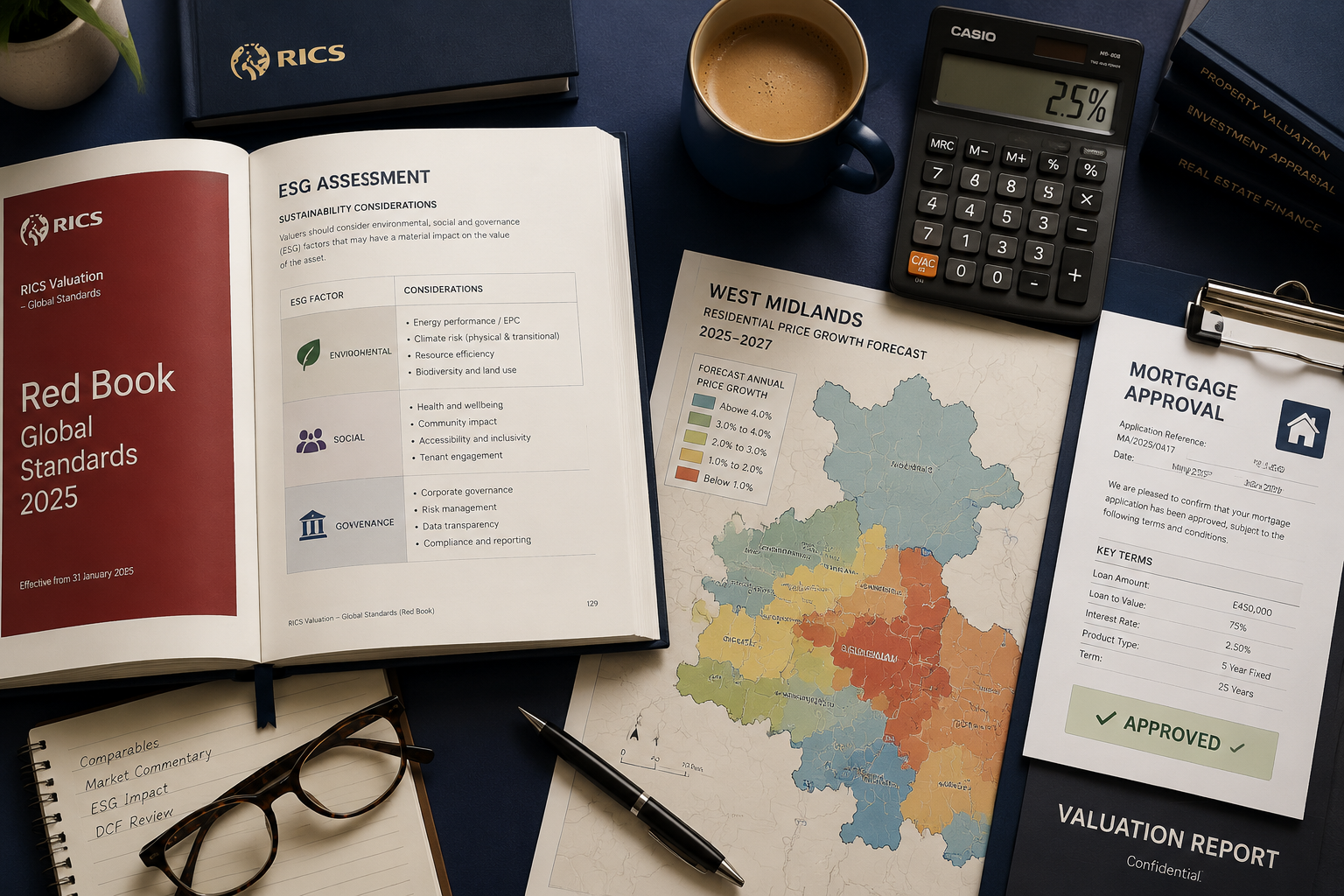
The RICS Red Book standards, updated in January 2025, provide the professional backbone for every formal valuation instruction. The revisions are specifically tailored for modest growth environments like the one projected for 2026, with three areas of particular relevance to Midlands practitioners [3].
Comparable Evidence in a High-Supply Market
2026 began with the highest level of homes for sale in over eight years, with the average agent marketing 32 properties [6]. For valuers, this is both an asset and a hazard. More comparables mean richer data — but it also means greater variance in achieved prices, particularly where motivated sellers have accepted discounts.
The RICS guidance recommends:
- Weighting recent transactions over asking prices — in a market where supply has risen sharply, the gap between asking and achieved price can widen without being reflected in portal listings.
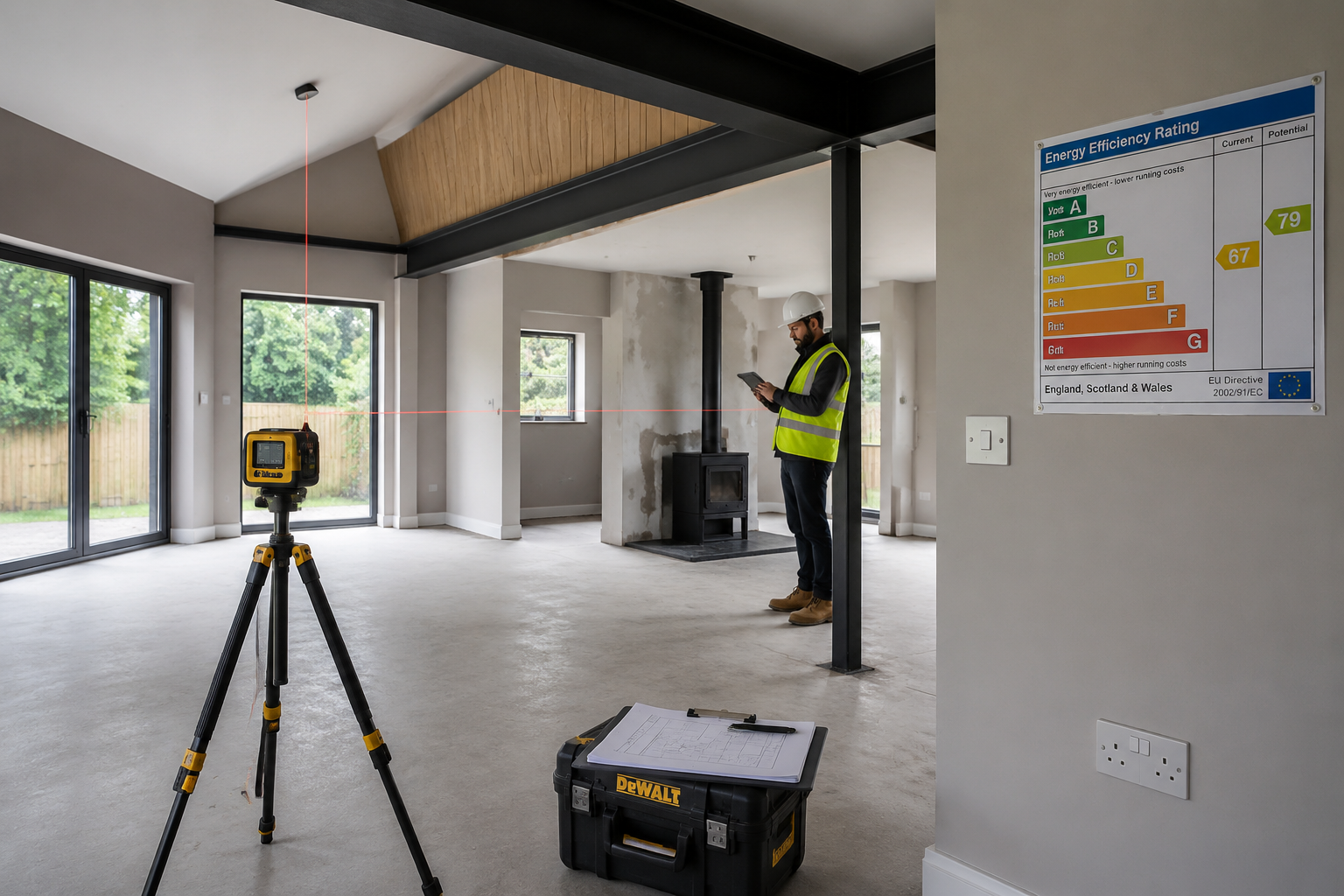
- Adjusting for condition and EPC rating — the updated Red Book explicitly requires surveyors to factor energy performance into comparable adjustments. Properties with EPC ratings below D are increasingly subject to buyer discount expectations, and this must be reflected in valuation methodology.
- Narrowing the comparable search radius — in a market with strong micro-level variation like the West Midlands, a 1-mile radius can span two entirely different demand profiles. Tighter geographic selection improves accuracy.
For clients requiring a formal independent property valuation, these methodological choices are not academic — they directly affect the figure that underpins mortgage offers, tax calculations, and legal settlements.
ESG Factors and the EPC Imperative
The January 2025 Red Book update embedded ESG considerations as a standard valuation input, not an optional commentary [3]. In practice, this means:
| EPC Rating | Valuation Implication in 2026 |
|---|---|
| A or B | Premium over comparable C-rated stock; strong buyer demand |
| C | Benchmark; no adjustment required in most cases |
| D | Minor downward adjustment in mortgage-sensitive transactions |
| E, F, or G | Material discount; lender restrictions may apply under MEES |
Surveyors working in the Midlands should be aware that a significant proportion of the region's older terraced and semi-detached stock falls into the D-to-F range. Understanding how to apply EPC-related adjustments consistently — and how to document them for RICS compliance — is now a core competency. For more on how energy performance intersects with survey work, see this guide to EPC ratings and MEES in building surveys.
Monitoring Regional Indicators Between Instructions
The RICS January 2026 survey recorded a national net balance of -10%, indicating price stabilisation [4]. However, that figure masks significant regional variation. Surveyors relying solely on national indices between instructions risk applying stale assumptions to active markets.
The recommended approach is to track:
- Monthly RICS residential market surveys at regional level
- Land Registry price paid data with a 4-to-6 week lag
- Local agent stock and sale-agreed volumes
- Mortgage approval trends from UK Finance
This intelligence feeds directly into the "market conditions" section of every Red Book-compliant valuation report.
Surveyor Playbook: Practical Strategies for Midlands Instructions in 2026
The Midlands property valuations in 2026: surveyor playbook for 2.5% growth leading national recovery is not simply a matter of applying the right methodology — it requires a structured workflow that accounts for the specific market conditions described above. Below is a practical framework for practitioners handling residential and mixed-use instructions across the region.
Step 1: Establish the Instruction Type and Its Sensitivity to Growth
Not all valuation instructions respond equally to a 2.5% growth environment. Before selecting comparables or applying adjustments, identify the purpose:
- Mortgage valuations: Lenders remain cautious following the drop in approvals seen in January 2026. Red Book compliance and conservative comparable selection are paramount.
- Capital gains tax valuations: With HMRC scrutiny of property disposals increasing, accurate base-date valuations are essential. See the capital gains tax valuation service for context on what HMRC expects.
- Matrimonial valuations: Contested valuations in divorce proceedings require defensible methodology. The matrimonial valuation service outlines the specific requirements for court-admissible reports.
- SIPP and pension fund valuations: Trustees require RICS-compliant valuations for commercial and mixed-use assets held in self-invested pension plans. The SIPP pension valuation service covers the regulatory framework in detail.
Step 2: Build a Comparable Matrix That Reflects Current Conditions
Given the high supply levels and the divergence between asking and achieved prices, a robust comparable matrix for a Midlands instruction in 2026 should include:
- A minimum of three Land Registry-confirmed sales within the past six months
- At least one comparable from within 0.5 miles where possible
- Explicit adjustments for EPC rating, condition, tenure, and floor area
- A commentary on any outliers and the reason they were excluded or discounted
"In a market where supply is at an eight-year high, the comparable you exclude is often as important as the one you include. Documenting that decision is what makes a valuation defensible."
Step 3: Account for the Rate Environment in Mortgage-Linked Instructions
Interest rates at 3.75% — with cuts expected later in 2026 — create a specific challenge for mortgage valuations [6]. A property valued today may be subject to a different affordability calculation by the time the mortgage offer is issued. Surveyors should:
- Flag rate sensitivity explicitly in the assumptions section of the report
- Avoid extrapolating current buyer appetite into forward valuations without qualification
- Note that any rate cut materialising in H2 2026 could release pent-up demand, particularly in the first-time buyer segment
Step 4: Leverage the Building Survey Demand Surge
Renewed mortgage lending volumes have driven increased demand for building surveys across the Midlands, North, and coastal commuter belts [7]. This creates a commercial opportunity for surveying practices — but also a quality risk if capacity is stretched.
For buyers, understanding the difference between survey levels is critical. The complete guide to choosing between a Level 2 and Level 3 survey sets out when each is appropriate. For older Midlands stock — Victorian and Edwardian terraces, for example — a full Level 3 building survey is typically the right choice given the potential for hidden defects.
Practices managing increased survey volumes should ensure:
- Turnaround times remain within RICS guidance
- Report quality is not compressed by commercial pressure
- Referral relationships with structural engineers and specialist contractors are maintained for complex instructions
For instructions requiring specialist input, the structural engineering service provides the technical backup that complex Midlands properties often demand.
Step 5: Address the Rental Market Dimension
With a net 28% of RICS survey respondents expecting rental prices to rise [6], buy-to-let investors are increasingly active in the Midlands market. Valuers handling investment instructions should:
- Apply a yield-based cross-check alongside the comparable evidence approach
- Reference current rental market data from local letting agents
- Consider the impact of new property management legislation on net yields
The guide to property investment provides a useful framework for clients navigating the buy-to-let landscape in the current cycle.
Key Risks and How to Mitigate Them
The 2.5% growth forecast is a central scenario, not a guarantee. Surveyors operating within the Midlands property valuations in 2026: surveyor playbook for 2.5% growth leading national recovery framework must hold that projection lightly and build appropriate caveats into their reports.
Primary risks to monitor:
| Risk Factor | Current Signal | Mitigation |
|---|---|---|
| Buyer enquiry decline | Net balance -26% in February 2026 [5] | Tighten comparable recency; flag market conditions |
| Mortgage approval weakness | Two-year low in January 2026 [5] | Conservative comparable selection; note lender sensitivity |
| Supply overhang | Eight-year high in stock levels [6] | Weight achieved prices; exclude overpriced comparables |
| EPC-driven discounts | Regulatory pressure on sub-D rated stock | Apply explicit EPC adjustment with documented rationale |
| Rate cut timing uncertainty | Rates held at 3.75% [6] | Qualify assumptions; avoid forward projections without caveat |
Conclusion
The Midlands property valuations in 2026: surveyor playbook for 2.5% growth leading national recovery is built on a clear premise: regional outperformance requires regional methodology. National stabilisation data is a starting point, not a conclusion.
For surveyors operating across the West Midlands and North West, the actionable priorities are:
- Refresh your comparable evidence framework to account for the eight-year supply high and the widening gap between asking and achieved prices.
- Embed EPC adjustments as a standard line item in every valuation report, consistent with the updated RICS Red Book standards.
- Differentiate by instruction type — mortgage, CGT, matrimonial, and SIPP valuations each carry distinct methodological and compliance requirements.
- Monitor regional indicators monthly, not quarterly — the West Midlands market is moving faster than national indices reflect.
- Capitalise on the building survey demand surge by maintaining quality standards and specialist referral networks as volumes increase.
The 2.5% growth projection represents a genuine recovery signal for the Midlands. Surveyors who align their methodology to the specific conditions driving that growth — affordability, rate sensitivity, ESG compliance, and regional transaction dynamics — will produce valuations that are both accurate and defensible.
References
[1] Housing Market Recovery Signals From Rics January 2026 Survey Implications For Building Surveyors And Party Wall Demand – wimbledonsurveyors.com
[2] 2026 Midlands Property Market Is Your Area Bucking The Trend – carpenter-surveyors.com
[3] Valuation Techniques For Modest 2 5 Price Growth Properties Rics Tools For 2026 Stabilising Markets – wimbledonsurveyors.com
[4] Valuing Stabilised National Prices In Early 2026 Rics Techniques From January Survey Insights – kingstonsurveyors.com
[5] West Midlands Regional Market Report – fineandcountry.co.uk
[6] Regional Property Market Update Spring 2026 West Midlands – morganandassociates.co.uk
[7] Building Survey Demand Surge In Q2 2026 Capitalising On Market Recovery While Managing Regional Price Divergence – wimbledonsurveyors.com