

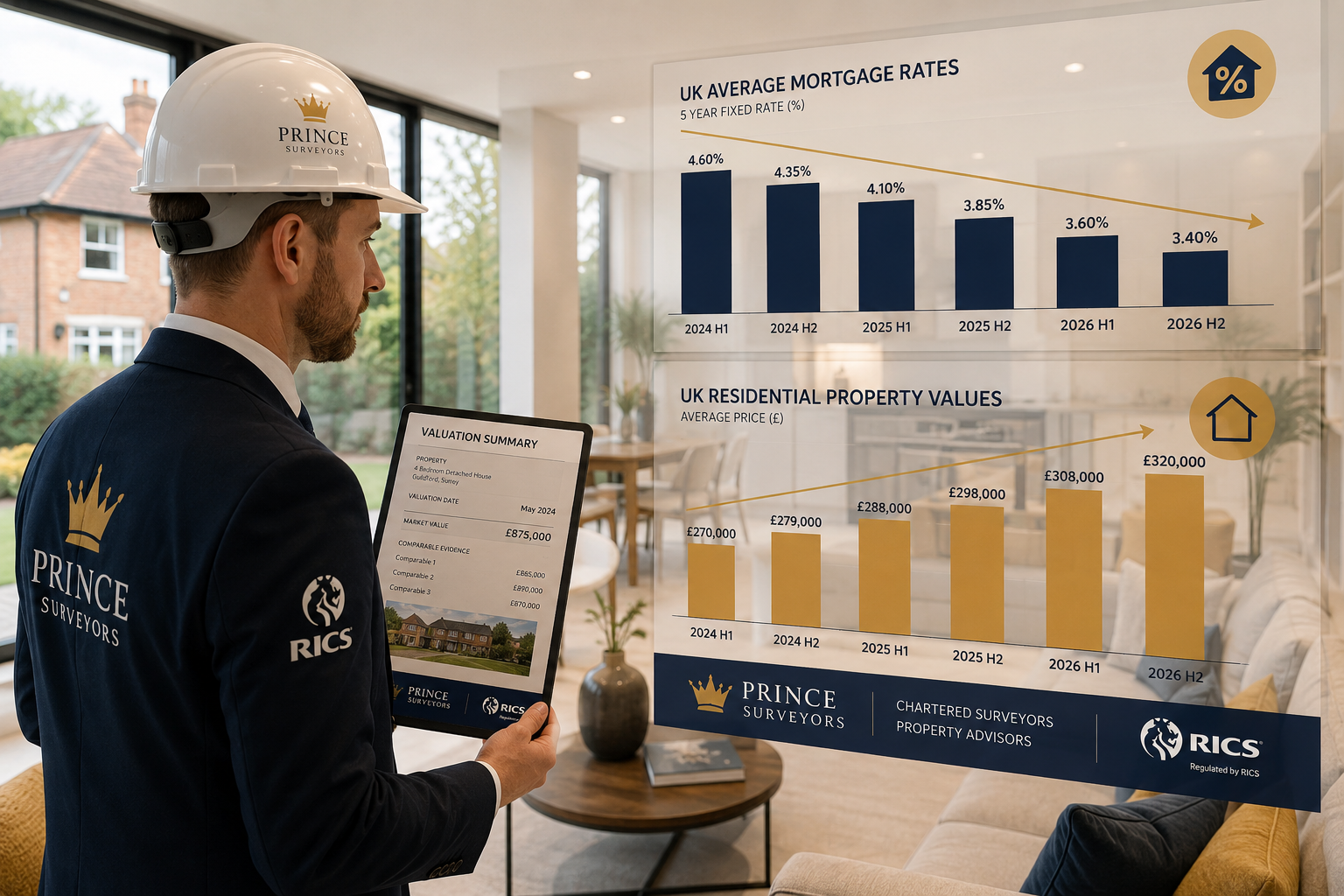
A 39% drop in buyer enquiries recorded by the Royal Institution of Chartered Surveyors (RICS) between February and March 2026 sent a clear signal to the property sector: the market is in transition, not decline [2]. That distinction matters enormously for chartered surveyors, landlords, and prospective buyers trying to make sense of a landscape where falling mortgage rates and shifting rental dynamics are pulling valuations in competing directions.
Chartered Valuations Post-Mortgage Rate Cuts 2026: Adjusting for Rental Shifts and Buyer Confidence sits at the centre of one of the most complex valuation environments in recent memory. Rate reductions have improved affordability on paper, but buyer behaviour has not responded uniformly. Surveyors must now account for a market where confidence is returning gradually, rental yields are being repriced, and traditional comparable-evidence methods alone are no longer sufficient.
Key Takeaways
- Mortgage rate reductions in 2026 are improving affordability, but buyer confidence is recovering unevenly across regions and property types.
- RICS data shows a significant short-term dip in buyer enquiries, requiring surveyors to apply scenario-based and forward-looking valuation methodologies.
- Rental market shifts are directly influencing capital valuations, particularly for buy-to-let and mixed-use properties.
- Chartered surveyors must recalibrate their approaches to reflect improved purchasing power while remaining cautious about overstating demand.
- Independent, professionally instructed valuations are more important than ever in a market where price signals are temporarily distorted.
Why Mortgage Rate Cuts Are Reshaping the Valuation Landscape in 2026
Morgan Stanley forecasts that 30-year fixed mortgage rates will fall to approximately 5.75% in 2026, a meaningful reduction from the elevated levels that suppressed transaction volumes throughout 2023 and 2024 [1]. In the UK context, the Bank of England's base rate trajectory has followed a similar downward path, with analysts at Martin & Co describing the recent base rate cut as "a turning point" that could gradually restore buyer confidence and rebalance supply and demand [5].
However, the relationship between rate cuts and market activity is rarely immediate or linear. Housingwire's 2026 housing forecast notes that inventory levels are returning toward normal and home-price growth is slowing, creating better conditions for buyers but not necessarily a surge in transactions [7]. Realtor.com's projections align with this cautious outlook, forecasting mortgage rates near 6.3% and home price growth of approximately 2.2% for the year [8].
For chartered surveyors, these figures are not abstract. They translate directly into how a property's market value is assessed.
Key factors driving valuation recalibration in 2026:
| Factor | Impact on Valuation |
|---|---|
| Lower mortgage rates | Increases buyer purchasing power; supports modest price growth |
| Reduced buyer enquiries | Limits comparable transaction evidence |
| Rising rental yields | Boosts investment valuations for buy-to-let stock |
| Increased inventory | Moderates upward price pressure |
| Improved affordability | Expands the buyer pool over time |
Morgan Stanley's data also suggests home prices will rise by 2% in 2026 and 3% in 2027, signalling a stabilisation rather than a boom [1]. Surveyors who interpret rate cuts as a trigger for aggressive upward revaluations risk overstating market value in a period where buyer behaviour is still catching up with improved affordability.
Understanding what to do if your home valuation is less than an offer is particularly relevant right now, as the gap between asking prices and chartered valuations can widen during transitional market phases.
Adjusting for Rental Shifts: What Chartered Valuations Post-Mortgage Rate Cuts 2026 Must Reflect

The rental sector has undergone significant structural change since the rate hiking cycle began in 2022. With homeownership temporarily out of reach for many households, rental demand surged. Now, as rates fall and some renters convert to buyers, landlords and surveyors face a different challenge: accurately pricing properties in a rental market that is beginning to soften at the margins while remaining structurally tight in many urban areas.
How Rental Yield Changes Feed Into Capital Values
A property's capital value and its rental income are intrinsically linked. When rental yields shift, so does the investment value of the asset. This is especially relevant for landlord and property investors who hold buy-to-let portfolios and need accurate valuations for refinancing, disposal, or portfolio restructuring.
Analysis from WillItFlow.io highlights a nuanced reality: while rate cuts can improve rental property cash flow by reducing financing costs, they rarely compensate for poor investment decisions made at peak prices [3]. This reinforces the importance of comprehensive, evidence-based valuations rather than relying on rate-cut optimism alone.
Surveyors adjusting rental-influenced valuations in 2026 should consider:
- Gross and net yield recalculation based on current achievable rents, not historic passing rents
- Void period assumptions, which may increase as some tenants transition to ownership
- Capitalisation rate adjustments reflecting improved investor appetite driven by lower borrowing costs
- Regulatory cost allowances, including energy efficiency compliance and licensing requirements
Knowing how often rental units should be inspected also feeds into valuation accuracy, as well-maintained properties with documented inspection records tend to command stronger investment valuations.
Regional Variation in Rental Market Adjustment
The rental market is not uniform. In high-demand urban areas such as South West London, Surrey, and parts of Essex, rental supply remains constrained and yields are holding firm. In contrast, some outer commuter zones are seeing modest softening as improved affordability draws tenants toward purchase.
Chartered surveyors operating across South West London and Surrey are reporting that rental evidence continues to support strong capital values, even as the owner-occupier market adjusts. This regional divergence requires surveyors to apply local market intelligence rather than applying national trends uniformly.
"A surveyor who applies a national rate-cut narrative to a hyper-local rental market without examining actual lettings evidence is not conducting a valuation — they are conducting an assumption."
Surveyor Methodologies for a Confidence-Boosting Environment
The RICS buyer enquiry data from early 2026 presents a methodological challenge. When transaction volumes fall, the pool of comparable sales evidence shrinks. Surveyors who rely solely on recent sales comparables may find insufficient data to support robust valuations [2]. This has prompted a shift toward more sophisticated, multi-method approaches.
Scenario-Based Valuations
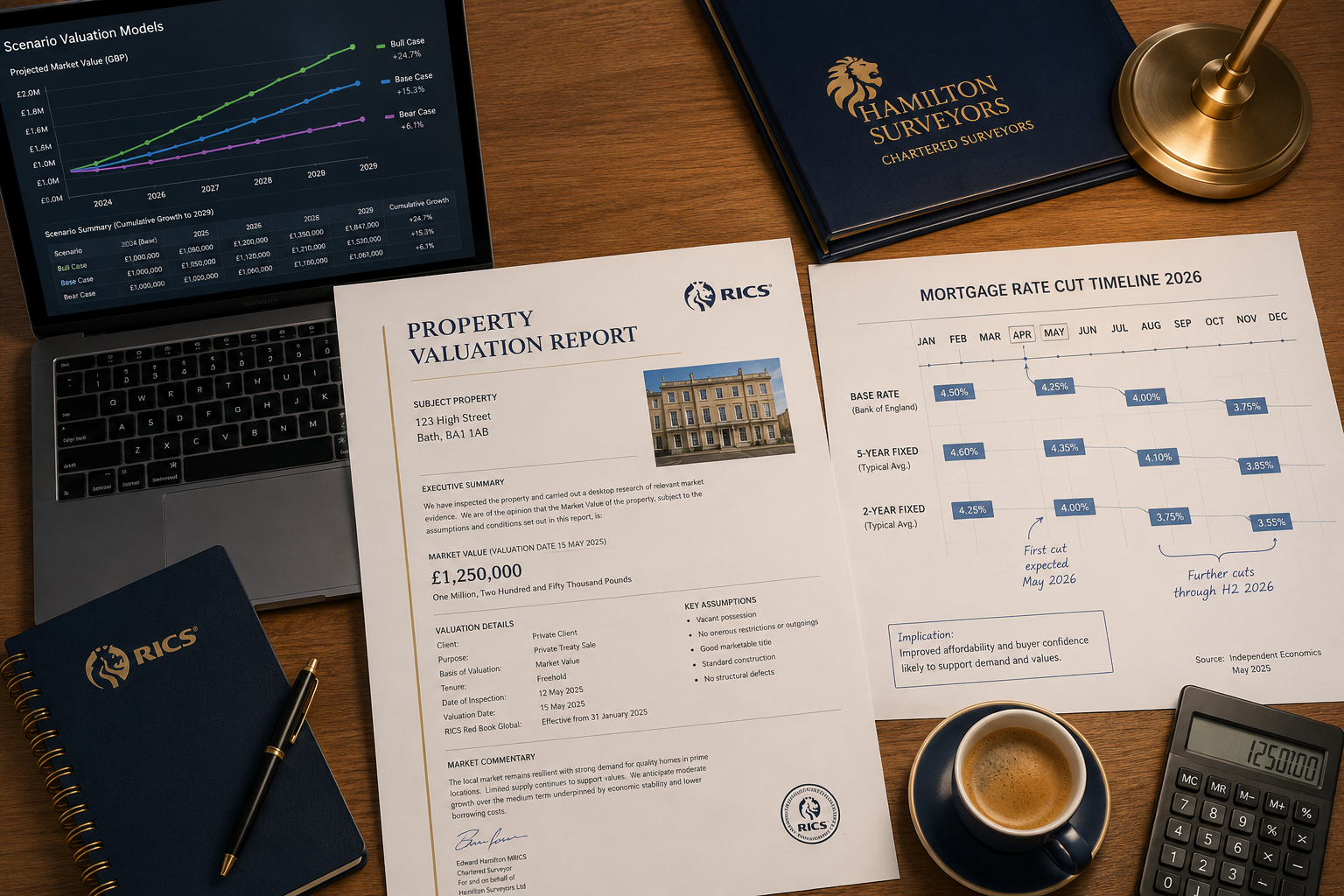
One of the most significant methodological developments in chartered valuations post-mortgage rate cuts 2026 is the adoption of scenario-based valuation frameworks. Rather than producing a single point estimate, surveyors present a range of values tied to different market assumptions:
- Base case: Current market conditions with gradual buyer confidence recovery
- Upside case: Faster-than-expected rate cuts drive stronger demand
- Downside case: Affordability challenges persist; buyer enquiries remain subdued
This approach, highlighted in recent surveyor strategy discussions [2], gives clients a clearer picture of risk and opportunity. It is particularly valuable for lenders assessing mortgage risk and for investors evaluating acquisition decisions.
Recalibrating Comparable Evidence
Falling mortgage rates necessitate that surveyors recalibrate how they weight comparable evidence [6]. A sale completed at the height of the rate-hiking cycle in 2023 carries different weight than one completed in Q1 2026. Surveyors must:
- Apply time adjustments to older comparables to reflect changed financing conditions
- Prioritise post-rate-cut transactions where available
- Cross-reference with active listing prices and days-on-market data
- Incorporate rental yield evidence for investment properties
Understanding the top three things looked at during a property valuation provides a useful foundation, though the weighting of those factors is shifting in response to the current market environment.
Buyer Confidence as a Valuation Input
Buyer confidence is not merely a sentiment indicator — it has a direct, quantifiable effect on market value. When confidence is low, properties take longer to sell, vendors accept lower offers, and surveyors must reflect this in their assessments. As confidence recovers, the reverse applies.
Forecasters at MPA Magazine anticipate a housing market reset in 2026 where buyers gain more leverage due to gradual affordability improvements and increased inventory [9]. This is a nuanced shift: buyers gaining leverage does not mean prices fall sharply, but it does mean that vendors can no longer expect the frenzied bidding conditions of 2021 and 2022.
For surveyors, this means:
- Monitoring active buyer enquiry data from agents in the subject property's area
- Reviewing mortgage approval statistics as a leading indicator of purchase intent
- Assessing whether properties are selling at, above, or below asking price in the local micro-market
The Role of Independent Valuations
In a market where estate agent valuations may still reflect peak-cycle optimism and lender automated valuation models (AVMs) may lag behind current conditions, the role of an independent chartered valuation has never been more important.
An independent property valuation provides an objective, evidence-based assessment that is not influenced by the desire to win an instruction or secure a loan. This is particularly valuable for:
- Buyers seeking to validate an agreed purchase price before committing
- Landlords refinancing buy-to-let portfolios
- Executors dealing with property when an owner passes away
- Investors assessing acquisition viability in a shifting rate environment
Affordability, First-Time Buyers, and the Confidence Gap
Despite the positive direction of mortgage rates, affordability remains a genuine concern. US Bank's analysis of interest rate impacts on the housing market confirms that even with rate reductions, monthly mortgage payments remain elevated relative to income levels for many first-time buyers [4]. The same dynamic applies in the UK, where house price-to-income ratios in many regions remain historically high.
This creates what might be called a "confidence gap" — the period between when rates fall and when buyers feel sufficiently secure to act. Several factors contribute to this gap:
- Job market uncertainty: Economic caution dampens willingness to commit to large financial obligations
- Deposit requirements: Lower rates do not reduce the upfront capital needed to purchase
- Residual rate trauma: Buyers who watched rates spike to 5-6% are cautious about locking in, even at improved levels
- Media narrative lag: Public perception of the market often trails actual conditions by several months
Millennial homebuyers in particular are navigating this confidence gap. Understanding how millennial homebuyers are changing home ownership patterns helps surveyors and agents anticipate where demand will crystallise as confidence returns.
For chartered surveyors, the confidence gap is a valuation input, not a background condition. A property in a market where buyer confidence is still recovering will not achieve the same value as an identical property in a market where confidence has fully returned. Reflecting this in the valuation requires both quantitative analysis and qualitative market judgement.
Practical Implications for Property Owners, Landlords, and Investors in 2026
The combined effect of mortgage rate reductions, rental market shifts, and recovering buyer confidence creates a set of practical considerations for different stakeholder groups.
For owner-occupiers:
- Obtain a chartered valuation before listing, rather than relying on estate agent appraisals alone
- Be prepared for valuations that reflect current market caution rather than peak-cycle prices
- Use the valuation to negotiate from a position of evidence
For landlords:
- Reassess portfolio valuations to reflect current achievable rents, not historic passing rents
- Consider the impact of potential tenant-to-buyer conversion on void rates
- Engage a chartered surveyor for refinancing decisions, particularly where loan-to-value ratios are close to lender thresholds
For investors:
- Apply scenario-based analysis to acquisition decisions
- Do not assume rate cuts alone justify premium pricing — comprehensive deal evaluation remains essential [3]
- Focus on locations where rental demand is structurally supported, not just cyclically elevated
For lenders and mortgage professionals:
- Commission independent valuations rather than relying solely on AVMs in transitional market conditions
- Apply appropriate time adjustments when using comparable evidence from the rate-hiking period
Conclusion
Chartered Valuations Post-Mortgage Rate Cuts 2026: Adjusting for Rental Shifts and Buyer Confidence is not a passive exercise in updating numbers. It requires active methodological adaptation, regional market intelligence, and a clear-eyed assessment of where buyer confidence currently sits versus where it is heading.
The data points to a market in gradual recovery. Rates are falling, affordability is improving, and inventory is normalising. But the recovery is uneven, confidence is rebuilding rather than restored, and rental dynamics are shifting in ways that affect capital values across different property types and locations.
Actionable next steps for stakeholders in 2026:
- Commission an independent chartered valuation before any major transaction decision — do not rely on automated or agent-led appraisals in a transitional market.
- Instruct surveyors who apply scenario-based methodologies and can demonstrate local comparable evidence from post-rate-cut transactions.
- Landlords should review rental income assumptions and stress-test valuations against potential void increases as some tenants convert to buyers.
- Buyers should use professionally instructed valuations as a negotiation tool, particularly where asking prices reflect pre-rate-cut market expectations.
- Investors should evaluate acquisitions on comprehensive fundamentals, not rate-cut optimism alone.
The chartered valuation profession is adapting. Those who engage with it properly in 2026 will be better positioned to make sound decisions in a market that rewards evidence over assumption.
References
[1] Mortgage Rates Forecast 2025 2026 Will Mortgage Rates Go Down – morganstanley.com
[2] Valuing Properties Amid February 2026 Rics Buyer Enquiry Slump North South Surveyor Strategies – manchestersurveyors.com
[3] Rate Cut Ladder Rental Cash Flow 2026 – willitflow.io
[4] Interest Rates Impact On Housing Market – usbank.com
[5] How The Base Rate Cut Could Affect Property In 2026 – martinco.com
[6] Valuation Adjustments For 2026 Mortgage Rate Cuts How Falling Interest Rates Impact Property Assessments – Valuation adjustments for 2026 mortgage rate cuts how falling interest rates impact property assessments
[7] Housingwire 2026 Housing Forecast – housingwire.com
[8] Realtor Com Predicts Gradual Housing Market Recovery In 2026 – housingwire.com
[9] mpamag – mpamag.com