

Fewer than one in three private landlords in England fully understood the Renters' Rights Act 2025 before its main provisions came into force on 1 May 2026 — and in high-demand rental markets such as Hammersmith, Chiswick, Ealing, Fulham, and Kensington, the consequences of non-compliance are already being felt. For West London landlords, letting agents, and their surveyor clients, Renters Rights Act June 2026 compliance is not a future consideration: it is an immediate operational reality. Section 21 'no-fault' evictions are gone. Every assured shorthold tenancy has converted to an open-ended periodic tenancy. The rules governing rent increases, pet requests, and property condition have all changed — and the evidence burden on landlords has never been heavier.
Key Takeaways
- The Renters' Rights Act 2025 received Royal Assent on 27 October 2025 and its core reforms went live on 1 May 2026.
- Section 21 'no-fault' evictions are permanently abolished; landlords must now rely on Section 8 grounds backed by documented evidence.
- All assured shorthold tenancies have automatically converted to open-ended periodic tenancies, with tenants able to leave on two months' notice.
- The 31 May 2026 deadline for issuing the statutory Information Sheet has passed; landlords who missed it face fines of up to £7,000.
- Chartered surveyors play a central role in compliance — from pre-inspection condition surveys to market rent evidence and HHSRS assessments.
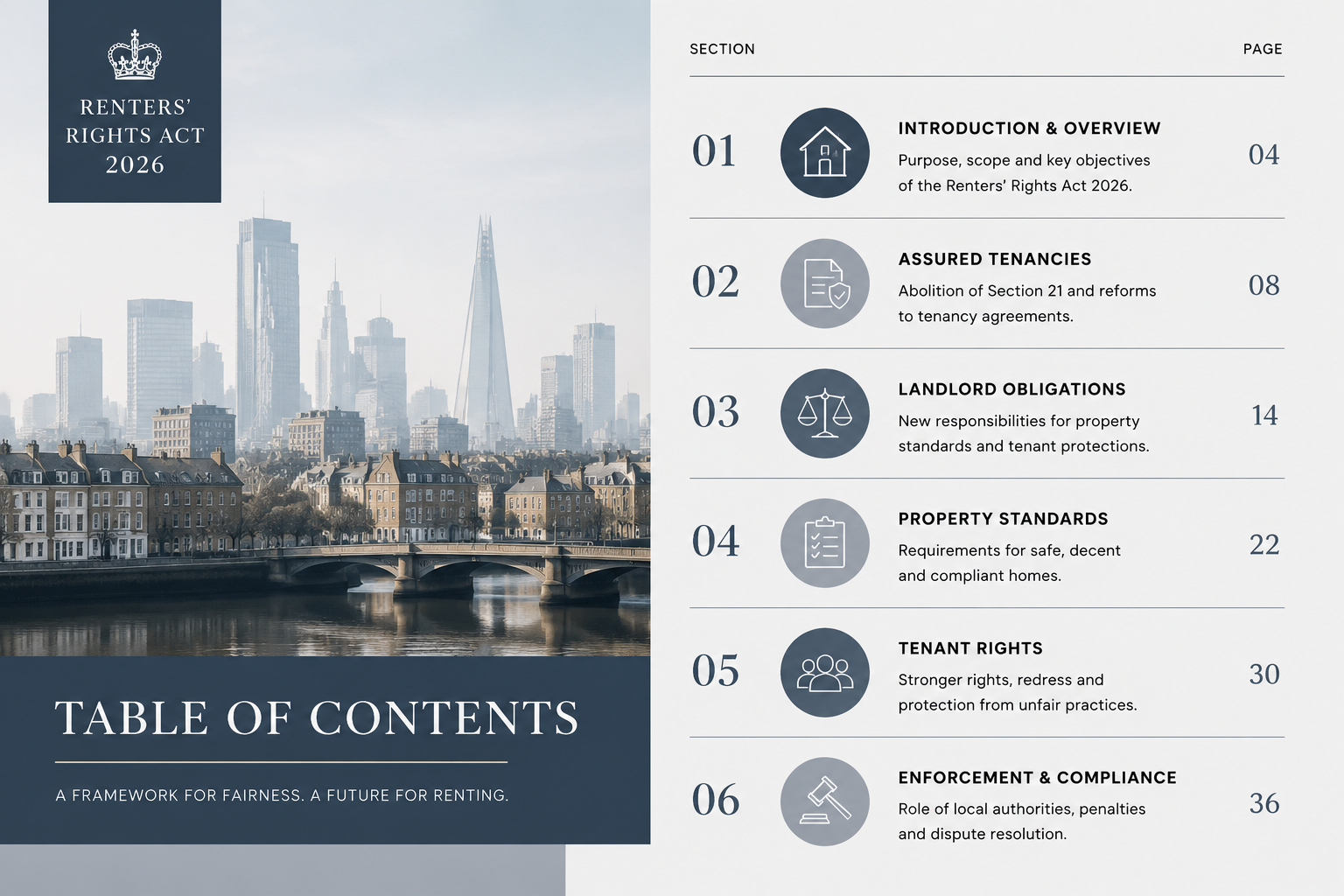
Table of Contents
- What the Renters' Rights Act 2025 Changed — and When
- Section 21 Abolished: The New Eviction Landscape for West London Landlords
- Rent Increases, Pet Rights, and the Information Sheet Deadline
- Why Surveyor Evidence Is Now Central to Renters Rights Act June 2026 Compliance
- Practical Steps for West London Landlords Still Catching Up
- FAQ
- Conclusion
What the Renters' Rights Act 2025 Changed — and When
The Renters' Rights Act 2025 received Royal Assent on 27 October 2025, ending years of legislative uncertainty that had followed the earlier Renters (Reform) Bill. The government confirmed that the main operative provisions would come into force on 1 May 2026, giving landlords and agents approximately six months to prepare.
The headline changes are as follows:
| Reform | Detail |
|---|---|
| Section 21 abolished | No-fault evictions ended for all tenancies from 1 May 2026 |
| AST conversion | All assured shorthold tenancies became open-ended periodic tenancies |
| Tenant notice period | Tenants may leave on two months' written notice at any time |
| Section 8 grounds | Landlords must use statutory grounds with supporting evidence |
| Rent increases | Limited to once per year via the Section 13 process |
| Pet requests | Tenants have the right to request a pet; refusal must be reasonable |
| Information Sheet | Landlords required to issue the statutory sheet by 31 May 2026 |
| PRS Database | National register of landlords — launch expected later in 2026 |
| PRS Ombudsman | Mandatory membership — launch expected later in 2026 |
According to guidance published on GOV.UK, the Act applies to all private rented sector tenancies in England, with no grandfather clause for existing agreements. Every tenancy active on 1 May 2026 converted automatically.
Section 21 Abolished: The New Eviction Landscape for West London Landlords
The abolition of Section 21 is the reform with the most immediate practical impact. Under the old regime, landlords could serve a Section 21 notice without giving any reason, provided they had met prescribed procedural steps. That route is now closed permanently.
Landlords must now use Section 8, relying on one or more of the statutory grounds set out in Schedule 2 of the Housing Act 1988 as amended by the 2025 Act. New grounds introduced by the Act include:
- Ground 1A — landlord wishes to sell the property
- Ground 6A — serious anti-social behaviour
- Ground 8 (strengthened) — at least two months' rent arrears at both notice and hearing
"The shift from Section 21 to Section 8 is not merely procedural — it is evidential. Landlords who cannot demonstrate their ground with documentary proof will find possession claims fail at court." — Banner Jones Solicitors commentary on the Renters' Rights Act 2025
The critical implication for West London landlords in areas such as Kensington, Ealing, and Fulham — where tenancies are often long-standing and properties are high-value — is that evidence must be gathered before a problem arises, not after. A condition survey completed at the outset of a tenancy, and updated periodically, becomes the foundation of any future Section 8 claim based on damage or deterioration.
For landlords managing properties across multiple London boroughs, our chartered surveyors covering West London can provide the pre-inspection documentation that supports robust possession grounds.

Rent Increases, Pet Rights, and the Information Sheet Deadline
Section 13 Rent Increases
Under the Act, landlords may increase rent only once per 12 months, and only via the formal Section 13 notice procedure. Tenants who believe the proposed increase exceeds the open market rent may refer the matter to the First-tier Tribunal. Landlords who cannot produce credible comparable market rent evidence risk having the tribunal set a lower figure — potentially below the proposed increase.
This makes an independent market rent valuation from a qualified RICS surveyor a practical necessity, not an optional extra. Prince Surveyors' property valuation services provide the documented comparable evidence that stands up to tribunal scrutiny.
Pet Requests
Tenants now have a statutory right to request permission to keep a pet. Landlords cannot unreasonably refuse. Reasonable grounds for refusal might include lease restrictions in a leasehold property or specific property characteristics. Landlords who refuse without good reason face potential enforcement action. Requiring pet damage insurance as a condition of consent is expressly permitted under the Act.
The Information Sheet — Deadline Already Passed
The statutory Information Sheet, prescribed by the Secretary of State, was required to be issued to all existing tenants by 31 May 2026. That deadline has now passed. Landlords who failed to issue the sheet face civil penalties of up to £7,000 per tenancy. If this applies to your portfolio, the priority action is to issue the sheet immediately and document the date of service, as prompt remediation may be considered in any enforcement assessment. The National Residential Landlords Association (NRLA) has published guidance on the prescribed content and format.
Why Surveyor Evidence Is Now Central to Renters Rights Act June 2026 Compliance
This is where the role of the professional surveyor has fundamentally expanded. Renters Rights Act June 2026 compliance for West London landlords is, in large part, a documentation exercise — and surveyors are the professionals best placed to provide it.
Pre-Inspection Condition Surveys
A detailed condition survey at the commencement of a tenancy establishes the baseline against which any deterioration is measured. Without it, a Section 8 claim based on damage is extremely difficult to sustain. Our construction and condition survey service provides precisely this baseline documentation for West London rental properties.
Schedules of Dilapidations
At the end of a tenancy, a professionally prepared schedule of dilapidations — cross-referenced against the original condition survey — gives landlords a defensible basis for deposit deductions and, where necessary, a Section 8 claim. The Tenancy Deposit Scheme and courts both respond better to surveyor-prepared schedules than to informal landlord assessments.
HHSRS and Damp Assessments
The Housing Health and Safety Rating System (HHSRS) remains the primary regulatory tool for local authorities assessing hazards in rental properties. Damp and mould are Category 1 hazards under HHSRS and are now also subject to Awaab's Law provisions, which require landlords to investigate and remedy damp and mould within prescribed timeframes. A professional HHSRS assessment protects landlords from enforcement action and demonstrates proactive compliance.
For landlords with properties in South West London or North West London, where Victorian and Edwardian stock is prevalent, damp assessments are particularly relevant.
Market Rent Evidence for Section 13 Challenges
As noted above, Section 13 tribunal referrals require landlords to produce comparable market rent evidence. A RICS-qualified surveyor's rent assessment report carries significantly more weight than a landlord's own estimate or an estate agent's informal opinion. For high-value properties in Kensington or Chiswick, the financial stakes of a tribunal determination are substantial.
For a broader overview of what professional survey services involve, see our complete guide to building surveys in London.
Practical Steps for West London Landlords Still Catching Up
If your portfolio is not yet fully compliant, the following priority checklist applies as of June 2026:
Immediate actions:
- Issue the statutory Information Sheet to any tenant who has not yet received it and document the date of service.
- Review all tenancy agreements to confirm they have been updated to reflect the open-ended periodic tenancy structure.
- Remove any reference to Section 21 from standard notices or template letters.
Within the next 30 days:
- Commission a condition survey for any property that does not have a documented baseline — particularly before any new tenancy begins.
- Obtain a market rent assessment if any Section 13 rent increase is planned in the next six months.
- Review your pet policy and ensure any refusal procedure is documented and defensible.
Ongoing compliance:
- Register for the PRS Database when it launches later in 2026 — mandatory membership will be required.
- Join the PRS Ombudsman scheme ahead of the compulsory deadline.
- Schedule periodic HHSRS/damp inspections, particularly for older stock.
Womble Bond Dickinson's analysis of the Act notes that the courts are likely to take a strict approach to evidential requirements in Section 8 proceedings, reinforcing the need for professional documentation at every stage. The NRLA similarly advises landlords to treat condition surveys as standard practice rather than an optional precaution.
For landlords with questions about statutory compliance considerations affecting their rental properties, professional advice from a chartered surveyor is the most reliable starting point.
FAQ
Q: Does the abolition of Section 21 apply to tenancies that started before 1 May 2026?
A: Yes. All assured shorthold tenancies, regardless of their start date, converted to open-ended periodic tenancies on 1 May 2026. Section 21 is abolished for all of them.
Q: Can a landlord still end a tenancy if they need to sell the property?
A: Yes, but only via Section 8 using the new Ground 1A (landlord intends to sell). The landlord must serve the correct notice and, if the tenant does not leave voluntarily, apply to court for a possession order with supporting evidence.
Q: What happens if a tenant refers a Section 13 rent increase to the tribunal?
A: The First-tier Tribunal will assess the open market rent for the property. If the landlord cannot produce credible comparable evidence, the tribunal may set a rent lower than the proposed increase. A RICS surveyor's market rent report is the most effective form of evidence.
Q: Is the PRS Database registration already required?
A: No. The Private Rented Sector Database and the PRS Ombudsman are both expected to launch later in 2026. Landlords should monitor GOV.UK for the confirmed launch dates and registration deadlines.
Q: What is Awaab's Law and does it apply to private landlords?
A: Awaab's Law, originally introduced for social housing, is being extended to the private rented sector. It requires landlords to investigate and remedy damp and mould hazards within defined timeframes. Failure to comply can result in enforcement action by the local authority.
Q: What fine applies for failing to issue the Information Sheet?
A: Civil penalties of up to £7,000 per tenancy can be imposed. Landlords who missed the 31 May 2026 deadline should issue the sheet immediately and retain proof of service.
Conclusion
The Renters' Rights Act 2025 has fundamentally redrawn the landlord-tenant relationship in England, and West London landlords face a compliance environment that is more demanding than at any point in recent decades. Section 21 is gone. Tenancies are now open-ended. Evidence, documentation, and professional surveyor input are no longer optional — they are the operational backbone of a legally sound rental portfolio.
For landlords in Hammersmith, Fulham, Chiswick, Ealing, and Kensington, the practical next steps are clear: commission condition surveys now, obtain market rent evidence before any Section 13 notice, ensure HHSRS and damp assessments are up to date, and prepare schedules of dilapidations at tenancy end. Those who treat Renters Rights Act June 2026 compliance as a surveyor-led process — rather than a paperwork exercise — will be best placed to protect their assets and manage possession proceedings effectively.
Prince Surveyors' team of chartered surveyors across London is available to assist West London landlords and letting agents with every aspect of compliance documentation. Contact the team today to discuss a condition survey, market rent assessment, or HHSRS inspection for your rental property.