

}
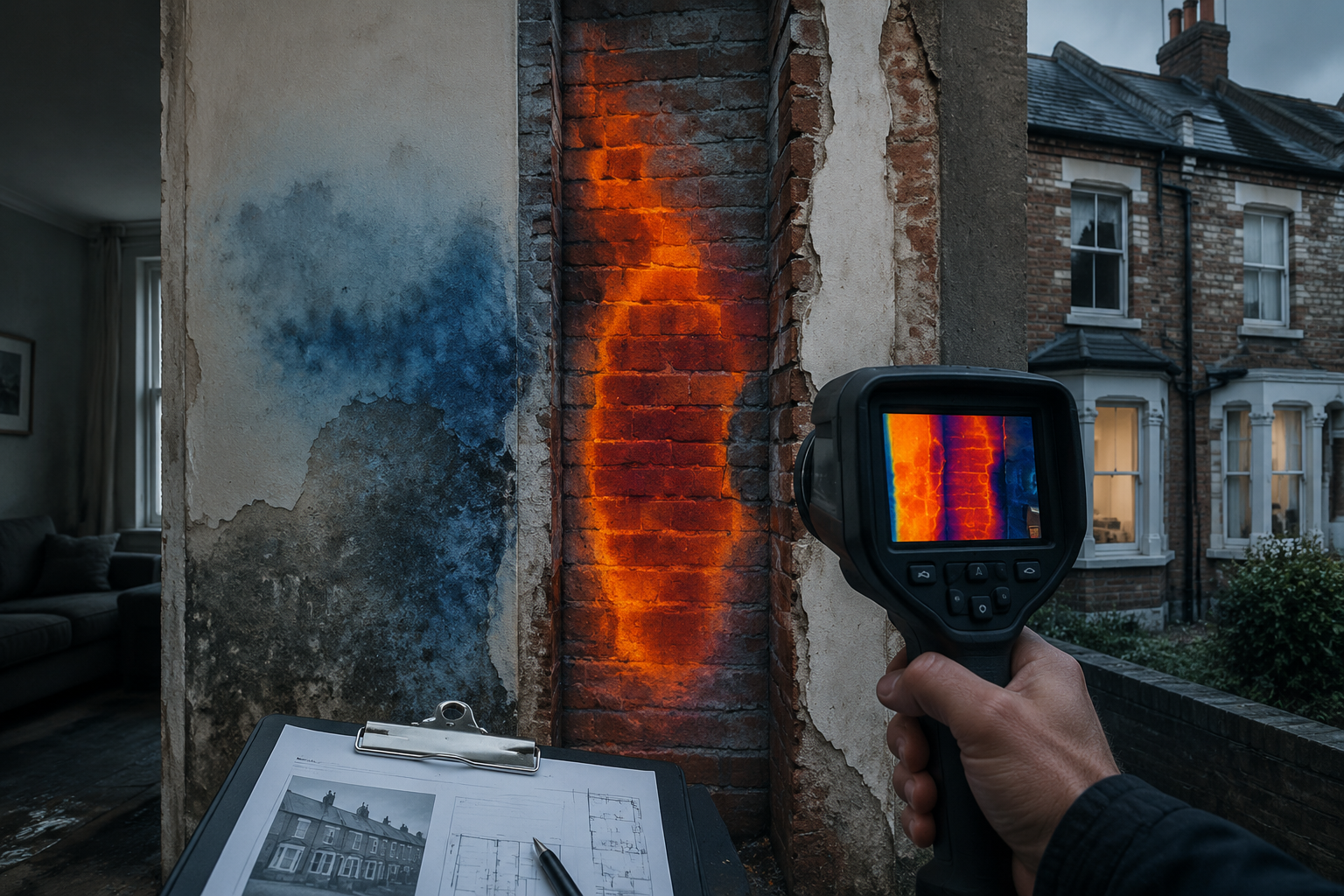
Over 2 million homes in England are estimated to suffer from damp and mould, yet until recently, no single piece of legislation forced landlords to act within defined timeframes. That changed on 27 October 2025, when Awaab's Law came into force — and in 2026, its reach is expanding in ways that fundamentally reshape how party wall surveyors assess, document, and award remediation for shared-wall moisture hazards. Understanding Awaab's Law excess moisture hazards in party wall surveys and the 2026 protocols for shared wall damp remediation awards is no longer optional for property professionals: it is a legal and professional necessity.
Key Takeaways
- Awaab's Law, effective from October 2025, mandates strict response timeframes for damp, mould, and emergency hazards — with Phase 2 in October 2026 extending obligations to private landlords and a broader range of HHSRS hazards.
- Interstitial condensation crossing party wall boundaries creates shared liability that must be addressed within party wall award documents.
- RICS 8th Edition protocols now incorporate thermal imaging as a standard survey tool for detecting hidden moisture defects in shared walls.
- Quantum assessment frameworks help expert witnesses calculate defensible remediation costs for moisture-proofing disputes.
- Non-compliance with Awaab's Law can result in fines of up to £7,000, making proactive survey documentation essential.
What Awaab's Law Means for Party Wall Surveyors in 2026
Awaab's Law was named after Awaab Ishak, a two-year-old boy who died in 2020 as a direct result of prolonged exposure to mould in a social housing property. The legislation, embedded within the Social Housing (Regulation) Act 2023, compels social landlords to respond to hazardous damp and mould within defined timeframes [1].
Phase 1, which began in October 2025, targets significant damp and mould hazards alongside all emergency hazards. Phase 2, expected in October 2026, expands coverage to a wider range of health hazards under the Housing Health and Safety Rating System (HHSRS) and is anticipated to extend obligations to private landlords [3][4]. Phase 3, arriving in 2027, will cover all remaining HHSRS hazards except overcrowding [3].
For party wall surveyors, this phased rollout introduces a new layer of professional responsibility. When a party wall notice is served and a surveyor is appointed, the scope of the survey must now account for moisture hazards that may originate on one side of a shared wall and migrate to the other. This is not a theoretical concern: interstitial condensation — moisture that forms within the fabric of a wall rather than on its surface — routinely crosses party boundaries in terraced and semi-detached properties.
"The party wall is not a barrier to moisture liability — it is a conduit for it."
Understanding the causes of moisture in buildings is therefore foundational to any compliant survey process in 2026.
Interstitial Condensation Across Party Boundaries: The Hidden Hazard
Standard damp surveys have historically focused on surface moisture — rising damp, penetrating rain, or condensation visible on interior walls. Interstitial condensation is more insidious. It occurs when warm, humid air migrates through wall materials and meets a cold surface within the wall structure, depositing moisture inside the masonry, insulation, or cavity.
In party wall contexts, this process becomes legally complex. A retrofit project on one side of a party wall — such as internal wall insulation added to comply with Minimum Energy Efficiency Standards — can shift the dew point within the shared structure. Moisture that previously dissipated safely may now accumulate within the wall cavity on the neighbouring property's side. The neighbour has no knowledge of the works, no consent was sought for the thermal change, and the resulting mould growth in their property triggers Awaab's Law obligations.
How Interstitial Condensation Creates Shared Liability
The Party Wall etc. Act 1996 already provides a framework for managing works that affect shared structures. However, it does not explicitly address moisture migration as a consequential hazard. In 2026, surveyors must bridge this gap by:
- Assessing pre-existing moisture conditions on both sides of the party wall before works commence
- Modelling the likely dew point shift resulting from proposed insulation or retrofit works
- Including moisture-proofing clauses within the party wall award
- Specifying monitoring requirements post-completion
The consequences of ignoring the Party Wall Act have always been significant, but in 2026 they carry an additional dimension: a building owner who proceeds without addressing moisture migration risk may face liability under Awaab's Law if the adjoining owner is a tenant in social or private rented accommodation.
For a detailed overview of the agreement process, the top party wall agreement considerations for renovation projects provides a useful starting point.
2026 Survey Protocols: Thermal Imaging and Non-Destructive Testing

The RICS 8th Edition protocols, introduced in May 2026, incorporate thermal imaging as a standard practice in party wall surveys for detecting hidden defects including damp and mould [5]. This represents a significant shift from the previous approach, where thermal imaging was considered an optional enhancement rather than a baseline requirement.
Thermal Imaging in Party Wall Surveys
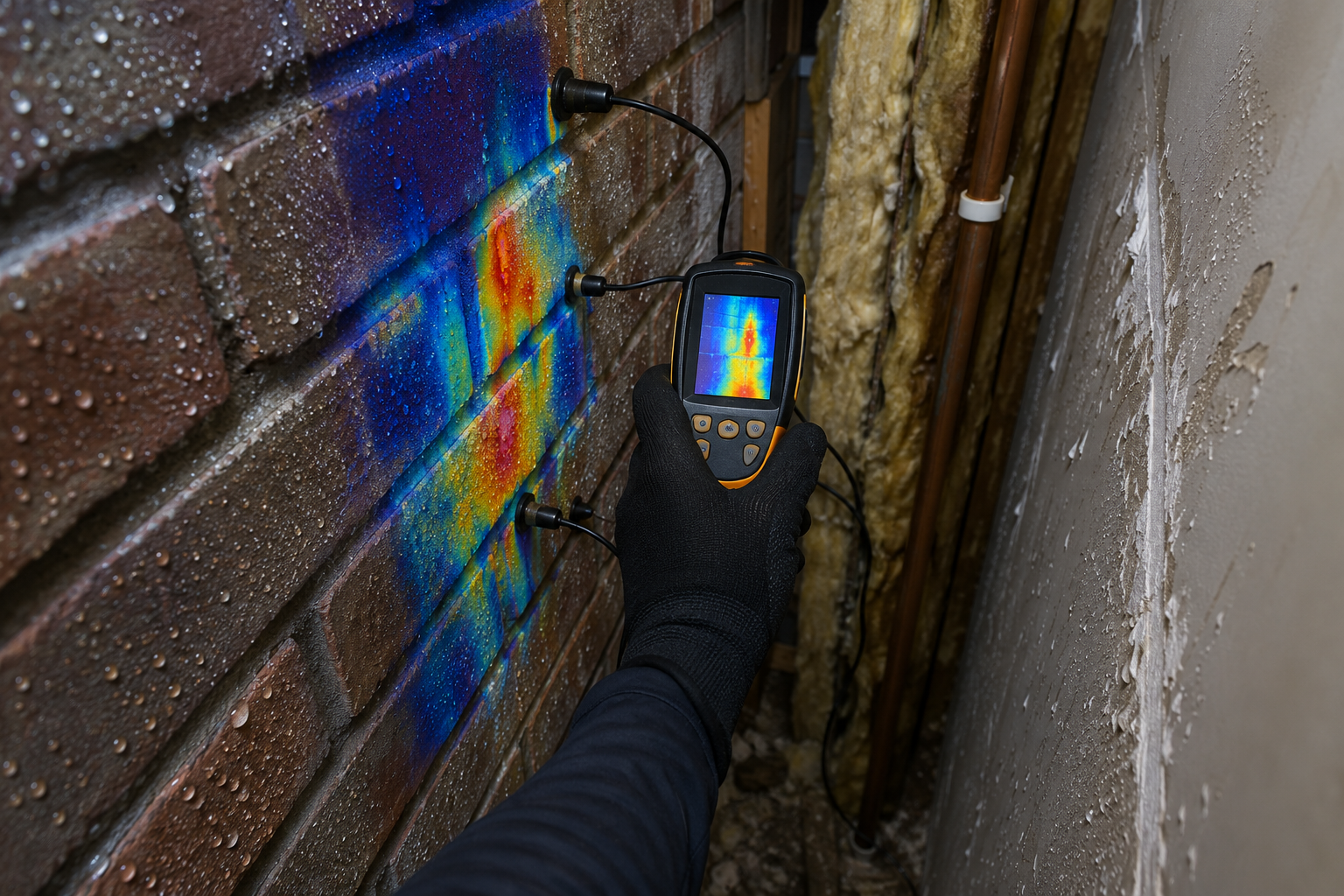
Thermal imaging cameras detect temperature differentials across wall surfaces. Where moisture is present — whether from interstitial condensation, rising damp, or a plumbing leak — the evaporative cooling effect creates a measurable temperature drop. In party wall surveys, this allows surveyors to:
- Map moisture distribution across the full height and width of the shared wall
- Identify hidden defects that would not be visible to the naked eye
- Create a timestamped baseline record before works begin
- Provide objective evidence for award documents and dispute resolution
The integration of thermal imaging into standard protocols means that surveyors who fail to use this technology in 2026 may be found to have conducted a substandard survey if a moisture dispute later arises.
Non-Destructive Moisture Testing Methods
Beyond thermal imaging, advances in non-destructive testing have expanded the surveyor's toolkit considerably. Aerial infrared data collection, capacitance moisture meters, and microwave moisture detection systems can now survey large wall areas without drilling or opening up the structure [6]. This is particularly valuable in party wall contexts, where invasive investigation on a shared structure requires consent from both building owners.
| Method | Application | Invasiveness | Accuracy |
|---|---|---|---|
| Thermal imaging | Surface and near-surface moisture mapping | None | High for active moisture |
| Capacitance meter | Surface moisture reading | None | Moderate |
| Microwave moisture detection | Through-wall moisture profiling | None | High for bulk moisture |
| Carbide bomb test | Precise moisture content by weight | Destructive | Very high |
| Hygrometer/RH probe | Relative humidity in cavities | Minimally invasive | High |
Surveyors conducting a Level 3 full building survey on properties with party walls should now consider non-destructive moisture profiling as part of their standard scope, particularly where retrofit works are planned or recently completed.
Drafting Moisture-Proofing Clauses in Party Wall Awards
The party wall award is the legal document that governs how works are carried out, what protections are in place for the adjoining owner, and what remediation is required if damage occurs. In 2026, Awaab's Law compliance demands that moisture-proofing clauses within these awards be drafted with greater precision than ever before.
Essential Clauses for Shared Wall Damp Remediation Awards
A compliant 2026 award addressing excess moisture hazards should include the following provisions:
1. Pre-Works Moisture Baseline
A schedule of condition must record moisture readings at defined points across the party wall, using both surface meters and thermal imaging. Readings should be taken on both sides of the wall and documented with photographs and thermal images.
2. Dew Point Analysis Clause
Where insulation or cladding works are proposed, the award should require the building owner to provide a dew point calculation prepared by a qualified building physicist or chartered surveyor. This calculation must demonstrate that the proposed works will not shift the dew point into the party wall structure.
3. Moisture Monitoring Requirement
The award should specify that calibrated hygrothermal data loggers are installed on both sides of the party wall for a defined monitoring period — typically 12 months post-completion — with readings reported quarterly to both surveyors.
4. Remediation Trigger Thresholds
The award must define the moisture content levels or relative humidity readings that will trigger a remediation obligation. For example: if relative humidity within the wall cavity exceeds 80% for more than 72 consecutive hours, the building owner is obligated to investigate and remediate within the timeframes specified by Awaab's Law.
5. Awaab's Law Compliance Clause
Where the adjoining owner is a tenant in social or private rented accommodation, the award should explicitly state that any moisture hazard attributable to the notifiable works must be remediated within the statutory timeframes: 24 hours for emergency hazards, and investigation within 10 working days for significant hazards, with written summary within 3 working days and safety work initiated within 5 working days thereafter [2].
Many disputes arise from common misconceptions about party wall agreements, including the mistaken belief that an award fully indemnifies a building owner against consequential damage. Moisture-proofing clauses must close this gap explicitly.
Quantum Assessment for Expert Witnesses: Calculating Remediation Costs
When a moisture dispute reaches the point of expert witness involvement — whether in the First-tier Tribunal, County Court, or through the party wall dispute resolution process — the expert must be able to provide a defensible quantum assessment of remediation costs. This is an area where many surveyors lack confidence, yet it is central to achieving fair outcomes under Awaab's Law excess moisture hazards frameworks.
Components of a Moisture Remediation Quantum Assessment
A robust quantum assessment for shared wall damp remediation should address the following cost heads:
Investigation Costs
- Thermal imaging survey: typically £400-£900 depending on property size
- Non-destructive moisture profiling: £300-£700
- Dew point and hygrothermal modelling: £500-£1,500
- Opening-up works (if required): £200-£600 per location
Remediation Works
- Cavity wall moisture barrier installation: £1,500-£4,000 per wall
- Vapour control layer to internal face of party wall: £800-£2,500
- Replacement of moisture-damaged plaster: £45-£75 per square metre
- Mould treatment and biocide application: £200-£600
- Replacement of moisture-damaged insulation: £600-£2,000
Consequential Losses
- Temporary rehousing of tenants during works (where required by Awaab's Law emergency provisions): £80-£150 per night
- Replacement of damaged personal property: assessed on evidence
- Health-related losses: subject to medical evidence and legal advice
Monitoring and Certification
- Post-remediation hygrothermal monitoring: £300-£800 per year
- Independent certification of completed works: £400-£900
Presenting Quantum Evidence
Expert witnesses should present quantum assessments using a structured schedule that separates agreed costs from disputed items. Where costs are disputed, the expert should provide a range based on competitive tender evidence or published price guides such as the BCIS Schedule of Rates. The expert must remain impartial and should not advocate for either party — the role is to assist the tribunal or court in understanding the true cost of remediation.
Non-compliance with Awaab's Law can result in fines of up to £7,000 and enforcement actions by local authorities [7], making it critical that quantum assessments also address the potential cost of regulatory penalties when advising building owners on the financial risk of inaction.
Landlord Obligations and Compliance Timelines Under 2026 Protocols
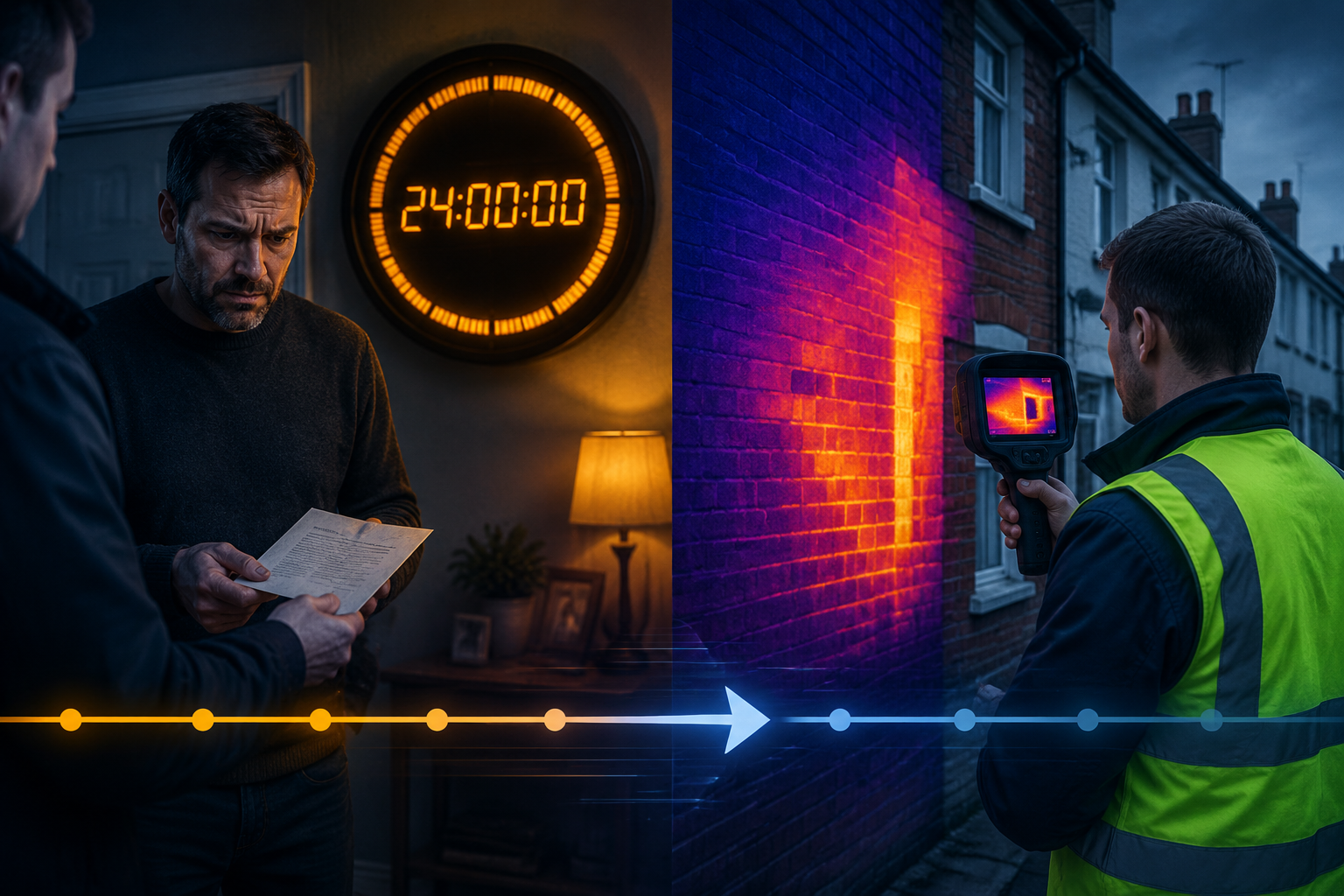
The mandatory response times under Awaab's Law are non-negotiable. For emergency hazards — those posing an immediate risk to health or safety — investigation and necessary safety work must be completed within 24 hours of the landlord becoming aware of the issue [2]. For significant hazards, including excess moisture that does not pose an immediate emergency, the landlord must investigate within 10 working days, provide a written summary to the tenant within 3 working days of completing the investigation, and initiate safety work within 5 working days if a significant hazard is confirmed [2].
In the context of party wall disputes, these timelines create a practical challenge. If moisture migrating from a neighbour's retrofit works triggers an Awaab's Law obligation in the adjoining tenanted property, the landlord of that property must act within statutory timeframes regardless of whether the party wall dispute has been resolved. The landlord cannot use the existence of a party wall dispute as a reason to delay remediation.
This means that landlords and their managing agents must maintain clear lines of communication with appointed party wall surveyors. Where a party wall award is in place, the award should specify a fast-track notification procedure to alert the building owner's surveyor if moisture readings breach trigger thresholds, enabling rapid response.
For properties where a neighbour has refused to engage with the party wall process, understanding the options available when a neighbour refuses party wall works is essential reading for landlords and their advisers.
Practical Steps for Surveyors and Building Owners in 2026
The convergence of Awaab's Law Phase 2 expansion, RICS 8th Edition thermal imaging protocols, and growing awareness of interstitial condensation risks means that the bar for party wall surveys in 2026 is materially higher than it was even twelve months ago. The following steps provide a practical framework for compliance.
For Building Owners Planning Works:
- Serve party wall notices at least two months before works begin
- Commission a pre-works moisture survey using thermal imaging and non-destructive testing
- Obtain a dew point analysis if insulation or cladding works are planned
- Ensure the party wall award includes moisture-proofing clauses and monitoring requirements
- Budget for post-completion hygrothermal monitoring
For Appointed Surveyors:
- Use thermal imaging as a baseline tool, not an optional extra
- Draft award clauses that explicitly address Awaab's Law compliance obligations
- Maintain detailed records of moisture readings before, during, and after works
- Be prepared to act as expert witness with a structured quantum assessment if disputes arise
For Landlords of Adjoining Properties:
- Ensure your managing agent is aware of any party wall notices affecting your property
- Request copies of pre-works moisture surveys and award documents
- Establish a monitoring protocol that will alert you to moisture changes within statutory response timeframes
- Understand that Awaab's Law obligations apply regardless of the status of any party wall dispute
The cost of a party wall agreement should now be understood to include the cost of comprehensive moisture assessment — a small investment compared to the potential cost of remediation, regulatory fines, and litigation.
Conclusion
Awaab's Law excess moisture hazards in party wall surveys represent one of the most significant shifts in residential property law and surveying practice in a generation. The 2026 protocols for shared wall damp remediation awards demand that surveyors move beyond surface-level damp assessments and engage with the full complexity of interstitial condensation, cross-boundary moisture migration, and the legal obligations that flow from them.
The actionable priorities for 2026 are clear. Surveyors must adopt thermal imaging and non-destructive testing as standard tools. Award documents must include robust moisture-proofing clauses with defined trigger thresholds and Awaab's Law compliance provisions. Expert witnesses must be equipped with structured quantum assessment frameworks that can withstand scrutiny in formal dispute resolution. And landlords — both social and, from October 2026, private — must understand that the statutory response clock starts ticking the moment they become aware of a moisture hazard, regardless of any ongoing party wall dispute.
Properties with shared walls are inherently interconnected. The moisture that forms within a party wall does not respect legal boundaries. In 2026, the law has caught up with that physical reality — and the surveying profession must do the same.
For a thorough assessment of any property where moisture or structural concerns are present, a Level 3 full building survey provides the most comprehensive evaluation available and should be considered the minimum standard where party wall works and Awaab's Law obligations intersect.
References
[1] Awaabs Law – bassetlaw.gov.uk
[2] Awaabs Law – magna.org.uk
[3] Awaabs Law – walthamforest.gov.uk
[4] Awaabs Law Phase 2 October 2026 Hhsrs Hazards What Private Landlords And Surveyors Must Do Now – canterburysurveyors.com
[5] Thermal Imaging Applications In Party Wall Surveys Rics 8th Edition Protocols For Hidden Defect Detection – wimbledonsurveyors.com
[6] Non Destructive Roof Moisture Surveys At Scale In 2026 – ramcom.com
[7] Awaabs Law Landlord Obligations 2026 – propready.co.uk