

By December 2025, the monthly cost of buying a home was running approximately 105% higher than renting — and that single statistic has turbocharged the build-to-rent (BTR) sector into one of the most active corners of residential construction in 2026 [5]. With roughly 61,700 BTR units currently under construction across the United States alone, and the South accounting for 61% of that pipeline [1], the demand for fast, accurate, and scalable surveying has never been greater.
Surveying for Build-to-Rent Communities: Challenges and Precision Strategies in the 2026 Boom sits at the intersection of this explosive growth and the technical discipline needed to deliver it safely and profitably. From boundary disputes on greenfield sites to utility mapping across multi-acre master-planned communities, surveyors and developers are navigating a uniquely complex landscape — one where precision is not optional, it is the product.
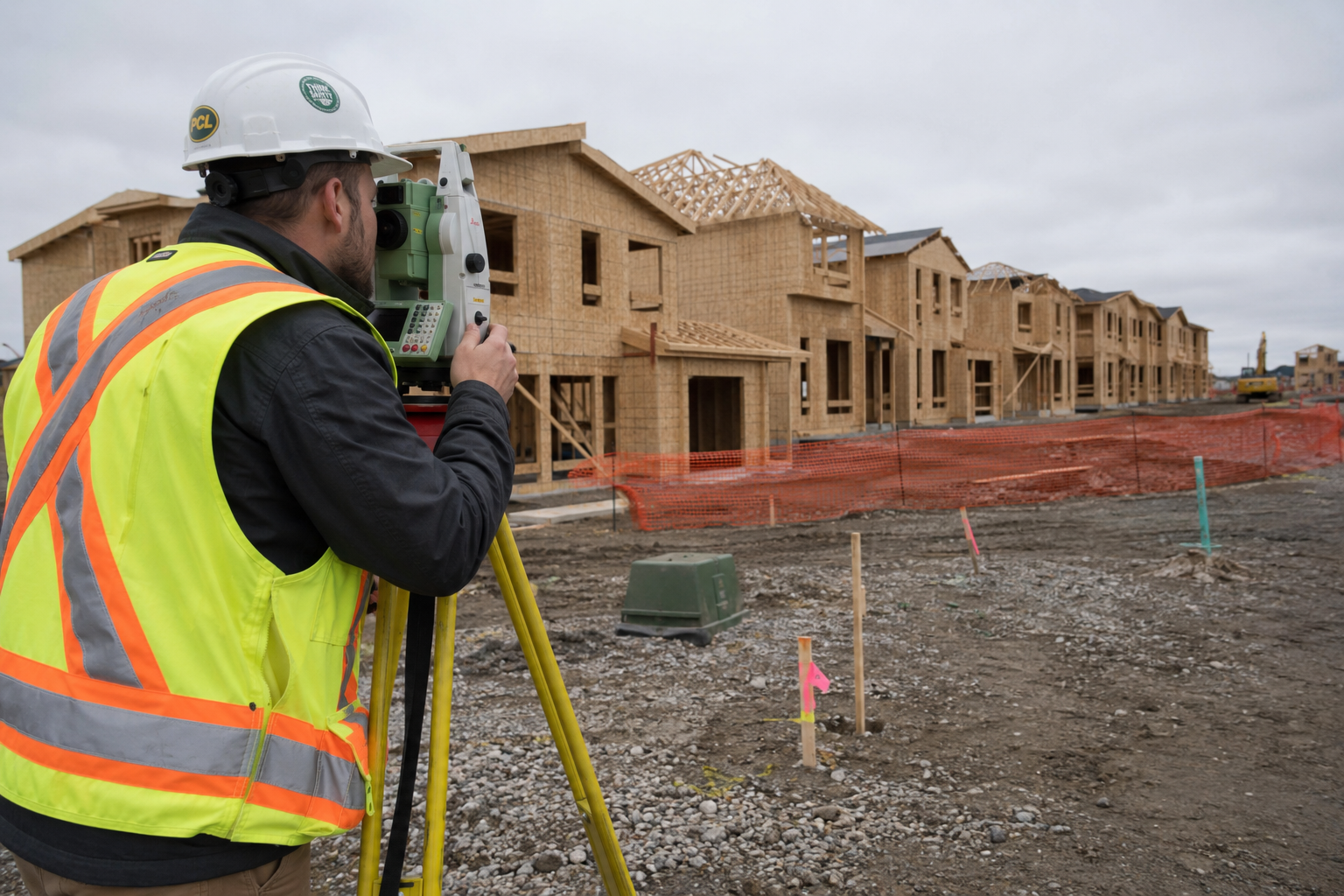
Key Takeaways 📌
- The BTR sector is booming in 2026, with over 61,700 units under construction and institutional capital flowing in from major investors [1][7].
- Accurate boundary surveys, utility mapping, and topographic assessments are mission-critical for large-scale BTR sites.
- Drone technology and AI-assisted workflows are reshaping how surveyors gather and process site data at speed.
- Environmental and statutory considerations — including drainage, contamination, and planning constraints — add layers of complexity unique to BTR-scale developments.
- Early-stage surveying investment significantly reduces costly delays, disputes, and defects during and after construction.
Why the 2026 BTR Boom Is Raising the Stakes for Surveyors
The BTR market in 2026 is not a niche — it is a mainstream housing solution. Institutional capital from entities like Blackstone, Pretium, and Nuveen continues to pour into the sector [7], while a small group of consolidating developers — eight of whom now hold pipelines exceeding 1,000 units each — are moving faster and at greater scale than ever before [4].
This consolidation matters for surveyors. Larger pipelines mean:
- Bigger sites with more complex boundary arrangements
- Tighter delivery schedules driven by investor timelines
- Multiple product types on a single site — from single-family detached homes to higher-density townhomes and attached units [7]
- Greater regulatory scrutiny as planning authorities respond to the scale of development
💬 "Speed without accuracy is the fastest route to a costly mistake on a BTR site. The pressure to deliver quickly must never outpace the precision of the survey."
The Southeast — particularly Florida, North Carolina, and Tennessee — accounted for roughly half of total BTR transaction volume in early 2026 [3]. These are regions with fast-moving soil conditions, high water tables, and complex utility networks. For surveyors, that combination demands both technical skill and local knowledge.
Core Challenges in Surveying for Build-to-Rent Communities: Challenges and Precision Strategies in the 2026 Boom
1. 🗺️ Boundary Accuracy on Large Greenfield Sites
BTR communities are frequently built on greenfield or edge-of-town land where historical records are incomplete or inconsistent. Establishing precise boundaries across multi-acre parcels is one of the most critical — and most disputed — aspects of site preparation.
Common boundary challenges include:
| Challenge | Impact |
|---|---|
| Inconsistent historical title deeds | Overlapping claims with adjacent landowners |
| Undefined easements and rights of way | Construction delays and legal disputes |
| Phased land assembly from multiple vendors | Misaligned boundary lines across the overall site |
| Legacy agricultural boundaries | Incorrect setbacks and planning violations |
A robust construction and condition survey conducted early in the development process can identify these discrepancies before groundworks begin — saving developers from costly remediation later.
Phased takedowns of completed units — a growing transactional trend in 2026 [3] — further complicate matters. When different parcels within a single BTR community are transferred to investors at different stages, boundary accuracy must be maintained and re-verified at each phase.
2. ⚡ Utility Mapping and Underground Infrastructure
Large BTR sites typically require entirely new utility infrastructure — water, gas, electricity, telecommunications, and drainage — laid across ground that may have existing legacy services buried beneath it.
Utility mapping failures are among the top causes of construction delays. Striking an uncharted cable or pipe during groundworks is not just expensive — it can be dangerous and legally consequential.
Precision strategies for utility mapping on BTR sites include:
- Ground Penetrating Radar (GPR): Non-invasive scanning to detect buried services before any excavation begins
- Electromagnetic location surveys: Identifying metallic pipes and cables at depth
- Cross-referencing utility records with local authority and network operator databases
- Drainage surveys using CCTV inspection cameras to map existing watercourses and sewers
Understanding environmental issues on site — including flood risk zones, contaminated land, and drainage constraints — is equally important. The Sun Belt and Southeast markets dominating BTR growth [2] often feature challenging ground conditions including expansive clay soils, high water tables, and hurricane drainage requirements that demand specialist assessment.
3. 🏗️ Topographic Surveys and Site Preparation
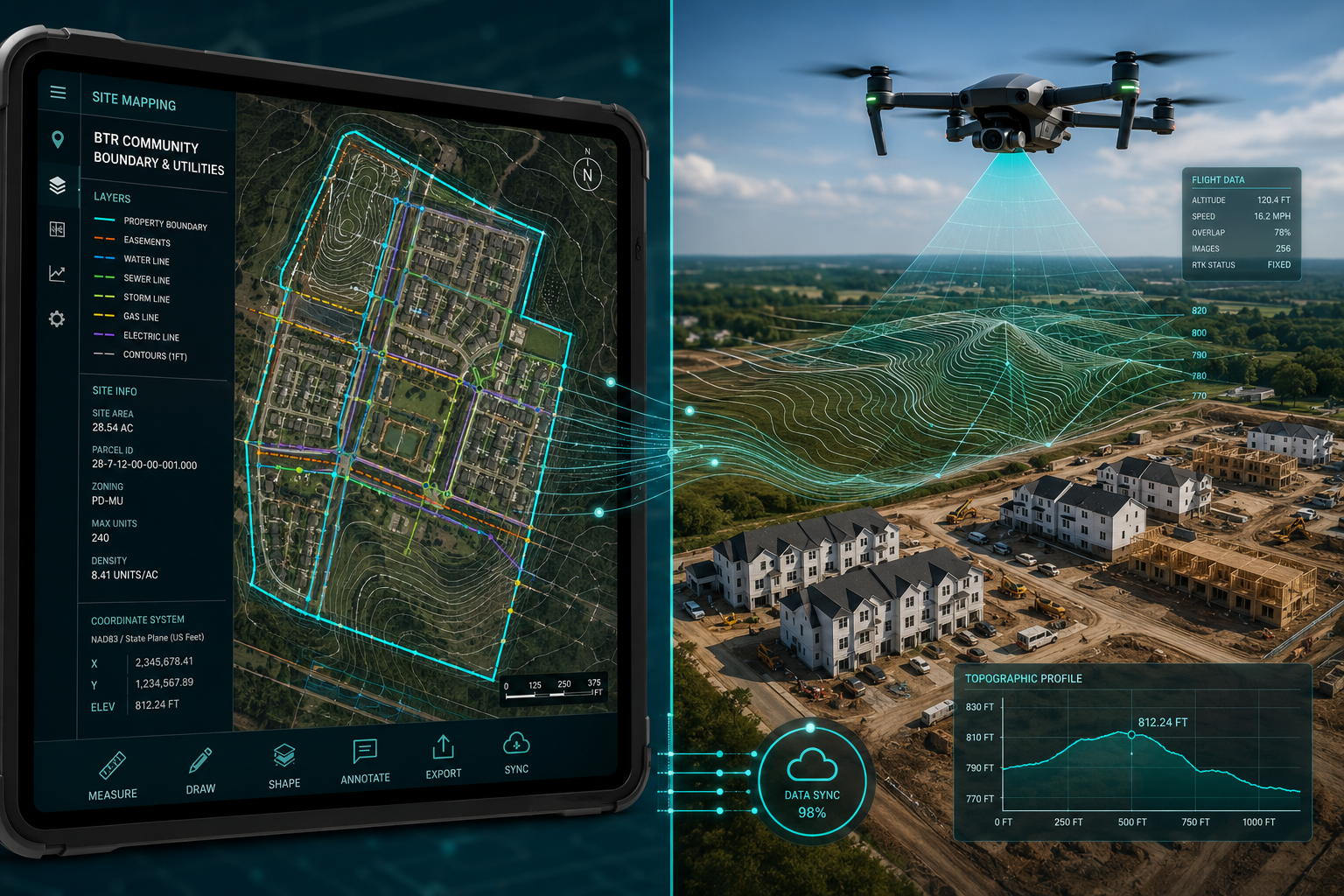
Before a single foundation is poured, a detailed topographic survey establishes the existing ground profile across the entire site. For BTR communities covering tens or even hundreds of acres, this is a substantial undertaking.
What a topographic survey must capture for BTR sites:
- Existing ground levels and gradients (critical for drainage design)
- Tree positions and root protection zones
- Existing structures, walls, and hardstandings
- Watercourses, ponds, and flood-prone areas
- Access points and road alignments
The diversity of BTR product types — from detached single-family homes to higher-density townhomes [7] — means that different areas of the same site may have different grading requirements. A townhome block requires different foundation conditions than a detached home with a private garden. Topographic data must be granular enough to inform both.
4. 🏚️ Building Pathology and Snagging at Scale
Once construction is underway, BTR developers face a challenge that traditional housebuilders selling individual units do not: every unit is retained in the portfolio. That means defects are not passed on to individual buyers — they remain the developer's or operator's long-term problem.
This makes building pathology assessment and snagging surveys at handover critically important. A defect left unaddressed in one unit type across 200 identical homes is a systemic problem, not an isolated one.
Key snagging and pathology considerations for BTR at scale:
- Moisture ingress through poorly detailed junctions (a common issue in rapidly built homes)
- Thermal bridging at wall-to-floor and wall-to-roof connections
- Mechanical ventilation performance — especially important in airtight modern builds (see our guide on mechanical ventilation in buildings)
- Structural movement in early occupation
- External drainage performance under heavy rainfall
Understanding what house snagging involves is essential for BTR operators who want to protect long-term asset value and tenant satisfaction.
Precision Strategies in the 2026 Boom: Technology Reshaping BTR Surveying
Drone Surveys: Speed and Coverage at Scale 🚁
The sheer size of BTR sites makes traditional ground-based surveying time-consuming and expensive. Premium drone survey technology has become a game-changer for the sector in 2026.
Drone surveys deliver:
- Photogrammetric mapping — creating accurate 3D models of entire sites from aerial imagery
- Thermal imaging — detecting heat loss, moisture, and insulation failures across completed buildings
- Progress monitoring — regular flyovers to track construction against programme
- Roof inspections — safely assessing roof conditions across hundreds of units without scaffolding
Developers are already using AI-powered workflows to expedite site screening and underwriting [7]. Drone data feeds directly into these workflows, providing the geospatial accuracy that AI models need to make reliable site assessments.
AI-Assisted Site Screening and Underwriting 🤖
AI integration in BTR development is accelerating fast. In 2026, developers are using machine learning tools to:
- Analyse satellite and drone imagery for site suitability
- Cross-reference planning history, flood risk data, and utility records automatically
- Model construction costs against topographic and ground condition data
- Flag potential areas requiring further investigation before committing to land purchase
For surveyors, this means the data they collect must be structured, digital, and interoperable with these platforms. Paper-based reporting is increasingly incompatible with the pace and scale of BTR development in 2026.
Building Materials Assessment and Compliance 🔬
BTR communities are built to last — and to perform. Operators managing hundreds of units need to know that the materials used in construction will not cause systemic maintenance problems five or ten years down the line.
A thorough building materials assessment during or after construction should evaluate:
- Cladding systems — fire performance and weather resistance
- Roofing materials — longevity and warranty compliance
- Insulation types — thermal and acoustic performance
- Foundation systems — appropriate to ground conditions
On older or brownfield BTR sites, asbestos surveys are a legal requirement before any demolition or refurbishment work begins. This is a non-negotiable step in due diligence that no developer should overlook.
Statutory Considerations and Regulatory Compliance
BTR developments at scale attract significant planning and statutory scrutiny. Surveyors must be familiar with the full range of obligations that apply, including:
- Section 106 agreements and community infrastructure levies
- Biodiversity Net Gain requirements now embedded in planning policy
- Building Regulations Part L (energy efficiency) and Part F (ventilation)
- Fire safety regulations — particularly for higher-density BTR blocks
- Party wall matters where BTR sites adjoin existing properties
Understanding statutory considerations in full — and flagging them early — protects developers from delays and enforcement action.
💬 "The consequences of failing to act on a surveyor's recommendations at the pre-construction stage can be severe — from planning enforcement notices to structural failures that compromise the entire investment."
The consequences of failing to act on survey findings are always more costly than addressing issues proactively.
The Supply Pipeline and What It Means for Surveying Demand
Supply-side pressures that built up through 2024 and early 2025 are expected to ease over the next two to three years as construction starts slow [6]. However, the current pipeline — with over 37,400 units underway in the South alone [2] — means that surveying demand remains intense right now.
Key market dynamics shaping surveying workload in 2026:
| Market Factor | Surveying Implication |
|---|---|
| 61,700 units under construction nationally [1] | High demand for topographic and boundary surveys |
| Consolidation among 8+ major developers [4] | Larger, more complex multi-phase site instructions |
| Investor return to BTR post-rate stabilisation [3] | Faster transaction timelines requiring rapid survey turnaround |
| Diverse product types on single sites [7] | Multi-discipline survey requirements per instruction |
| Affordability gap sustaining rental demand [5] | Long-term pipeline of new BTR sites entering pre-construction |
How Often Should BTR Communities Be Inspected Post-Completion?
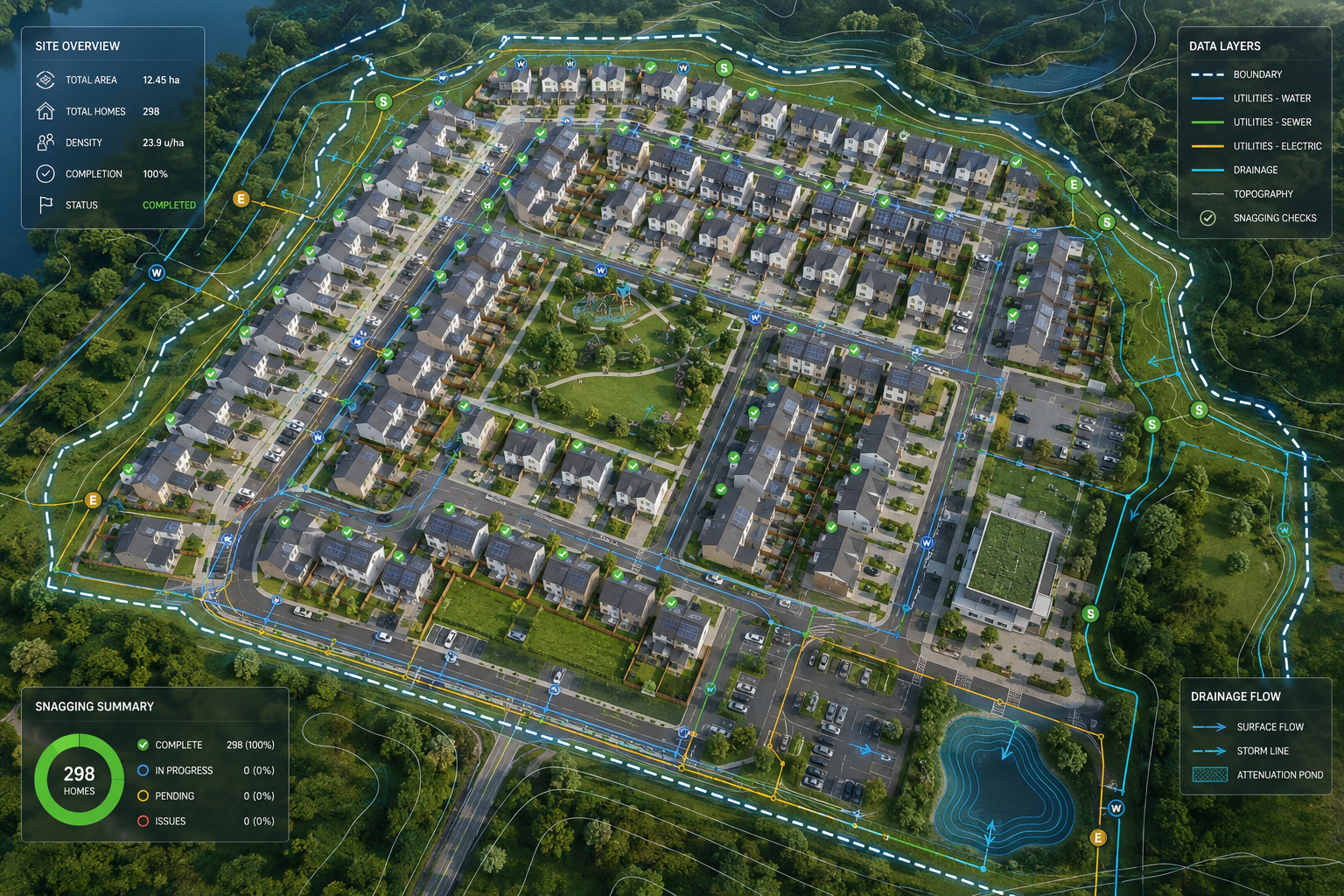
The surveying relationship with a BTR community does not end at practical completion. Ongoing inspection and condition monitoring is essential for operators managing large portfolios.
Regular inspections help:
- Identify early signs of structural movement or water ingress
- Maintain compliance with building safety regulations
- Protect asset value ahead of refinancing or portfolio sale
- Ensure tenant satisfaction and reduce void periods
For guidance on inspection frequency and best practice, the article on how often rental units should be inspected provides a useful framework for BTR operators building their asset management strategy.
Conclusion: Actionable Next Steps for BTR Developers and Surveyors
Surveying for Build-to-Rent Communities: Challenges and Precision Strategies in the 2026 Boom demands a step-change in how both developers and surveyors approach the pre-construction, construction, and post-completion phases of large-scale residential development.
The BTR sector's scale, speed, and institutional ownership model create surveying challenges that are qualitatively different from traditional housebuilding. Getting them right is not a cost — it is an investment in the long-term performance of the asset.
✅ Actionable Next Steps
- Commission boundary and topographic surveys early — before land purchase if possible, to identify constraints that affect viability.
- Integrate drone technology into site monitoring from groundworks through to handover — it saves time and delivers data quality that ground surveys alone cannot match.
- Mandate utility mapping using GPR and electromagnetic surveys before any excavation begins on site.
- Build snagging and pathology inspections into the construction programme — not as an afterthought at practical completion, but as a rolling quality assurance process.
- Ensure statutory compliance is reviewed at every project gateway — planning, building regulations, fire safety, and environmental obligations all carry real consequences if missed.
- Adopt digital, structured data formats for all survey outputs to ensure compatibility with AI-assisted development workflows.
- Plan for ongoing post-completion inspections as part of the asset management strategy from day one.
The BTR boom of 2026 is a significant opportunity — for developers, investors, and the surveying professionals who underpin every successful scheme. Precision is the foundation everything else is built on.
References
[1] Sun Belt Dominates Us Build To Rent Construction Pipeline – credaily.com
[2] Btr Under Construction 1q 2026 – realpage.com
[3] Investors Return To Build To Rent As Rates Stabilize – globest.com
[4] Top Btr Pipelines Are Consolidating Under A Small Group Of Operators – globest.com
[5] Build To Rent Investment Opportunities 2026 – catalystcp.com
[6] Build Rent Special Report Supply Side Pressures Ease 2026 – northmarq.com
[7] Build To Rent Residential Development 2026 – build.inc
[8] Why Build To Rent Is Shaping The Housing Market In 2026 – matthews.com