

Nearly one in three property transactions in England and Wales involves some form of boundary ambiguity — yet the vast majority are resolved quietly, without ever reaching a courtroom or requiring a formal valuation adjustment. The critical question professionals and property owners must answer is: at what point does a routine boundary uncertainty cross the line into a valuation impact or a CPR-compliant expert witness instruction? This guide — When Does a Boundary Issue Become a Valuation or Expert Witness Problem? A Surveyor's Practical Playbook — maps out that journey in practical, decision-ready terms.
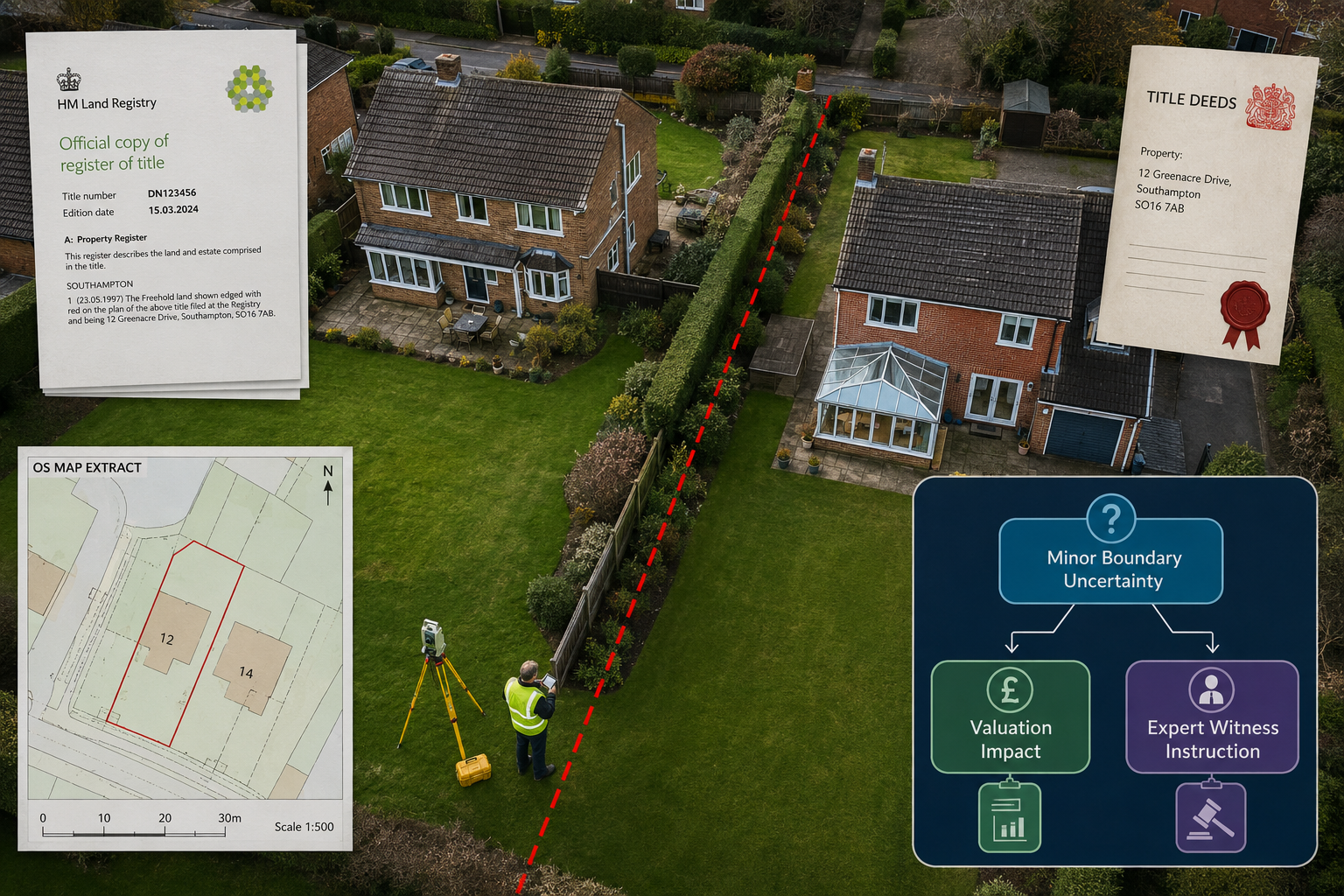
Key Takeaways 📋
- Not every boundary dispute needs an expert witness — the trigger is formal litigation, tribunal, or arbitration, not mere neighbour disagreement.
- A boundary issue becomes a valuation problem when the disputed line materially affects land area, development potential, access rights, or marketability.
- Surveyors wear two very different hats: client adviser vs. court-appointed or party-instructed expert witness — and mixing them up creates serious professional risk.
- Documentation from day one is the single most powerful tool for controlling how far a boundary issue escalates.
- In 2026's recovering property market, even a modest strip of disputed land can carry significant financial weight, making early professional intervention essential.
From Minor Uncertainty to Major Problem: Understanding the Escalation Journey
Most boundary issues begin quietly. A surveyor conducting a Level 3 Full Building Survey flags a discrepancy between the physical fence line and the title plan. The client asks, "Is this a problem?" The honest answer is: it depends on what happens next.
Stage 1 — Discovery: The Survey Red Flag
The journey typically starts during a pre-purchase survey or a planning application. Common triggers include:
- 📌 Title plan discrepancies — the registered boundary (often a general boundary under Land Registry rules) doesn't match the physical boundary on the ground.
- 📌 Encroachments — a neighbour's extension, fence, or outbuilding sits on or near the boundary line.
- 📌 Easement conflicts — a right of way, drainage run, or access route is disputed.
- 📌 Historic conveyance ambiguity — old deeds use imprecise language ("the hedge on the north side") that no longer maps cleanly to modern plans.
At this stage, the issue is informational. The surveyor's role is to identify and communicate the risk, not to adjudicate it [2].
Stage 2 — Negotiation: Still Manageable
If both parties engage in good faith, most boundary uncertainties are resolved through:
- Solicitor correspondence
- Agreed boundary agreements registered at HMLR
- Mediation
- Deed of variation
The surveyor may provide a measured survey or a boundary report to support negotiations. This is ordinary professional practice — not expert witness work [1]. The report is prepared for the client's benefit, not for a court.
💬 "The moment a surveyor's opinion is prepared for use in litigation rather than solely for client guidance, the professional obligations change fundamentally." — A principle consistently reinforced in expert witness guidance [9]
Stage 3 — Escalation: When the Playbook Changes
The escalation threshold is crossed when:
- Formal legal proceedings are issued (County Court, First-tier Tribunal (Property Chamber), or arbitration)
- A party requests a CPR Part 35-compliant expert witness report
- The boundary uncertainty materially affects a transaction value and a formal valuation is required for tax, probate, or dispute purposes
At this point, When Does a Boundary Issue Become a Valuation or Expert Witness Problem? A Surveyor's Practical Playbook becomes directly relevant — because the rules of the game change entirely.
When a Boundary Issue Becomes a Valuation Problem
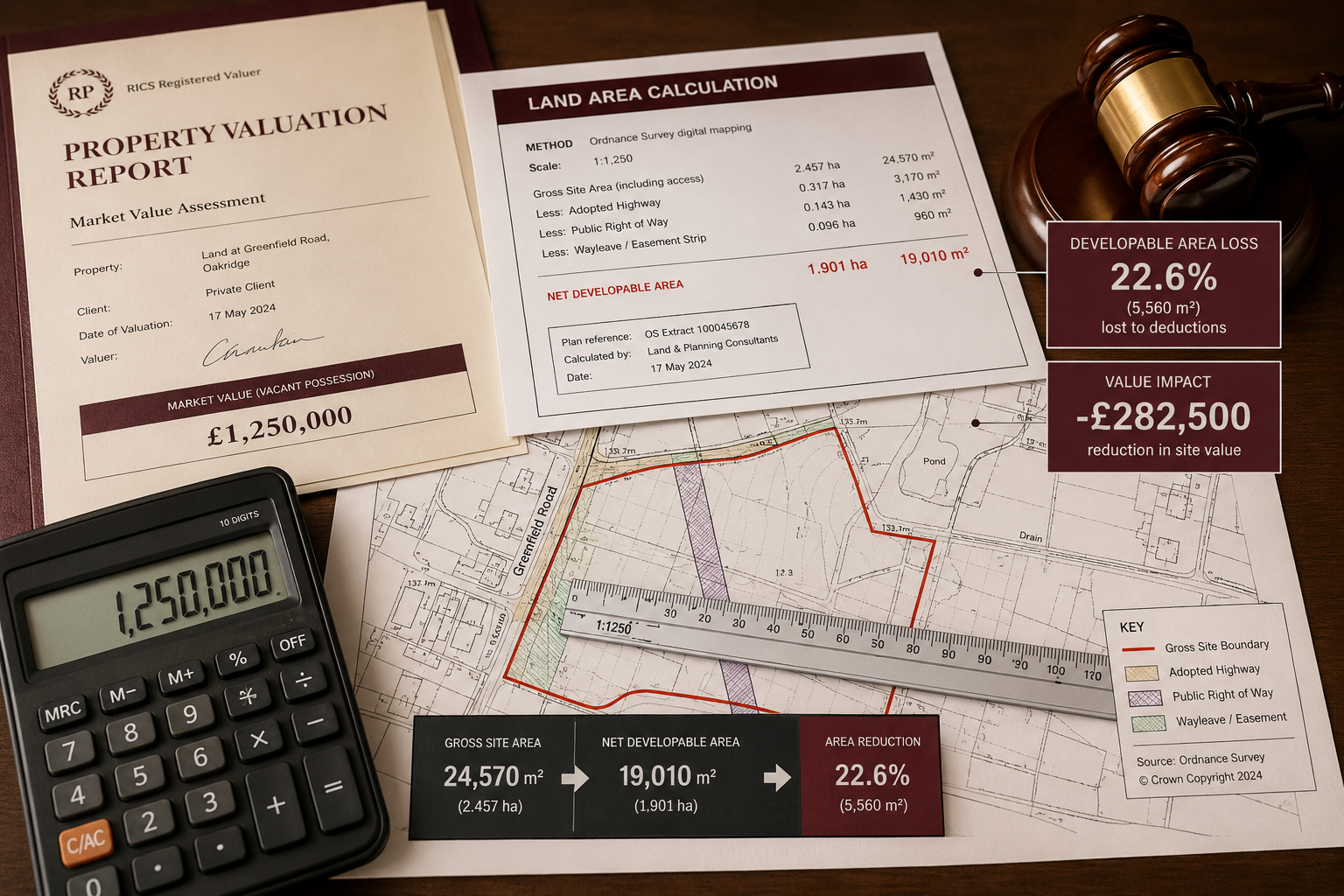
A boundary dispute becomes a valuation problem when the disputed land has a quantifiable economic impact. This is not always obvious — a strip of land 30cm wide might seem trivial until it blocks a proposed side-extension or removes a parking space.
The Five Valuation Triggers
| Trigger | Why It Creates a Valuation Problem |
|---|---|
| Land area reduction | Affects price per sq ft calculations and comparable analysis |
| Development potential loss | A boundary shift may remove permitted development rights |
| Access and easement disruption | Loss of a right of way can render a property unmortgageable |
| Marketability blight | An unresolved dispute deters buyers and suppresses offers |
| Ransom strip creation | A small disputed strip can hold disproportionate leverage value |
In 2026's recovering property market, these impacts are amplified. Lenders are more cautious, and even minor boundary uncertainties can trigger mortgage retention or refusal [9]. For properties with development potential, the stakes are even higher — a boundary shift of just a few metres can remove the viability of a project entirely. Surveyors involved in property development valuations will recognise this scenario immediately.
Quantifying the Impact: What Valuers Must Address
When a boundary issue reaches the valuation stage, the appointed valuer must:
- Establish the "as-is" value — the property with the boundary uncertainty unresolved
- Establish the "if-resolved" value — the property assuming the most favourable outcome
- Assess the probability-weighted impact — blending both scenarios based on legal likelihood
- Document comparable evidence — sales of properties with and without similar encumbrances
This is complex work. It often intersects with capital gains tax valuations and inheritance tax valuations where HMRC requires a defensible, documented opinion of value at a specific date — regardless of whether the boundary dispute was resolved by that date.
🔑 Key point: A valuation prepared for tax purposes must reflect the actual facts at the valuation date, including any unresolved boundary uncertainty — even if that uncertainty later resolves favourably.
When Does a Boundary Issue Become a Valuation or Expert Witness Problem? A Surveyor's Practical Playbook for Court Compliance
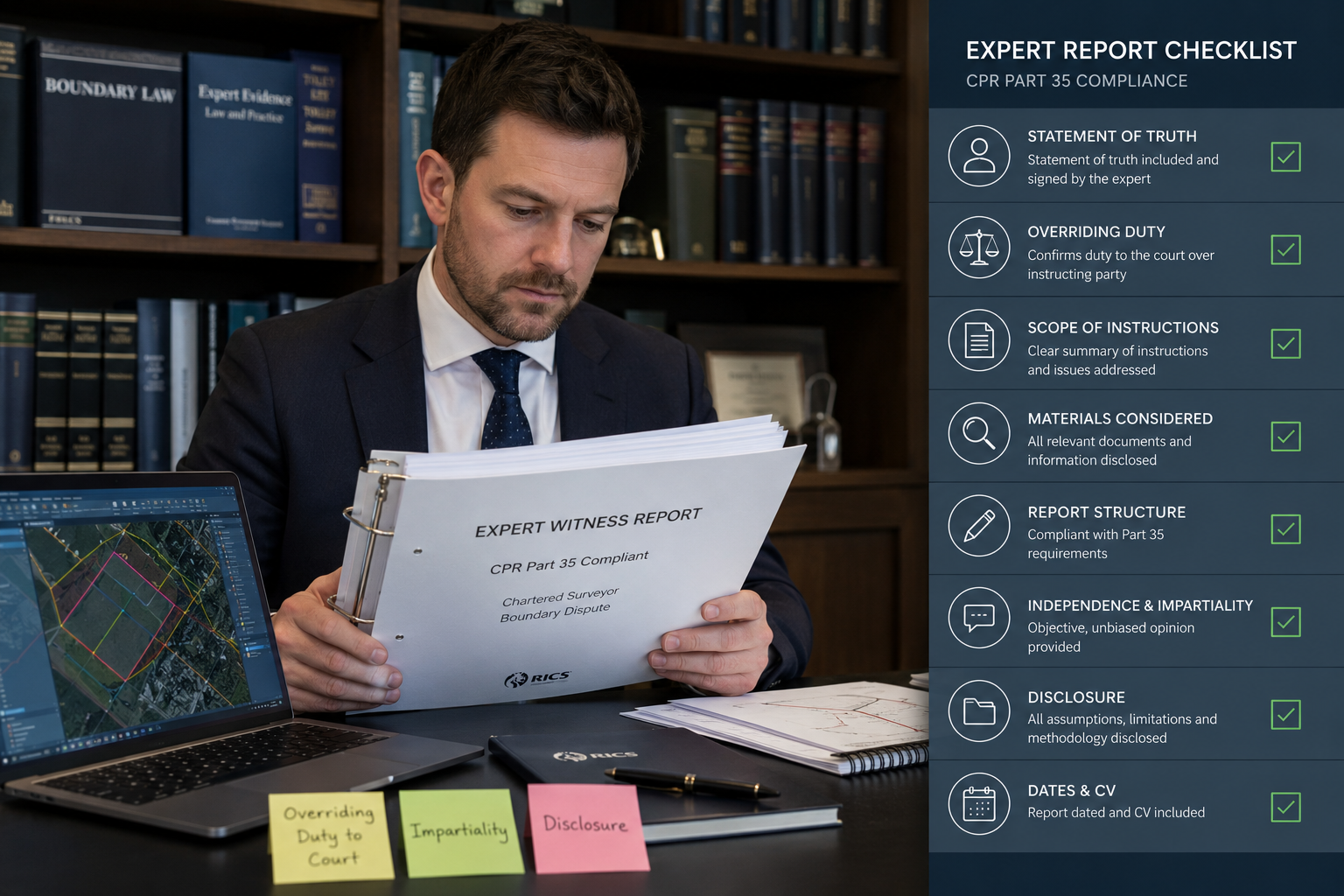
The shift from valuation adviser to expert witness is one of the most significant professional transitions a surveyor can make. It is not simply a matter of writing a more detailed report — it is a change in who the surveyor's primary duty runs to.
The Overriding Duty: Court, Not Client
Under CPR Part 35, an expert witness's overriding duty is to the court, not to the instructing party [1]. This means:
- The expert must give an objective, impartial opinion — even if it is unhelpful to the instructing party
- The expert must disclose all material facts, including those that undermine their opinion
- The expert must not act as an advocate for either side
This is a fundamentally different mindset from the client-adviser role. Surveyors who conflate the two — producing a report that reads more like a legal argument than an independent opinion — risk having their evidence excluded or their credibility challenged in cross-examination [5].
The CPR Part 35 Checklist for Boundary Expert Witnesses ✅
Before accepting an expert witness instruction on a boundary matter, a surveyor should confirm:
- They have no conflict of interest (they have not previously advised either party on the same matter)
- They have relevant expertise in boundary surveying, not just general practice
- They can produce a report that complies with CPR Part 35 and Practice Direction 35
- They understand the single joint expert (SJE) option — courts increasingly prefer one jointly instructed expert over two competing ones [6]
- They are prepared to attend a joint experts' meeting and sign a statement of agreed/disagreed issues
- They can withstand cross-examination on their methodology and conclusions
What Goes Into a Compliant Boundary Expert Witness Report?
A CPR-compliant boundary expert witness report must include [7]:
- A statement of truth — confirming the expert understands their duty to the court
- Details of instructions — what the expert was asked to consider
- Summary of facts — the physical and documentary evidence examined
- Methodology — how the boundary was determined (deed interpretation, OS data, physical features, witness evidence)
- Opinion — clearly stated, with reasons
- Areas of uncertainty — honestly acknowledged
- Declaration — that the report complies with CPR Part 35
💬 "Expert witnesses in boundary disputes must be prepared to defend not just their conclusion, but every methodological step that led to it." [10]
For complex cases involving building pathology or structural encroachments, additional specialist input may be required alongside the boundary evidence — and the expert witness report should clearly signpost where other disciplines are needed.
The Decision Tree: A Practical Framework 🌳
Use this framework to determine which professional response a boundary issue requires:
Boundary uncertainty identified
        │
        ▼
Is it material to the transaction or use of the property?
    NO → Note in survey report; monitor
    YES ↓
        ▼
Can it be resolved by agreement between the parties?
    YES → Solicitor-led negotiation + measured survey support
    NO ↓
        ▼
Does it affect the property's value or tax position?
    YES → Commission formal valuation (RICS Red Book or equivalent)
    NO ↓
        ▼
Have formal legal proceedings been issued or threatened?
    NO → Mediation; boundary agreement; deed of variation
    YES ↓
        ▼
Expert witness instruction required
(CPR Part 35 compliant; consider SJE appointment)
Documentation Tips at Each Stage
At discovery:
- Photograph all physical boundary features with date stamps
- Obtain a copy of the registered title plan and any filed deeds
- Note any verbal statements made by neighbours
During negotiation:
- Keep all correspondence in writing
- Ensure any agreed positions are confirmed by solicitors
- Obtain a measured survey to a recognised standard (e.g., RICS guidance note on boundary surveys)
At valuation stage:
- Instruct a RICS-registered valuer with experience of encumbered properties
- Provide the valuer with all relevant legal correspondence
- Ensure the valuation report explicitly addresses the boundary uncertainty
At expert witness stage:
- Instruct separately from the client's legal team to preserve independence
- Agree the scope of instruction in writing before commencing
- Review the sourcing extra advice guidance to ensure all necessary disciplines are covered
Common Mistakes That Escalate Boundary Issues Unnecessarily
Understanding When Does a Boundary Issue Become a Valuation or Expert Witness Problem? A Surveyor's Practical Playbook also means knowing what not to do.
❌ Mistake 1: Treating All Boundary Issues as Disputes
Many boundary uncertainties are simply general boundary limitations — the Land Registry does not guarantee exact boundary positions. Treating a title plan imprecision as an active dispute can create conflict where none existed [8].
❌ Mistake 2: The Surveyor Who Becomes an Advocate
A surveyor who has advised a client through negotiation should not then accept an expert witness instruction in the same matter. The prior advisory role compromises impartiality [1].
❌ Mistake 3: Ignoring the Valuation Dimension
Solicitors and surveyors sometimes focus so heavily on where the boundary is that they fail to address what it costs if the boundary falls in the less favourable position. A valuation impact assessment should run in parallel with boundary determination, not after it [3].
❌ Mistake 4: Poor Documentation Early On
Cases that reach the First-tier Tribunal frequently hinge on evidence that was available at the outset but was never formally recorded. Photographs, measurements, and neighbour conversations noted contemporaneously carry far more weight than recollections years later [5].
❌ Mistake 5: Overlooking Party Wall Implications
Boundary disputes near shared structures often trigger Party Wall Act obligations simultaneously. Failing to serve the correct notices — or failing to recognise that a boundary dispute affects a party wall — can compound both the legal complexity and the cost [2].
Special Scenarios: When the Stakes Are Highest
Leasehold and Enfranchisement Cases
Boundary disputes in leasehold contexts are particularly complex. The extent of the demise — what the lease actually grants — is a boundary question with direct valuation consequences. In enfranchisement claims, a disputed boundary can affect the premium calculation significantly. Specialist leasehold extension and enfranchisement valuations must account for any boundary uncertainty in the demise.
Commercial Property
In commercial contexts, boundary issues can affect planning permissions, site coverage ratios, and lease terms. A commercial property valuation that ignores a boundary dispute risks being challenged by HMRC, a lender, or a counterparty. The financial stakes — and the scrutiny — are considerably higher than in residential cases.
Insurance Reinstatement
Where a boundary dispute affects the footprint of a building, it can also affect the insurance reinstatement cost valuation. If an encroaching structure is damaged, who insures it — and to what extent — becomes a live question.
Conclusion: Actionable Next Steps for Surveyors and Property Owners
The journey from a minor boundary uncertainty to a full valuation or expert witness problem is not inevitable — but it is predictable. When Does a Boundary Issue Become a Valuation or Expert Witness Problem? A Surveyor's Practical Playbook comes down to three core principles:
-
Identify early. Flag boundary ambiguities at the survey stage, document them thoroughly, and communicate the potential consequences clearly to clients.
-
Escalate appropriately. Not every boundary issue needs a valuation report, and not every dispute needs an expert witness. Use the decision tree above to match the professional response to the actual risk level.
-
Maintain role clarity. A surveyor advising a client, a valuer quantifying an impact, and an expert witness reporting to a court are three distinct roles with three distinct sets of obligations. Conflating them creates professional risk and weakens the client's position.
In 2026, with property values under close scrutiny and litigation costs rising, the cost of getting this wrong — whether by under-reacting or over-escalating — has never been higher [9].
Actionable next steps:
- ✅ Review your firm's boundary survey report template against CPR Part 35 requirements
- ✅ Establish a clear internal protocol for when to recommend a formal valuation alongside a boundary investigation
- ✅ Build a referral network of solicitors, mediators, and valuers specialising in boundary-related disputes
- ✅ Consider RICS CPD on expert witness obligations if boundary work forms part of your practice
- ✅ Document every boundary observation at the time of survey — not retrospectively
References
[1] (pehr) Surveyorinct – plsc.net
[2] How Land Surveyors Help Resolve Boundary Disputes – mckissock.com
[3] Mapping And Surveying S 3 – jurispro.com
[5] Mapping Surveying Expert Witness Case Summary – expertwitnessblog.com
[6] Land Surveying Expert Witness – seakexperts.com
[7] Boundaries – jspubs.com
[8] Boundary Dispute Resolution – apexsurveyor.com
[9] Expert Witness Essentials For 2026 Boundary Disputes Strengthening Cases In A Recovering Property Market – nottinghillsurveyors.com
[10] Choosing An Expert – cnettleman.net