

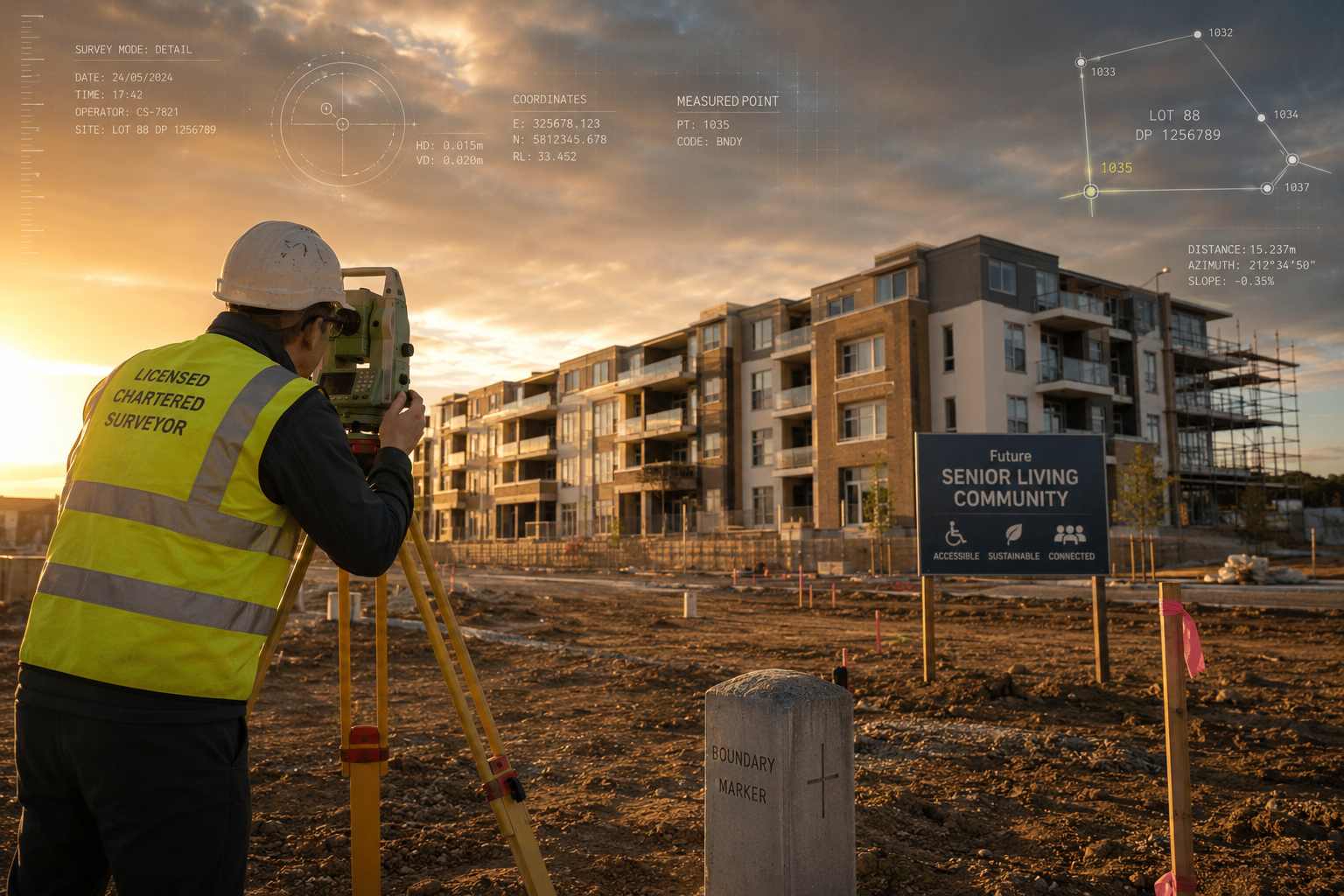
By 2026, the oldest baby boomers are turning 80 — and the senior housing sector is feeling every bit of that demographic shift. Senior housing occupancy climbed to 89.5% in Q1 2026, marking the 19th consecutive quarter of growth, while new units under construction fell to their lowest level since 2012 [1]. The gap between demand and supply has never been more acute, and developers racing to close it cannot afford surveying errors. Surveying for senior housing developments: meeting 2026 demand surge with precise boundary and site analysis is no longer a back-office formality — it is a front-line competitive advantage.
Key Takeaways 📋
- Senior housing occupancy hit 89.5% in Q1 2026, driven by baby boomer demographics and a record-low supply pipeline [1].
- Precise boundary surveys and site analysis are critical to avoiding costly planning disputes and construction delays.
- Wellness-focused layouts, accessibility gradients, and tech-enabled infrastructure demand higher surveying precision than standard residential projects.
- Drone surveys and LiDAR technology are transforming how surveyors capture topographic and boundary data on large senior living sites.
- Early-stage surveying — covering environmental, structural, and planning dimensions — protects developer investment and speeds regulatory approval.
The 2026 Baby Boomer Inflection Point and What It Means for Developers
The numbers are striking. The U.S. population aged 80 and over is projected to grow by 36.6% over the next decade, compared to just 5% for the total population [2]. In the UK, parallel trends are reshaping the housing landscape, with local authorities under mounting pressure to allocate land for specialist older persons' accommodation.
Investment is following the demographic signal. Rolling four-quarter transaction volume in the seniors housing sector reached $24 billion by year-end 2025 — the highest level since Q2 2015 [3]. Meanwhile, 86% of investors plan to increase their sector exposure in 2026, drawn by favorable demographics and strong occupancy fundamentals [6].
Yet supply is not keeping pace. Year-over-year inventory growth hit a record low of 0.4% in Q1 2026 [1]. High construction costs, tight capital markets, and — critically — slow or inaccurate site preparation are all contributing factors. Every week lost to a boundary dispute or a failed planning application is a week that a vulnerable older adult waits for appropriate housing.
💬 "At the current pace of development and demand, analysts believe senior housing occupancy is on track to surpass 90% well before the end of the year." [1]
This pressure makes precise surveying the foundation of every viable senior housing project in 2026.
Why Senior Housing Sites Present Unique Surveying Challenges
Senior living developments are not standard residential builds. They combine the complexity of commercial construction with the sensitivity of healthcare environments. Surveyors working on these projects must navigate a distinct set of technical and regulatory demands.
Accessibility and Gradient Requirements 🏗️
Building regulations for older persons' housing — including care homes, assisted living, and retirement villages — mandate strict gradient controls for pathways, ramps, and communal spaces. A topographic survey that misses a 2% gradient variance can invalidate an entire accessibility plan, triggering costly redesigns.
Key gradient-related surveying tasks include:
- Precise spot-level mapping across all pedestrian routes
- Drainage fall analysis to prevent pooling near entrances
- Ramp and threshold profiling to meet Part M (UK) or ADA (US) compliance
Wellness-Focused Site Layouts
The fastest-growing segment of senior housing in 2026 integrates wellness amenities — hydrotherapy pools, sensory gardens, walking circuits, and outdoor fitness zones. These features demand detailed topographic and boundary surveys to ensure sufficient land allocation without encroaching on neighbouring properties or protected green space.
A full Level 3 building survey at the pre-acquisition stage can identify whether an existing structure on a prospective site is suitable for conversion or whether a full demolition and rebuild is required — a decision that fundamentally changes the development programme.
Tech-Enabled Infrastructure Demands
Modern senior living facilities incorporate smart building systems: remote health monitoring, automated lighting, emergency call infrastructure, and high-speed connectivity. Each of these requires accurate sub-surface surveys to map existing utilities and plan new service routes without conflict.
University-partnered senior living communities — a trend growing rapidly in 2026, with between 85 and 100 such communities now operating [5] — add another layer of complexity, often requiring surveys to reconcile boundaries between educational and residential land uses.
Surveying for Senior Housing Developments: Meeting 2026 Demand Surge with Precise Boundary and Site Analysis — Core Survey Types Explained
Getting the survey strategy right from day one separates profitable senior housing projects from expensive failures. The following survey types are essential at different stages of development.
1. Boundary and Title Surveys
Before any planning application is submitted, a precise boundary survey establishes the legal extents of the site. Errors here can:
- Invalidate planning permissions
- Trigger neighbour disputes under the Party Wall Act
- Create title defects that delay or derail financing
For complex senior housing sites — particularly those assembled from multiple land parcels — a chartered surveyor with planning expertise can identify potential boundary ambiguities before they become legal liabilities.
2. Topographic Surveys
A topographic survey captures the three-dimensional shape of the land, including:
| Feature Captured | Why It Matters for Senior Housing |
|---|---|
| Ground levels and contours | Accessibility ramp design |
| Existing trees and vegetation | Wellness garden planning |
| Drainage channels | Surface water management |
| Utility positions | Service route planning |
| Existing structures | Demolition or retention decisions |
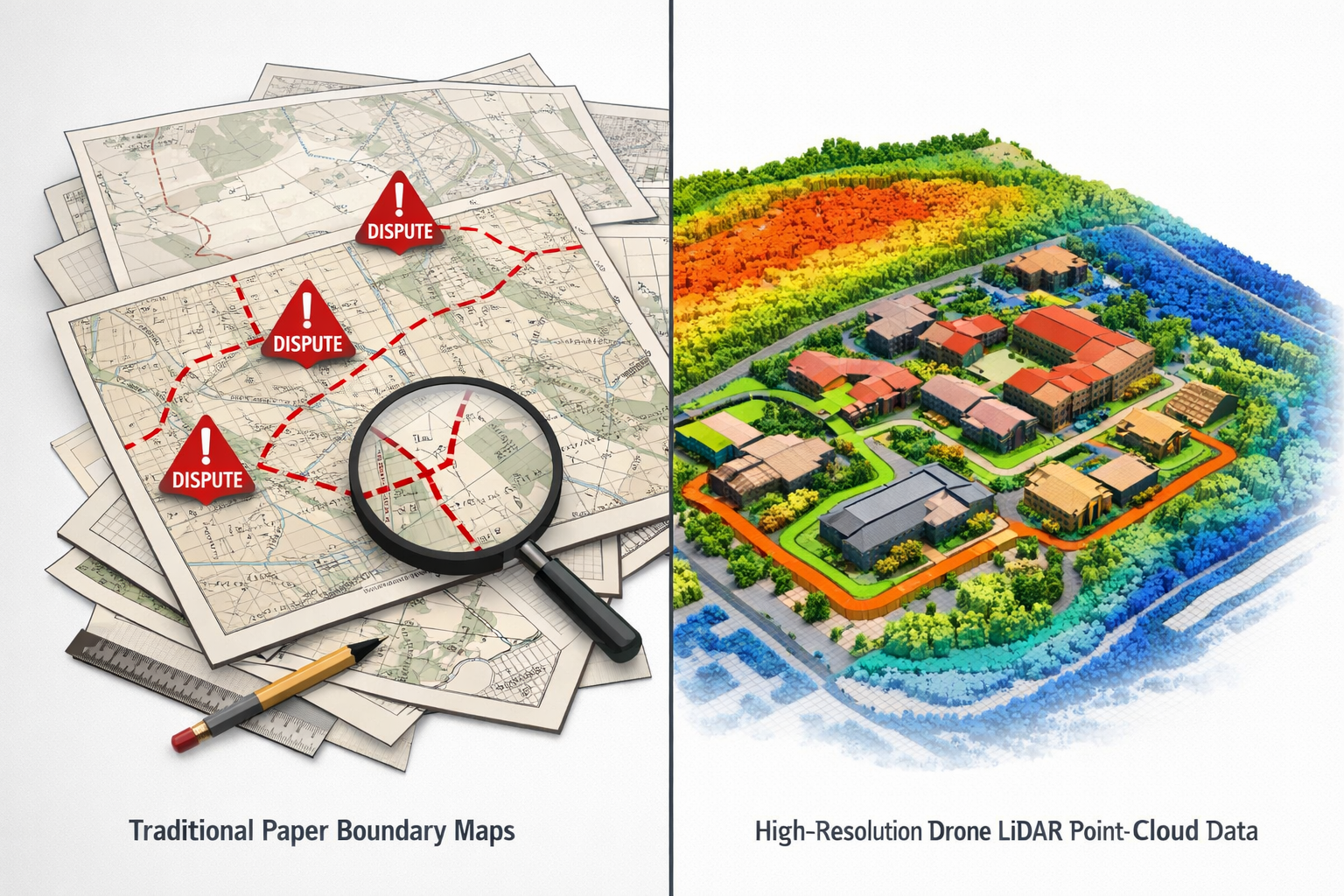
Modern topographic surveys using drone-mounted LiDAR sensors can cover large senior living campuses in a fraction of the time required by traditional ground-based methods. Premium drone survey services now deliver centimetre-level accuracy across multi-hectare sites, making them ideal for the large-format senior living developments that investors are prioritising in 2026.
3. Environmental and Ground Condition Surveys
Senior housing sites must meet high environmental standards, both for regulatory compliance and for resident wellbeing. An environmental issues assessment at the pre-development stage should cover:
- Contaminated land risk (especially on brownfield sites)
- Flood zone classification
- Air quality and noise exposure
- Radon levels (particularly relevant for ground-floor accessible units)
Failing to identify environmental constraints early is one of the most common causes of planning refusal for senior housing schemes.
4. Measured Building Surveys
Where an existing building is being converted or extended for senior use — a growing trend given land scarcity — a measured building survey provides the accurate floor plans, section drawings, and elevations that architects need. Understanding the cost of a measured building survey at the outset helps developers budget accurately and avoid mid-project surprises.
5. Condition Surveys
For acquisitions involving existing care homes or retirement properties, a detailed condition survey report identifies structural defects, maintenance liabilities, and compliance gaps — all of which affect both the purchase price and the development programme.
How Technology Is Reshaping Senior Housing Site Analysis in 2026
The surveying profession is undergoing rapid technological transformation, and senior housing development is one of the sectors benefiting most directly.
Drone and Aerial Survey Technology 🚁
Drone surveys have moved from novelty to standard practice for large senior living sites. Benefits include:
- Rapid data capture across multi-acre campuses
- High-resolution orthomosaic mapping for boundary verification
- Thermal imaging to detect subsurface anomalies
- Progress monitoring during phased construction
BIM Integration
Building Information Modelling (BIM) workflows increasingly depend on survey data as their foundational layer. When surveyors deliver data in BIM-compatible formats, architects, structural engineers, and mechanical and electrical consultants can all work from the same verified dataset — reducing coordination errors that are particularly costly in the complex, multi-use environments of senior living campuses.
Digital Twin Capabilities
Cutting-edge senior housing projects in 2026 are using survey data to create digital twins — virtual replicas of the physical site that can be used for design iteration, regulatory submissions, and long-term facilities management. Accurate initial surveys are the prerequisite for this technology to function reliably.
Planning, Regulation, and the Surveyor's Role in Senior Housing Approvals
Senior housing development sits at the intersection of residential, healthcare, and commercial planning policy. Surveyors play a critical role in navigating this complexity.
Areas of Further Investigation
Complex senior housing sites frequently reveal issues that require specialist follow-up. A thorough areas of further investigation assessment flags items such as:
- Structural concerns in retained buildings
- Unexplained ground settlement
- Boundary features with uncertain ownership
- Services that do not appear on utility records
Identifying these issues before planning submission — rather than during construction — is the difference between a smooth approval process and a prolonged, expensive delay.
Energy Performance and Sustainability
With the UK's Minimum Energy Efficiency Standards (MEES) tightening, senior housing developers must ensure that new and converted buildings meet EPC requirements from day one. Understanding EPC and MEES implications during the survey stage allows design teams to integrate energy efficiency measures into the fabric of the building rather than retrofitting them later.
Party Wall Considerations
Senior housing developments on constrained urban sites frequently involve works adjacent to existing properties. Party wall surveyor requirements must be addressed early — particularly where foundation works, basement excavations, or extensions are planned close to neighbouring boundaries.
Surveying for Senior Housing Developments: Meeting 2026 Demand Surge — A Practical Development Checklist
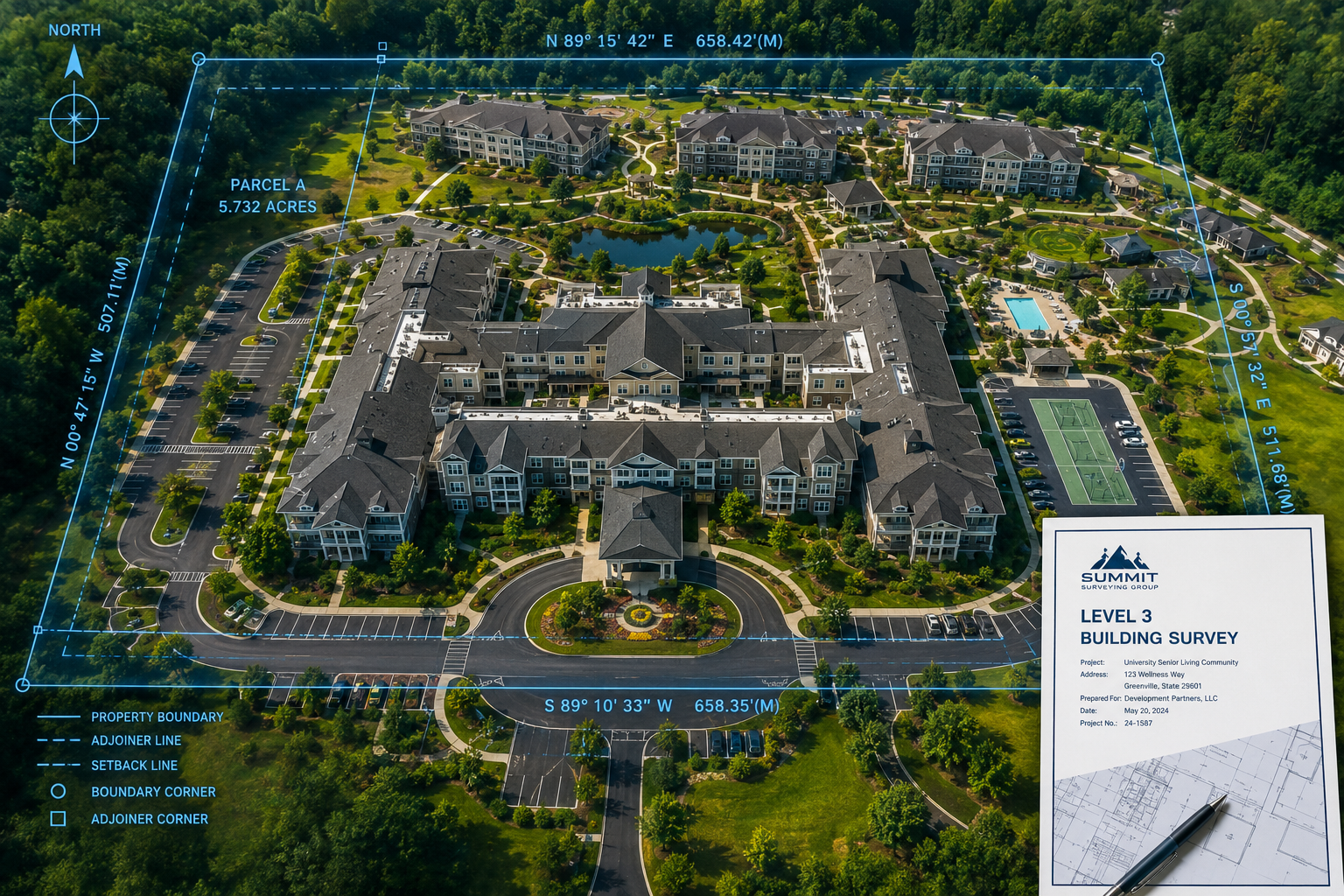
The following checklist summarises the surveying milestones that every senior housing developer should build into their programme in 2026:
Pre-Acquisition Stage ✅
- Boundary and title survey to confirm legal extents
- Desktop environmental search
- Condition survey of any existing structures
- Initial topographic survey for feasibility modelling
Pre-Planning Stage ✅
- Full topographic survey (drone-assisted where site size warrants)
- Environmental and ground condition assessment
- Measured building survey (if conversion is proposed)
- Party wall notices served where applicable
Planning Application Stage ✅
- Survey data integrated into BIM/design platform
- EPC and MEES compliance review
- Drainage and flood risk survey
- Accessibility gradient verification
Pre-Construction Stage ✅
- Setting-out survey to establish build lines
- Utility mapping and service corridor confirmation
- Structural survey of any retained elements
- Final boundary verification against approved plans
The Financial Case for Getting Surveying Right First Time
Senior housing rents have grown 28.8% from pre-COVID levels, reaching a monthly average of $5,479 [4]. With occupancy rates in primary markets reaching 89.9% [3], the revenue potential of a well-executed senior housing development is substantial. But that potential is only realised if the project completes on time and within budget.
Consider the cost of common surveying-related failures:
| Failure Type | Typical Cost Impact |
|---|---|
| Boundary dispute requiring legal resolution | £15,000–£100,000+ |
| Planning refusal due to inaccurate site data | 6–18 months delay |
| Accessibility redesign post-planning | £50,000–£500,000 |
| Environmental remediation not identified pre-purchase | £100,000–£1M+ |
| Party wall dispute during construction | 3–12 months delay |
Investing in comprehensive surveying at each stage of development is not a cost — it is risk mitigation with a measurable return.
For developers evaluating property development valuations, accurate survey data also underpins the residual land value calculations that determine whether a site is financially viable in the first place.
Conclusion: Actionable Next Steps for Senior Housing Developers in 2026
The demographic case for senior housing investment in 2026 is overwhelming. The challenge is not demand — it is execution. With inventory growth at a record low [1] and 86% of investors planning to increase their sector exposure [6], the developers who move fastest and most accurately will capture the greatest returns.
Surveying is where that accuracy begins. Here are the immediate actions every senior housing developer and investor should take:
- Commission a boundary survey before any land acquisition — do not rely on title plan sketches for complex or assembled sites.
- Integrate drone-assisted topographic surveys into the feasibility stage for sites above 0.5 hectares.
- Appoint a chartered surveyor with senior housing or care sector experience — the accessibility, environmental, and planning dimensions of these projects require specialist knowledge.
- Build environmental and condition surveys into the pre-acquisition budget — the cost of discovery at this stage is a fraction of the cost of discovery during construction.
- Use survey data as the foundation for BIM workflows — this reduces coordination errors across the entire design and construction team.
- Address party wall obligations early — senior housing projects on urban infill sites are particularly vulnerable to neighbour disputes that derail programmes.
The 2026 demand surge in senior housing is a generational opportunity. Precise boundary and site analysis is the technical foundation that makes that opportunity deliverable.
References
[1] Senior Living Occupancy Grows Amid Construction Slowdown Limiting Options For Older Adults – nic.org
[2] Senior Housing – pwc.com
[3] Seniors Housing Investment Reaches Decade High Of 24 Billion – jll.com
[4] Senior Housing Demand Forecast Is Bright – bdcnetwork.com
[5] Demand For Senior Living University Projects Still Growing Despite Development Challenges – seniorhousingnews.com
[6] Senior Housing Demand Surges Into 2026 – credaily.com