

Nearly one in three commercial lease dilapidation claims that reach formal dispute resolution in the UK involve a challenge to the quality or completeness of the original building survey. That single statistic explains why the journey from condition report to courtroom is not a hypothetical risk — it is a documented reality that chartered surveyors, landlords, tenants, and buyers face every year.
This article walks through the full lifecycle of a building survey that later becomes a piece of legal evidence. It explains what transforms a routine inspection into a defensible expert document, and how surveyors can future-proof their work — through precise wording, thorough file notes, systematic photography, and carefully drafted limitation clauses — so it holds up under cross-examination.
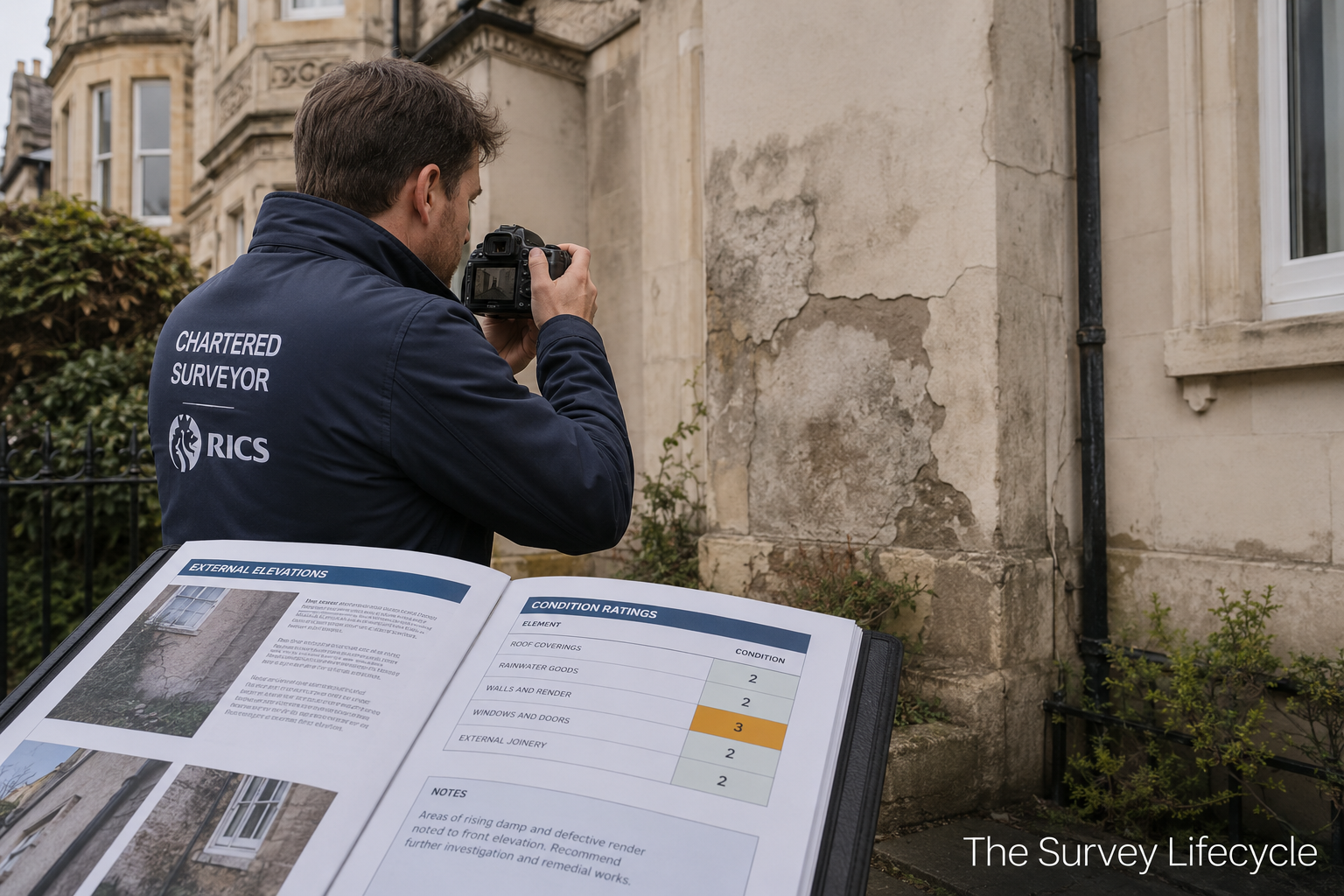
Key Takeaways 📋
- A building survey can be called as evidence in defect claims, dilapidation disputes, and professional negligence actions — often years after it was written.
- Courts in 2026 expect photographic evidence, measurement data, cost analysis, and lease analysis from surveyors acting as expert witnesses. [6]
- Incomplete documentation — such as omitting rear façades or basement areas — is one of the most common triggers for dispute. [2]
- Surveyors who carry out repairs without preserving evidence risk spoliation sanctions in legal proceedings. [5]
- Future-proofing a survey requires disciplined file management, proportionate limitation clauses, and a methodology that is systematic and reproducible. [1]
The Lifecycle of a Survey: From Instruction to Dispute
Every building survey begins simply enough: a client instructs a chartered surveyor to assess a property. Whether it is a Level 3 Full Building Survey ahead of a purchase, a schedule of condition at lease commencement, or a dilapidations assessment at lease end, the surveyor's job is to record what they find and communicate it clearly.
But the lifecycle rarely ends at delivery of the report. Properties change hands. Leases expire. Defects worsen. Relationships between landlords and tenants break down. When that happens, the original survey document stops being a professional advisory tool and starts being a piece of evidence.
Stage 1 — Instruction and Scope Agreement
The first vulnerability in any survey is an unclear scope. If the client's instruction letter does not define which elements are included, which are excluded, and what access was available, a court will later be asked to infer what the surveyor was — and was not — responsible for assessing.
Best practice in 2026 requires surveyors to:
- Confirm the agreed scope in writing before inspection
- Record any access restrictions on the day (locked rooms, fixed floor coverings, overgrown areas)
- Note explicitly what could not be inspected and why
- Reference the relevant RICS guidance note or Home Survey Standard applicable to the instruction
Stage 2 — The Inspection Itself
This is where most evidential problems originate. Research into building pathology methodology confirms that surveyors must apply a systematic process to identify hidden structural issues — and that findings must be proportional to the actual evidence gathered, not assumptions. [1]
Common inspection failures that later cause legal difficulty include:
| Failure | Legal Consequence |
|---|---|
| Omitting rear façades or basement areas | Dispute over undocumented defects [2] |
| No photographic record of specific defect locations | Inability to prove condition at a point in time |
| Vague condition ratings without supporting narrative | Challenged as opinion rather than fact |
| No measurement data for crack widths or damp readings | Expert evidence undermined under cross-examination |
| Failure to flag need for specialist investigation | Professional negligence exposure [7] |
💬 Pull Quote: "A survey that cannot be reproduced — where another surveyor following the same methodology would reach the same conclusions — is a survey that will struggle in court."
Drone technology is increasingly used to capture evidence of roof and high-level defects that would otherwise be inaccessible. Premium drone surveys provide timestamped, georeferenced imagery that is far more defensible than a surveyor's written note about a distant roof slope.
Stage 3 — Report Writing and Wording
The language of a survey report is scrutinised intensely in litigation. Vague phrases like "some cracking noted" or "evidence of past moisture" are almost useless as evidence. Courts need to know:
- Where exactly the defect was located
- How severe it was at the date of inspection (with measurement data where possible)
- What caused it (or what further investigation is needed to determine cause)
- What the recommended action is and within what timeframe
For dilapidation disputes specifically, the surveyor's report must connect physical observations to lease obligations. This is why construction law advice integrated into the surveying process — rather than bolted on afterwards — produces far more legally coherent documents.
Future-Proofing Your Survey: Documentation, Photography, and File Notes
The gap between a survey that collapses under legal scrutiny and one that holds up is almost never about the surveyor's technical knowledge. It is almost always about documentation discipline.
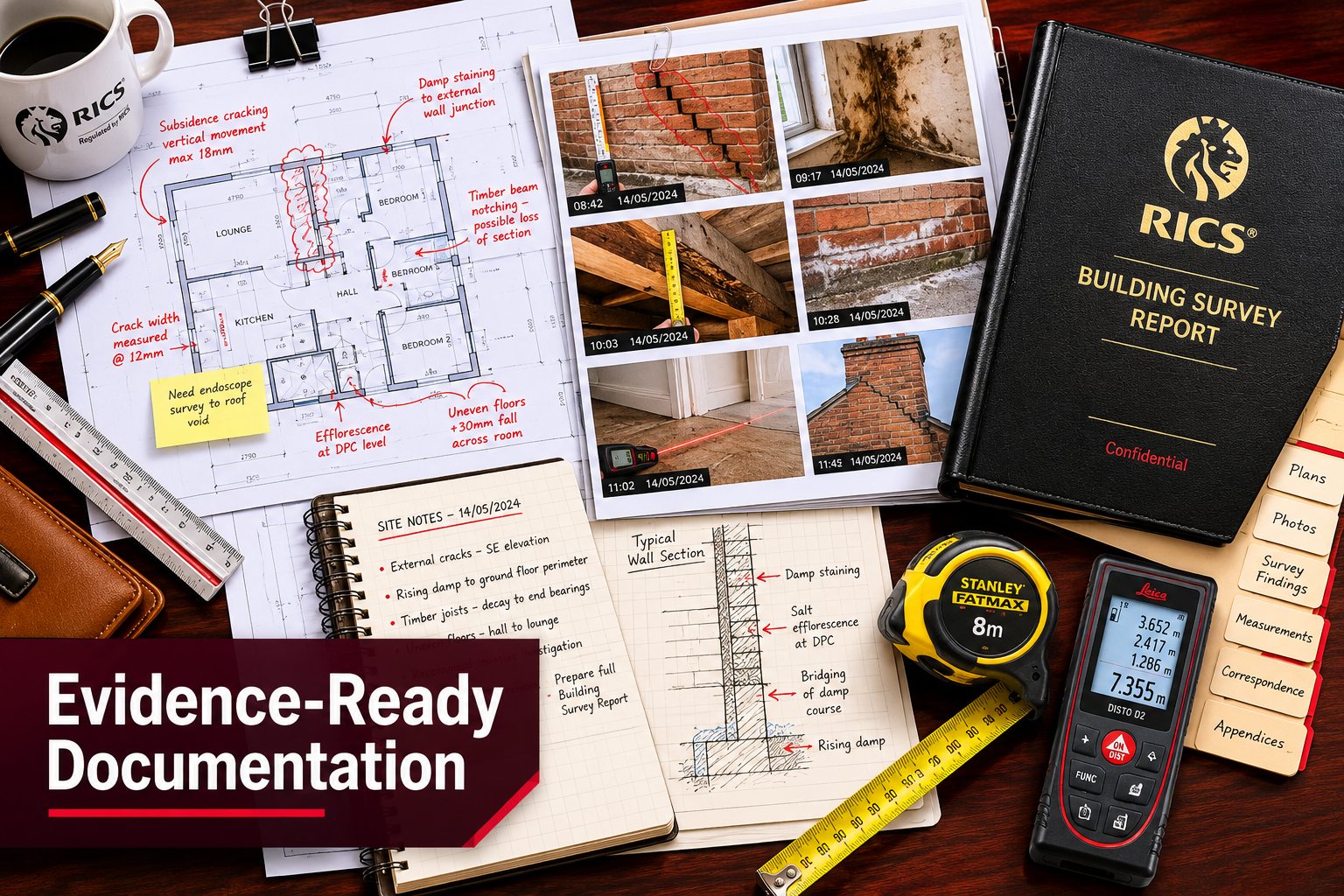
Photography as Primary Evidence
Photographs are the single most powerful evidential tool available to a surveyor. Yet many survey files contain images that are:
- ❌ Undated or without geolocation metadata
- ❌ Too wide-angle to show defect detail clearly
- ❌ Unlabelled, making it impossible to locate the defect within the building
- ❌ Taken on a personal smartphone not linked to the professional file
Best practice for evidential photography in 2026:
- Use a camera or device that embeds EXIF metadata (date, time, GPS coordinates)
- Photograph each defect at three scales: context (showing location within the building), mid-range (showing the defect in relation to surrounding elements), and close-up (showing detail)
- Include a scale reference (ruler, coin, or measuring tape) in close-up shots
- Number photographs sequentially and cross-reference them to the written report
- Store originals in an unedited master file — editing or compressing images can be challenged as alteration of evidence [5]
File Notes: The Surveyor's Running Record
File notes are the contemporaneous record of everything that happened during and around the inspection. They are not part of the report delivered to the client — but they are disclosable in litigation and can be the difference between a credible expert and a discredited one.
Effective file notes should capture:
- Pre-inspection communications — what the client said they were concerned about
- Site conditions on the day — weather, lighting, access restrictions
- Observations not included in the final report and the reason for exclusion
- Conversations held on site with owners, agents, or contractors
- Any instruction to limit scope received verbally
🔑 Key Point: If a surveyor decides not to recommend further investigation of a suspicious area, the file note explaining that decision is what protects them from a professional negligence claim later. [7]
Limitation Clauses: Protection Without Evasion
Limitation clauses in survey reports are legitimate and necessary — but they must be proportionate and specific, not blanket disclaimers designed to evade all responsibility.
Courts have consistently found that overly broad limitation clauses (for example, "no liability is accepted for any matters not visible at the time of inspection") do not protect surveyors from claims arising from matters that were visible but were missed. [7]
Effective limitation clauses:
- Identify specific elements that were not inspected and why (e.g., "The roof void was not accessed due to the absence of a hatch")
- Reference the standard of inspection applied (e.g., RICS Home Survey Standard Level 3)
- Confirm the purpose for which the report was prepared and that it should not be relied upon for other purposes
- State clearly that specialist investigations (structural engineer, asbestos surveyor, drainage CCTV) were not within scope
For properties with complex material histories, a building materials assessment or asbestos survey should be recommended explicitly — and the surveyor's file should record whether that recommendation was accepted or declined.
From Condition Report to Courtroom: The Surveyor as Expert Witness
When a dispute reaches formal proceedings — whether through the courts, RICS Dispute Resolution Service, or arbitration — the original surveyor may be called as a fact witness (giving evidence about what they personally observed) or as an expert witness (giving an independent opinion on technical matters).
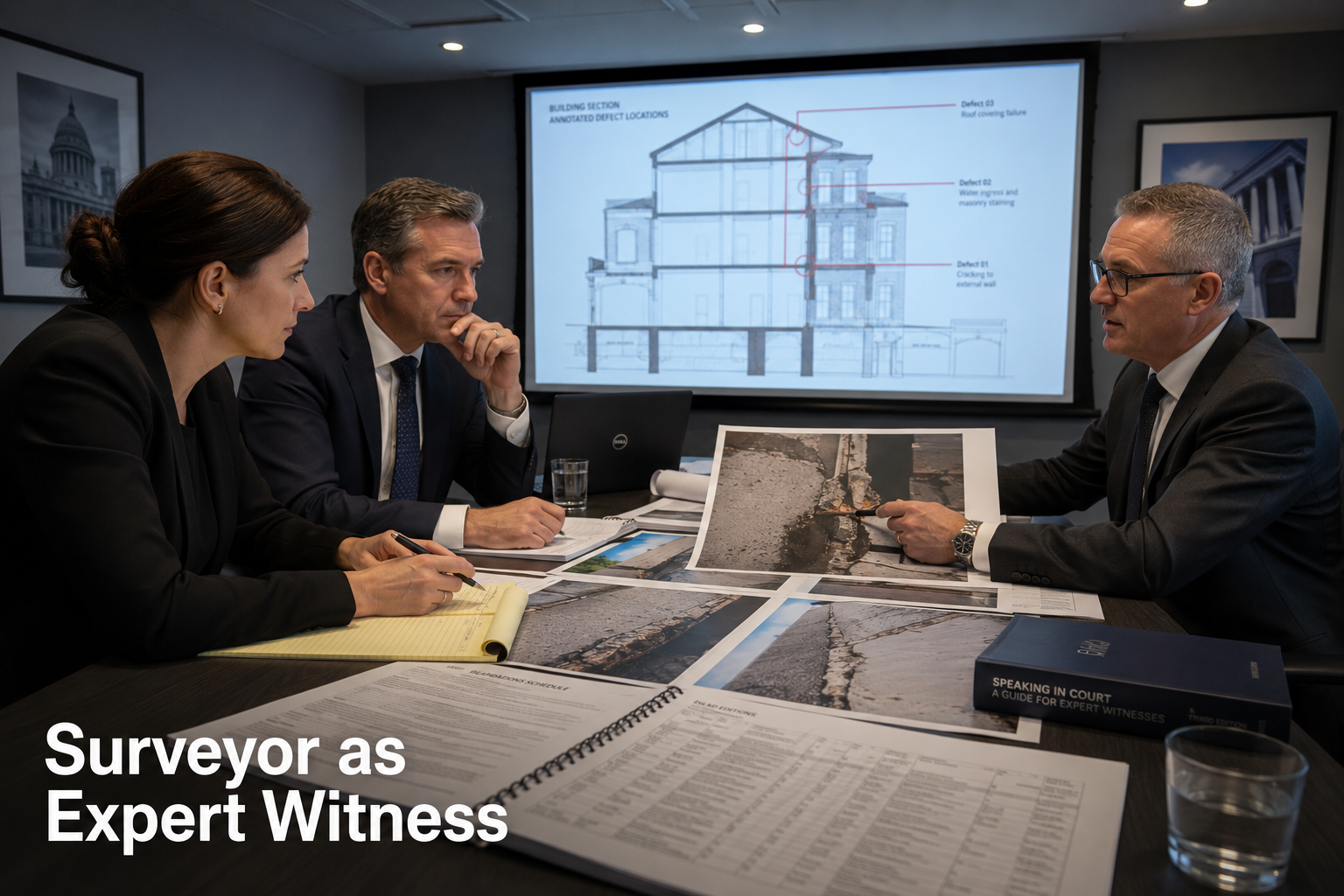
These are fundamentally different roles, and confusing them is a common mistake.
Fact Witness vs. Expert Witness
| Role | What They Do | Key Duty |
|---|---|---|
| Fact Witness | Gives evidence of personal observations | Duty to the client/instructing party |
| Expert Witness | Gives independent technical opinion | Overriding duty to the court |
A surveyor acting as an expert witness in a dilapidation or defect dispute in 2026 must meet the evidence standards set out in CPR Part 35 (Civil Procedure Rules). Courts now expect detailed photographic evidence, measurement data, cost evidence, and lease analysis — and the January 2026 Supreme Court ruling in Berk v. Choy has reinforced that substantive expert evidence takes precedence over procedural technicalities. [6]
What Courts Look For in Survey Evidence
Forensic engineering principles — which go well beyond a visual inspection — are increasingly expected in high-value defect claims. [3] A court-ready survey or expert report should demonstrate:
- Methodology: How was the inspection conducted? What standards were applied?
- Reproducibility: Would another qualified surveyor, following the same process, reach the same conclusions?
- Proportionality: Are the findings supported by the evidence, or do they go beyond what was actually observed? [1]
- Independence: Has the surveyor maintained objectivity, or are they acting as an advocate for their client?
For dilapidation claims specifically — which are among the most frequently litigated property matters in England and Wales — the surveyor's dilapidations service must connect each alleged breach to a specific lease covenant, supported by photographic and measurement evidence taken at a defined point in time.
The Spoliation Problem: Repairs Before Evidence Is Preserved
One of the most serious evidential traps in defect disputes is spoliation — the destruction or alteration of evidence, usually through repairs carried out before the other party has had an opportunity to inspect.
The American Bar Association's construction law guidance identifies this as a significant risk: courts consider factors including whether the party had notice of potential litigation, whether the evidence was unique, and whether alternative evidence exists when determining whether to impose sanctions. [5] UK courts apply similar principles under the Civil Evidence Act and case management powers.
Practical rule for 2026: Before any remedial works are carried out on a property that is subject to a dispute — or where a dispute is reasonably foreseeable — the existing condition must be fully documented by an independent surveyor. This applies equally to landlords carrying out dilapidation works after lease expiry and to buyers repairing defects discovered post-completion.
Budgeting for repairs in a dispute context requires careful thought. A budgeting for repairs and restoration assessment that is prepared before works begin creates a defensible cost record that can be relied upon in subsequent proceedings.
Emerging Technology in Defect Evidence
Convolutional Neural Networks (CNNs) and AI-assisted defect detection tools are beginning to appear in high-value survey work, offering automated identification and localisation of cracks, spalling, and moisture damage from photographic data. [8] While these tools are not yet standard in routine residential surveys, their use in commercial and forensic contexts is growing — and survey files that incorporate AI-assisted analysis alongside traditional methodology are likely to carry greater evidential weight as courts become more familiar with the technology.
Practical Checklist: Making Every Survey Litigation-Ready
Whether a surveyor is conducting a pre-purchase inspection or a Level 3 Full Building Survey, the following checklist helps ensure the work will survive scrutiny if it ever travels from condition report to courtroom.
✅ Before the Inspection
- Confirm scope and limitations in writing
- Identify any specialist investigations required
- Review lease or title documents relevant to the inspection
✅ During the Inspection
- Follow a systematic, documented methodology [1]
- Photograph all defects at context, mid-range, and close-up scale
- Record access restrictions contemporaneously
- Take measurement readings (damp meter, crack width gauge) and log them
✅ In the Report
- Use precise location references (not "south wall" but "south elevation, 1.2m from south-east corner, 2.4m above DPC level")
- Distinguish between observed fact and professional opinion
- Recommend specialist investigations where warranted — and document if declined
- Apply proportionate, specific limitation clauses
✅ After Delivery
- Retain the complete file (photos, notes, correspondence) for at least 15 years
- Store photographs in an unedited master archive
- If litigation becomes likely, seek legal advice before carrying out or authorising repairs [5]
Conclusion: Surveys That Stand Up When It Matters Most
The journey from condition report to courtroom — when a building survey becomes evidence in defect and dilapidation disputes — is one that no surveyor plans for at the moment of instruction, but every surveyor should prepare for from the first photograph they take.
The difference between a survey that protects its author and one that exposes them to professional negligence claims lies in discipline, not expertise. Systematic methodology, meticulous photography, honest file notes, and proportionate limitation clauses are not bureaucratic burdens — they are the professional infrastructure that makes a surveyor's opinion credible when it matters most.
Actionable next steps:
- 🔍 Review your current survey template — does your report wording distinguish clearly between observed fact and professional opinion?
- 📸 Audit your photography workflow — are images timestamped, labelled, and stored in an unedited master file?
- 📁 Check your file retention policy — 15 years is the recommended minimum for survey files that may be called as evidence
- ⚖️ Seek construction law input on any survey instruction where litigation is already foreseeable
- 🏗️ Before any repairs, commission an independent condition record to avoid spoliation risk
For property owners, buyers, and tenants who want to understand which level of survey provides the strongest evidential foundation, this guide to building survey types explains the options in plain language.
References
[1] Defect Diagnosis In Building Pathology How Surveyors Identify Hidden Structural Issues Before They Become Costly Claims – canterburysurveyors.com
[2] Common Pitfalls In Existing Conditions Documentation And How To Avoid Them – saltusllc.com
[3] journal.nafe – journal.nafe.org
[4] Understanding – hba.org.my
[5] Building Is Evidence – americanbar.org
[6] Building Surveyors As Expert Witnesses Evidence Standards For Construction Claims And Dilapidations In 2026 – wimbledonsurveyors.com
[7] Expert Witness Reports For Professional Negligence Claims Building Surveyor Duties In 2026 Litigation – kingstonsurveyors.com
[8] arxiv – arxiv.org