

Seventy-eight percent of challenged retrofit valuations in Q1 2026 were rejected — not because the numbers were wrong, but because the fire safety documentation was insufficient [5]. That single statistic captures the seismic shift now reshaping how surveyors, valuers, and expert witnesses operate under the Building Safety Act 2022 Updates: Expert Witness Protocols for Fire Safety and Retrofit Valuations in 2026 framework. For professionals working on higher-risk buildings (HRBs), the rules have changed fundamentally, and the consequences of getting them wrong are severe.
This article breaks down exactly what those changes mean in practice — from Golden Thread compliance and Gateway evidence to courtroom-ready expert testimony and valuation adjustments for fire safety upgrades.
Key Takeaways 📋
- Digital documentation is now mandatory for all HRB expert witness reports, with full enforcement from April 1, 2026 [10]
- Golden Thread compliance is a prerequisite for expert testimony — non-compliant reports are excluded from Building Safety Regulator proceedings [7]
- Retrofit valuations must explicitly document how fire safety upgrades affect long-term maintenance costs following the Smith v. London Housing Authority ruling [9]
- Expert witnesses must hold the new Building Safety Competence Assessment certification as of May 1, 2026 [10]
- Property managers face a 45% increase in enforcement actions for failing to retain complete expert fire safety documentation [3]
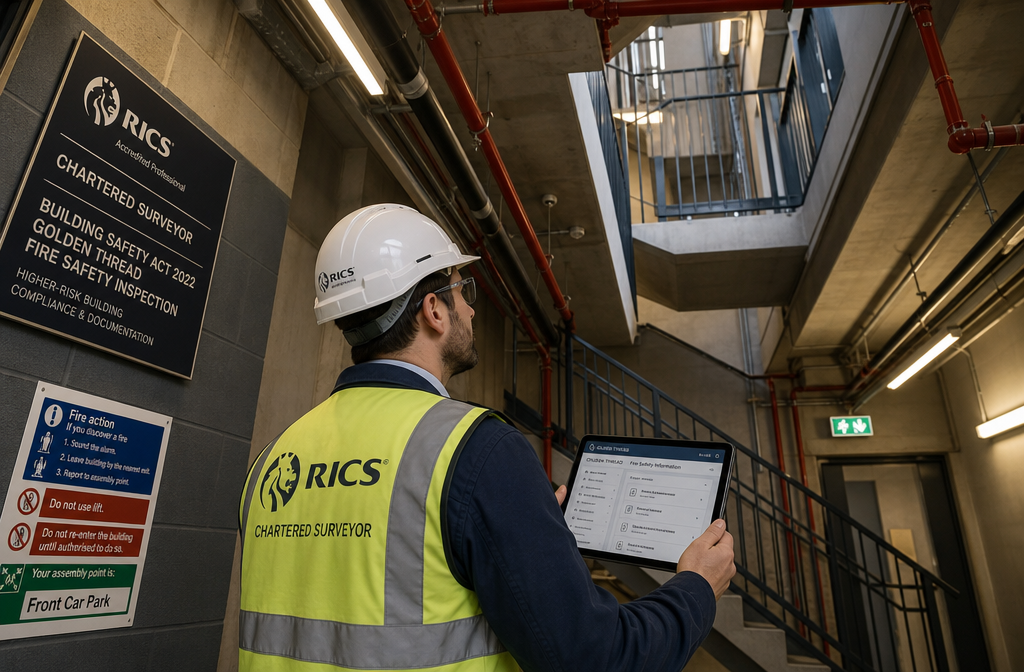
The Surveyor's Role in Higher-Risk Building Due Diligence
The Building Safety Act 2022 created a new category of building — the higher-risk building (HRB) — defined broadly as residential structures of 18 metres or more, or at least 7 storeys. For chartered surveyors, this classification triggers a completely different standard of due diligence compared to standard residential or commercial instructions.
What Due Diligence Now Requires
Before any transaction, dispute, or regulatory submission involving an HRB, surveyors must verify and document:
| Due Diligence Element | Requirement | Enforcement Date |
|---|---|---|
| Golden Thread digital records | Structured, version-controlled format | April 1, 2026 [10] |
| Gateway 3 completion evidence | Must be verified and included in reports | March 2026 [6] |
| Fire safety lifecycle costing | Explicit documentation in valuations | February 2026 [9] |
| Competence certification | Building Safety Competence Assessment | May 1, 2026 [10] |
| BS 8644-1:2026 compliance | Version history for all assessments | Q1 2026 [2] |
A thorough building survey now serves as the foundation for this due diligence process. Surveyors who treat HRB instructions as standard residential inspections are exposing their clients — and themselves — to serious legal and regulatory risk.
The Golden Thread: From Concept to Compliance Requirement
The Golden Thread was introduced under the Building Safety Act as a requirement to maintain a continuous, accessible digital record of a building's design intent, as-built conditions, and ongoing maintenance history [2]. In 2026, it has moved from a theoretical framework to an actively enforced compliance standard.
💡 Pull Quote: "92% of successful expert testimony in Q1 2026 included complete version histories meeting the new BS 8644-1:2026 standard." [2]
For surveyors conducting due diligence on HRBs, this means:
- Requesting the full Golden Thread dataset before commencing any assessment
- Verifying that records are structured in a format compatible with the Building Safety Regulator's digital submission requirements
- Flagging gaps in maintenance history or design documentation as material defects that affect valuation and risk assessment
- Documenting their own assessment as a new layer within the Golden Thread, with version control
Property managers are equally affected. The Building Safety Regulator has reported a 45% increase in enforcement actions against property managers who failed to maintain complete expert documentation since January 2026 [3]. For surveyors advising landlords and managing agents, understanding these obligations is now a core part of professional competence. Those involved in Section 20 major works should be particularly alert to how Golden Thread requirements intersect with leaseholder consultation obligations.
Expert Witness Protocols Under the Building Safety Act 2022 Updates
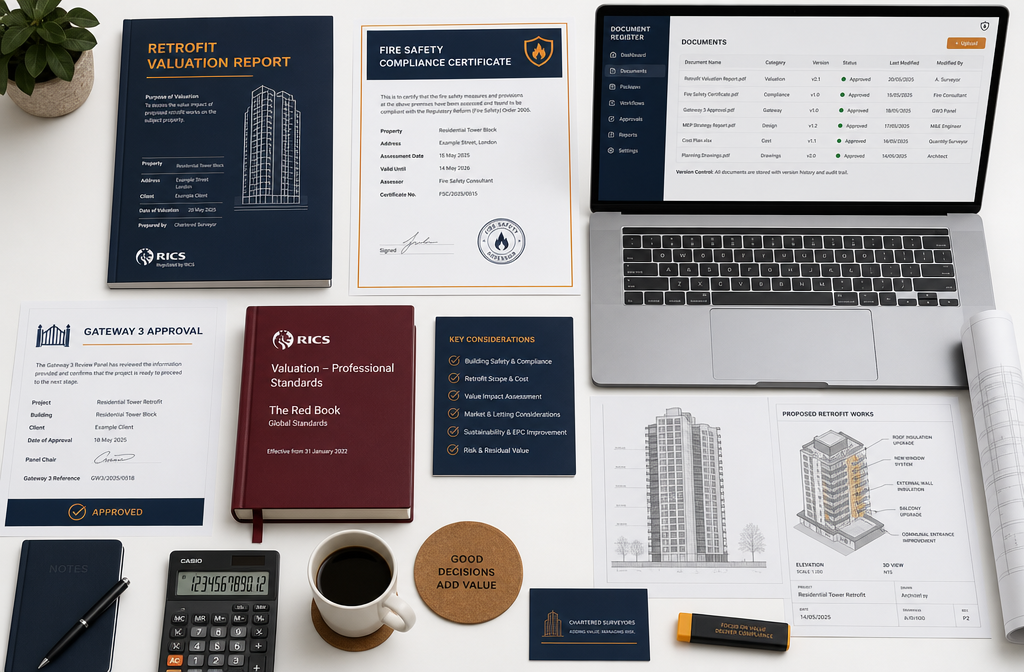
The Building Safety Act 2022 Updates: Expert Witness Protocols for Fire Safety and Retrofit Valuations in 2026 have introduced the most significant changes to expert witness practice in the property sector in a generation. These are not incremental adjustments — they represent a structural overhaul of what courts and the Building Safety Regulator will accept as credible evidence.
Mandatory Competence Certification
As of May 1, 2026, every expert witness providing fire safety testimony must hold the Building Safety Competence Assessment certification, administered directly by the Building Safety Regulator [10]. Within the first month of implementation, 12,347 professionals had certified through the programme — a figure that reflects both the scale of the sector and the urgency with which practitioners have responded.
This certification requirement applies to:
- 🔥 Fire safety engineers providing technical assessments
- 🏗️ Chartered surveyors acting as expert witnesses in HRB disputes
- 📊 Valuers preparing retrofit valuation reports for legal proceedings
- 🔍 Building consultants advising on Gateway compliance
Professionals who have not yet completed the assessment should treat this as an urgent priority. Expert witness reports produced by uncertified individuals risk being excluded from proceedings entirely.
Golden Thread Certification in Expert Testimony
Since March 15, 2026, expert witnesses must certify that their assessments incorporate the complete Golden Thread of information [7]. This is not a box-ticking exercise. The Building Safety Regulator has made clear that non-compliant testimony will be excluded from proceedings — a rule that has already reshaped litigation strategy in several high-profile cases.
What Golden Thread certification in testimony requires:
- Design intent documentation — evidence that the building was designed to meet the fire safety standards applicable at the time of construction
- As-built conditions — verified records of what was actually built, including any deviations from the approved design
- Maintenance history — a complete log of fire safety-related maintenance, inspections, and remediation works
- Version-controlled records — all documents must carry version histories meeting BS 8644-1:2026 [2]
Digital Documentation: The April 2026 Enforcement Threshold
The Building Safety Regulator's strategic plan for 2026 to 2027 confirms that mandatory digital documentation requirements for all HRBs came into full enforcement on April 1, 2026 [10]. Expert witnesses must now provide fire safety evidence in structured digital formats that align with the Golden Thread framework.
This has practical implications for how reports are prepared, stored, and submitted:
- Paper-only reports are no longer acceptable for Building Safety Regulator proceedings
- Unstructured digital files (e.g., scanned PDFs without metadata) do not meet the standard
- Structured digital formats with embedded version control and audit trails are required
For surveyors who have historically prepared reports in traditional formats, this represents a significant workflow change. Those conducting building defects surveys on HRBs should review their documentation systems immediately to ensure compliance.
Retrofit Valuations: Adjusting for Fire Safety Compliance Costs
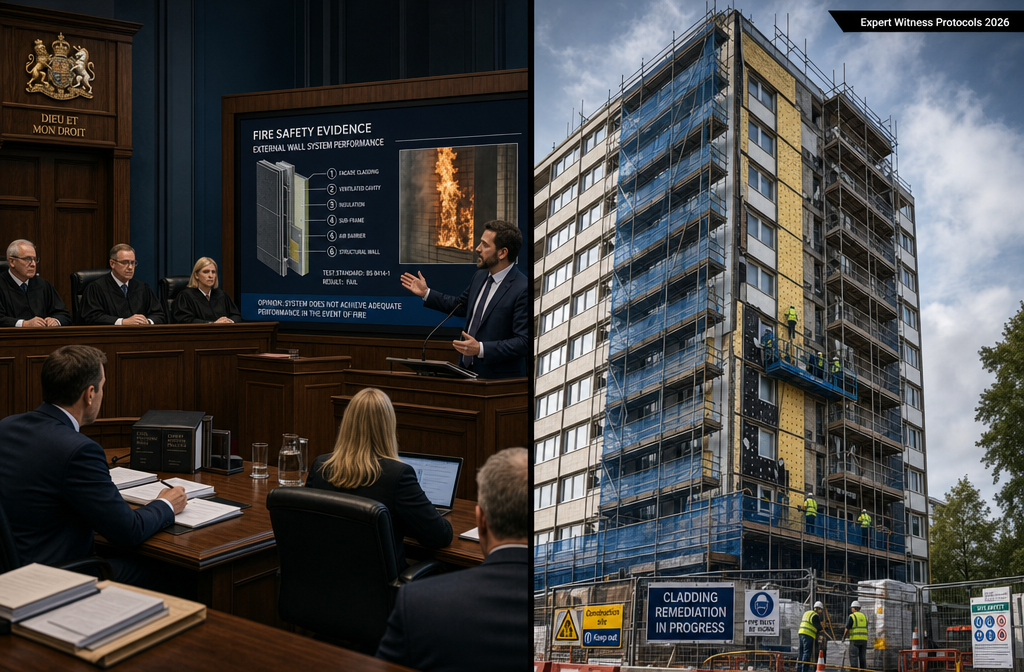
Retrofit valuations for HRBs have always been complex. The Building Safety Act 2022 Updates: Expert Witness Protocols for Fire Safety and Retrofit Valuations in 2026 have added a new layer of required analysis that many valuers are still catching up with — with significant consequences for those who fall behind.
The Smith v. London Housing Authority Precedent
The February 2026 case of Smith v. London Housing Authority established a landmark precedent for retrofit valuations [9]. The court ruled that retrofit valuations must include explicit documentation of how fire safety upgrades affect long-term maintenance costs. Critically, the court rejected 37% of retrofit valuation reports for insufficient fire safety lifecycle costing analysis.
⚠️ Key Ruling: Valuers cannot simply document the upfront cost of fire safety remediation. They must model and document the ongoing maintenance cost implications over the building's lifecycle.
This ruling aligns with the CMS Law Building Safety Act Review of April 2026, which confirmed that retrofit valuation assessments must now explicitly document how fire safety upgrades align with the Building Regulations 2010 (as amended) [5]. The 78% rejection rate for insufficiently documented retrofit valuations in Q1 2026 is a direct consequence of these new standards.
What a Compliant Retrofit Valuation Must Include
A retrofit valuation that will withstand scrutiny in 2026 must address the following elements:
🔧 Technical Compliance Documentation
- Explicit reference to Building Regulations 2010 (as amended) alignment
- Gateway 3 completion evidence where applicable
- Fire safety upgrade specification and scope
💰 Financial Analysis Requirements
- Upfront remediation costs with supporting contractor evidence
- Lifecycle maintenance cost modelling (the element most commonly missing in rejected reports)
- Impact on service charge projections for leaseholders
- Effect on building insurance premiums
📋 Legal and Regulatory Context
- Leaseholder protections under the Building Safety Act
- Relevant case law, including post-Smith v. London Housing Authority precedents
- Confirmation of Golden Thread compliance
For valuers working on property development valuations, these requirements add a significant analytical burden. However, they also create an opportunity for well-prepared professionals to differentiate their services in a market where compliant valuations are in high demand.
EPC and Energy Efficiency Intersections
Fire safety retrofit works frequently intersect with energy efficiency upgrades, particularly in older residential blocks where cladding replacement, insulation upgrades, and mechanical system overhauls are being carried out simultaneously. The interaction between fire safety compliance costs and Minimum Energy Efficiency Standards (MEES) obligations is increasingly relevant to retrofit valuations.
Surveyors should be aware that EPC and MEES compliance considerations can materially affect the cost-benefit analysis of retrofit programmes, and that valuations which fail to address this intersection may be challenged as incomplete.
Preparing Evidence for Building Safety Disputes in 2026
The Building Safety Act Conference held in March 2026 highlighted a clear message from legal practitioners and regulators: the quality of expert evidence is now the primary determinant of dispute outcomes in HRB cases [6]. Cases are being won and lost not on the underlying facts, but on whether the evidence has been prepared to the required standard.
Gateway Evidence and Expert Testimony
Gateway 3 — the final regulatory approval stage before a higher-risk building is occupied — has become a critical reference point in disputes. Expert witnesses must verify that their fire safety assessments include Gateway 3 completion evidence, and non-compliant testimony is now given reduced weight in legal proceedings [6].
For buildings that predate the Gateway system, expert witnesses must document the equivalent evidence trail — demonstrating that the building met the applicable standards at the time of construction and has been maintained accordingly.
Structuring Expert Reports for Regulatory Proceedings
A well-structured expert witness report for Building Safety Regulator proceedings in 2026 should follow this framework:
- Expert's credentials and competence certification — including Building Safety Competence Assessment reference number
- Scope of instructions — clearly defined, with any limitations noted
- Golden Thread compliance statement — certifying that all three elements (design intent, as-built, maintenance history) have been reviewed
- Technical findings — structured in alignment with Building Regulations 2010 (as amended)
- Version-controlled appendices — all supporting documents with full audit trails
- Lifecycle cost analysis (for retrofit valuations) — modelled over minimum 30-year horizon
- Declaration of independence — meeting CPR Part 35 requirements
Surveyors who regularly prepare budgeting for repairs and restoration reports will recognise elements of this framework, but the fire safety and Golden Thread requirements represent genuinely new territory that demands specific expertise.
The Enforcement Landscape: What Regulators Are Prioritising
The Building Safety Regulator's strategic plan for 2026 to 2027 makes clear that enforcement activity will focus on [10]:
- Non-compliant expert testimony — reports that lack Golden Thread certification
- Incomplete digital documentation — particularly in HRBs that have undergone retrofit works
- Property managers who have failed to retain expert fire safety reports as part of the Golden Thread
For commercial valuations involving mixed-use HRBs, these enforcement priorities create additional due diligence obligations that must be factored into instructions from the outset.
Conclusion: Actionable Next Steps for Surveyors and Valuers in 2026
The Building Safety Act 2022 Updates: Expert Witness Protocols for Fire Safety and Retrofit Valuations in 2026 have fundamentally changed the professional landscape for anyone working on higher-risk buildings. The combination of mandatory competence certification, Golden Thread compliance requirements, digital documentation standards, and new case law precedents means that the bar for acceptable expert evidence has risen dramatically.
Immediate Actions for Professionals 🎯
Within the next 30 days:
- ✅ Complete the Building Safety Competence Assessment if not already certified
- ✅ Audit existing report templates against Golden Thread certification requirements
- ✅ Upgrade documentation systems to produce structured digital outputs meeting BS 8644-1:2026
Within the next 90 days:
- ✅ Review all active retrofit valuation instructions against the Smith v. London Housing Authority lifecycle costing standard
- ✅ Verify that Gateway 3 evidence is being requested and documented for all HRB instructions
- ✅ Brief clients — particularly property managers — on their Golden Thread retention obligations
Ongoing:
- ✅ Monitor Building Safety Regulator enforcement updates and case law developments
- ✅ Ensure all expert witness reports include version-controlled appendices with full audit trails
- ✅ Engage with professional bodies (RICS, BESA) for updated guidance as standards evolve
The professionals who thrive in this environment will be those who treat compliance not as a burden, but as a competitive advantage. In a market where 78% of challenged retrofit valuations are being rejected [5], a well-prepared, fully compliant report is genuinely rare — and genuinely valuable.
References
[1] Watch – youtube.com
[2] Golden Thread – thebesa.com
[3] How The Building Safety Act Impacts Property Managers – mosaicgt.com
[4] Building Safety Act 2022 What To Expect In 2026 – gowlingwlg.com
[5] BSA Review 2026 – cms.law
[6] Building Safety Act Conference 2026 – youtube.com
[7] Building Safety Act FAQs – rics.org
[8] Fire Safety Research – sciencedirect.com
[9] Round Up Of Building Safety Caselaw In 2025 And What To Look Out For In 2026 – taylorwessing.com
[10] Building Safety Regulator Strategic Plan 2026 To 2027 – gov.uk