

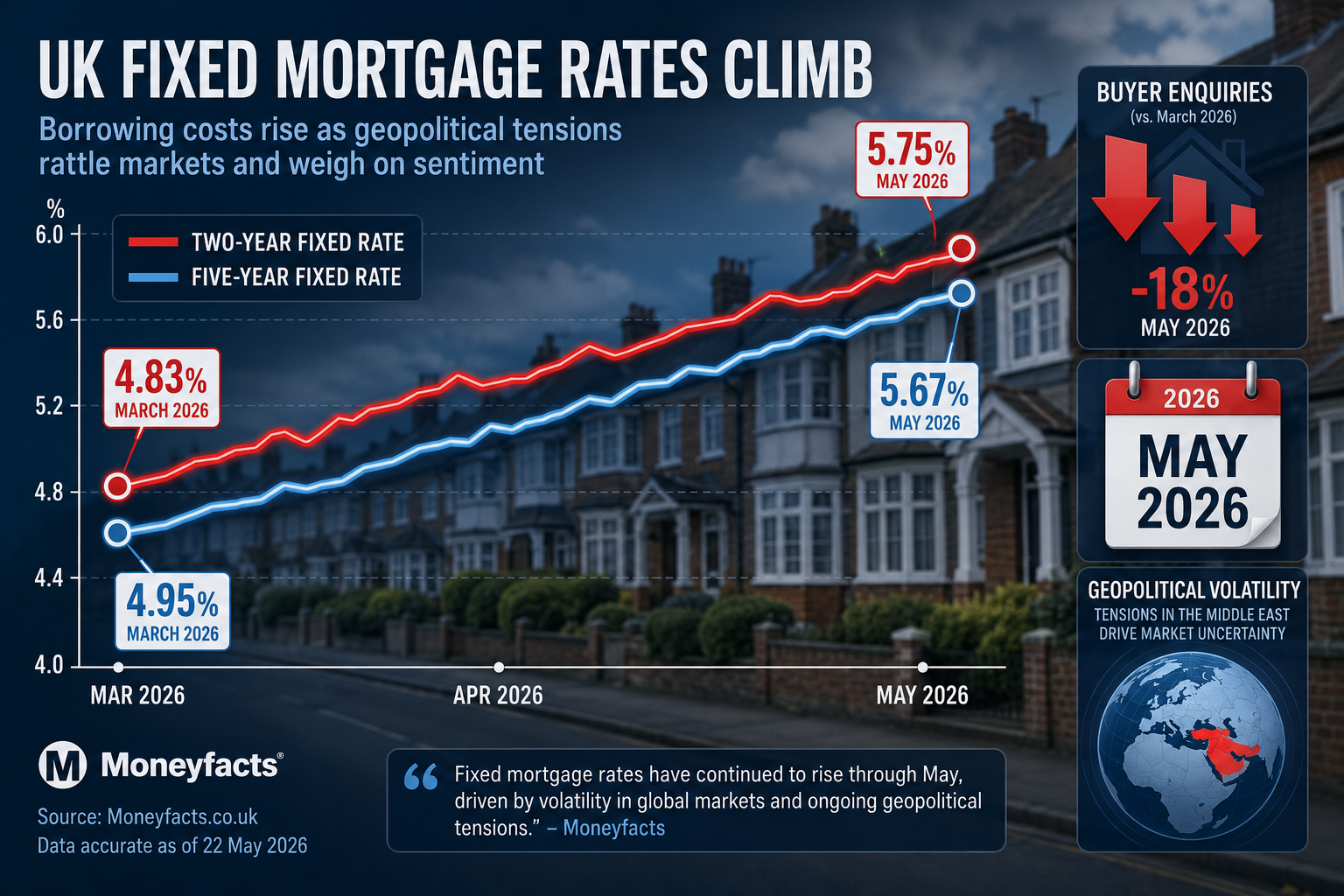
Between 1 March and 18 May 2026, the average UK two-year fixed mortgage rate jumped from 4.83% to 5.75% — a rise of nearly a full percentage point in under three months. The five-year fix moved from 4.95% to 5.67% over the same period, driven largely by geopolitical tensions in the Middle East and Iran-related market uncertainty. For anyone involved in UK property — buyers, lenders, or chartered surveyors — this kind of rapid repricing creates real, measurable problems. The challenge of UK mortgage rate volatility May 2026 property valuation impact surveyors is not abstract: it is showing up in falling buyer enquiries, softening asking prices, and genuine methodological pressure on RICS Red Book valuations right now.
Key Takeaways 📌
- Average two-year fixed rates rose from 4.83% to 5.75% between March and May 2026, per Moneyfacts data.
- RICS new buyer enquiries are at their lowest since August 2023, signalling a cooling market.
- Rate spikes reduce buyer affordability, compress transaction volumes, and put downward pressure on asking prices.
- Red Book valuations must reflect current market conditions — surveyors cannot rely on comparable evidence from before the rate spike.
- Clear assumptions, transparent market commentary, and proactive lender communication are essential right now.
Table of Contents
- How the Rate Spike Happened: The Geopolitical Trigger
- Impact on Buyer Affordability and Transaction Volumes
- What the Data Shows: RICS, Rightmove, and Nationwide
- UK Mortgage Rate Volatility May 2026: Impact on Property Valuations
- Red Book Methodology in Volatile Conditions
- Practical Guidance for Surveyors: Supporting Valuations Under Pressure
- Dealing With Lender Feedback and Downvaluation Concerns
- FAQ
- Conclusion
How the Rate Spike Happened: The Geopolitical Trigger {#how-the-rate-spike-happened}
Swap rates — the wholesale funding benchmark that lenders use to price fixed mortgages — are highly sensitive to global risk sentiment. When tensions in the Middle East escalated sharply in early 2026, including Iran-related developments that rattled energy markets and sovereign bond yields, UK gilt yields moved upward. Lenders responded quickly. According to Moneyfacts, the average two-year fixed rate crossed 5.5% by late April 2026 and reached 5.75% by 18 May 2026. The five-year fix hit 5.67% — its highest point since late 2023.
This is not a Bank of England base rate story, at least not directly. Swap markets can move independently of base rate decisions, and that is precisely what happened here. The repricing was fast, broad, and caught many buyers mid-application.
💬 "When swap rates move this quickly, lenders have no choice but to reprice. The problem for the property market is that buyers and sellers don't adjust at the same speed."
Impact on Buyer Affordability and Transaction Volumes {#impact-on-buyer-affordability}
The arithmetic of affordability is brutal when rates rise sharply. Consider a buyer purchasing a £300,000 property with a 10% deposit (£270,000 mortgage):
| Rate | Monthly Payment (25-yr repayment) | Annual Cost |
|---|---|---|
| 4.83% (March 2026) | ~£1,548 | ~£18,576 |
| 5.75% (May 2026) | ~£1,699 | ~£20,388 |
| Difference | +£151/month | +£1,812/year |
That £151 monthly increase is not trivial. For many buyers, it pushes them below lender affordability thresholds or forces them to reconsider their maximum offer. Knight Frank research consistently shows that each 50 basis point rise in mortgage rates reduces effective buyer demand by a meaningful margin — and this cycle has seen nearly a 100 basis point move in two-year fixes.
The knock-on effects include:
- 🏠 Asking-price reductions as sellers accept that buyers can no longer stretch to previous offer levels
- 📉 Falling transaction volumes as deals collapse at the mortgage offer stage
- ⏳ Longer time-to-sell as properties sit on portals for extended periods
- 🔄 Renegotiations on agreed sales, with buyers seeking price cuts to offset higher borrowing costs
Rightmove data for May 2026 shows that the proportion of properties with asking-price reductions has risen compared to the same period in 2025, consistent with previous rate-spike episodes. Understanding what to do if your home valuation is less than an offer has become an increasingly relevant question for buyers and sellers alike.
What the Data Shows: RICS, Rightmove, and Nationwide {#what-the-data-shows}
The most telling indicator right now is the RICS Residential Market Survey. New buyer enquiries have fallen to their lowest level since August 2023 — a period that was itself defined by post-Truss-era rate turbulence. This is a net balance figure, meaning more surveyors are reporting falling enquiries than rising ones.
Nationwide Building Society house price data for April and May 2026 shows month-on-month price growth stalling, with annual growth moderating from the modest gains seen in early 2026. This is consistent with previous rate-spike episodes where the market takes several weeks to fully absorb the affordability shock before price adjustments follow.
Rightmove portal data shows:
- Average time on market increasing in most regions
- Seller asking prices beginning to soften in higher-value brackets (£500k+)
- First-time buyer segment most acutely affected due to higher loan-to-value ratios
Knight Frank has noted that prime central London and commuter belt markets are showing resilience among cash buyers and equity-rich movers, but mortgage-dependent buyers — the majority of the market — are clearly under pressure.
The combination of these data points creates a specific challenge for UK mortgage rate volatility May 2026 property valuation impact surveyors: the market evidence is shifting in real time, and valuations instructed even four to six weeks ago may not reflect current conditions.
UK Mortgage Rate Volatility May 2026: Impact on Property Valuations {#valuation-impact}

When rates spike, valuations face pressure from multiple directions simultaneously. The core issue is that Market Value under the RICS Red Book (Global Standards) is defined as the estimated amount for which an asset should exchange on the valuation date — not last month, not at the peak of the market. That "valuation date" clause matters enormously right now.
The Comparable Evidence Problem
Most residential valuations rely heavily on recent comparable sales. In a stable market, comparables from the past three to six months are generally reliable. In a volatile rate environment, comparables from before the rate spike may overstate current market value. A sale agreed in February 2026 — when two-year fixes were below 5% — reflects a different affordability landscape than the market a buyer faces in May 2026.
Surveyors must therefore:
- Weight recent comparables more heavily, even if fewer in number
- Apply adjustments where older comparables are used, with clear reasoning
- Avoid anchoring to asking prices or estate agent appraisals that have not yet adjusted to the new rate environment
Understanding the top things looked at during a property valuation helps clients understand why surveyors may reach figures below agreed prices — it is not arbitrary caution but methodological rigour.
Market Commentary Requirements
The Red Book does not just require a number — it requires context. In volatile conditions, the market commentary section of a valuation report should:
- Explicitly reference the rate environment and its timing
- Note the direction of travel in buyer enquiries (citing RICS survey data)
- Acknowledge uncertainty where it exists, using appropriate caveats
- Reference the sources used (Moneyfacts, RICS, Nationwide, Rightmove)
Special Assumptions
In some cases — particularly new-build valuations or Help-to-Buy successor scheme properties — surveyors may be asked to value on a Special Assumption (e.g., assuming a specific incentive is not in place). The RICS Red Book requires any special assumption to be clearly stated, reasonable, and agreed with the client. In volatile conditions, surveyors should be especially cautious about special assumptions that could mask genuine market softness.
For those involved in property development valuations, the rate environment also affects residual land value calculations, where even small changes in assumed end values can significantly alter viability.
Red Book Methodology in Volatile Conditions {#red-book-methodology}
RICS Global Standards (the Red Book) provide a robust framework, but they require active judgement — not mechanical application. Here is how key methodological elements should be approached right now:
Comparable Evidence Sensitivity
📋 Best practice: Where possible, use only comparables with completion dates from May 2026 or late April 2026. Where older comparables are unavoidable, apply a reasoned time adjustment and document your reasoning fully.
- Prioritise completed sales over agreed sales (which may still fall through)
- Cross-reference portal data (Rightmove, Zoopla) with Land Registry completions
- Note where comparables are thin — do not manufacture false confidence
Valuation Date Discipline
The valuation date is not the inspection date. If there is a gap between inspection and report issue, and rates have moved further in that window, the surveyor must reflect conditions as at the stated valuation date. This is particularly relevant for lender panel valuations where turnaround times can stretch.
Uncertainty and Caveats
RICS guidance allows — and in some circumstances requires — surveyors to include a material valuation uncertainty (MVU) declaration where market conditions are such that less certainty than normal can be attached to the opinion of value. The current rate environment may not yet meet the threshold for a formal MVU declaration in most cases, but surveyors should keep this tool in mind and document their reasoning either way.
For context on how different types of valuations are structured, see our overview of chartered surveyor valuation services.
Practical Guidance for Surveyors: Supporting Valuations Under Pressure {#practical-guidance}
The UK mortgage rate volatility May 2026 property valuation impact surveyors challenge is ultimately a professional judgement challenge. Here is practical guidance for RICS members carrying out Red Book valuations right now:
✅ Do This
- Date-stamp your comparable evidence clearly in every report
- Include a market conditions paragraph that references the rate spike, citing Moneyfacts data (4.83% → 5.75% two-year fix)
- Use RICS survey data on new buyer enquiries to support your market narrative
- Photograph and document any evidence of price reductions or extended marketing periods in the subject property's locality
- Discuss your methodology with the instructing lender or client before issuing the report if you anticipate a significant gap between agreed price and valuation
❌ Avoid This
- Relying solely on pre-March 2026 comparables without adjustment
- Matching the agreed sale price without independent comparable support
- Omitting market commentary because the report template does not prompt for it
- Assuming the market has not moved because your local area "feels" stable
For surveyors working on inheritance tax valuations or capital gains tax valuations, the same discipline applies — the valuation date is fixed, and the evidence must reflect conditions at that specific point in time.
Dealing With Lender Feedback and Downvaluation Concerns {#lender-feedback}
Downvaluations — where the surveyor's opinion of value falls below the agreed purchase price — are more common in volatile rate environments. Lenders will often query the comparable evidence used, and buyers may push back through their solicitors.
How to Handle Lender Queries
- Respond promptly and in writing with a clear restatement of your methodology
- Provide additional comparable evidence if available, but do not revise your opinion simply because the lender or buyer disagrees
- Reference market conditions explicitly — the rate spike is documented, public, and material
- Stand by your professional judgement — RICS members have a duty to the public interest, not to any particular transaction outcome
For Buyers Facing a Downvaluation
If you are a buyer whose agreed purchase has been downvalued, it is worth understanding that the surveyor's role is to protect the lender's security interest — and, by extension, your own. An independent property valuation can provide a second opinion, though it must also be grounded in current market evidence.
Buyers should also consider commissioning a Level 2 or Level 3 building survey alongside any mortgage valuation — the mortgage valuation is for the lender, not for you.
FAQ {#faq}
Q1: Why have UK mortgage rates risen so sharply in May 2026?
The primary driver has been geopolitical volatility — particularly Middle East and Iran-related tensions — which pushed up gilt yields and swap rates. Lenders price fixed-rate mortgages off swap rates, so when swaps move, mortgage rates follow quickly. According to Moneyfacts, the average two-year fix rose from 4.83% in March 2026 to 5.75% by 18 May 2026.
Q2: How does a rate spike affect my property valuation?
Higher rates reduce what buyers can afford to borrow, which puts downward pressure on what they can offer. Surveyors carrying out Red Book valuations must reflect current market conditions — including this affordability constraint — which can result in valuations below recently agreed sale prices.
Q3: Can a surveyor use comparables from before the rate spike?
Yes, but with caution. Older comparables should be clearly dated, and surveyors should apply a reasoned time adjustment where the rate environment has changed materially. Pre-March 2026 comparables may overstate current market value and should not be used without commentary.
Q4: What is a material valuation uncertainty (MVU) declaration?
An MVU is a formal statement in a RICS Red Book report that less certainty than normal can be attached to the valuation opinion, due to market conditions. It does not mean the valuation is wrong — it signals that the market is in a state of flux. Surveyors should consider whether current conditions warrant an MVU and document their reasoning.
Q5: What should I do if my purchase is downvalued?
First, ask the lender for the surveyor's comparable evidence. You can challenge a downvaluation if you have strong recent comparable sales that the surveyor may have missed. However, if the market has genuinely softened, renegotiating the purchase price may be the most practical outcome. Seek independent advice from a chartered surveyor.
Q6: Are all property types equally affected by rate volatility?
No. Cash buyers and equity-rich movers are less affected. First-time buyers at high loan-to-value ratios are most exposed. Prime and ultra-prime markets show more resilience. Leasehold flats and new-build properties, which already carry specific valuation challenges, face additional scrutiny in volatile conditions.
Conclusion {#conclusion}
The UK mortgage rate volatility May 2026 property valuation impact surveyors face is a genuine professional challenge — not a theoretical one. With two-year fixed rates up nearly 100 basis points since March 2026, buyer affordability has been materially eroded, RICS new buyer enquiries are at a multi-year low, and the comparable evidence base is shifting faster than the market can fully absorb.
For chartered surveyors, the response must be methodologically rigorous and clearly documented. Use recent comparables, date your evidence, write meaningful market commentary, and do not allow transaction pressure to compromise your professional judgement. RICS Red Book standards exist precisely for moments like this.
Actionable Next Steps
- Surveyors: Review your comparable evidence cut-off dates immediately. Ensure every report issued in May 2026 includes explicit market commentary referencing the rate environment.
- Lenders: Expect increased scrutiny of pre-March 2026 comparables in surveyor reports. This is appropriate professional practice, not over-caution.
- Buyers: Commission an independent survey alongside your mortgage valuation. Understand that a downvaluation may reflect genuine market conditions, not surveyor error.
- Sellers: If your property has been on the market since before the rate spike, revisit your asking price with your agent using current comparable evidence.
For professional valuation support in this environment, explore our full range of property valuation services or learn more about why property owners hire surveyors to understand the value of independent professional advice.
References
- Moneyfacts (2026). UK Mortgage Rate Tracker — Two-Year and Five-Year Fixed Rate Averages, March–May 2026. Moneyfacts Group.
- RICS (2026). UK Residential Market Survey, April 2026. Royal Institution of Chartered Surveyors.
- RICS (2022). RICS Valuation — Global Standards (Red Book Global Standards). Royal Institution of Chartered Surveyors.
- Nationwide Building Society (2026). House Price Index, April 2026. Nationwide Building Society.
- Knight Frank (2026). UK Residential Market Update, May 2026. Knight Frank LLP.
- Rightmove (2026). House Price Index, May 2026. Rightmove plc.