

The Grenfell Tower fire killed 72 people on 14 June 2017 — and every chartered building surveyor working in the UK today is, in some way, still responding to that night. The Building Safety Act 2022 and its supporting secondary legislation represent the most significant overhaul of construction and property safety law in a generation. Yet much of the professional commentary has stayed at the level of policy summaries. What is actually changing on the ground — inside inspections, inside reports, inside professional indemnity (PI) conversations — is where the real story lies.
How the Building Safety Regime is changing day‑to‑day work for chartered building surveyors goes far deeper than simply learning new terminology. It demands a step‑by‑step rethinking of how surveyors scope commissions, conduct inspections, document findings, advise clients, and protect themselves from liability. This article unpacks exactly that.
Key Takeaways 📋
- The Building Safety Act 2022 creates a tiered regulatory framework that affects all building surveyors, not just those working on high-rise residential towers.
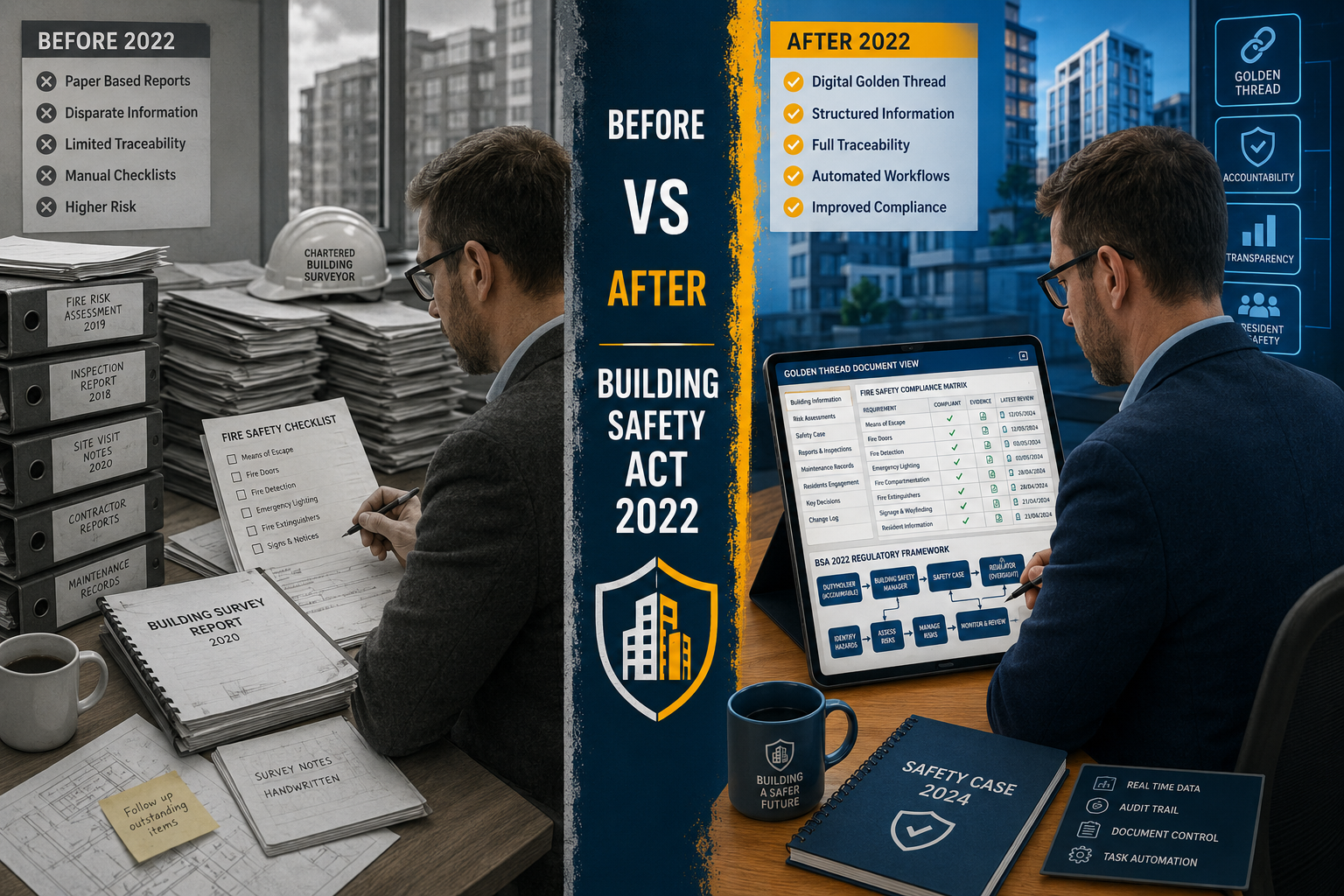
- The Golden Thread of information is now a live obligation — surveyors must understand how their reports feed into it.
- Inspection scope, report language, and duty-of-care thresholds have all materially shifted for Higher-Risk Buildings (HRBs).
- PI insurance exposure has increased; surveyors must review their engagement letters and scope exclusions carefully.
- Non-HRB stock is not exempt — secondary legislation and updated RICS guidance are raising the bar across the board.
The Regulatory Framework: What Surveyors Must Now Understand
Before examining practical changes, it helps to map the landscape clearly.
The Three-Gateway System for Higher-Risk Buildings
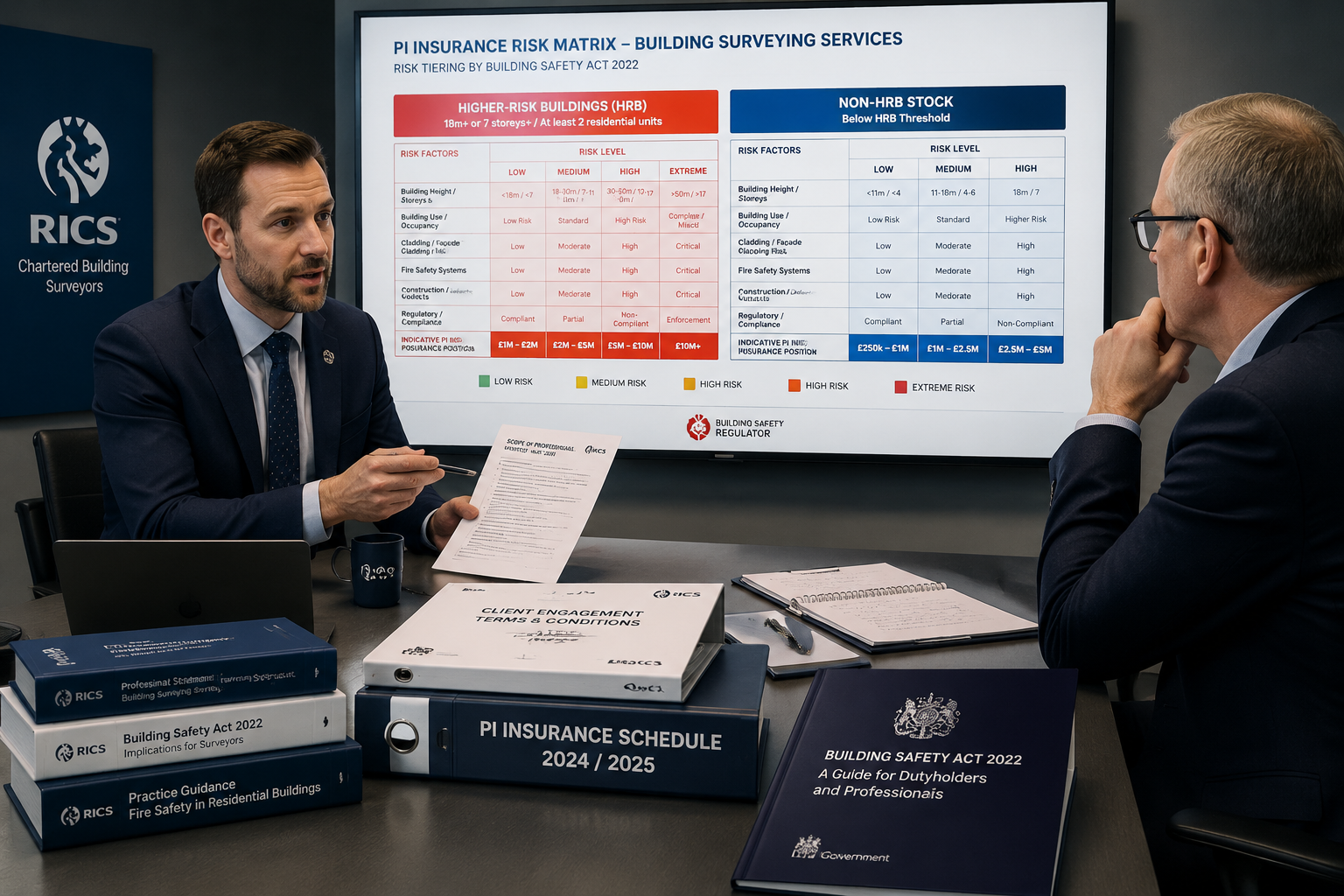
The Building Safety Regulator (BSR), now operating under the Health and Safety Executive, introduced a three-gateway process for Higher-Risk Buildings — currently defined as residential buildings 18 metres or taller, or with at least 7 storeys and two or more residential units.
| Gateway | Stage | What It Means for Surveyors |
|---|---|---|
| Gateway 1 | Planning | Fire safety information submitted at planning stage |
| Gateway 2 | Before construction | Full building control approval before work begins |
| Gateway 3 | Completion | Sign-off before occupation; building safety case required |
Chartered building surveyors advising clients on new-build or refurbishment projects touching HRBs must now understand where a project sits within this gateway process. Providing advice without that context is a scope gap — and a liability gap.
Dutyholders and the Accountable Person
The Act introduces formal dutyholder roles: Principal Designer, Principal Contractor, Accountable Person, and Building Safety Manager. Surveyors are frequently appointed in roles that overlap with these duties, even when the appointment letter does not use that language.
💡 Pull Quote: "A surveyor who acts as a de facto Principal Designer — coordinating design information, reviewing specifications — may carry statutory duties they have not formally acknowledged."
Understanding statutory considerations in building surveys is no longer optional background knowledge. It is a front-line professional competency.
How the Building Safety Regime Is Changing Day‑to‑Day Inspections
This is where the practical shift is most visible. The way a chartered building surveyor physically approaches an inspection — and what they are looking for — has changed materially.
Step 1: Pre-Inspection Scoping Has Become More Demanding
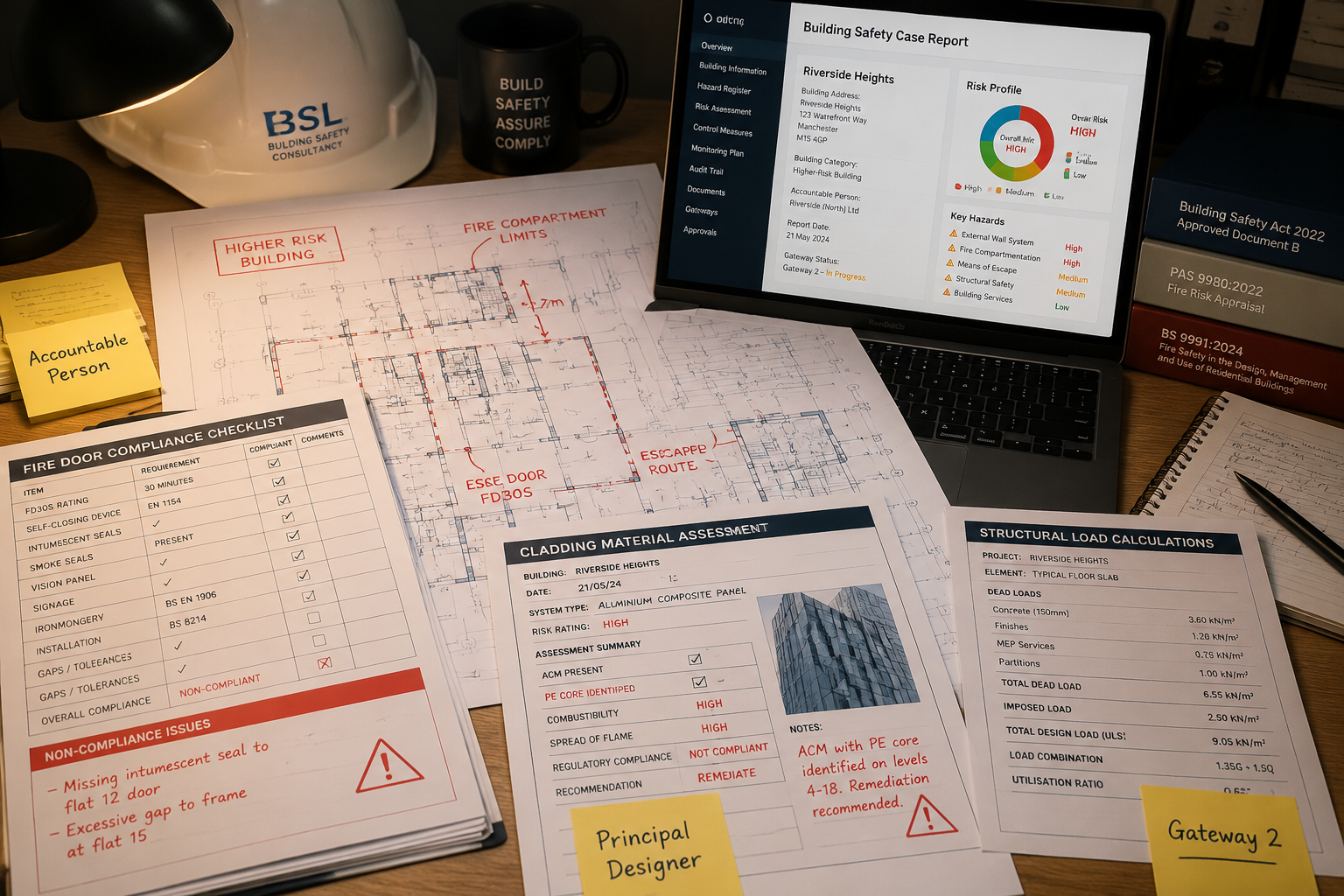
Previously, a surveyor might confirm a building's age, use class, and general condition before deciding on inspection depth. Now, the pre-inspection checklist must also address:
- Height and storey count — does this building meet the HRB threshold?
- Cladding system identification — is there any form of Aluminium Composite Material (ACM), High-Pressure Laminate (HPL), or other potentially combustible external wall system?
- Existing safety case documentation — has a Building Safety Case been registered with the BSR?
- Occupation status and resident engagement — are there Resident Engagement Strategies in place?
For building regulation compliance testing, this pre-scoping work is not administrative overhead — it directly shapes what the surveyor is contractually and professionally obliged to inspect and report on.
Step 2: Cladding and External Wall Assessments Are Now Core, Not Optional
The EWS1 (External Wall System) form process — though technically a market-driven tool rather than a statutory requirement — has become embedded in transactional surveying. More importantly, the underlying technical competency it demands is now expected of any surveyor working on multi-occupied residential buildings.
Surveyors must be able to:
- Identify cladding system types visually and from specification documents
- Flag combustibility concerns with appropriate technical language
- Know the limits of their own competence and refer to specialist fire engineers where necessary
Detailed building materials assessments have therefore moved from a niche specialism to a mainstream expectation. Surveyors who cannot engage with this area risk both professional criticism and PI exposure.
Step 3: Structural Inspection Depth Has Increased
The Act places greater emphasis on structural safety as a component of building safety — not just fire. For surveyors conducting construction and condition surveys, this means:
- Greater attention to structural movement patterns and their potential causes
- More explicit commentary on load-bearing elements and any modifications to them
- Clearer signposting to areas of further investigation where structural integrity cannot be confirmed visually
The days of a brief note saying "no significant structural concerns noted" without supporting evidence are increasingly difficult to defend.
Step 4: The Golden Thread Obligation Changes Documentation
The Golden Thread of information — the digital record of a building's design, construction, and ongoing safety management — is a live obligation for HRBs. Surveyors contributing reports, assessments, or specifications to an HRB project must understand that their documentation may become part of this permanent record.
Practical implications:
- Reports must be version-controlled and clearly dated
- Assumptions and limitations must be explicitly stated, not buried in small print
- Photographs must be labelled and geolocated where possible
- Any recommendations must be traceable — who said what, when, and on what basis
This is a cultural shift as much as a technical one. Surveying firms that have relied on template-heavy, boilerplate reports face the greatest adaptation challenge.
How the Building Safety Regime Is Changing Reporting, PI Risk, and Non-HRB Work
The changes do not stop at the inspection. How surveyors write reports, manage professional risk, and advise on non-HRB stock has also shifted significantly.
Reporting Language: Precision Over Caution
There is a long-standing professional habit in surveying of hedging report language — using phrases like "may require further investigation" or "appears to be in reasonable condition." The Building Safety Regime has made this habit more professionally dangerous, not less.
The reason is accountability. When a building safety incident occurs and reports are reviewed, vague language does not protect the surveyor — it exposes them. Regulators and courts are looking for evidence that the surveyor:
- Identified the relevant risk category of the building
- Applied appropriate inspection depth for that category
- Communicated findings clearly and with sufficient technical specificity
- Recommended appropriate action — including specialist referral where warranted
Understanding the consequences of failing to act on survey findings is now a client education responsibility as much as a professional one. Surveyors should be explicit in reports about what happens if recommendations are not followed.
Professional Indemnity: The New Risk Landscape 🛡️
PI insurers have been watching the Building Safety Regime closely, and the market has responded. Key changes affecting chartered building surveyors include:
Higher-Risk Building exclusions: Many PI policies now contain specific exclusions or sub-limits for claims arising from HRB work. Surveyors must read their policy wording carefully and ensure their scope of work does not inadvertently stray into excluded territory.
Cladding and fire safety exclusions: Some policies exclude claims arising from advice on external wall systems or fire safety compliance. This creates a serious gap for surveyors who are routinely asked to comment on these issues.
Extended limitation periods: The Building Safety Act extended the limitation period for certain claims relating to defective buildings to 30 years (for claims arising before the Act) and 15 years going forward. This dramatically increases the tail risk for surveyors and has implications for run-off cover.
Practical steps for PI risk management:
- Review engagement letters to ensure scope is clearly defined and excludes HRB-specific duties not covered by your PI policy
- Include explicit statements in reports about the limits of the inspection and what has not been assessed
- Maintain detailed contemporaneous records of all site visits, client communications, and decisions made
- Consult your PI broker before accepting commissions that involve HRB work if you have not done so recently
Non-HRB Stock: Do Not Assume Immunity
A common misreading of the Building Safety Regime is that it only affects surveyors working on tall residential buildings. This is incorrect for several reasons.
Secondary legislation and updated Approved Documents — particularly Approved Document B (fire safety) — apply to a much wider range of buildings. Any building undergoing material change of use, extension, or refurbishment must comply with current standards, which have been significantly updated.
RICS guidance has been updated to reflect higher baseline expectations for all residential surveys. The building pathology competency expected of a Level 3 surveyor now implicitly includes awareness of fire safety and structural safety considerations even in lower-rise stock.
Client expectations have shifted. Homebuyers, lenders, and insurers are all more aware of building safety issues than they were five years ago. A surveyor who fails to flag a potential fire safety concern in a purpose-built flat conversion — even one below the HRB threshold — faces reputational and professional risk if that concern later materialises.
Adapting CPD, Competency, and Team Structures
The professional response to these changes requires more than individual learning. It requires structural adaptation within surveying practices.
Competency Frameworks Are Being Redrawn
RICS has updated its competency frameworks to reflect Building Safety Act requirements. Surveyors working towards or maintaining their chartered status must demonstrate competency in:
- Fire safety awareness at a level appropriate to their work type
- Building safety legislation — understanding the Act, secondary legislation, and BSR guidance
- Digital information management — understanding Golden Thread principles even if not directly managing a Golden Thread system
For firms considering growth, the open roles at Prince Chartered Surveyors reflect the kind of competency profile that forward-thinking practices are now seeking.
Specialist Referral Networks Are Now Essential
No single surveyor can be an expert in all aspects of building safety. The regime has made it more important — and more professionally defensible — to build and use a network of specialists:
- Fire engineers for external wall system assessments and fire strategy reviews
- Structural engineers for load-bearing element assessments
- Asbestos surveyors for pre-demolition or pre-refurbishment surveys
- Mechanical and electrical consultants for ventilation and smoke control systems
Knowing when to refer is itself a competency. Surveyors who attempt to cover all bases without specialist support face greater PI exposure, not less.
Timeframes and Fee Structures Must Reflect New Demands
The additional pre-inspection scoping, enhanced documentation requirements, and post-inspection report drafting demanded by the Building Safety Regime take time. Building survey timeframes and fee structures that were set before 2022 may no longer be commercially or professionally viable for HRB-adjacent work.
Surveyors should:
- Revisit fee scales for any commission involving multi-occupied residential buildings
- Build in time for pre-inspection research and post-inspection report review
- Be transparent with clients about why fees have increased and what additional work is being undertaken
Conclusion: Practical Next Steps for Chartered Building Surveyors in 2026
The Building Safety Regime is not a compliance exercise to be completed and filed away. It is a permanent shift in the professional environment for chartered building surveyors — one that is still evolving as secondary legislation develops and the Building Safety Regulator establishes its enforcement approach.
Here are the actionable next steps every chartered building surveyor should take now:
-
✅ Audit your current commissions — identify any that involve HRBs or buildings that may meet the threshold, and review your scope, PI cover, and documentation standards for each.
-
✅ Review your engagement letter templates — ensure scope limitations, HRB-specific exclusions, and referral obligations are clearly stated.
-
✅ Update your CPD plan — include at least one structured learning module on the Building Safety Act 2022, BSR guidance, and updated Approved Document B.
-
✅ Talk to your PI broker — specifically about HRB exclusions, cladding exclusions, and the implications of the extended limitation periods.
-
✅ Build your specialist referral network — identify fire engineers, structural engineers, and other specialists you can refer to with confidence.
-
✅ Upgrade your documentation practices — version control, explicit assumptions, labelled photographs, and clear recommendations are no longer best practice; they are baseline expectations.
The surveyors who will thrive under the new regime are those who treat these changes not as burdens but as opportunities to differentiate on quality, competency, and client trust. The bar has been raised — and that is ultimately good for the profession and for the people who live in the buildings it serves.
For expert chartered surveying services that reflect the latest building safety standards, explore the full range of building survey services available from Prince Chartered Surveyors.