

Nearly 2.5 million UK households live in damp or mouldy homes — yet until recently, the legal consequences for landlords who ignored the problem were largely theoretical. That changed on 27 October 2025, when Awaab's Law came into force for the social rented sector, and the ripple effects are now reshaping how valuation surveyors must assess, report and price habitability risk across both social and private rented stock.
This article unpacks Awaab's Law, damp and mould: what UK valuation surveyors now need to say about habitability risk — a topic most coverage treats as a building surveyor or landlord compliance issue, but which carries profound implications for valuation methodology, lender reporting and investment-grade commentary.
Key Takeaways 📋
- Awaab's Law is now live for social landlords in England (from 27 October 2025) and is being extended to private rented sector tenancies under the Renters' Rights Act 2025.
- Statutory timeframes — 24 hours for emergencies, 48 hours to begin investigation of serious hazards, 14 days for remediation — create measurable compliance obligations that directly affect a property's lettability and value.
- Valuation surveyors must now explicitly flag damp and mould as a habitability risk in reports, not merely note it as a maintenance defect.
- Non-compliance exposes landlords to enforcement action, rent repayment orders and reputational damage — all of which are material to investment valuations.
- Both RICS guidance and lender requirements are evolving; surveyors who fail to address the new legal landscape risk professional liability.

The Legal Background: How Awaab's Law Came to Reshape UK Housing Standards
From Tragedy to Statute
In December 2020, two-year-old Awaab Ishak died in Rochdale after prolonged exposure to black mould in a social housing flat. The 2022 coroner's inquest found systemic failure by the landlord to investigate or remediate the damp — a finding that shocked the sector and triggered urgent legislative action [10].
The response was swift by parliamentary standards. The Social Housing (Regulation) Act 2023 introduced what became known as Awaab's Law: a statutory duty requiring social landlords to investigate and repair damp, mould and other hazards within fixed timeframes [9]. Secondary regulations then set the specific timescales that came into force on 27 October 2025 [5].
💬 "Awaab's Law represents a fundamental shift — damp and mould is no longer a maintenance inconvenience. It is a legal liability with a clock attached."
Critically, the legislation did not stop at social housing. The Renters' Rights Act 2025 is extending equivalent obligations to the private rented sector (PRS) in England, meaning that by 2026, both social and private landlords are operating under a common standard for how quickly dangerous damp and mould must be addressed [4][6].
What the Statutory Timeframes Actually Require
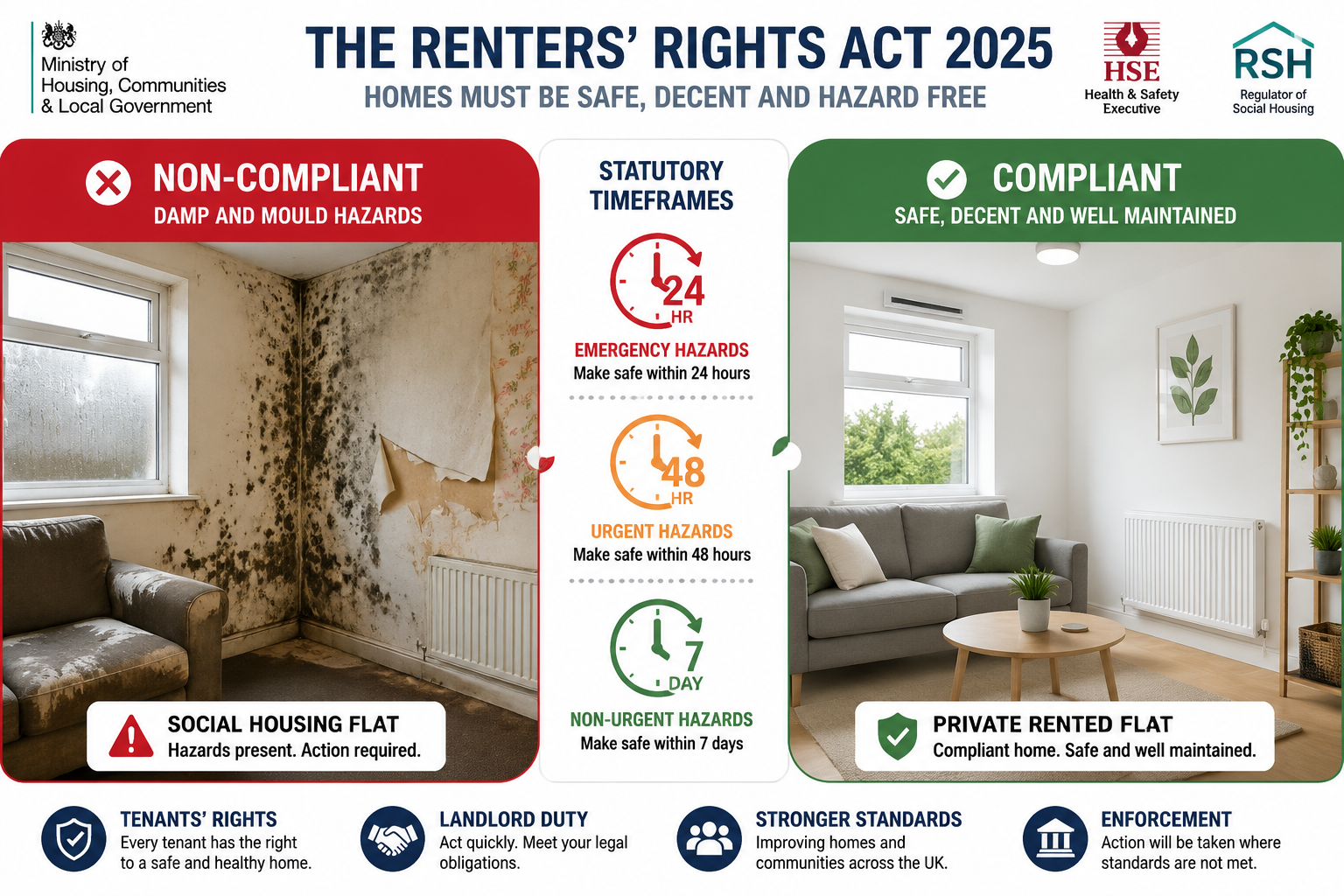
Understanding the specific timescales is essential for any valuer assessing habitability risk. Under Awaab's Law as it applies to the social sector — and as it is being mirrored for the PRS — the framework is [3][9]:
| Hazard Type | Investigation Must Begin | Remediation Deadline |
|---|---|---|
| Emergency hazard (immediate risk to life) | Within 24 hours | Make safe within 24 hours |
| Serious damp/mould (non-emergency) | Within 48 hours | Works completed within 14 days |
| All other damp/mould hazards | Within 14 days | Works completed within 28 days |
| Complex cases (structural/systemic) | Within 14 days | Agreed schedule, but must start within 7 days of investigation |
These are not aspirational targets — they are statutory obligations [9]. Failure to meet them can trigger enforcement action by the Regulator of Social Housing, rent repayment orders, and in the PRS, potential civil liability under the Homes (Fitness for Human Habitation) Act 2018 [6][7].
For Scotland, similar legislative momentum is building. The Scottish Parliament is actively considering equivalent "Awaab's Law" provisions for its private rented sector, signalling that this is a UK-wide direction of travel [2].
Awaab's Law, Damp and Mould: Direct Implications for Valuation Methodology
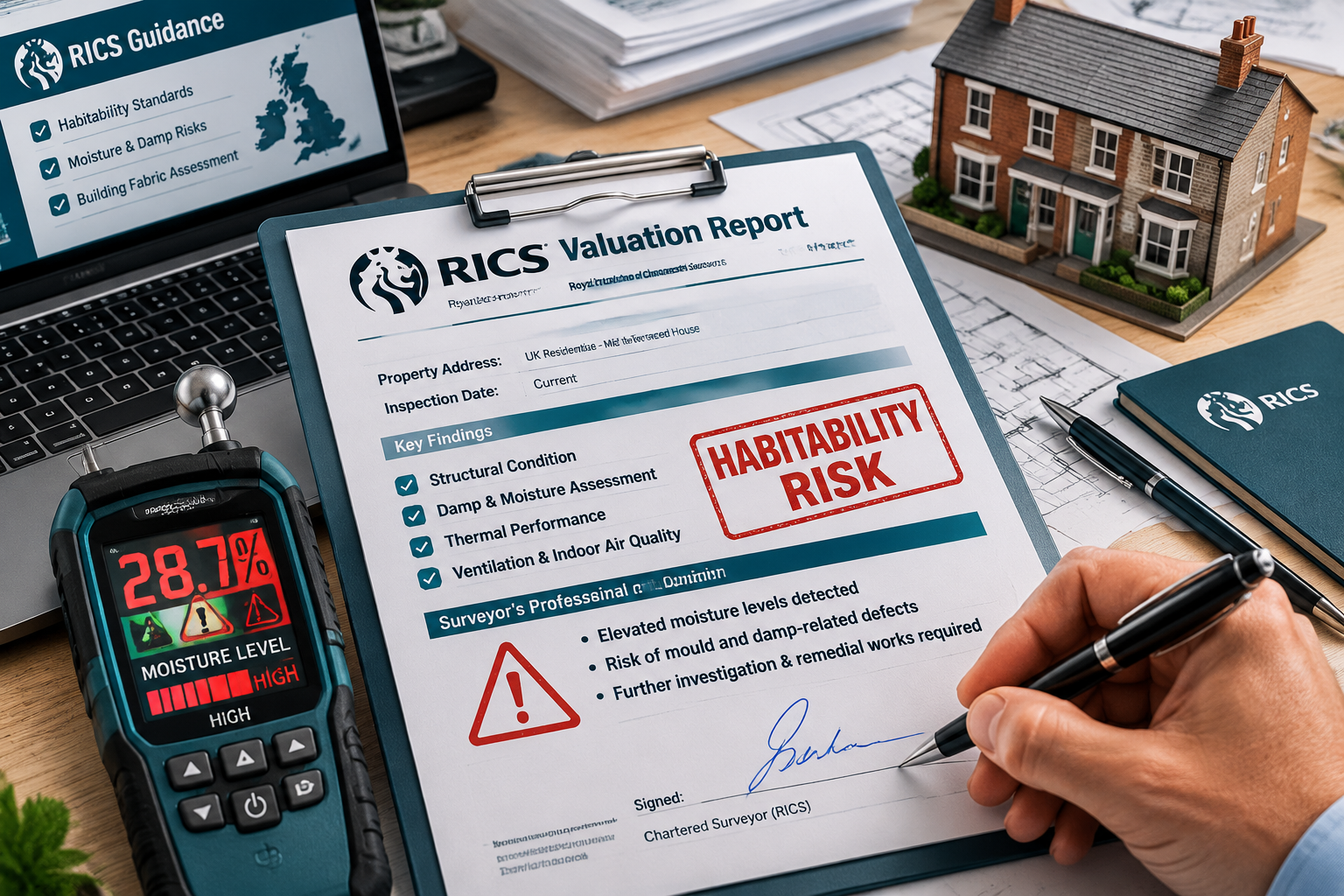
Why This Is a Valuation Issue, Not Just a Building Survey Issue
Most commentary on Awaab's Law focuses on building surveyors, property managers and landlord compliance teams. But the new legal framework has direct and material consequences for valuation surveyors — particularly those instructed on:
- Residential investment portfolios (social housing stock, PRS blocks)
- Mortgage valuations for buy-to-let and social housing lenders
- Commercial valuations of mixed-use or residential-led assets
- Dilapidations and reinstatement cost assessments
A property that cannot be lawfully let — because active damp or mould hazards cannot be remediated within statutory timeframes — is not generating rental income. That is a capital value event, not merely a maintenance note.
Understanding what causes moisture in buildings is therefore no longer just a technical curiosity for building surveyors; it is foundational knowledge for any valuer assessing the income-generating capacity of residential rental stock.
What Valuers Must Now Say Explicitly
The days of noting "some dampness observed — recommend further investigation" and moving on are over. In 2026, a valuation report on rented residential property should address the following points clearly:
1. Compliance status under Awaab's Law
Does the property currently have active damp or mould? If so, has the landlord met — or is the landlord capable of meeting — the statutory investigation and remediation timeframes? A property with unresolved Category 1 damp hazards under the Housing Health and Safety Rating System (HHSRS) is potentially non-compliant with Awaab's Law from the moment a tenant reports it [9].
2. Lettability risk
If remediation cannot be completed within the statutory window, the property may be unlettable for a period. Valuers should consider whether a void risk adjustment is appropriate in the income capitalisation approach.
3. Capital expenditure requirements
The cost of bringing a property into compliance — whether through damp-proofing, ventilation upgrades, structural repairs or roof works — must be reflected in the valuation. Reviewing what roof surveyors do and understanding the relationship between roof condition and internal damp is directly relevant here.
4. Enforcement and reputational risk
For portfolio valuations, the risk of regulatory enforcement, rent repayment orders or adverse publicity should be acknowledged as a factor that could affect investor appetite and, therefore, yield.
The RICS Framework and Evolving Lender Expectations
RICS guidance on residential valuations already requires surveyors to comment on matters affecting value, including legal compliance and fitness for habitation. Awaab's Law strengthens this obligation considerably.
Lenders — particularly those active in the social housing bond market and the PRS — are beginning to ask explicit questions about Awaab's Law compliance in their valuation instructions. Surveyors who cannot demonstrate awareness of the statutory framework, or who fail to flag material damp and mould issues, face increasing professional liability exposure.
For those working on commercial valuations that include residential components, or on insurance reinstatement cost valuations for residential blocks, the same principles apply: damp-related defects must be assessed through the lens of legal compliance, not just physical condition.
Practical Guidance: How to Assess and Report Habitability Risk Under the New Framework
Step-by-Step: What a Compliant Valuation Commentary Should Cover
Translating the legal framework into practical valuation commentary requires a structured approach. The following checklist reflects best practice for 2026:
✅ Pre-inspection
- Review any available landlord compliance records, repair logs or tenant complaint history
- Check whether the property is in the social rented sector (Awaab's Law already in force) or PRS (transitional provisions under Renters' Rights Act 2025)
- Note the age and construction type — older stock is disproportionately affected 11 common defects in older homes are well documented and often include chronic damp
✅ On-site inspection
- Use a calibrated moisture meter; note readings in the report
- Photograph all visible damp, mould, staining or condensation
- Assess ventilation provision — inadequate ventilation is a primary driver of condensation mould [1]
- Inspect roof, gutters, flashings and external envelope for penetrating damp sources
- Check basement and ground floor for rising damp indicators
✅ Valuation commentary
- State explicitly whether damp or mould was observed and its likely cause
- Reference Awaab's Law and the applicable statutory timeframe for the tenure type
- Quantify estimated remediation costs and their impact on value
- Note whether the property is currently lettable in its present condition
- Flag any HHSRS Category 1 hazards that would trigger mandatory Awaab's Law obligations
✅ Lender/client reporting
- Use clear, unambiguous language — avoid euphemisms like "some moisture noted"
- Recommend specialist investigation where the cause of damp is unclear
- Cross-reference any building survey findings if a separate structural survey has been commissioned
Common Damp and Mould Scenarios: Valuation Impact Matrix
| Scenario | Awaab's Law Trigger? | Valuation Impact |
|---|---|---|
| Minor surface condensation, no mould | Unlikely | Minimal — note and monitor |
| Active black mould, bedroom walls | Yes — 48hr investigation | Void risk; remediation cost deduction |
| Penetrating damp from failed roof | Yes — depends on severity | Significant CAPEX; possible unlettable status |
| Rising damp, ground floor | Yes — structural assessment needed | Major deduction; specialist report required |
| Post-remediation, clear compliance record | No current trigger | Neutral to positive — evidence of proactive management |
The Private Rented Sector: A Transitional but Urgent Picture
For PRS properties, the position in 2026 is transitional but rapidly hardening. The Renters' Rights Act 2025 is extending Awaab's Law obligations to private landlords in England, with implementation expected to follow the social sector model closely [4][7].
Private landlords who have not yet audited their stock for damp and mould compliance are already behind the curve. From a valuation perspective, this creates a two-tier market: properties with documented compliance programmes will attract stronger investor demand and tighter yields; those with unresolved hazards will face value discounts and reduced lender appetite [6].
Surveyors instructed on PRS portfolio valuations should be asking clients for evidence of proactive damp and mould management — not waiting for enforcement action to make the issue visible.
For block management contexts, understanding fire risk assessments alongside damp and mould compliance creates a more complete picture of habitability risk across a managed building.
A Note on Scotland and the Wider UK Picture
Scotland is actively considering its own version of Awaab's Law for the private rented sector, with the Scottish Parliament examining how statutory repair timeframes could be introduced [2]. Welsh and Northern Irish housing regulators are similarly monitoring developments. Valuers operating across UK jurisdictions should track these developments carefully, as the legal baseline for "fit for human habitation" is converging upward across all four nations.
Conclusion: Actionable Next Steps for UK Valuation Surveyors in 2026
Awaab's Law, damp and mould: what UK valuation surveyors now need to say about habitability risk is no longer a niche compliance question — it is a core competency for any professional valuing residential rental property in 2026.
The legal framework is clear. The statutory timeframes are fixed. The consequences of non-compliance — for landlords and, increasingly, for surveyors who fail to flag material risks — are real and growing.
Here are the immediate actions every UK valuation surveyor should take:
- Update your inspection protocols to include explicit damp and mould assessment, moisture meter readings and ventilation checks as standard.
- Revise your report templates to include a dedicated Awaab's Law compliance section for all rented residential instructions.
- Upskill on the HHSRS — understanding how damp and mould is categorised under the Housing Health and Safety Rating System is essential for accurate risk grading.
- Engage with lender requirements proactively — ask instructing lenders whether they have updated their valuation panel requirements to reflect Awaab's Law.
- Consider specialist referrals — where the cause of damp is unclear or remediation costs are significant, recommend a specialist damp survey and factor the uncertainty into your valuation assumptions.
- Stay current on PRS implementation — the Renters' Rights Act 2025 is still bedding in; monitor RICS, MHCLG and Regulator of Social Housing guidance for updated requirements.
The profession that adapts earliest to this new legal landscape will be best placed to serve clients, protect lenders and uphold the standard of care that habitability risk now demands.
References
[1] Preventing Damp And Mould In 2026 Under Awaab's Law – augustapp.com
[2] Dampness And Mould In Rented Housing What Will Awaab's Law In Scotland Do – spice-spotlight.scot
[3] Awaab's Law Damp Mould Timelines – platinumchemicals.co.uk
[4] Awaab's Law Private Landlords 2026 – idealresponse.co.uk
[5] Awaab's Law Timeline – glplaw.com
[6] Awaab's Law Landlords 2026 Hazards Timescales England – letcompliance.com
[7] Awaab's Law What Private Landlords Need To Know Before 2026 – objectivehealth.co.uk
[9] Awaab's Law Guidance For Social Landlords Timeframes For Repairs In The Social Rented Sector – gov.uk
[10] CBP-10661 (House of Commons Library Research Briefing) – commonslibrary.parliament.uk