

Nearly 60% of England's housing stock was built before 1960 — long before modern insulation standards existed — yet millions of buyers still rely on a single letter grade to judge a home's energy efficiency [8]. That single letter is about to become far less relevant. Thermal performance in 2026 building surveys: from EPC bandings to real-world retrofit costing is now one of the most consequential topics for buyers, landlords, and surveyors alike, as sweeping regulatory changes reshape how properties are assessed and what compliance will actually cost.
Key Takeaways 📌
- October 2026 brings a four-metric EPC system replacing the single A–G band, with Fabric Performance as the non-negotiable baseline metric.
- A building survey that stops at the EPC certificate is no longer sufficient — buyers need U-values, fabric condition assessments, and realistic retrofit cost ranges.
- The fabric-first approach (insulation before heat pump) is both the regulatory direction of travel and the most cost-effective retrofit strategy.
- Landlords face a 2030 deadline to achieve EPC C or above; early planning dramatically reduces compliance costs.
- Loft insulation to 270mm remains the cheapest high-impact measure available for most unimproved UK properties.
Why the Old EPC System Is No Longer Fit for Purpose
For two decades, the Energy Performance Certificate reduced a building's entire thermal story to a single letter — A through G — calculated by a composite formula that blended fabric quality, heating system type, and running costs into one score. The problem? A property with a gas boiler, poor insulation, and cheap fuel could score identically to a well-insulated home with an expensive renewable heating system. The numbers looked the same; the buildings were fundamentally different.
💬 "The single-band EPC allowed low-carbon heating technology to mask genuinely poor building fabric — a problem the 2026 reform is specifically designed to fix." [2]
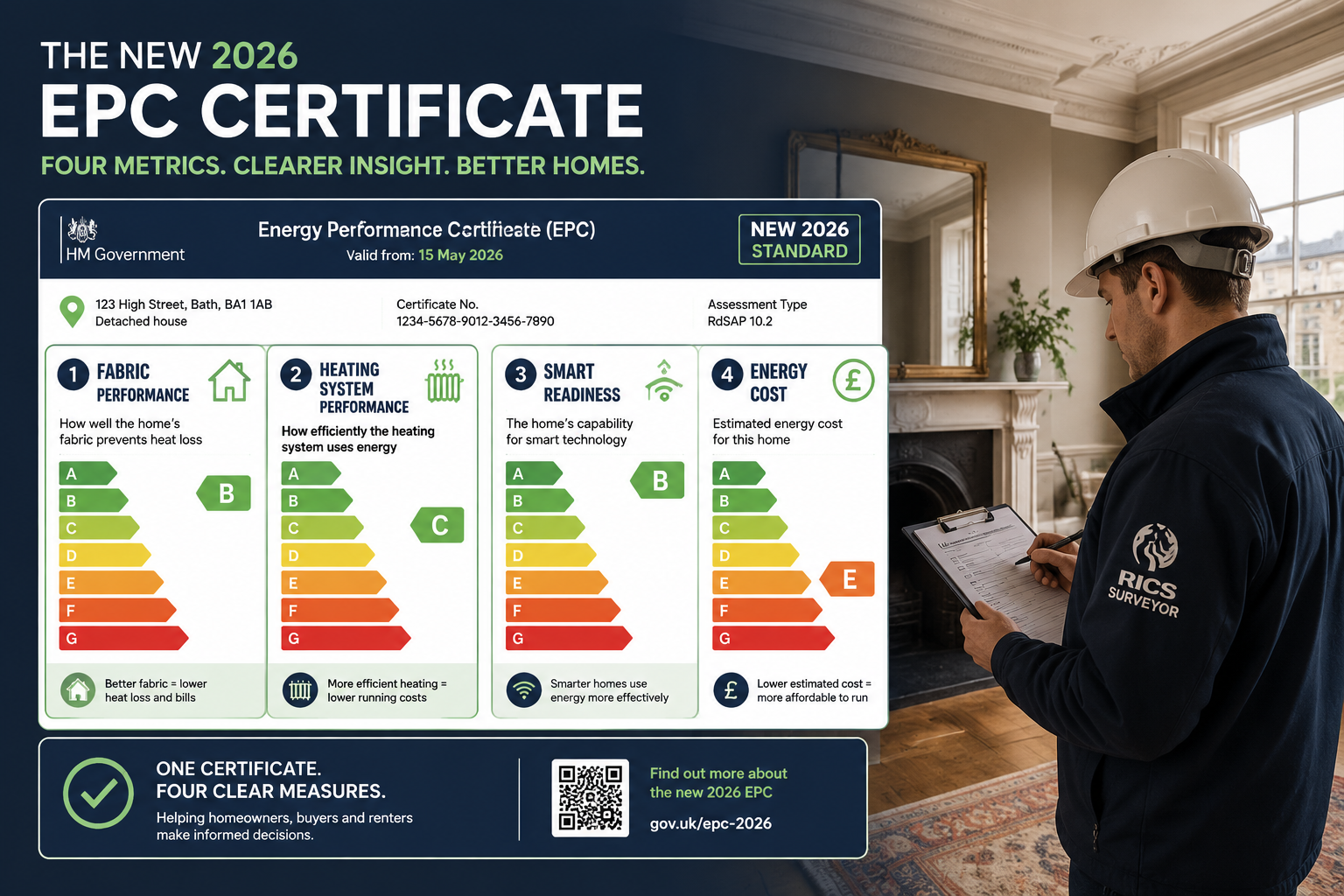
The government published its partial consultation response on 21 January 2026, confirming that the reformed EPC framework will present four headline performance metrics from October 2026 [2]:
| Metric | What It Measures |
|---|---|
| Fabric Performance | Insulation, draught proofing, windows/glazing |
| Heating System Performance | Boiler, heat pump, or other primary heating technology |
| Smart Readiness | Ability to respond to smart grid signals and time-of-use tariffs |
| Energy Cost | Estimated annual energy bill in pounds |
Critically, Fabric Performance is mandatory — it must be satisfied before landlords can choose between satisfying the heating system or smart readiness metrics [1]. This represents a decisive policy shift toward what the industry calls a fabric-first approach.
For buyers and their surveyors, this means the EPC letter grade alone is increasingly insufficient. A proper assessment of thermal performance in 2026 building surveys — from EPC bandings to real-world retrofit costing — now demands a deeper investigation into the physical fabric of the building itself.
Understanding the New Four-Metric EPC Framework in 2026
Fabric Performance: The Non-Negotiable Baseline
The new Fabric Performance metric assesses the building envelope directly: wall insulation, roof insulation, floor insulation, window glazing specifications, and air-tightness. Crucially, improvements to insulation and glazing will now be directly visible on the certificate rather than absorbed into a composite score [2]. This transparency changes the commercial dynamic significantly.
Properties that previously achieved a respectable composite band by virtue of cheap gas or a modern boiler will now be exposed if their fabric is poor. For landlords, this is particularly significant: properties with high "Cost" scores but low insulation levels face increased scrutiny, requiring a review of existing certificates and proactive retrofit planning [2].
How the Home Energy Model Changes the Calculation
The reformed system uses the Home Energy Model (HEM) as its underlying calculation methodology — a more granular replacement for the Standard Assessment Procedure (SAP). HEM separates insulation assessment from technology assessment, which means a heat pump alone can no longer compensate for a draughty, under-insulated Victorian terrace [2].
For surveyors conducting Level 3 full building surveys, this shift reinforces the importance of documenting:
- U-values for walls, roof, and floor (or estimated U-values based on construction type and age)
- Window specification (single, double, or triple glazing with approximate age)
- Air permeability indicators (visible draughts, unsealed penetrations, chimney condition)
- Existing insulation depth and condition (particularly loft insulation)
What Surveyors Should Be Reporting That EPCs Don't Cover
An EPC is produced by a Domestic Energy Assessor using a standardised checklist. It is not a building survey. It does not assess the condition of insulation (only its presence), identify thermal bridging, flag moisture-related heat loss, or provide retrofit cost estimates tailored to the specific property.
A Level 3 building survey should go considerably further, addressing:
- Thermal bridging at junctions (wall-to-floor, wall-to-roof, window reveals)
- Moisture and condensation risk associated with insulation upgrades
- Ventilation adequacy — critical when improving air-tightness
- Structural compatibility with proposed insulation measures (e.g., solid wall external insulation affecting eaves and window reveals)
- Heritage and planning constraints for listed buildings or conservation areas
Understanding environmental issues affecting a property — including flood risk, ground conditions, and orientation — also informs how thermal upgrades should be prioritised and sequenced.
Real-World Retrofit Costing: What Buyers and Landlords Actually Need to Know
The Fabric-First Principle in Practice
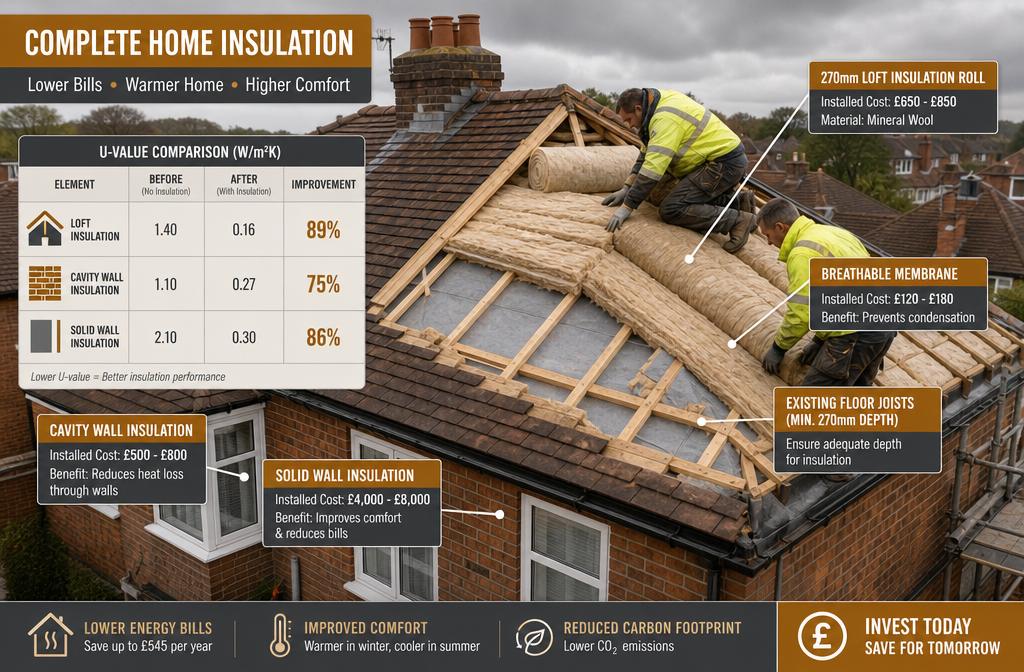
The most important principle in retrofit planning is deceptively simple: fix the fabric before upgrading the heating system. Installing a heat pump in a poorly insulated property forces it to operate at higher flow temperatures to compensate for heat loss, undermining its efficiency and increasing running costs [3]. The fabric-first sequence — insulate first, then decarbonise the heating — produces better performance and more cost-effective outcomes across the board.
This principle aligns directly with the new EPC framework's mandatory Fabric Performance metric, making it both a regulatory requirement and sound financial planning.
Retrofit Measures by UK Housing Archetype
Different property types face very different retrofit challenges and costs. The table below provides indicative cost ranges for the most common UK housing archetypes in 2026:
| Property Type | Priority Measure | Indicative Cost Range |
|---|---|---|
| Post-1990 semi-detached | Loft top-up to 270mm | £300 – £600 |
| 1930s–1980s cavity wall | Cavity wall insulation | £1,500 – £3,000 |
| Pre-1919 solid wall terrace | External wall insulation | £8,000 – £25,000 |
| Pre-1919 solid wall terrace | Internal wall insulation | £5,000 – £15,000 |
| Any unimproved property | Double glazing replacement | £4,000 – £10,000 |
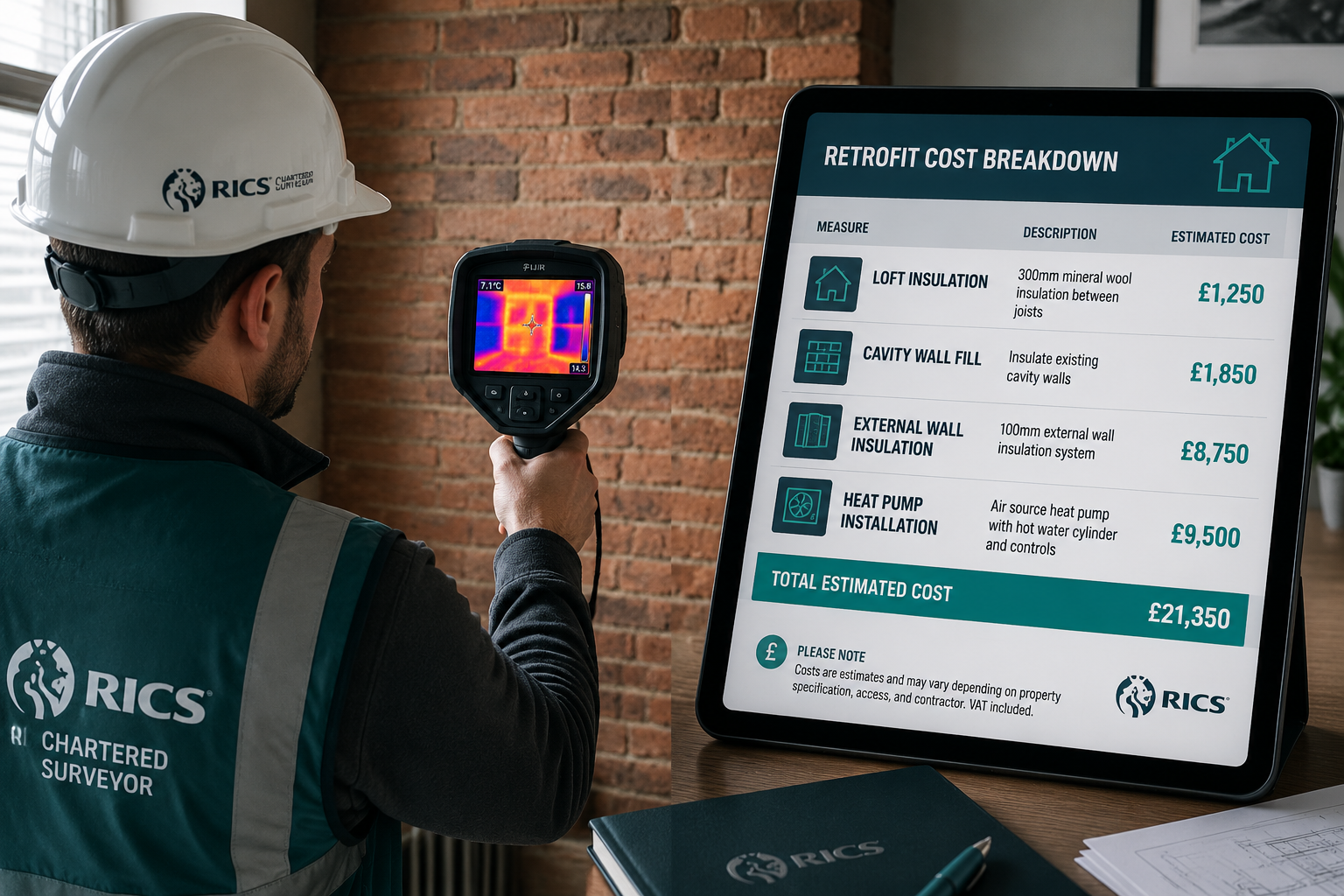
| Any property | Air source heat pump | £8,000 – £15,000 (before grant) |
⚠️ Costs vary significantly by region, property size, and contractor. Always obtain multiple quotes and commission a proper survey before committing to any programme.
Loft Insulation: The Cheapest High-Impact Measure
For any unimproved property, topping up loft insulation to 270mm is identified as the cheapest high-impact measure available [3]. It directly improves the new HEM Fabric Performance assessment, reduces heat loss by up to 25% in poorly insulated homes, and typically costs between £300 and £600 — often with grant support available through the Great British Insulation Scheme.
Surveyors should record existing loft insulation depth precisely. A property with 100mm of mineral wool installed in the 1980s will score significantly differently from one topped up to the current 270mm recommended depth.
Wall Insulation: The Central Challenge for Older Homes
For solid wall properties — typically pre-1919 construction — wall insulation is almost always the central measure for achieving EPC Band C before the 2029/2030 landlord compliance deadline [3]. The choice between external wall insulation (EWI) and internal wall insulation (IWI) involves significant trade-offs:
- EWI preserves internal floor area, addresses thermal bridging more effectively, and is generally preferred — but alters the external appearance of the building, which can trigger planning considerations and may be restricted in conservation areas or for listed buildings.
- IWI avoids external appearance changes but reduces room dimensions, requires careful management of thermal bridging at floor and ceiling junctions, and creates condensation risk if not detailed correctly.
A qualified surveyor should flag these constraints clearly in any pre-purchase report, as they can materially affect the cost and feasibility of compliance.
Heat Pumps and the Boiler Upgrade Scheme
A heat pump installation is expected to satisfy HEM's Heating System Performance metric. The Boiler Upgrade Scheme currently offers a £7,500 grant toward installation costs for both landlords and owner-occupiers [3]. However, the grant does not reduce the importance of fabric improvement — a heat pump installed in a poorly insulated property will underperform and generate higher running costs than projected.
The combined cost of a full retrofit programme — fabric improvements plus heat pump — can reach £20,000–£40,000 for a solid wall property, making it "more expensive and complex" than the current single-band EPC requirement implies [3]. Buyers negotiating on properties with poor fabric ratings should factor these costs into their offer strategy. For guidance on using survey findings to negotiate, see this practical guide on how to negotiate a house price down after a survey.
What This Means for Building Surveys in 2026
Integrating Thermal Assessment into Level 2 and Level 3 Surveys
The surge in buyer focus on energy costs and running cost comfort has made thermal performance a mainstream concern rather than a niche interest. Buyers increasingly want surveys that go beyond structural condition to address energy efficiency, retrofit feasibility, and realistic cost planning.
For building inspections and surveys for homeowners, this means asking surveyors the right questions upfront. When commissioning a survey, buyers should specifically request:
✅ Assessment of existing insulation levels and estimated U-values
✅ Identification of thermal bridging risks
✅ Commentary on ventilation adequacy and condensation risk
✅ Indicative retrofit cost ranges for the specific property type
✅ Flagging of any planning or heritage constraints on insulation measures
✅ Cross-referencing with the current EPC and any recommended improvements
Knowing what questions to ask during a building survey is one of the most effective ways buyers can ensure they receive actionable thermal performance data rather than generic commentary.
The Landlord Compliance Timeline
The regulatory pressure on landlords is particularly acute. From 2030, all rental properties must achieve EPC C or above [4]. Given that retrofit programmes for older properties can take 12–24 months to plan, procure, and execute — and that contractor availability for insulation and heat pump installation is already constrained — landlords who begin planning in 2026 are in a significantly better position than those who wait.
The 2026 EPC reform changes are a precursor to this enforcement deadline. Landlords who review their portfolio against the new four-metric framework now will identify which properties require fabric-only improvements (lower cost, lower complexity) versus those requiring both fabric and heating system upgrades (higher cost, longer programme).
Ventilation: The Overlooked Component
As buildings are made more air-tight through draught-proofing and insulation, ventilation becomes critical. Inadequate ventilation in a tightened building leads to moisture accumulation, condensation, mould growth, and poor indoor air quality — all of which can undermine the very fabric improvements being made.
Surveyors should assess existing ventilation provision (trickle vents, extract fans, passive stack systems) and flag where mechanical ventilation with heat recovery (MVHR) or other solutions may be needed as part of the retrofit programme. This is an area where building surveys add genuine value that an EPC assessment simply cannot provide.
Conclusion: Turning Thermal Data Into Actionable Decisions
Thermal performance in 2026 building surveys: from EPC bandings to real-world retrofit costing is no longer a specialist concern — it sits at the heart of property value, compliance risk, and long-term running costs for buyers, owners, and landlords across the UK.
The October 2026 EPC reform, with its four-metric framework and mandatory Fabric Performance standard, makes the limitations of the old single-band certificate impossible to ignore. Properties that appeared compliant under the composite scoring system may now require significant investment to meet the new fabric-first standard.
Actionable Next Steps 🎯
- Commission a Level 3 building survey that explicitly addresses insulation levels, U-values, thermal bridging, and ventilation — not just structural condition.
- Cross-reference the EPC with the survey findings to identify gaps between the certificate's assumptions and the building's actual fabric condition.
- Obtain indicative retrofit costs for the specific property type before exchange, and use these to inform negotiation or budget planning.
- Check planning and heritage constraints early — EWI on a terrace in a conservation area may not be permitted, fundamentally changing the retrofit strategy.
- Landlords: start the compliance clock now. The 2030 deadline requires action in 2026, not 2029.
- Follow the fabric-first sequence — insulate before upgrading the heating system for maximum efficiency and cost-effectiveness.
For tailored advice on your specific property, contact a chartered surveyor for free initial guidance before committing to any assessment or retrofit programme.
References
[1] New Epc Regulations – blog.goodlord.co
[2] 2026 Epc Reform Technical Update – buildingenergyexperts.co.uk
[3] How To Improve Your Epc Rating Before The Home Energy Model Changes Everything In 2027 2026 – epccertificates.co.uk
[4] Epc Ratings How Are They Changing In 2026 And What Does That Mean For Home Heating – ecostrad.com
[8] Energy Performance Of Buildings Certificates Statistical Release January To March 2026 England And Wales – gov.uk