

Nearly one in three UK property transactions collapsed before completion in recent years — and the buyer's post-offer survey remained the single most common trigger. That statistic alone explains why a growing number of sellers are commissioning their own surveys before listing. But the strategy is not without risk. Sellers' Pre‑Sale Surveys in 2026: When They Reduce Fall‑Throughs and When They Backfire is a question every UK homeowner preparing to sell should understand before signing the surveyor's instruction letter.
With housing inventory now running roughly 20% above prior-year levels [4] and 39% of potential sellers expecting to make concessions — up sharply from 30% in 2025 [2] — the market has shifted toward buyers. In that environment, a credible pre-sale survey can be a powerful trust signal. Used carelessly, however, it can expose defects that derail negotiations, invite legal liability, or simply hand buyers a ready-made renegotiation script.
Key Takeaways 📋
- Pre-sale surveys can shorten transaction timelines by surfacing defects early and reducing post-offer shock — but only when the property and market conditions are right.
- Buyers' solicitors and surveyors are not obliged to rely on a seller-commissioned report; best-practice reliance clauses and professional indemnity coverage are essential.
- Disclosure obligations cut both ways: once a seller has a survey, concealing its findings can constitute misrepresentation.
- Older, complex, or defect-prone properties benefit most from pre-sale surveys; newer or straightforward homes rarely need them.
- The 2026 market shift toward balance means sellers can no longer rely on bidding wars to paper over structural issues — transparency is increasingly a competitive advantage.
Why Sellers Are Commissioning Surveys in 2026
The 2026 spring market tells a nuanced story. While 74% of potential sellers believe now is a good time to sell — citing strong home values and stabilising interest rates [1] — the underlying data paints a more cautious picture. Inventory is up, days-on-market nationally sit at 57 days [2], and nearly half of sellers expect to carry out repairs or upgrades before listing [3].
Against that backdrop, the pre-sale survey has moved from niche tactic to mainstream consideration. The logic is straightforward:
- Buyers commission surveys after agreeing a price. If a serious defect emerges at that stage, the buyer renegotiates, delays, or walks away.
- A seller who already knows the property's condition can price accurately, fix issues proactively, or disclose transparently — all of which reduce the chance of a late-stage collapse.
- Estate agents increasingly recommend pre-sale surveys for older or complex stock, because a collapsed sale damages their pipeline too.
💬 "The best time to find out about a cracked lintel is before you accept an offer — not three weeks before exchange." — common advice from experienced conveyancers.
The 2026 Market Context
The housing market is undergoing what economists describe as a "reset" — a shift from supply-constrained conditions to a more balanced environment [5]. That shift has practical consequences for sellers:
| Market Condition | 2024–2025 | 2026 |
|---|---|---|
| Inventory vs prior year | Tight | ~20% higher [4] |
| Sellers expecting concessions | 30% | 39% [2] |
| Average days on market | ~45 days | 57 days [2] |
| Sellers expecting asking price or above | ~80% | 83% [1] |
The gap between seller price expectations (83% expecting asking price or more [1]) and the reality of a slower, more buyer-friendly market is precisely where pre-sale surveys add value — or cause damage.
When Sellers' Pre‑Sale Surveys in 2026 Reduce Fall‑Throughs
Properties That Benefit Most
Not every home needs a pre-sale survey. The strongest candidates are:
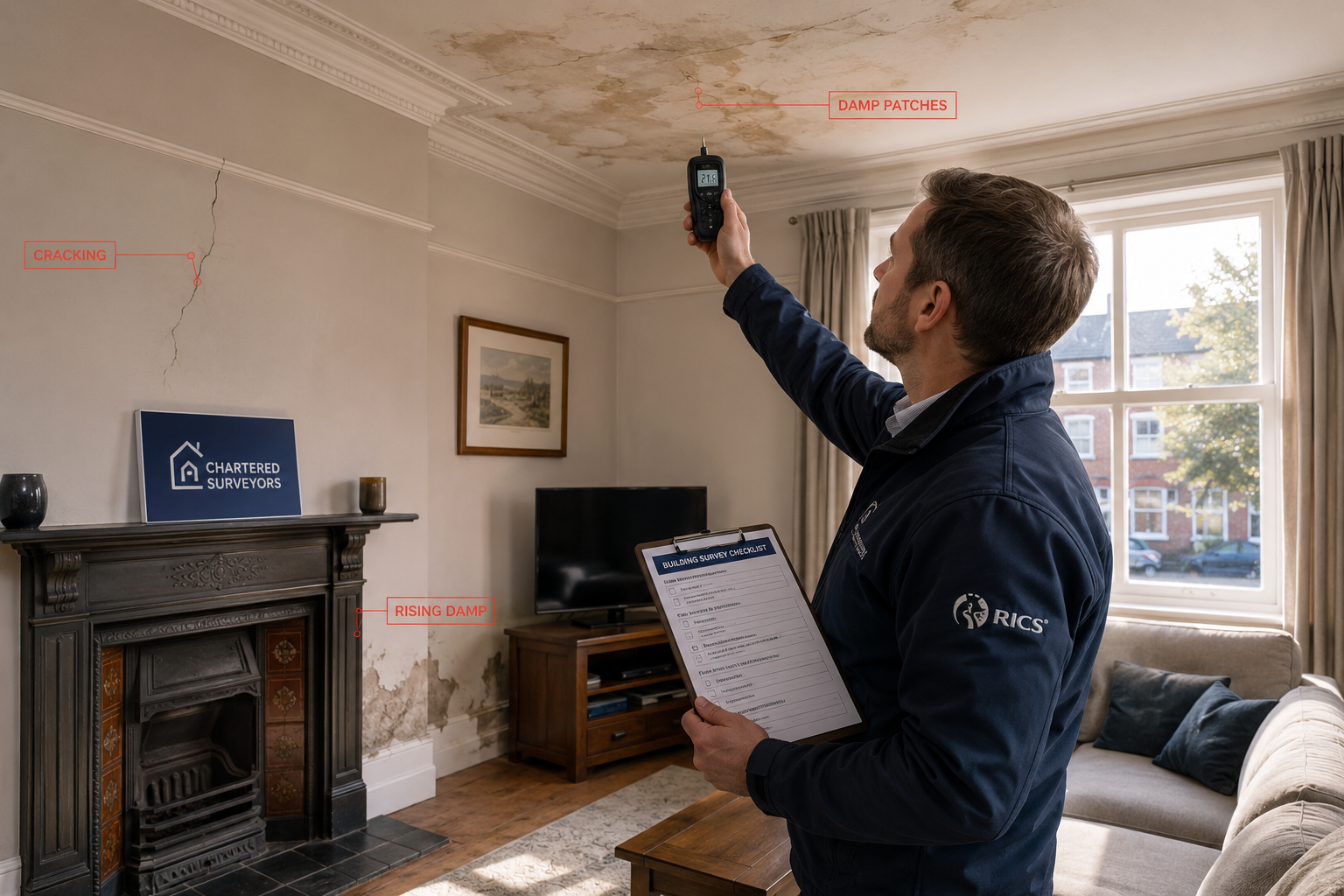
- Pre-1919 Victorian and Edwardian terraces with original roofs, solid-wall construction, or period drainage
- Properties with visible defects such as cracks, damp patches, or sagging rooflines
- Extended or converted homes where building regulations compliance may be questioned
- Leasehold flats in older blocks where structural or cladding issues are possible
- Homes in areas with known ground movement, mining subsidence, or flood risk
For these property types, a Level 3 full building survey commissioned by the seller can be genuinely transformative. It allows the seller to:
- Fix critical defects before listing, removing the renegotiation trigger entirely
- Obtain repair cost estimates to support accurate pricing — see guidance on budgeting repairs and restoration
- Demonstrate transparency to buyers, which builds trust and reduces the emotional friction that causes deals to fall apart
- Accelerate the buyer's own due diligence, since a detailed seller's report gives the buyer's surveyor a solid baseline
The Trust-Building Mechanism
When a seller presents a thorough, RICS-compliant survey from a reputable chartered surveyor, it signals confidence. Buyers — particularly first-time buyers — are often anxious about hidden defects. A credible pre-sale report reduces that anxiety and can reduce the time between offer and exchange by several weeks.
Key conditions for the trust-building effect to work:
- ✅ The survey must be genuinely independent (not commissioned from a firm with a commercial relationship to the seller's agent)
- ✅ The surveyor must be RICS-registered with appropriate professional indemnity insurance
- ✅ The report must be complete and unredacted — cherry-picked summaries destroy credibility
- ✅ The seller must act on serious findings, not simply disclose and ignore them
Understanding the difference between Level 2 and Level 3 surveys matters here. A Level 2 HomeBuyer Report may be insufficient for older or complex properties; buyers' solicitors may challenge its scope, reducing its value as a trust-building tool.
Reducing the Post-Survey Price Reduction
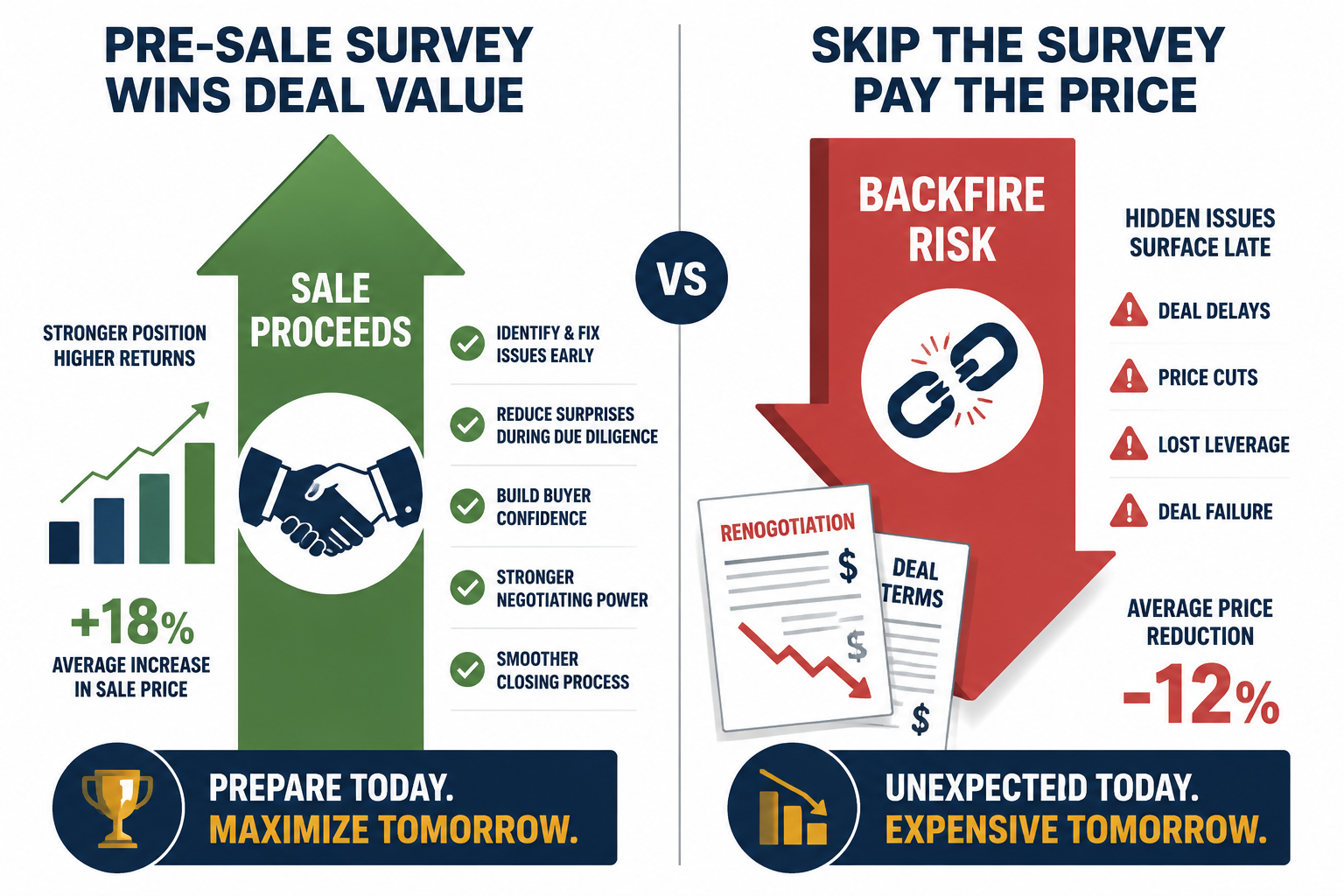
Research consistently shows that post-survey renegotiations are a major source of fall-throughs and price reductions. Understanding the average price reduction after a survey helps sellers appreciate the financial stakes. A pre-sale survey that identifies a £12,000 roof repair allows the seller to either fix it (and list at full price) or price it in from day one — avoiding the painful mid-transaction renegotiation that often ends in collapse.
When Sellers' Pre‑Sale Surveys in 2026 Backfire
The Disclosure Trap 🚨
Here is the central legal risk that many sellers overlook: once you commission a survey, you cannot unknow its findings. Under UK property law, sellers have a duty not to misrepresent the condition of a property. If a pre-sale survey identifies a significant defect and the seller fails to disclose it — or actively conceals it — they may face claims for misrepresentation after completion.
This creates a difficult position for sellers whose surveys reveal:
- Structural movement that would require expensive underpinning
- Roof or chimney defects requiring immediate replacement
- Damp or timber decay affecting habitable areas
- EPC or MEES compliance issues — understanding EPC ratings and building surveys is increasingly important as energy efficiency regulations tighten
If the cost of remediation exceeds what the seller can absorb, and disclosure would trigger a price reduction larger than the survey cost, the pre-sale survey has backfired financially.
Scenarios Where Pre-Sale Surveys Cause Damage
| Scenario | Why It Backfires |
|---|---|
| Seller discloses major structural defect without fixing it | Buyers renegotiate aggressively or withdraw |
| Survey reveals defects seller cannot afford to fix | Property becomes stigmatised; longer time on market |
| Buyer's surveyor disputes findings | Creates conflict, delays, and legal uncertainty |
| Survey scope is too narrow | Buyer commissions own survey anyway; seller paid twice |
| Report is shared selectively | Solicitors flag incomplete disclosure; trust collapses |
The "Buyers Will Survey Anyway" Problem
A significant proportion of buyers — particularly those using mortgage finance — will commission their own survey regardless of what the seller provides. In that case, the seller has spent money on a report that:
- Did not replace the buyer's survey
- May have flagged issues the buyer's surveyor would have missed or rated differently
- Has created a disclosure obligation the seller must now manage
For straightforward, post-2000 properties in good condition, the pre-sale survey often adds cost without adding proportionate value.
How Buyers' Surveyors Should Treat Seller-Commissioned Reports
This is a nuanced professional question. A buyer's RICS surveyor is not obliged to rely on a seller-commissioned report. Their duty of care runs to their client — the buyer — not to the seller. Standard professional practice requires them to conduct an independent inspection.
However, a seller's survey can legitimately serve as:
- A useful baseline for identifying areas requiring closer inspection
- A source of historical data on known defects and any remediation carried out
- Evidence of the seller's awareness of specific issues (relevant if disputes arise post-completion)
The buyer's surveyor should note in their report whether a seller's survey was made available, what its scope was, and whether their own findings are consistent or divergent. Significant divergence — for example, the seller's survey rating a defect as Condition 2 (requiring attention) while the buyer's surveyor rates it Condition 3 (urgent) — should be explicitly flagged.
Best-Practice Clauses for Relying On or Challenging Survey Findings
Reliance Letters and Professional Indemnity
For a buyer to place legal weight on a seller-commissioned survey, a reliance letter from the surveying firm is essential. This letter:
- Extends the surveyor's duty of care to the buyer
- Confirms that the professional indemnity insurance covers the buyer as an additional named party
- Specifies the limitations of the report's scope
Without a reliance letter, the buyer has no contractual relationship with the seller's surveyor and cannot bring a professional negligence claim if the report proves inaccurate.
Sellers should request reliance letter provisions at the point of instruction — not after the report is issued. Many surveying firms will include this as standard if asked; others charge a supplementary fee.
Contractual Clauses in the Sale Agreement
Solicitors on both sides should address the seller's survey explicitly in the sale contract. Recommended clauses include:
- Acknowledgement clause: The buyer acknowledges receipt of the seller's survey and its date of inspection
- Non-reliance clause (buyer's option): The buyer confirms they have commissioned their own independent survey and do not rely on the seller's report for their purchase decision
- Disclosure clause: The seller warrants that the pre-sale survey has been provided in full and unredacted
- Remediation clause: Where the seller has carried out works identified in the survey, the contract should specify the works completed, the contractor used, and any guarantees provided
Challenging Survey Findings
If a buyer's surveyor identifies defects not mentioned — or underrated — in the seller's survey, the buyer's solicitor should:
- Request written clarification from the seller's surveyor on the discrepancy
- Obtain a specialist report (structural engineer, damp specialist, roofing contractor) where the defect is serious — see when to hire a structural engineer
- Use the discrepancy as a negotiation basis for a price reduction or remediation undertaking
- Consider withdrawal if the seller's survey appears to have been deliberately misleading
For complex properties, drone surveys can provide aerial inspection of roofs and chimney stacks that ground-level surveys may miss — a useful tool for challenging the scope of a seller's report.
What Sellers Should Do After Receiving Their Survey
Immediate steps:
- Read the full report carefully — do not rely on the summary alone
- Obtain repair cost estimates for all Condition 3 and serious Condition 2 items
- Instruct a solicitor to review disclosure obligations before listing
- Decide: fix, price in, or disclose and negotiate
- Ensure the surveying firm can provide reliance letters if required
Ongoing maintenance records — boiler service history, roof repairs, damp treatment guarantees — should be compiled alongside the survey to give buyers a complete picture. Guidance on property maintenance planning can help sellers structure this documentation effectively.
Practical Decision Framework: Should You Commission a Pre-Sale Survey?
Use this framework to assess whether a pre-sale survey makes sense for a specific property:
✅ Commission a Pre-Sale Survey If:
- The property is pre-1919 or has had significant alterations
- There are visible defects (cracks, damp, roof sag, settlement)
- The local market is slow and buyers are cautious
- The seller wants to fix defects before listing to maximise price
- The seller's agent recommends it based on comparable fall-through rates in the area
- The property is unusual, listed, or in a conservation area
❌ Skip the Pre-Sale Survey If:
- The property is post-2000, well-maintained, and defect-free
- The seller cannot afford to act on potential findings
- The local market is still competitive and buyers are moving quickly
- The property type (e.g., new-build flat) means buyers will rely on developer warranties
- The seller is unwilling to provide reliance letters to buyers
Conclusion: Making Pre-Sale Surveys Work in 2026
The 2026 property market has shifted the balance of power toward buyers. With inventory up 20% year-on-year [4], average selling times stretching to 57 days [2], and the proportion of sellers expecting concessions rising to 39% [2], the days of relying on competition to paper over property defects are fading.
Sellers' Pre‑Sale Surveys in 2026: When They Reduce Fall‑Throughs and When They Backfire ultimately comes down to three variables: property condition, seller preparedness, and professional execution. When all three align — a defect-prone property, a seller willing to act on findings, and a RICS-registered surveyor who provides reliance letters — a pre-sale survey can meaningfully shorten timelines, reduce renegotiations, and build the buyer confidence that closes deals.
When they misalign — a seller who commissions a survey hoping it will show nothing, then faces a disclosure obligation they cannot manage — the survey becomes a liability rather than an asset.
Actionable Next Steps for Sellers in 2026:
- Consult a RICS-registered chartered surveyor before deciding whether a pre-sale survey is appropriate for your specific property
- Instruct your solicitor to review disclosure obligations before the survey is shared with any buyer
- Request reliance letter provisions at the point of surveyor instruction
- Compile maintenance records to accompany the survey report
- Act on serious findings — fix what you can, price in what you cannot, and disclose everything
- Use specialist inspections (structural engineers, drone surveys) where the pre-sale report scope may be insufficient for complex defects
A well-executed pre-sale survey is not a guarantee against fall-throughs. But in a market where 35% of sellers facing delays would resort to a price reduction [1], it is one of the most effective tools available to avoid reaching that point in the first place.
References
[1] 2026 04 14 Realtor Com R Survey Finds Sellers Are Optimistic Heading Into The 2026 Spring Market – mediaroom.realtor.com
[2] 2026 Sellers Survey Btts – realtor.com
[3] Is 2026 A Good Time To Buy Or Sell A Home What Buyers And Sellers Say – thepernateam.com
[4] 2026 Real Estate Outlook What Leading Housing Economists Are Watching – nar.realtor
[5] 2026 Housing Market Outlook Sales Starts Trends – bldr.com