

Only 19.3% of landlords felt ready to meet the new standards introduced when the Renters' Rights Act came into force on 1 May 2026 — and for building surveyors, that unpreparedness has created both a challenge and an opportunity [5]. Navigating Renters' Rights Act 2026 in Building Surveys: Surveyor Protocols for Pet Damage Risks and Periodic Tenancy Valuations is no longer a niche concern. It sits at the heart of every Level 3 inspection, every periodic tenancy valuation, and every landlord compliance conversation happening across the private rented sector (PRS) right now.
The Act's mandatory pet permission framework has fundamentally shifted the risk calculus for landlords and surveyors alike. Where pet damage was once a discretionary concern, it is now a statutory reality — and the profession needs clear, practical protocols to respond.
Key Takeaways 📋
- The Renters' Rights Act 2026 came into force on 1 May 2026, abolishing Section 21 evictions and restricting rent reviews to annual statutory processes.
- Landlords must not unreasonably refuse pet requests in periodic tenancies, making pet damage assessment a core surveyor responsibility.
- Level 3 building surveys must now include dedicated pet damage checklists covering floors, subfloors, doors, walls, and ventilation systems.
- Periodic tenancy valuations require adjusted methodologies that account for increased wear-and-tear risk, insurance implications, and reduced landlord exit flexibility.
- With 41.7% of private landlords considering exiting the PRS [5], surveyors who offer robust pet damage and compliance reporting will be in high demand.
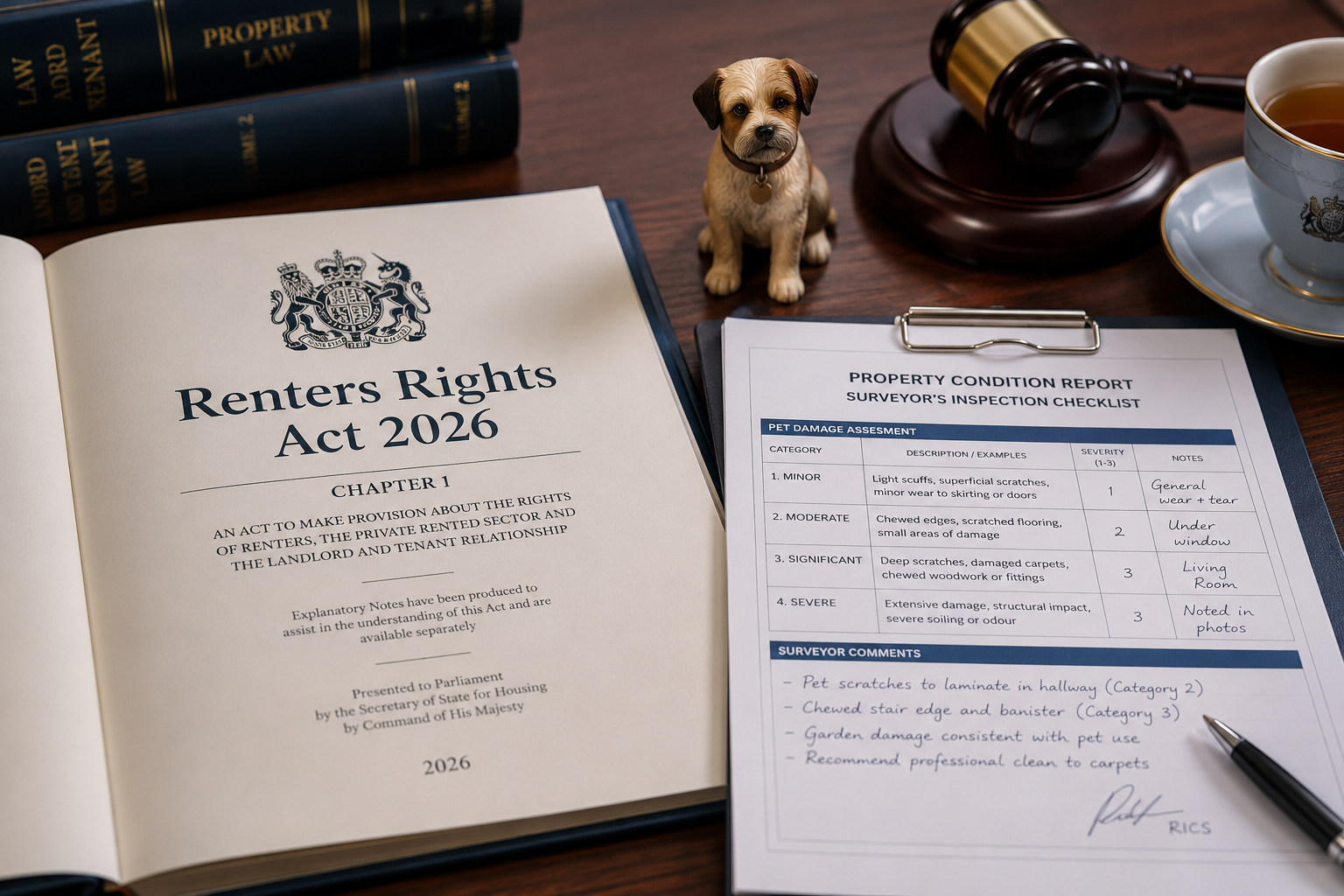
The Renters' Rights Act 2026: What Changed and Why It Matters for Surveyors
The Renters' Rights Act 2026 represents the most significant overhaul of the private rented sector in a generation. Its core provisions, effective from 1 May 2026, include:
- Abolition of Section 21 "no-fault" evictions — landlords can now only terminate tenancies on reformed statutory grounds [4]
- Annual rent review cap — contractual rent reviews are no longer enforceable; increases must follow a statutory notice procedure to "market rent" [4]
- Mandatory pet permission framework — landlords cannot unreasonably refuse a tenant's request to keep a pet
- PRS Database registration — expected to launch in late 2026, requiring standardised property condition reporting [4]
- Awaab's Law extension — property hazard response timelines now apply to the PRS [4]
💬 "The abolition of Section 21 means that accurate, defensible property condition documentation is no longer optional — it is the landlord's primary legal protection."
For surveyors, the implications are profound. The removal of no-fault evictions means that property condition at the start and end of a tenancy becomes the primary mechanism for resolving disputes. If a landlord cannot prove that damage exceeds fair wear and tear, they have no remedy. This places the building surveyor's report — particularly the Level 3 Full Building Survey — at the centre of landlord risk management.
The Pet Permission Mandate: A New Surveyor Obligation
Under the Act, landlords who refuse a tenant's request to keep a pet must provide a valid reason. In practice, most refusals will be challengeable. This means surveyors conducting pre-tenancy or mid-tenancy inspections must now treat pet occupancy as a baseline assumption in many properties, not an exception.
The data supports the scale of this shift. Approximately 41.7% of private landlords surveyed indicated they are unlikely to continue letting following the Act's implementation — a figure that rises to 51.8% among single-property landlords [5]. Those who remain will need comprehensive documentation to protect their assets. Surveyors who can deliver that documentation will be essential.
Surveyor Protocols for Pet Damage Risks in Level 3 Building Surveys
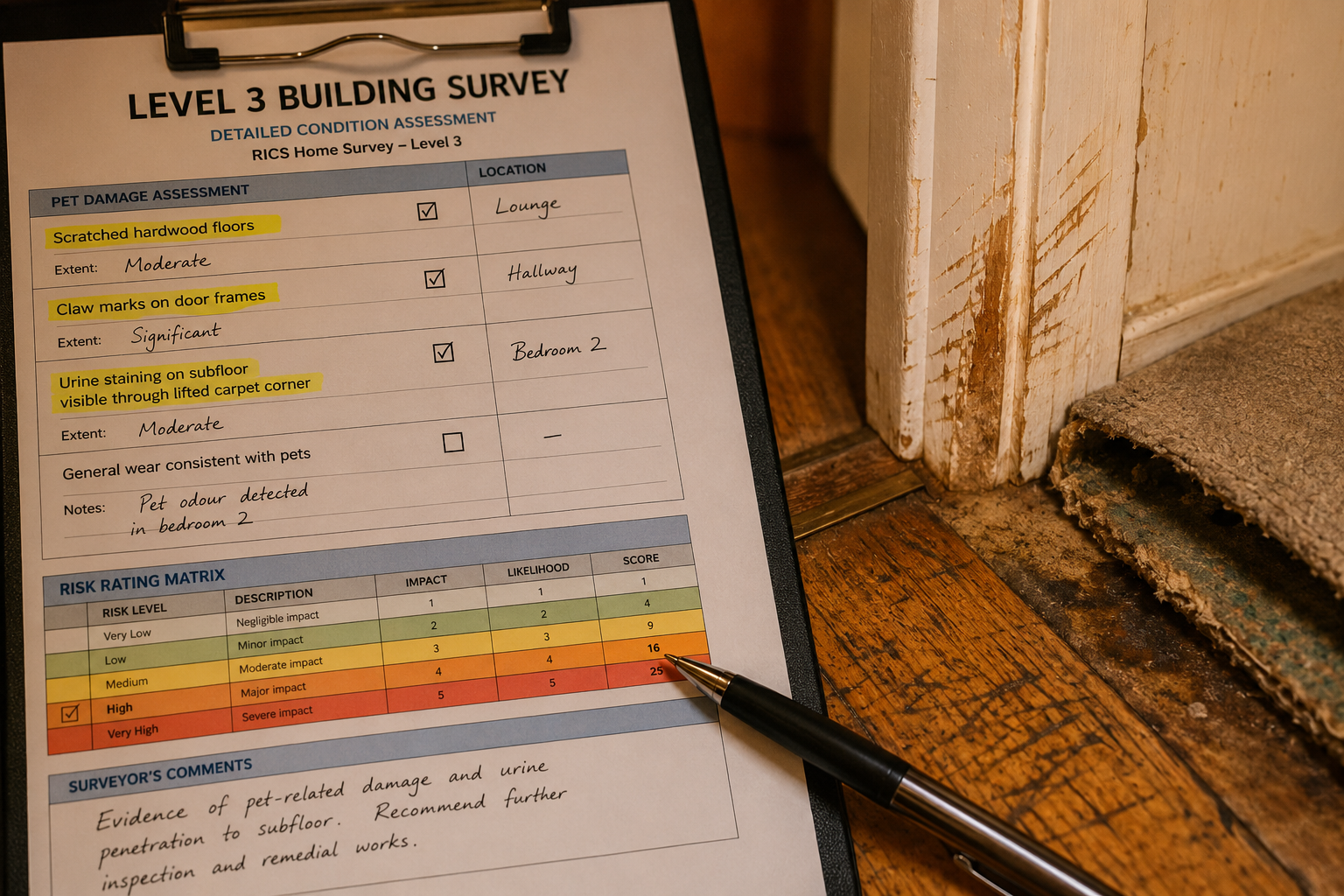
Navigating Renters' Rights Act 2026 in Building Surveys: Surveyor Protocols for Pet Damage Risks and Periodic Tenancy Valuations requires a structured, evidence-based approach. The following protocols are designed to integrate into a Level 3 Full Building Survey framework.
The Pet Damage Assessment Checklist 🐾
A robust pet damage checklist should cover six core inspection zones:
| Inspection Zone | Common Pet Damage Indicators | Risk Rating |
|---|---|---|
| Flooring & Subfloor | Claw scratches, urine saturation, staining | High |
| Door Frames & Skirting | Chewing, scratching, impact damage | High |
| Walls & Plaster | Scent marking, impact holes, staining | Medium |
| Garden & External Areas | Digging, lawn damage, fence deterioration | Medium |
| Ventilation & Air Quality | Pet dander accumulation, odour ingress | Medium |
| Fixtures & Fittings | Damaged blinds, chewed cables, stained upholstery | Low–Medium |
Each zone should be rated using a three-tier condition system:
- ✅ Fair wear and tear — no deduction warranted
- ⚠️ Accelerated deterioration — partial cost recovery possible
- ❌ Wilful or negligent damage — full cost recovery likely
This distinction matters enormously under the new legal framework. The building defects survey methodology provides a useful template for categorising damage severity with photographic evidence and cost estimates.
Documentation Standards: Learning from 2026 Survey Updates
The 2026 ALTA/NSPS Land Title Survey standards (US) introduced enhanced documentation requirements, mandating that surveyors provide comprehensive explanatory notes whenever discrepancies arise between recorded and measured information [3]. While these are American standards, the underlying principle — transparency and traceability in all surveyor notes — is directly applicable to UK pet damage assessments.
In practice, this means:
- Timestamped photographic records at every inspection stage
- Written condition narratives for each inspection zone, not just tick-box ratings
- Cost estimate ranges for remediation, referenced to current trade rates
- Comparison against the original Schedule of Condition where one exists
Surveyors should also flag areas requiring further investigation — for example, where urine saturation may have penetrated subfloor joists, requiring specialist moisture testing or structural assessment.
Subfloor and Structural Concerns: When Pet Damage Goes Deeper
Urine contamination is the most structurally significant pet damage risk. Repeated saturation can:
- Degrade timber joists through persistent moisture exposure
- Compromise concrete screeds through chemical reaction with uric acid
- Create mould pathways that trigger obligations under Awaab's Law [4]
- Affect EPC ratings through compromised floor insulation
Surveyors should be aware that Awaab's Law's extension to the PRS — combined with the government's push toward EPC C standards by 2030 [4] — means that pet-related moisture damage could trigger multiple compliance failures simultaneously. For guidance on energy performance implications, the EPC and MEES building survey guide provides a useful reference.
💬 "Pet urine saturation in timber subfloors is not cosmetic damage — it can trigger structural, environmental, and energy compliance failures in a single inspection."
Party Wall and Shared Structures: An Overlooked Pet Damage Vector
In terraced houses and flats — the most common PRS property types — pet damage can extend beyond the demised premises. Noise complaints, odour transmission through party walls, and damage to shared garden areas all require careful documentation. Party wall survey protocols must now account for tenant rights in all relevant notices [1], and surveyors should note any pet-related impact on shared structures as a separate line item in their reports.
Periodic Tenancy Valuations Under the Renters' Rights Act 2026: Adjusted Methodologies
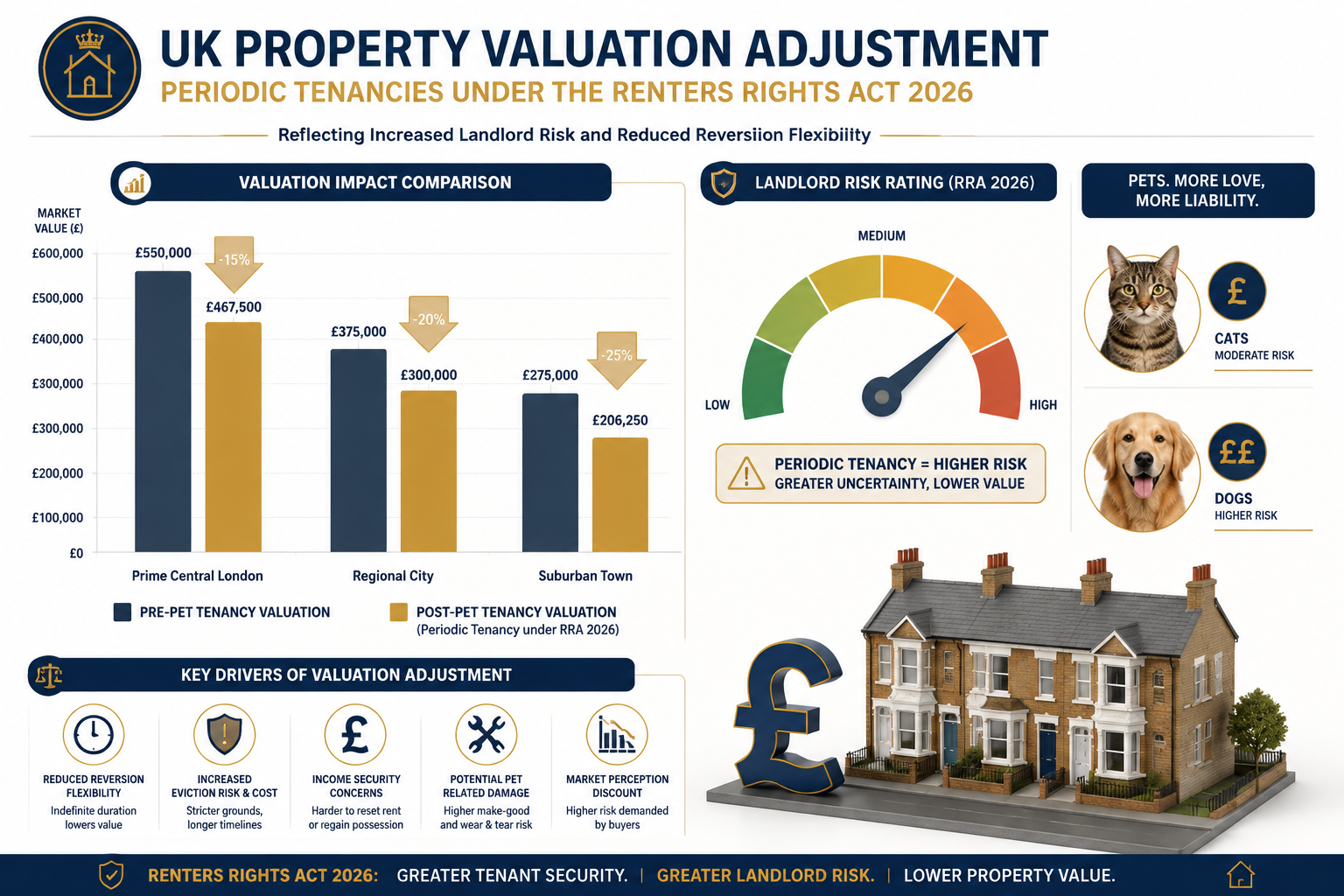
The shift from fixed-term to periodic tenancies — now the default under the Act — has significant implications for how surveyors approach property valuations. Navigating Renters' Rights Act 2026 in Building Surveys: Surveyor Protocols for Pet Damage Risks and Periodic Tenancy Valuations requires surveyors to rethink several core valuation assumptions.
How Periodic Tenancies Change the Valuation Landscape
Under the old regime, a landlord with a fixed-term tenancy could plan around a known end date. Under the new framework:
- Tenancies roll on indefinitely until the tenant or landlord triggers a statutory ground for termination
- Rent increases are capped to annual market rent reviews via statutory notice [4]
- Pet occupancy is presumed unless actively (and successfully) refused
- Condition deterioration is cumulative over an unpredictable tenancy length
This creates a compounding risk profile that traditional yield-based valuations do not fully capture. Surveyors providing rental valuations must now incorporate:
1. Extended Wear-and-Tear Depreciation Curves
Model depreciation over 5–10 year periodic tenancy scenarios, not just standard 12-month cycles. Pet occupancy accelerates depreciation in key areas by an estimated 20–35% depending on animal type and number.
2. Pet Damage Reinstatement Cost Reserves
Factor in a reinstatement cost reserve as part of the gross-to-net yield calculation. This is analogous to the methodology used in insurance reinstatement cost valuations, where full rebuild costs are assessed independently of market value.
3. Market Rent Benchmarking
With contractual rent reviews abolished [4], surveyors must be confident in their market rent assessments at each annual review point. Properties with pet occupancy may command slightly lower market rents in some sub-markets, or may attract a premium in pet-friendly areas — local comparable evidence is essential.
4. Void Period Risk Adjustment
Pet-occupied properties may require longer void periods for remediation between tenancies. A 0.5–1.5% downward yield adjustment may be appropriate for properties with confirmed pet occupancy history, depending on condition evidence.
The Compliance Cost Pressure on Valuations
The financial pressure on landlords is significant. Research shows that 70.3% of landlords plan to respond to increased compliance costs by raising rents, while 23.2% intend to sell [5]. This dual pressure — rising rents and reducing stock — will affect comparable evidence for surveyors conducting market rent assessments.
Surveyors should:
- Flag thin comparable markets in areas with high landlord exit rates
- Document compliance cost assumptions in valuation reports
- Consider the impact of PRS Database registration (expected late 2026) on property marketability [4]
For landlords considering exit, understanding the consequences of failing to act on property condition issues before sale is critical — and surveyors are well-placed to provide that guidance.
Dilapidations and End-of-Tenancy Assessments
The dilapidations framework under periodic tenancies requires careful handling. With no fixed end date, surveyors may be called upon to conduct mid-tenancy condition assessments as well as terminal schedules. Key principles:
- Betterment must not be claimed — landlords cannot use dilapidations to upgrade a property beyond its pre-tenancy condition
- Age and condition at grant must be documented in the original schedule
- Pet-specific clauses in tenancy agreements (now permitted under the Act) should be cross-referenced in all dilapidations assessments
For a detailed framework on this process, the dilapidation protocols guide provides essential background for surveyors navigating end-of-tenancy disputes.
Practical Implementation: Building the New Surveyor Workflow
Pre-Tenancy: Establishing the Baseline
The most important document in any pet-damage dispute is the original Schedule of Condition. Under the new regime, this should be:
- Completed before any pet occupancy begins
- Photographic and written — not tick-box only
- Signed by both landlord and tenant
- Stored digitally with timestamped metadata
Surveyors should recommend a Level 3 Full Building Survey for all PRS properties where pet occupancy is anticipated. The depth of investigation in a Level 3 report — covering construction, materials, and concealed defects — provides the most defensible baseline for future damage claims.
Mid-Tenancy: Periodic Condition Reviews
Given the indefinite nature of periodic tenancies, surveyors should advise landlords to commission annual condition reviews. These are lighter-touch than a full Level 3 survey but should specifically address:
- All six pet damage inspection zones (see checklist above)
- Any changes to pet occupancy (additional animals, different species)
- Emerging defects that may be accelerated by pet occupancy
- EPC-relevant deterioration (insulation, ventilation, moisture)
Post-Tenancy: The Terminal Schedule
At tenancy end, the terminal schedule must compare current condition against the original baseline, not against a notional ideal condition. Surveyors should:
- Revisit every item in the original Schedule of Condition
- Apply the three-tier damage rating system
- Provide itemised cost estimates for each remediation item
- Distinguish clearly between fair wear and tear and pet-specific damage
- Reference any mid-tenancy review findings as supporting evidence
Conclusion: Actionable Next Steps for Surveyors in 2026
The Renters' Rights Act 2026 has permanently changed the operating environment for building surveyors working in the private rented sector. The mandatory pet permission framework, combined with indefinite periodic tenancies and restricted rent reviews, makes robust property condition documentation more valuable — and more legally significant — than ever before.
Actionable steps for surveyors to take now:
- ✅ Update your Level 3 survey templates to include a dedicated pet damage assessment section covering all six inspection zones
- ✅ Develop a standardised Schedule of Condition product specifically for PRS landlords anticipating pet occupancy
- ✅ Revise your periodic tenancy valuation methodology to incorporate extended depreciation curves, reinstatement cost reserves, and void period risk adjustments
- ✅ Build your dilapidations expertise — mid-tenancy and terminal schedules will become routine in the new PRS landscape
- ✅ Stay ahead of PRS Database requirements — standardised condition reporting will likely be mandated when Phase 2 launches in late 2026
- ✅ Educate landlord clients — with only 19.3% feeling ready for compliance [5], surveyors who can explain the new framework clearly will build lasting client relationships
The surveying profession has a genuine opportunity to lead in this space. Landlords who remain in the PRS need expert guidance, and the surveyors who develop clear, practical protocols for pet damage assessment and periodic tenancy valuations will be indispensable partners in that journey.
For tailored advice on building survey requirements in the current regulatory environment, contact a chartered surveyor to discuss the right approach for your specific property portfolio.
References
[1] Party Wall Surveys For Institutional Buy To Let Expansions Compliance Strategies For 2026s Landlord Investment Surge – wimbledonsurveyors.com
[3] 2026 Alta Survey Standards Updates – hklaw.com
[4] On Your Radar – bclplaw.com
[5] The Renters Rights Act What Do Our Clients Think – allsop.co.uk
[8] Building Survey Quality Standards 2026 Navigating Rics Updates And Enhanced Home Inspection Requirements – nottinghillsurveyors.com
[10] Renters Right Act Conference – landmarkchambers.co.uk