

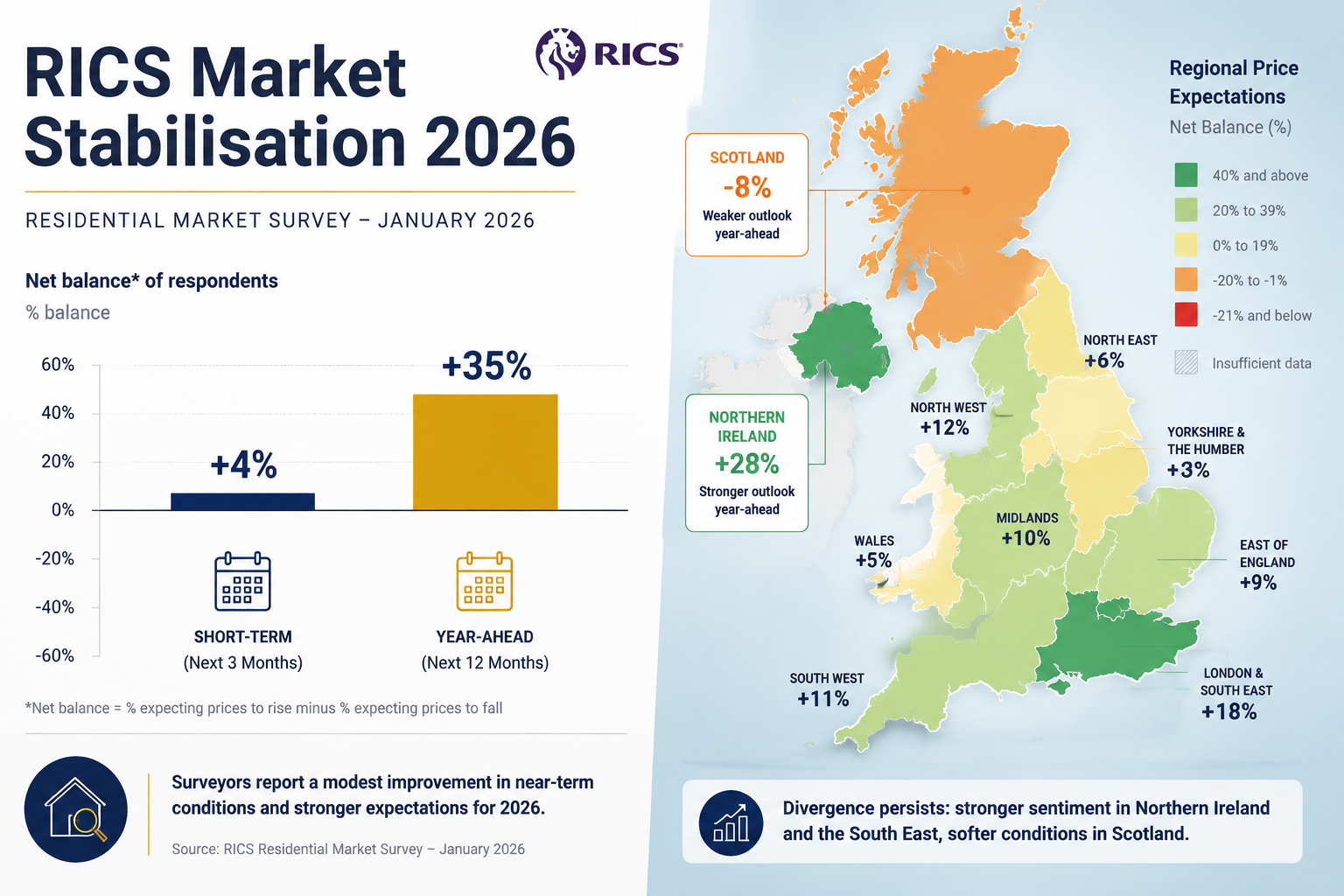
A net balance of +35% of property professionals now expect sales activity to rise over the next twelve months — a dramatic swing from October 2025's deeply negative reading of -19% [5]. That recovery signal, embedded in the RICS UK Residential Market Survey for January 2026, carries a consequence that many buyers, sellers, and surveyors are only beginning to grasp: as transaction volumes climb back toward normalcy, so does the volume of notifiable works under the Party Wall etc. Act 1996. Understanding the Party Wall Implications of RICS UK Residential Survey January 2026: Survey Protocols Amid Buyer Demand Stabilisation is therefore not merely academic — it is operationally urgent for every chartered surveyor, conveyancer, and property owner active in the current market.
Key Takeaways 📋
- The January 2026 RICS survey signals a tentative market turning point, with year-ahead sales expectations at +35% — directly increasing the pipeline of notifiable party wall works.
- Short-term caution persists at only +4% net balance for immediate sales expectations, meaning surveyors should prepare for a phased, not sudden, workload increase.
- The RICS 8th edition draft Party Wall Legislation and Procedure guidance raises professional standards beyond minimum legal compliance, with enhanced notice templates, fee guidance, and award clauses.
- Regional divergence — particularly in Northern Ireland and Scotland — means party wall surveying practices must account for different market tempos across the UK.
- Robust schedules of condition, notice protocols, and award documentation are now more critical than ever in a rising-transaction environment.
What the RICS January 2026 Data Means for Transaction-Linked Party Wall Activity
The Party Wall Implications of RICS UK Residential Survey January 2026: Survey Protocols Amid Buyer Demand Stabilisation begin with understanding the market backdrop. The January 2026 RICS Residential Market Survey describes conditions as potentially "turning a corner," with activity-related indicators recording their least negative readings in several months [5]. This language is deliberately measured — the recovery is real but fragile.
Breaking Down the Key Market Metrics
| Indicator | Reading | Context |
|---|---|---|
| Short-term sales expectations | +4% net balance | Flat near-term outlook; ongoing caution [5] |
| Year-ahead sales expectations | +35% net balance | Significant optimism; up from -19% in Oct 2025 [5] |
| Regional outlier (positive) | Northern Ireland & Scotland | Diverging upward from national trend [5] |
💬 "The market is not roaring back — it is cautiously finding its footing. For party wall surveyors, that distinction matters enormously when forecasting instruction volumes."
The +4% short-term reading reflects ongoing caution around the immediate outlook [5]. However, the +35% year-ahead figure represents a genuine shift in professional sentiment. For party wall surveyors, this forward-looking optimism translates directly into a growing pipeline of residential transactions — and with more transactions come more extensions, loft conversions, basement excavations, and structural alterations that trigger the Act.
Why Rising Transactions Drive Party Wall Demand
Every residential transaction involving a semi-detached or terraced property carries the potential for future notifiable works. New homeowners frequently undertake:
- Rear extensions (requiring two-month party wall notices)
- Loft conversions affecting party structures
- Basement excavations within three metres of neighbouring foundations
- Structural alterations to shared walls
As the RICS data points toward increased activity, the cumulative effect on party wall instruction volumes becomes significant [8]. Surveyors operating in high-density urban areas — from chartered surveyors in Hammersmith to chartered surveyors in Clapham — will feel this pressure most acutely.
Survey Protocols and Notice Frameworks: Adapting to Increased Notifiable Works
The Party Wall Implications of RICS UK Residential Survey January 2026: Survey Protocols Amid Buyer Demand Stabilisation extend well beyond market statistics. The practical question for surveyors is: how should professional protocols adapt when instruction volumes are rising?
Statutory Notice Requirements — A Refresher for a Busy Market
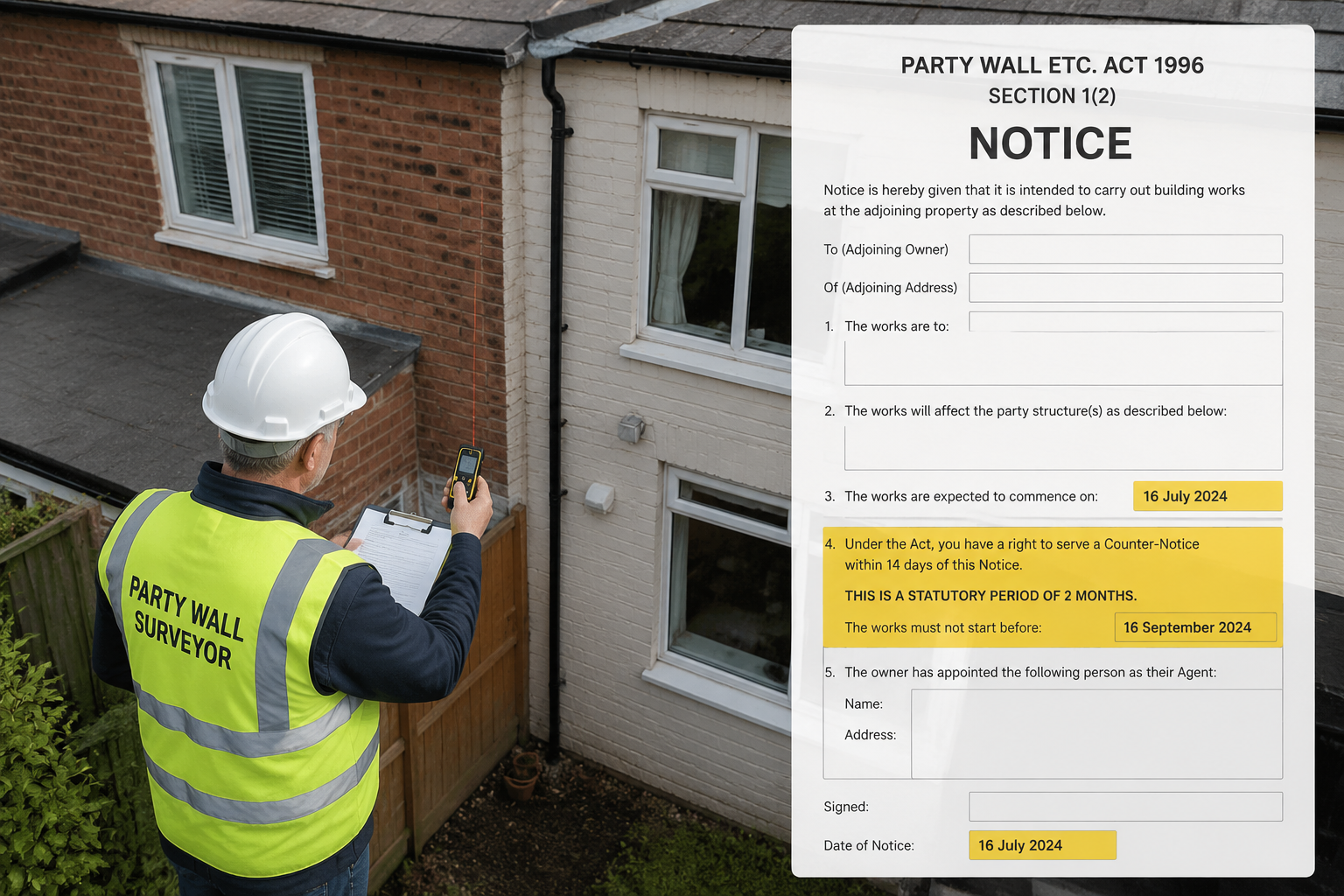
The Party Wall etc. Act 1996 imposes strict statutory timeframes that cannot be compressed regardless of market pressure:
- ⏱️ Two months' notice for works to a party structure (e.g., extensions, structural alterations)
- ⏱️ One month's notice for new boundary walls
- ⏱️ One month's notice for excavation works near neighbouring buildings
These timeframes are not guidelines — they are legal requirements. In a rising-transaction environment, building owners often feel pressure to accelerate projects. Surveyors must hold firm on statutory compliance. Understanding what happens when a neighbour refuses party wall works becomes especially relevant when timelines are tight and tempers run high.
Essential Elements of a Compliant Party Wall Notice (2026 Template Framework)
A robust notice should include the following components:
🔲 Building Owner Details
Full name, address, and contact information of the party undertaking works.
🔲 Adjoining Owner Details
Accurate identification of all adjoining owners and occupiers — a step frequently missed in rushed transactions.
🔲 Description of Proposed Works
Clear, specific description referencing the relevant section of the Act (Section 1, 2, or 6).
🔲 Proposed Commencement Date
Must respect the statutory notice period from the date of service.
🔲 Surveyor Appointment Clause
Statement of the building owner's appointed surveyor and invitation for the adjoining owner to appoint their own.
🔲 Consent or Dissent Mechanism
Clear instruction on how the adjoining owner may respond within 14 days.
For surveyors managing high volumes of instructions, a standardised notice template aligned with the forthcoming RICS 8th edition guidance reduces error risk considerably [1].
The Schedule of Condition: Your Most Important Pre-Works Document
In an upticking market where construction activity is accelerating, the party wall schedule of condition becomes the single most important protective document for both parties. A thorough schedule:
- Records the pre-works condition of the adjoining property with photographic evidence
- Establishes a baseline for any future damage claims
- Protects the building owner from spurious claims
- Protects the adjoining owner's right to compensation for genuine damage
💬 "A schedule of condition prepared before works begin is worth ten arguments avoided after they finish."
The 2026 construction surge is bringing heightened scrutiny to party wall agreements and awards, making robust documentation and professional surveying practices increasingly critical [8]. Surveyors who cut corners on schedules of condition in a busy market expose their clients — and themselves — to significant professional risk.
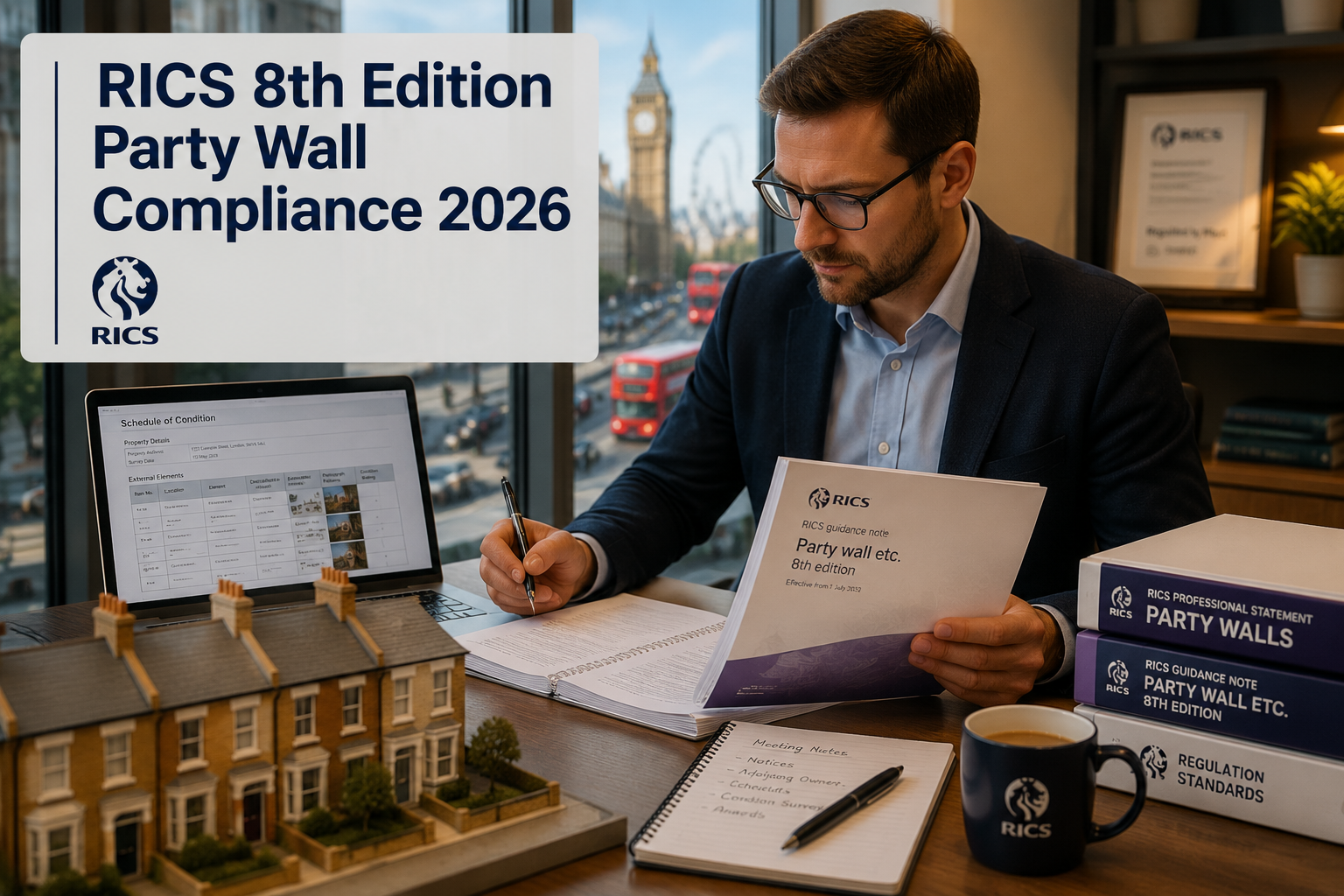
The RICS 8th Edition Party Wall Guidance: What Surveyors Must Know in 2026
No discussion of the Party Wall Implications of RICS UK Residential Survey January 2026: Survey Protocols Amid Buyer Demand Stabilisation would be complete without addressing the profession's own evolving standards. RICS launched a consultation on the draft 8th edition of Party Wall Legislation and Procedure in early 2026, with the consultation closing in May 2026 [7]. The profession is, in the words of one commentary, "still catching up" with implementation requirements [7].
What Has Changed from the 7th Edition?
The 8th edition represents a substantive upgrade, not a cosmetic revision [1]. Key changes include:
| Area | 7th Edition | 8th Edition Enhancement |
|---|---|---|
| Fee practices | General guidance | Strengthened clarity on fee transparency [4] |
| Third Surveyor use | Procedural outline | Enhanced procedural guidance [4] |
| Service of notices | Standard templates | Revised letters of appointment and updated templates [1] |
| Award drafting | Basic framework | Updated draft award template [1] |
| Public engagement | Limited guidance | Expanded guidance for client communication [4] |
| Professional independence | Implied | Explicitly stated: appointment is "personal and statutory, independent of client instruction" [4] |
This last point deserves particular emphasis. The updated guidance makes clear that a party wall surveyor's appointment is personal and statutory, independent of client instruction [4]. In a rising market where building owners may attempt to pressure surveyors toward faster or more favourable outcomes, this principle is a professional lifeline.
Enhanced Standards Beyond Minimum Legal Compliance
RICS has developed comprehensive guidance specifically for party wall work, setting expectations that go beyond minimum legal compliance [3]. For surveyors handling increased instruction volumes in 2026, this means:
- Conducting thorough pre-works inspections even when clients are impatient
- Issuing notices with sufficient lead time regardless of project pressure
- Preparing awards that anticipate likely dispute scenarios
- Maintaining independence even when appointed by the building owner
Understanding the consequences of ignoring the Party Wall Act — for both surveyors and their clients — has never been more important than in the current environment of rising activity and heightened regulatory expectations.
Award Clauses Tailored to Rising Transaction Volumes
In a high-volume market, party wall awards benefit from more comprehensive drafting. Recommended award clause enhancements for 2026 include:
✅ Extended access provisions — specifying precise access windows given busier construction schedules
✅ Enhanced damage notification protocols — shorter timeframes for reporting damage given faster project turnarounds
✅ Escalation clauses — clear procedures if the Third Surveyor needs to be engaged quickly
✅ Completion inspection requirements — mandatory post-works inspection before the award is formally closed
✅ Insurance confirmation clauses — requiring building owners to confirm adequate contractor insurance before works commence
For complex projects such as basement excavations, specialist party wall surveying for basement works requires additional award provisions addressing groundwater, structural monitoring, and vibration thresholds.
Regional Divergence and Its Practical Implications for Party Wall Surveyors
The January 2026 RICS data highlights widening regional divergence, with Northern Ireland and Scotland showing notably different trajectories from the rest of the UK market [5]. This is not merely a statistical footnote — it has direct implications for party wall surveying practices.
How Regional Market Tempo Affects Party Wall Workflows
In higher-activity regions (London, South East, parts of the Midlands):
- Instruction volumes are rising faster
- Notice periods are being tested by impatient building owners
- Dispute rates may increase as neighbours feel overwhelmed by construction activity
- Surveyors in areas like Guildford and Weybridge should anticipate heavier workloads
In diverging regions (Northern Ireland, Scotland):
- Different legal frameworks apply — Scotland does not use the Party Wall etc. Act 1996
- Surveyors must be alert to jurisdiction-specific requirements
- Market recovery may be faster, creating localised pressure points
The Buyer Due Diligence Angle
For buyers entering the market amid stabilising demand, understanding party wall obligations before purchasing is essential. A buyer who purchases a terraced house without understanding their party wall rights may face unexpected costs and delays when they later wish to extend or renovate.
This is where pre-purchase surveys and party wall awareness intersect. A RICS building survey should flag any evidence of previous party wall works — whether properly documented or not — as part of its structural assessment. Undocumented party wall works can create title complications and insurance issues that surface only after completion.
Practical Checklist for Surveyors Operating in the 2026 Stabilising Market 📋
Given the convergence of rising transaction volumes, new RICS guidance, and heightened professional expectations, here is a practical operational checklist for party wall surveyors in 2026:
Before Accepting Instructions:
- Confirm jurisdiction (England and Wales only for the Act)
- Identify all adjoining owners and occupiers accurately
- Review any existing party wall agreements or awards on the property
- Check for evidence of previous undocumented works
Notice Stage:
- Use updated notice templates aligned with 8th edition guidance
- Serve notices with adequate lead time (do not backdate)
- Document service of notice with proof of delivery
- Record the 14-day response window clearly
Schedule of Condition:
- Photograph all potentially affected areas comprehensively
- Note existing cracks, settlement, and defects with measurements
- Obtain adjoining owner's signature or acknowledgement
- Store securely with date-stamped metadata
Award Drafting:
- Use updated award template from 8th edition guidance
- Include enhanced access, damage notification, and completion inspection clauses
- Confirm Third Surveyor appointment details are current
- Ensure award is served on all parties before works commence
Post-Works:
- Conduct completion inspection
- Compare against schedule of condition
- Document any damage and initiate compensation process if required
- Formally close the award
Conclusion: Turning Market Recovery Into Professional Opportunity
The January 2026 RICS data tells a story of cautious optimism — a market that is finding its footing after a difficult period, with year-ahead expectations firmly positive at +35% [5]. For party wall surveyors, this recovery is both an opportunity and a responsibility.
Rising transaction volumes mean more notifiable works. More notifiable works mean more notices to serve, more schedules of condition to prepare, and more awards to draft. The RICS 8th edition guidance arriving in 2026 raises the bar for professional conduct precisely when the volume of work is increasing [1][7]. That combination demands preparation, not improvisation.
Actionable Next Steps 🎯
- Update your notice templates to align with RICS 8th edition draft guidance before the next instruction arrives.
- Review your schedule of condition process — ensure photographic coverage is comprehensive and systematically stored.
- Audit your award precedents to include enhanced clauses for access, damage notification, and completion inspection.
- Communicate proactively with clients about statutory timeframes — the +4% short-term market reading means some clients will be impatient; manage expectations early.
- Stay informed on regional market conditions — the divergence between Northern Ireland, Scotland, and the rest of the UK means a one-size-fits-all approach to workload planning is inadequate.
- Consider specialist advice for complex projects — party wall disputes in a high-activity market can escalate quickly, and early specialist involvement saves time and cost.
The intersection of market recovery and regulatory enhancement creates a defining moment for the party wall surveying profession in 2026. Those who prepare thoroughly will serve their clients well and protect their professional reputation. Those who do not may find the rising tide of transactions brings more problems than opportunities.
References
[1] Rics Launches Consultation On Updated Party Wall Practice Guidance – rics.org
[2] Rics Launches Consultation On Party Wall Guidance – thenegotiator.co.uk
[3] Party Wall Surveys And Neighbour Disputes During 2026s Construction Uptick Rics Compliance Framework – nottinghillsurveyors.com
[4] Rics Opens Consultation On Party Wall Guidance Update – propertywire.com
[5] Uk Residential Market Survey January 2026 – rics.org
[6] Party Wall Agreement – hoa.org.uk
[7] Rics 8th Edition Party Wall Guidance 2026 Implementation Challenges And Surveyor Compliance Strategies – wimbledonsurveyors.com
[8] Party Wall Surveys Amid 2026 Construction Boom Handling Disputes In High Demand Uk Housing Markets – nottinghillsurveyors.com
[9] Rics January 2026 Residential Survey Insights Implications For Valuation Surveyors In A Stabilising Market – manchestersurveyors.com
[10] Rics 8th Edition Party Wall Guidance 2026 Whats Changed And How Surveyors Must Adapt – wimbledonsurveyors.com