

"Fewer than 40% of commercial property disputes in the UK are resolved within six months — a statistic the RALA Code of Practice 2025 was designed to change."
Effective 31 December 2025, the Rent and Lease Arbitration (RALA) Code of Practice 2025 introduced a landmark shift in how commercial property valuations and lease-related disputes are handled across England and Wales. For chartered surveyors operating in this space, the implications are immediate, wide-reaching, and non-negotiable. The RALA Code of Practice 2025: Implications for Chartered Surveyors in Commercial Property Valuations and Dispute Resolution is not simply a regulatory update — it redefines professional obligations, reporting standards, and the role of surveyors as expert witnesses in arbitration proceedings.
Whether advising landlords, tenants, or lenders, chartered surveyors must now navigate a more structured, transparent, and time-bound framework. This article breaks down what the Code requires, how it affects commercial valuation methodology, and what practical strategies professionals should adopt right now in 2026.
Key Takeaways 📋
- ✅ The RALA Code of Practice 2025 became effective 31 December 2025, directly affecting all commercial lease dispute and valuation processes in England and Wales.
- ✅ Chartered surveyors face new transparency and consistency obligations in how valuations are prepared, documented, and presented in dispute proceedings.
- ✅ The Code introduces faster arbitration timelines, requiring surveyors to produce expert witness reports to tighter deadlines.
- ✅ Valuation methodology must now align with both RALA standards and existing RICS professional guidance [9].
- ✅ Proactive integration of RALA requirements into client advisories and expert witness reports is now a competitive differentiator for surveying firms.

What Is the RALA Code of Practice 2025 and Why Does It Matter?
The RALA Code of Practice 2025 emerged from the Commercial Rent (Coronavirus) Act 2022 framework and subsequent industry consultations that identified persistent inefficiencies in how commercial rent disputes were resolved. The Code formalises arbitration processes for protected rent debt, but its influence now extends broadly into commercial lease renewals, rent reviews, and associated valuation disputes.
At its core, the Code mandates three things:
- Transparency — Valuations and supporting evidence must be fully disclosed to all parties and the arbitrator.
- Consistency — Methodologies must follow recognised standards, reducing the risk of conflicting expert opinions derailing proceedings.
- Speed — Arbitration timelines are compressed, with strict deadlines for submitting valuation evidence and expert reports.
For chartered surveyors, this means the days of loosely structured expert reports are over. Every opinion on value must now be traceable, methodology-justified, and compliant with the Code's evidentiary standards.
How Does RALA Interact With Existing RICS Standards?
The RALA Code does not replace RICS professional standards — it layers on top of them. The RICS Red Book (RICS Valuation — Global Standards) remains the authoritative framework for valuation methodology in the UK [9]. However, RALA introduces procedural requirements that go beyond what RICS mandates in terms of disclosure, timing, and arbitration conduct.
Surveyors must therefore satisfy two parallel frameworks simultaneously:
| Framework | Focus | Authority |
|---|---|---|
| RICS Red Book | Valuation methodology & ethics | RICS [9] |
| RALA Code 2025 | Arbitration process & evidence standards | RALA/Government |
| EVS 2025 | European valuation standards alignment | TEGoVA [8] |
This dual compliance requirement is one of the most significant operational changes facing firms in 2026.
RALA Code of Practice 2025: Implications for Chartered Surveyors in Commercial Property Valuations
Valuation Methodology Under the New Framework
Commercial property valuation has always involved selecting the right approach for the right asset type. The three primary methods — income capitalisation, comparable sales, and the cost approach — remain valid under RALA [1][3]. However, the Code places new emphasis on justifying methodology selection in writing, particularly when comparable evidence is limited or contested.
The income approach, which estimates value based on net operating income divided by a capitalisation rate, is especially common in commercial lease disputes [3]. Under RALA, surveyors must now:
- Document the selection rationale for their chosen capitalisation rate
- Disclose all comparable transactions considered, including those rejected
- Explain adjustments made to comparables in plain, auditable language [2]
This is a significant departure from previous practice, where some of these decisions remained implicit in the surveyor's professional judgment. The Code makes implicit reasoning explicit — and therefore challengeable.
💬 "The RALA Code effectively transforms valuation from a professional art into a documented science — every assumption must now be visible and defensible."
Handling Valuations Without Strong Comparables
One of the trickiest challenges in commercial property valuation — particularly for specialist assets like industrial units, healthcare premises, or mixed-use developments — is the absence of direct comparable evidence [4]. The RALA Code acknowledges this reality but requires surveyors to demonstrate a systematic approach to evidence gathering even when comparables are scarce.
Recommended strategies include:
- Using multiple valuation methods and cross-checking results [5]
- Applying depreciated replacement cost (DRC) methodology for specialist properties with appropriate disclosure
- Documenting the limitations of the evidence base explicitly in the expert report
- Referencing market commentary and economic data to contextualise the valuation
For firms offering commercial property valuations, building robust internal processes around these documentation requirements is now essential — not optional.
Tax-Related Valuations and RALA Compliance
The Code's transparency requirements also ripple into valuations prepared for tax purposes. Where a commercial property valuation feeds into a dispute that also has tax implications — such as a lease restructuring affecting rateable value or a disposal triggering capital gains — surveyors must ensure their reports are consistent across both contexts.
Professionals advising on capital gains tax valuations or inheritance tax valuations for commercial assets should review whether their standard report formats meet the new RALA evidentiary standards, particularly if those valuations could later be drawn into arbitration proceedings.
RALA Code of Practice 2025: Implications for Chartered Surveyors in Dispute Resolution
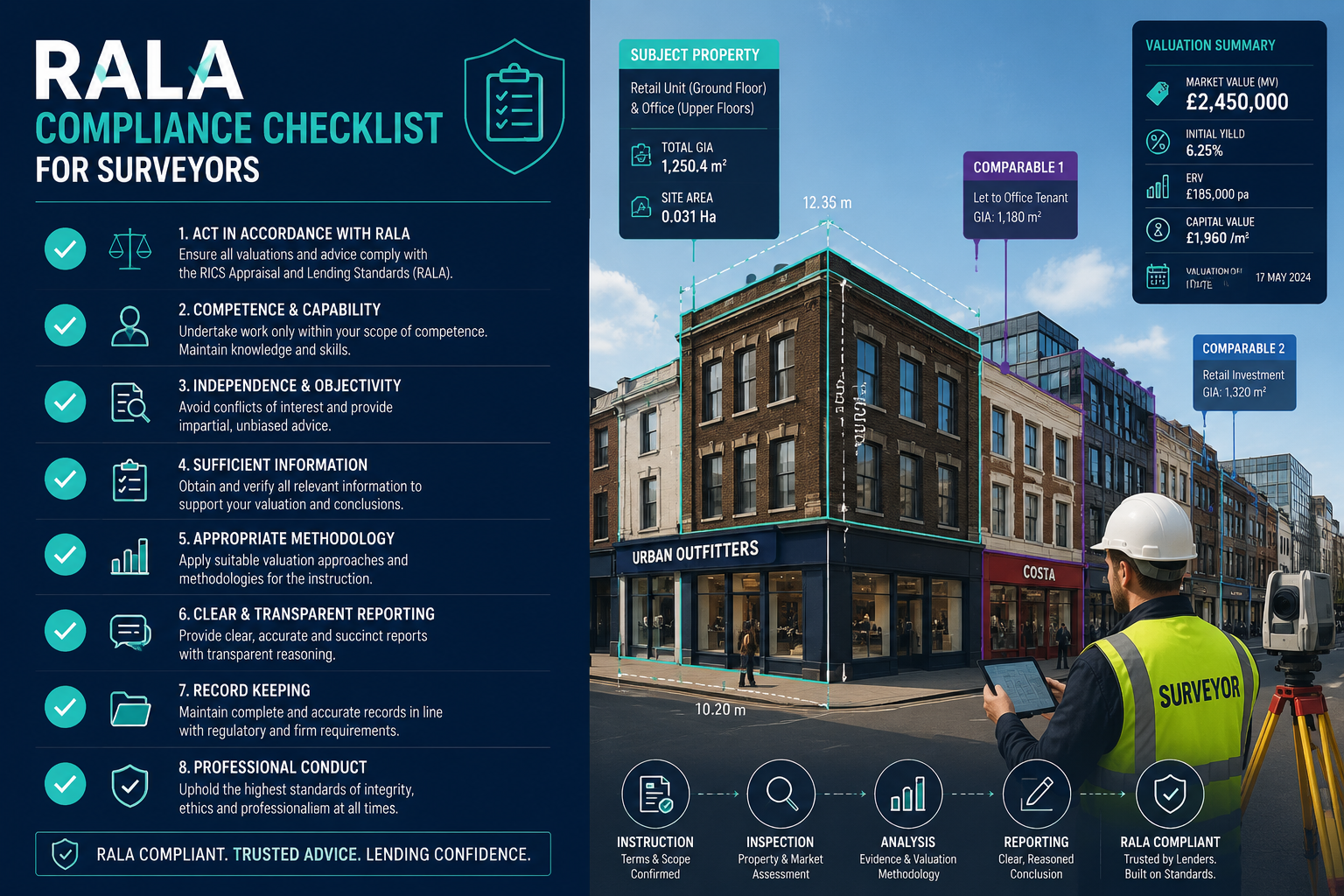
The Expert Witness Role: New Obligations and Tighter Timelines
Perhaps the most operationally demanding aspect of the RALA Code of Practice 2025 is its impact on the expert witness function. Chartered surveyors appointed as expert witnesses in RALA arbitrations now operate under a compressed and highly structured timetable.
Key procedural requirements include:
- Initial submission deadlines: Expert reports must typically be submitted within 28 days of appointment, depending on case complexity.
- Sequential exchange: The Code often requires sequential (rather than simultaneous) exchange of expert reports, meaning the responding party's surveyor must engage directly with the first report's methodology.
- Without-prejudice meetings: Surveyors are expected to participate in expert meetings to narrow areas of disagreement before the arbitrator makes a determination.
- Joint statements: Where experts disagree, a joint statement of agreed and disputed points is required — a practice borrowed from court procedure but now formalised in RALA arbitrations.
These requirements demand that surveyors acting as expert witnesses have strong procedural literacy alongside their technical valuation skills. Firms operating across regions — from chartered surveyors in Central London to chartered surveyors in Surrey — should ensure their expert witness practitioners receive specific RALA procedural training.
Drafting RALA-Compliant Expert Witness Reports
A well-structured expert witness report under the RALA Code should follow this framework:
📄 Recommended Report Structure:
- Instructions and scope — Who appointed the surveyor and what question they were asked to answer
- Methodology — Which valuation approach was used and why [1][3]
- Evidence base — All comparables considered, with full disclosure of rejected evidence [2]
- Adjustments — Documented rationale for every adjustment to comparable evidence
- Valuation conclusion — The opinion of value with a clear statement of confidence level
- Limitations — Any constraints on the evidence or methodology [4]
- Expert declaration — Confirmation that the report complies with RALA requirements and RICS standards [9]
This structure ensures the report is both technically robust and procedurally compliant — reducing the risk of evidence being challenged or excluded by the arbitrator.
Regulatory Parallels: What International Frameworks Tell Us
The push for greater transparency and consistency in property valuation is not unique to the UK. Singapore's regulatory enhancements to property valuation oversight [7] and Victoria's 2025 Valuation Best Practice Guidelines [10] both reflect a global trend toward more structured, auditable valuation processes. The RALA Code sits within this international movement, and UK surveyors can draw useful lessons from how peer jurisdictions are managing similar transitions.
The European Valuation Standards 2025 (EVS 2025) also provide relevant methodological guidance that aligns with RALA's transparency requirements [8], particularly for cross-border commercial assets or properties with international investor interest.
Practical Strategies for Chartered Surveyors: Integrating RALA Into Daily Practice
Building a RALA-Ready Practice in 2026
The transition to RALA compliance is not a one-time exercise — it requires embedding new habits into everyday professional practice. Here are the most effective strategies for chartered surveyors and surveying firms:
🔧 Operational Changes to Implement Now:
- Audit existing report templates against RALA evidentiary requirements and update accordingly
- Create a comparable evidence log for each instruction, recording all transactions considered — not just those used
- Establish internal peer review for any valuation likely to enter arbitration
- Train fee earners on RALA procedural timelines and expert witness obligations
- Update client engagement letters to reflect RALA disclosure requirements from the outset
Client Advisory: What Landlords and Tenants Need to Know
Chartered surveyors also have a responsibility to educate their clients about how RALA changes the dispute landscape. Key messages for client advisories in 2026 include:
- Arbitration is now faster — clients should be prepared to make decisions and provide instructions quickly
- Evidence quality matters more than ever — poor record-keeping by landlords or tenants will directly weaken their surveyor's position
- The Code favours transparency — attempts to withhold comparable evidence or obscure valuation assumptions are likely to backfire in arbitration
For clients with portfolios spanning multiple asset classes — including those requiring SIPP pension property valuations or insurance reinstatement cost valuations — surveyors should proactively review whether any of those assets could be drawn into RALA proceedings and prepare accordingly.
Staying Current: Continuing Professional Development
The RALA Code of Practice 2025 is a living document — updates and clarifications are expected as arbitration case law develops through 2026 and beyond. Chartered surveyors should:
- Monitor RICS guidance updates regularly [9]
- Attend CPD events focused on RALA arbitration practice
- Subscribe to professional publications covering commercial lease law and valuation standards
- Engage with regional surveying networks to share emerging best practice
Firms with broad geographic coverage — including those serving clients from Hertfordshire to Hampshire — will benefit from centralised RALA compliance resources that can be adapted for local market conditions.
Conclusion: Turning Compliance Into Competitive Advantage
The RALA Code of Practice 2025: Implications for Chartered Surveyors in Commercial Property Valuations and Dispute Resolution represents one of the most significant shifts in UK commercial property practice in recent years. Effective since 31 December 2025, it demands greater transparency, tighter documentation, and faster expert witness performance from every chartered surveyor involved in commercial lease disputes.
The surveyors who will thrive in this environment are not those who merely comply — they are those who use RALA as a framework to deliver higher-quality, more defensible valuations that serve clients better at every stage, from initial instruction through to arbitration outcome.
Actionable next steps for chartered surveyors in 2026:
- ✅ Review and update all commercial valuation report templates for RALA compliance
- ✅ Train your team on RALA procedural timelines and expert witness obligations
- ✅ Update client advisories to reflect the new arbitration landscape
- ✅ Engage with RICS for the latest guidance updates [9]
- ✅ Seek specialist legal advice on any live disputes that may fall under RALA jurisdiction
- ✅ Explore the full range of valuation services available through your practice — from commercial valuations to annual tax valuations — to ensure all are RALA-ready
The Code is not a burden — it is an opportunity to demonstrate the professionalism, rigour, and client focus that defines the best chartered surveyors in the UK market.
References
[1] Major Methods Commercial Real Estate Valuation – altusgroup.com
[2] Best Method And Tools For Commercial Property Valuation Appeals – avalara.com
[3] Commercial Real Estate Valuation Approaches – jpmorgan.com
[4] Understanding Commercial Real Estate Valuation Without Comps A Detailed Guide – jdmpartners.com
[5] Calculating The Value Of Commercial Real Estate Properties – aeiconsultants.com
[7] Enhancements To Regulatory Regime For Property Valuation And Auditors SGX Response – cfasocietysingapore.org
[8] EVS 2025 – scribd.com
[9] RICS Standards And Guidance – rics.org
[10] Valuation Best Practice Specifications Guidelines 2025 – land.vic.gov.au