

Over 4.4 million social housing residents in England live in properties where structural defects intersect with health hazards — and since October 2025, ignoring those hazards has become a legal liability with real financial consequences. The convergence of Awaab's Law enforcement and escalating retrofit programmes has created an urgent new reality: party wall surveys must now function as multi-hazard compliance instruments, not just boundary-protection documents.
Party Wall Surveys for Structural Collapse Hazards: 2026 RICS Protocols Under Awaab's Law Retrofit Mandates sits at the crossroads of housing law, structural engineering, and tenant safety. This guide explains exactly what surveyors, landlords, and property managers must do in 2026 to stay compliant, protect adjoining owners, and avoid enforcement action. [3][4]
Key Takeaways 📋
- Awaab's Law came into force on 27 October 2025, mandating investigation of health and safety hazards within 14 calendar days of tenant notification [3]
- Structural collapse risks — including cracked lintels, failed wall ties, and bulging brickwork — now fall within the expanded hazard scope of Awaab's Law [2]
- RICS has formally endorsed the law's requirements, committing the profession to prompt, evidence-based hazard assessments [4]
- Party wall notices and awards must now incorporate structural hazard condition schedules when retrofit works affect shared boundaries
- Extension of Awaab's Law to the private rented sector is anticipated in 2026, meaning all landlords should prepare compliance protocols now [2]
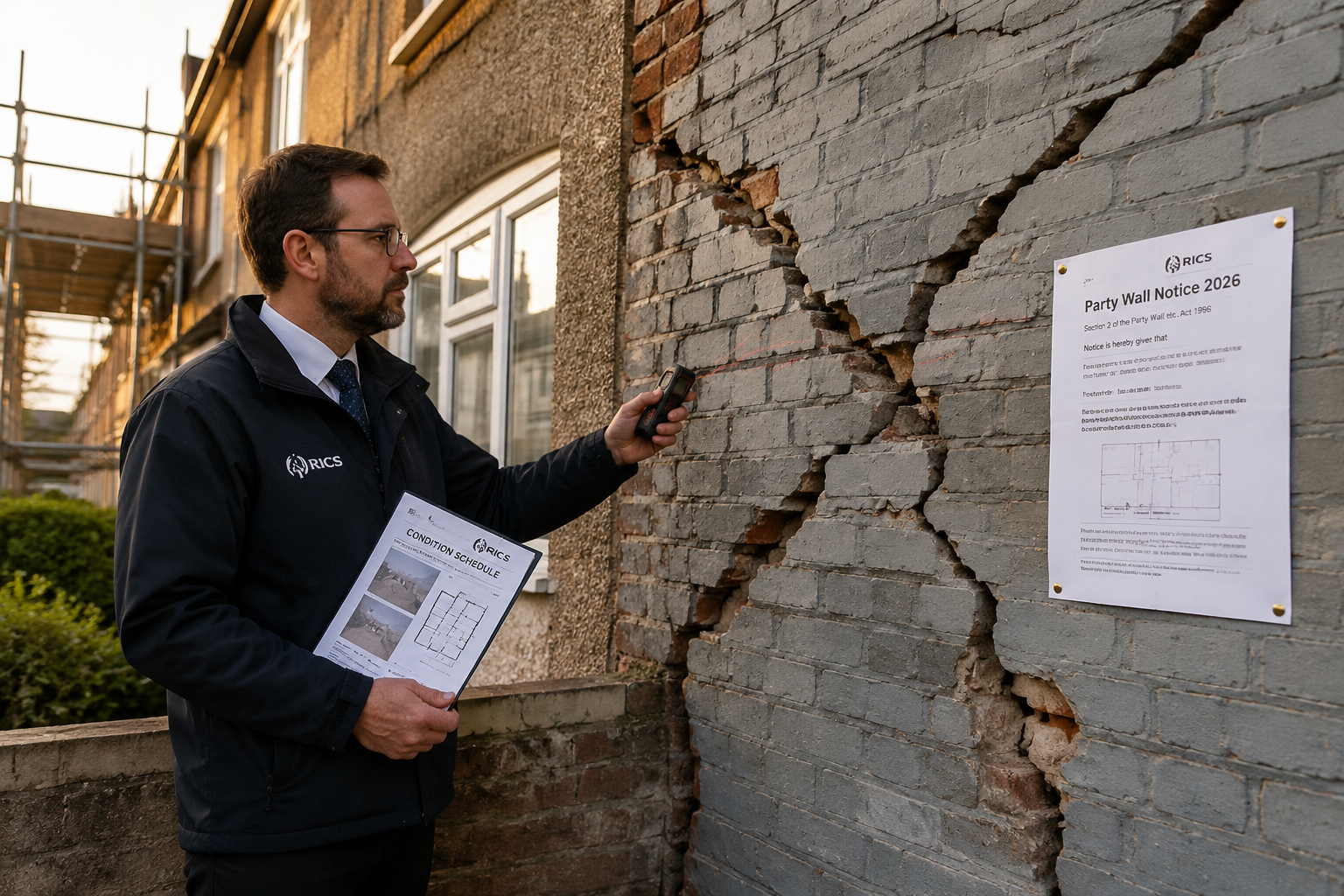
What Awaab's Law Means for Structural Hazard Assessments in 2026
The Law's Expanded Hazard Scope
Awaab's Law — named after two-year-old Awaab Ishak, who died in 2020 following prolonged exposure to mould in a Rochdale social housing flat — initially focused on damp and mould remediation. However, its implementation framework has been deliberately written to encompass broader health and safety hazards including:
- 🏚️ Structural collapse risks (cracked party walls, failed wall ties, subsidence)
- 🔥 Fire hazard conditions affecting shared walls and escape routes
- 🥶 Excess cold from inadequate insulation or failed heating systems
- ⚠️ Fall hazards introduced or worsened by retrofit works [2]
Since coming into force on 27 October 2025, the law requires social housing landlords to investigate reported hazards within 14 calendar days — or sooner if the risk is immediate — and to complete remediation within a defined, proportionate timeframe [3].
💬 "RICS has welcomed Awaab's Law, affirming the profession's commitment to mandates requiring social landlords to investigate and act promptly on health and safety hazards." — RICS [4]
Why Structural Collapse Hazards Are Now a Priority
Retrofit programmes accelerating across England in 2026 — driven by net zero targets, EPC upgrade mandates, and the Social Housing (Regulation) Act — are disturbing party walls at an unprecedented rate. Insulation installation, heat pump flue penetrations, and window replacements all create vibration, loading changes, and moisture pathways that can destabilise existing structural defects in shared walls.
When a retrofit contractor opens up a cavity wall between two terraced houses and discovers cracked mortar, failed wall ties, or a bulging leaf, that discovery now triggers simultaneous obligations under both the Party Wall etc. Act 1996 and Awaab's Law. Surveyors who fail to recognise this dual obligation risk exposing their clients to enforcement action, civil liability, and reputational damage.
For a thorough understanding of what happens when the Party Wall Act is not properly observed, see this detailed guide on the consequences of ignoring the Party Wall Act.
How Party Wall Surveys for Structural Collapse Hazards Integrate 2026 RICS Protocols Under Awaab's Law Retrofit Mandates
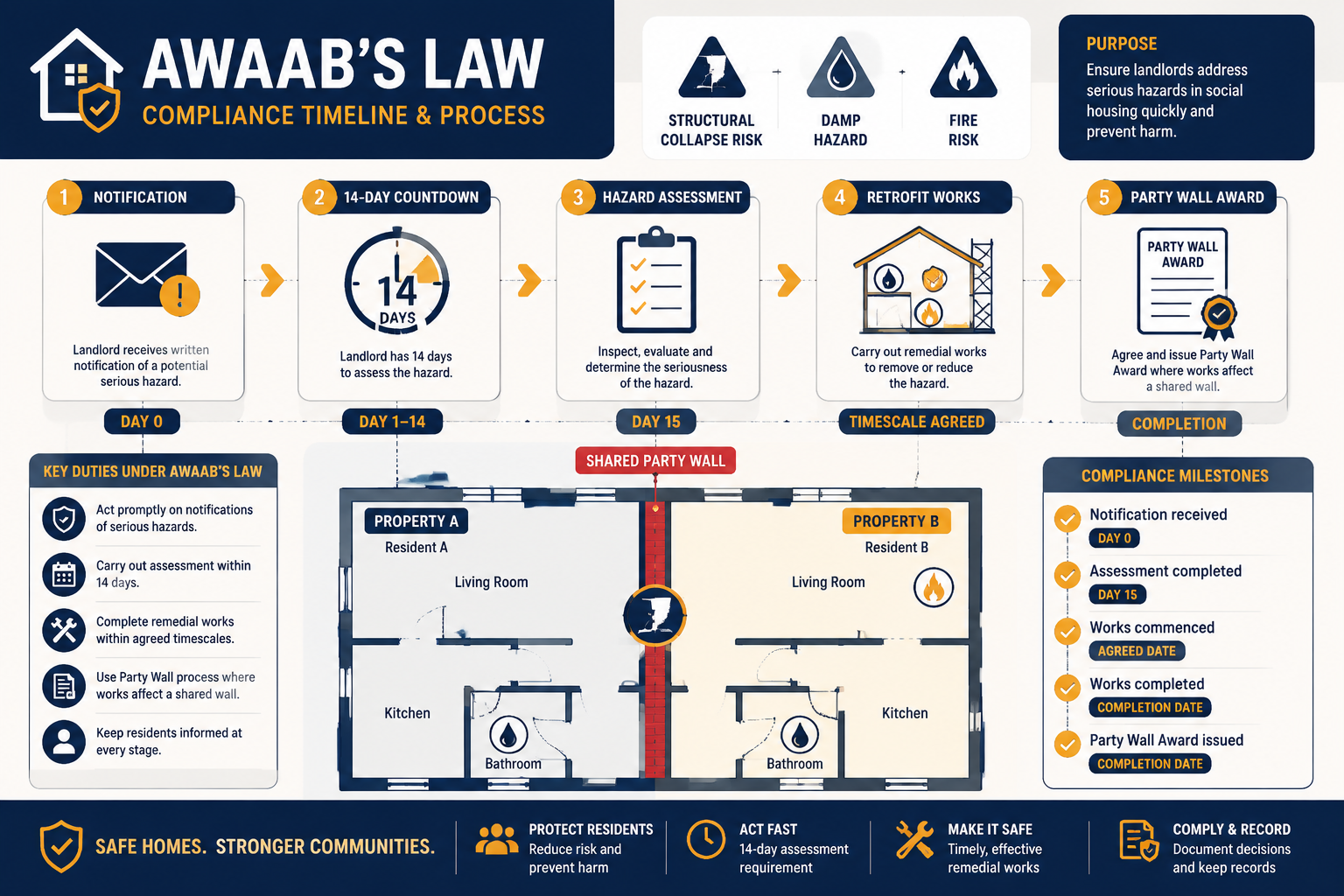
The New Dual-Compliance Framework
RICS guidance in 2026 requires party wall surveyors working on high-risk retrofit projects to operate within a dual-compliance framework that satisfies both the Party Wall etc. Act 1996 and Awaab's Law obligations. This framework has three core pillars:
| Pillar | Party Wall Act Requirement | Awaab's Law Requirement |
|---|---|---|
| Notification | Serve valid party wall notice | Document hazard notification date |
| Assessment | Prepare condition schedule | Classify hazard severity within 14 days |
| Award/Remedy | Issue party wall award | Specify remediation timeline in award |
Structural Hazard Classification Under RICS Protocols
RICS-aligned surveyors in 2026 are adopting a three-tier structural hazard classification system when preparing condition schedules for party wall works:
Tier 1 — Immediate Risk (Red): Active structural movement, imminent collapse potential, visible crack widths exceeding 25mm, or bulging exceeding 50mm. Requires emergency notification and suspension of retrofit works pending structural engineer review.
Tier 2 — Significant Risk (Amber): Cracking patterns consistent with differential settlement, failed wall ties confirmed by borescope, or mortar deterioration affecting more than 30% of a wall face. Retrofit works may proceed with enhanced monitoring conditions written into the party wall award.
Tier 3 — Monitored Risk (Green): Historic cracking, hairline fractures, or minor pointing deterioration. Documented in condition schedule with photographic record and monitoring frequency specified.
For complex structural issues, engaging a structural engineering specialist alongside the party wall surveyor is strongly recommended.
Integrating Hazard Assessments into Party Wall Notices
The party wall notice itself must now signal the structural hazard context. In 2026, best practice requires notices to include:
- A hazard disclosure statement — confirming whether preliminary inspection has identified structural collapse risks
- Reference to Awaab's Law obligations — where the building owner is also a social landlord
- Proposed condition schedule scope — specifying that the schedule will document pre-existing structural conditions to the required depth [1][2]
Adjoining owners who receive a notice have the right to appoint their own surveyor. Understanding when you need a party wall surveyor is essential for both building owners and neighbours before works begin.
Condition Schedule Templates: Protecting Adjoining Owners from Structural Collapse Claims
Why Condition Schedules Are More Critical Than Ever
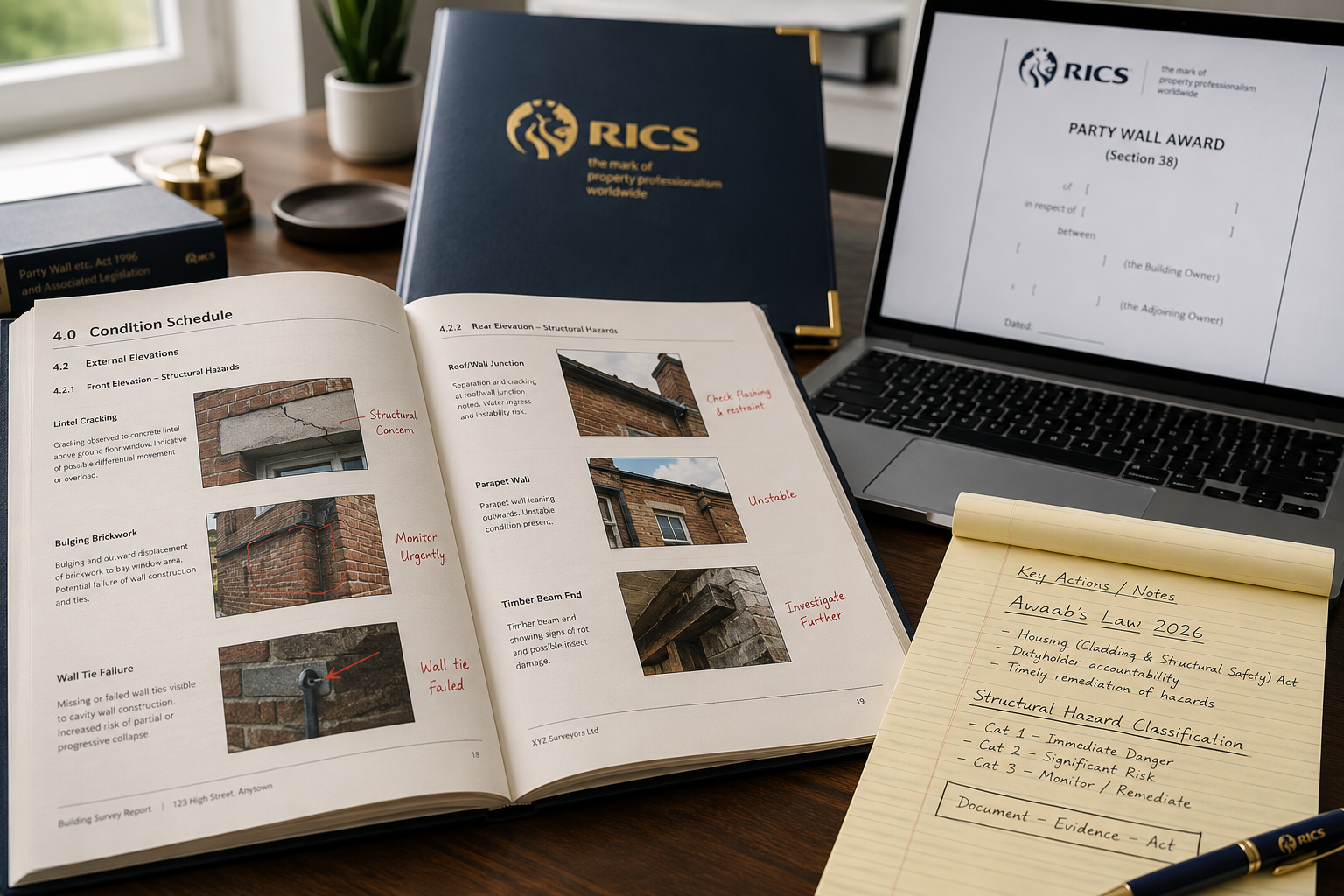
A condition schedule is the photographic and written record of an adjoining owner's property before works commence. In the context of structural collapse hazards, it serves three vital functions:
- ✅ Establishes a baseline — documenting pre-existing cracks, movement, and structural defects
- ✅ Protects the building owner from spurious post-works claims
- ✅ Protects the adjoining owner by creating an evidence trail if new damage occurs
Under 2026 RICS protocols, condition schedules for high-risk structural projects must go significantly further than a standard photographic record.
Recommended Condition Schedule Components for Structural Collapse Hazards
Section A: Property Identification
- Full address, tenure type (social housing / private rented / owner-occupied)
- Confirmation of Awaab's Law applicability
- Date of inspection and surveyor credentials
Section B: Structural Condition Assessment
- Crack mapping to BS 8102 categories (hairline to very severe)
- Wall tie condition (visual inspection + borescope where accessible)
- Lintel condition above openings within 3 metres of party wall
- Foundation type and evidence of differential settlement
- Chimney breast and flue condition where shared
Section C: Hazard Classification
- Tier 1/2/3 classification per RICS 2026 protocol
- Awaab's Law hazard category (if applicable)
- Recommended monitoring frequency
Section D: Photographic Record
- Minimum 20 photographs with GPS-tagged metadata
- Crack width measurements using calibrated crack gauge
- Video walkthrough reference (file stored securely)
Section E: Surveyor's Declaration
- Confirmation of independence
- Professional indemnity insurance details
- RICS membership number
💬 "The condition schedule is not a bureaucratic formality — in 2026, it is the primary legal instrument protecting both parties when structural collapse hazards are present near shared boundaries."
For a comprehensive overview of what a full structural survey covers, the Level 3 Full Building Survey provides the most detailed inspection available for high-risk properties.
Party Wall Awards: Embedding Awaab's Law Compliance Conditions
What Must a 2026 Party Wall Award Include?
When structural collapse hazards are identified, the party wall award — the legally binding document governing how works proceed — must be substantially more detailed than a standard award. RICS protocols for 2026 specify the following mandatory inclusions for high-risk structural projects:
🔹 Structural monitoring schedule — frequency of inspections during works (minimum weekly for Tier 1 hazards)
🔹 Trigger thresholds — defined crack width or movement measurements that automatically pause works
🔹 Awaab's Law compliance clause — where the building owner is a social landlord, the award must reference the 14-day investigation obligation and confirm hazard classification
🔹 Remediation responsibility matrix — clearly allocating responsibility for pre-existing defects versus works-induced damage
🔹 Emergency contact protocol — named structural engineer and out-of-hours contact for immediate risk scenarios
🔹 Post-works inspection requirement — mandatory condition re-survey within 28 days of works completion [1][2]
To understand the full scope and legal weight of a party wall award, the party wall awards service page provides essential context for building owners and adjoining owners alike.
Enforcement and Penalties: The Stakes in 2026
Non-compliance with Awaab's Law carries significant financial penalties. Social landlords who fail to investigate and remediate within the statutory timeframes face:
- Regulatory notices from the Regulator of Social Housing
- Civil claims from tenants for breach of statutory duty
- Reputational damage through the Housing Ombudsman's published determinations [3]
For party wall surveyors, failing to identify and document structural collapse hazards — particularly when those hazards later cause damage to an adjoining property — creates professional negligence exposure. RICS members are expected to exercise reasonable skill and care; in 2026, that standard explicitly includes awareness of Awaab's Law obligations where applicable [4].
Understanding the cost of a party wall surveyor in context is important: the fee for a properly scoped survey and award is negligible compared to the liability exposure of inadequate documentation.
Private Rented Sector: Preparing for the 2026 Extension
What PRS Landlords Must Do Now
The government has signalled that Awaab's Law will extend to the private rented sector during 2026 [2]. This means millions of additional landlords will face the same 14-day investigation and remediation obligations currently binding social housing providers.
For PRS landlords with terraced, semi-detached, or converted properties — where party walls are ubiquitous — the practical implications are significant:
| Action | Timeline | Priority |
|---|---|---|
| Audit existing properties for structural hazards | Immediately | 🔴 High |
| Establish tenant notification logging system | Q1 2026 | 🔴 High |
| Appoint RICS-accredited party wall surveyor for retrofit works | Before works commence | 🔴 High |
| Review condition schedules for all shared-wall properties | Q2 2026 | 🟡 Medium |
| Train property managers on 14-day response protocol | Q2 2026 | 🟡 Medium |
The Retrofit Trigger Point
The most common scenario in which PRS landlords will encounter the intersection of party wall law and Awaab's Law is during mandatory EPC upgrade works. Installing external wall insulation on a terrace, upgrading windows, or adding mechanical ventilation to address damp — all of these works can disturb party walls and simultaneously engage Awaab's Law obligations if structural hazards are present or created [1][2].
Landlords planning retrofit works should read the party wall agreement essentials before instructing contractors, and should ensure their surveyor is briefed on the full scope of Awaab's Law requirements.
It is also worth understanding common misconceptions about party wall agreements — particularly the mistaken belief that verbal agreements with neighbours are sufficient when structural collapse hazards are involved.
Practical Checklist: Party Wall Surveys for Structural Collapse Hazards in 2026
Use this checklist to ensure full compliance before, during, and after retrofit works affecting shared boundaries:
✅ Pre-Works Phase
- Serve valid party wall notice with hazard disclosure statement
- Appoint RICS-accredited surveyor with structural hazard experience
- Commission condition schedule to 2026 RICS protocol standard
- Classify structural hazards using Tier 1/2/3 system
- Confirm Awaab's Law applicability and document notification date
- Obtain party wall award with all mandatory 2026 inclusions
✅ During Works Phase
- Implement monitoring schedule per award conditions
- Record any trigger threshold breaches immediately
- Maintain daily site diary with photographic log
- Conduct weekly structural inspections for Tier 1/2 hazards
✅ Post-Works Phase
- Commission post-works condition re-survey within 28 days
- Compare pre- and post-works condition schedules
- Issue formal completion notice to adjoining owner
- Retain all documentation for minimum 12 years (limitation period)
Conclusion: Acting Now Protects Everyone
The integration of Awaab's Law obligations into party wall survey practice is not optional — it is the new professional standard for 2026. Party Wall Surveys for Structural Collapse Hazards: 2026 RICS Protocols Under Awaab's Law Retrofit Mandates demands a fundamentally upgraded approach: richer condition schedules, more detailed party wall awards, and proactive hazard classification built into every notice served on a high-risk property.
Actionable Next Steps
-
Surveyors: Update your condition schedule templates to include the five-section structural hazard framework outlined above. Brief your PI insurer on your Awaab's Law compliance approach.
-
Social housing landlords: Audit your retrofit pipeline immediately. Every project touching a party wall needs a surveyor briefed on dual-compliance obligations.
-
Private rented sector landlords: Do not wait for the formal PRS extension. Establish your hazard notification logging system and identify RICS-accredited surveyors in your area now.
-
Adjoining owners: If your neighbour serves a party wall notice for retrofit works, exercise your right to appoint a surveyor — particularly if the property has visible structural defects.
-
All parties: Retain all documentation. In structural collapse scenarios, the condition schedule and party wall award are your primary legal protection.
The cost of getting this right is modest. The cost of getting it wrong — in enforcement penalties, civil claims, and potential harm to residents — is not. [3][4]
References
[1] Party Wall Surveys For Heat Pump And Solar Retrofit Projects Navigating 2026 Net Zero Mandates On Shared Boundaries – nottinghillsurveyors.com
[2] Party Wall Surveys For Excess Cold And Fire Hazard Retrofits Awaabs Law 2026 Extensions And Compliance Protocols – nottinghillsurveyors.com
[3] Awaabs Law Technical Compliance Hvac Ventilation – arm-environments.com
[4] Awaabs Law – rics.org