

A single discrepancy of just 5% in measured floor area can shift a commercial property valuation by tens of thousands of pounds — and with the RICS Property Measurement 2nd Edition now officially archived, that risk is no longer theoretical. The Revised RICS Property Measurement Guidance: Impacts on Building Surveys and Valuations in Q2 2026 marks a pivotal moment for chartered surveyors, property owners, and lenders alike. Understanding what has changed, what compliance now demands, and where the accuracy risks lie is no longer optional — it is a professional obligation.
Key Takeaways 📌
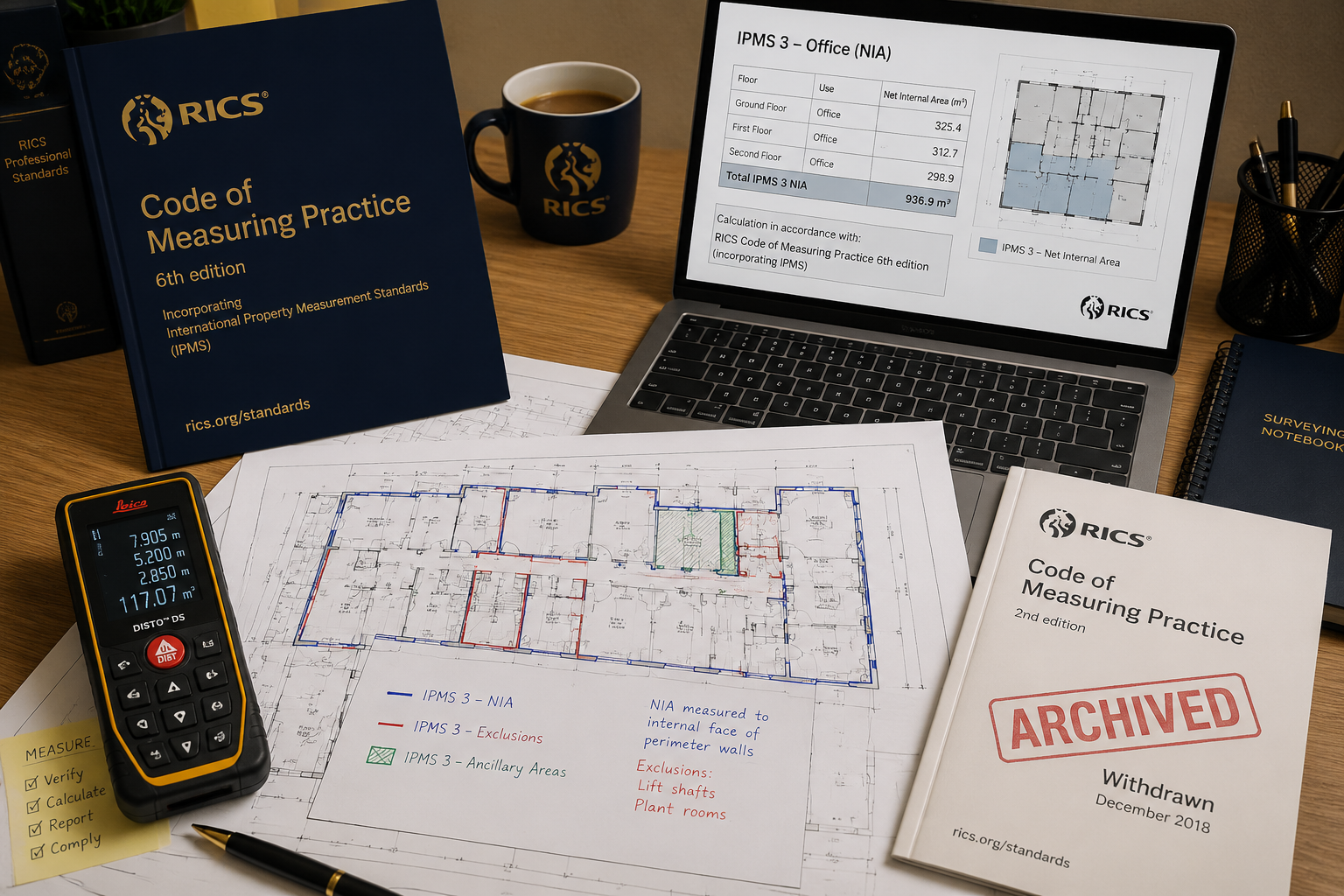
- The RICS Property Measurement 2nd Edition has been officially archived and must only be used as a historical reference — not for live instructions.
- Surveyors must now use either the Code of Measuring Practice (6th edition) or IPMS: All Buildings standards during the current transition period.
- A 7th edition of the Code of Measuring Practice is expected later in 2026, following a Q2 2026 consultation.
- The basis of measurement must be formally documented in all reports — a mandatory transparency requirement.
- Alongside measurement changes, RICS released an updated Home Survey Standard (2nd edition) in April 2026, strengthening quality expectations across all survey types.
What the Revised RICS Property Measurement Guidance Means for Q2 2026
The Withdrawal of the 2nd Edition: A Hard Stop
The RICS Property Measurement 2nd Edition has been officially archived [3]. This is not a soft deprecation or a phased wind-down. RICS members and regulated firms are now directed away from this standard entirely, with the document retained only as a historical reference point.
For practitioners who built workflows around the 2nd edition — particularly those handling residential valuations, lease negotiations, or planning applications — this represents a genuine operational disruption. The familiar definitions, measurement conventions, and reporting structures from that edition no longer carry regulatory weight.
💬 "The basis of measurement used must be formally documented by all RICS members and regulated firms." — RICS Code of Measuring Practice [1]
This documentation requirement is significant. It means that every survey report, valuation instruction, and floor area schedule must now explicitly state which standard was applied. Vague references to "RICS standards" are no longer sufficient.
The Two Permitted Standards in Q2 2026
During the current transition period — while the 7th edition of the Code of Measuring Practice is being finalised — RICS members must use one of two approved bases [1]:
| Standard | Status in Q2 2026 | Best Suited For |
|---|---|---|
| Code of Measuring Practice (6th edition) | Active & permitted | UK domestic and commercial measurement |
| IPMS: All Buildings | Active & permitted | International and cross-border instructions |
| RICS Property Measurement 2nd Edition | ⚠️ Archived — historical reference only | Not for live use |
The International Property Measurement Standards (IPMS): All Buildings framework represents RICS' long-term direction of travel. First gaining global traction after the Code of Measuring Practice achieved worldwide effectiveness in May 2015 [1], IPMS was designed to harmonise measurement definitions across jurisdictions — a priority as cross-border investment and international valuation instructions have grown.
For most UK-based practitioners handling domestic instructions, the 6th edition of the Code of Measuring Practice remains the practical default. However, the Q2 2026 consultation on the forthcoming 7th edition signals that this too will evolve [1].
The 7th Edition Consultation: What to Expect
The Q2 2026 consultation on the 7th edition of the Code of Measuring Practice is a structured review process. While the full content of the 7th edition has not yet been published, the direction of the consultation reflects RICS' broader consolidation goal: aligning the Code of Measuring Practice more closely with IPMS: All Buildings to reduce dual-standard complexity [1][3].
Practitioners should monitor RICS communications closely and consider submitting consultation responses, particularly where specific property types or market sectors may be affected by proposed definitional changes.
Accuracy Risks to Floor Areas in Valuations and Building Condition Reports
Why Measurement Standard Mismatches Are Dangerous
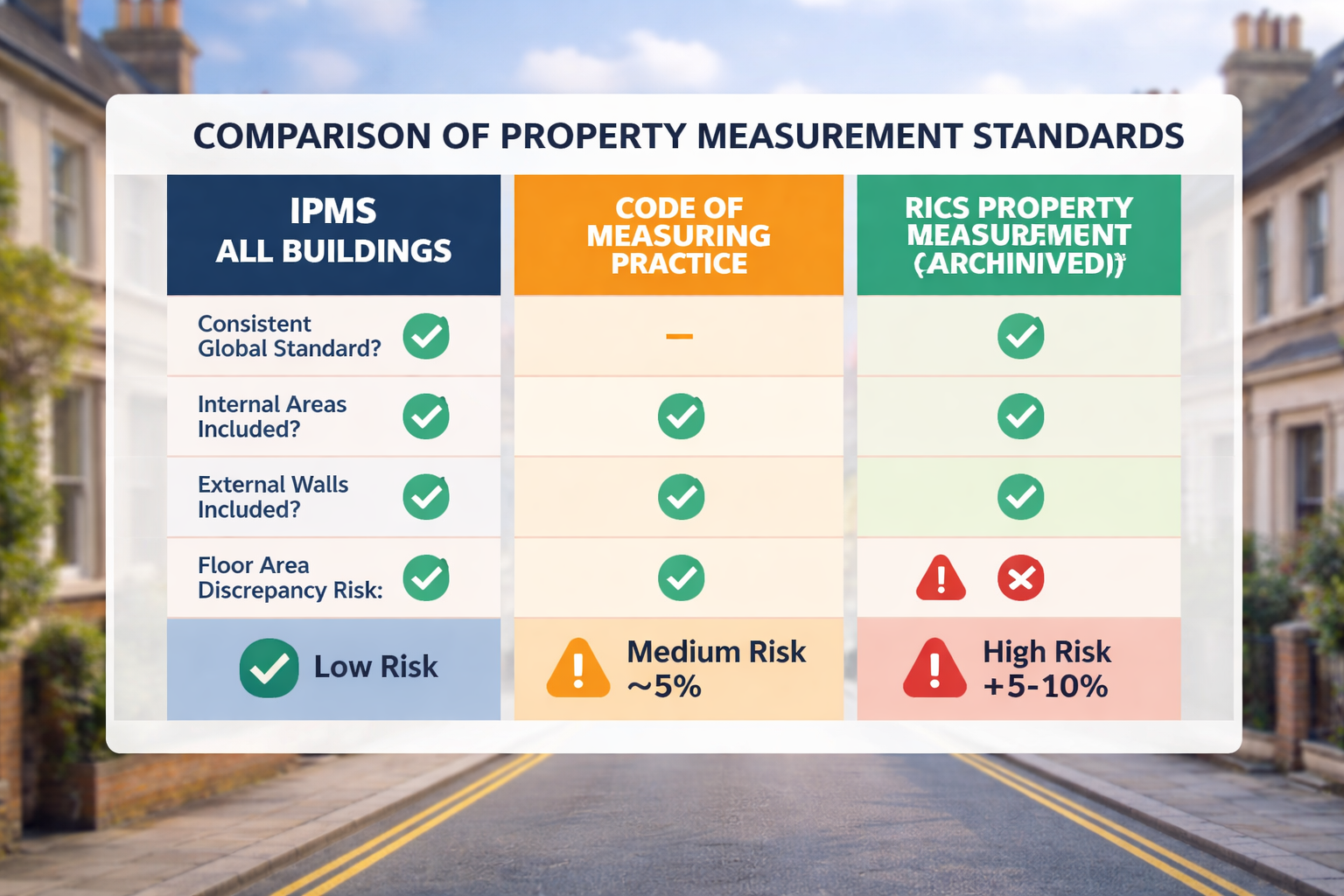
The core risk introduced by the 2nd Edition withdrawal is measurement inconsistency. When different standards are applied to the same property at different points in time — or by different practitioners — the resulting floor area figures can diverge meaningfully.
Consider a typical scenario:
- A commercial property was measured under the RICS Property Measurement 2nd Edition in 2022.
- A new valuation instruction arrives in Q2 2026.
- The valuer applies IPMS: All Buildings, which uses different component definitions for areas such as balconies, voids, and service risers.
- The resulting floor area is 4–7% smaller — and the valuation shifts accordingly.
This is not a hypothetical edge case. Measurement standard transitions have historically produced exactly these kinds of discrepancies, particularly in mixed-use buildings, older commercial stock, and properties with complex internal configurations. Understanding what a measured building survey involves is the first step to appreciating how these definitional differences translate into real-world floor area variances.
High-Risk Property Types 🏗️
Certain property categories carry elevated accuracy risk during this transition:
- Victorian and Edwardian residential properties — irregular layouts, bay windows, and sloped ceilings create definitional ambiguity between standards.
- Mixed-use commercial buildings — retail, office, and residential components may be measured differently under IPMS component classifications.
- Converted properties — loft conversions, basement extensions, and outbuildings where habitable area definitions vary significantly.
- Leasehold flats — where Net Internal Area (NIA) definitions affect service charge apportionment and lease renewal negotiations.
For properties undergoing budgeting for repairs and restoration, an inaccurate floor area figure can also distort cost-per-square-metre repair estimates, leading to under-budgeting on significant works.
Impact on Specific Valuation Types
The measurement standard applied has direct downstream effects on several valuation categories:
📊 Capital Gains Valuations
For capital gains tax purposes, the floor area of a property at the point of disposal or acquisition affects comparative analysis. A shift in measured area between historical records and a current valuation can complicate HMRC submissions and trigger queries.
🏢 Insurance Reinstatement Cost Valuations
Insurance reinstatement cost valuations depend heavily on accurate gross external area (GEA) figures. If the measurement basis changes between policy renewals, the rebuild cost estimate may be materially incorrect — leaving property owners either over-insured or, more dangerously, under-insured.
💰 Independent Property Valuations
For buyers and sellers seeking an independent property valuation, the measurement standard underpinning the comparable evidence used by the valuer matters. If market comparables were measured under the archived 2nd edition and the subject property is measured under IPMS, like-for-like comparison becomes problematic.
The Documentation Requirement as a Risk Mitigation Tool
The mandatory documentation of measurement basis [1] is not merely an administrative burden — it is a professional liability safeguard. By explicitly stating the standard applied, surveyors create a clear audit trail that:
- Allows future practitioners to identify and reconcile any measurement basis changes.
- Demonstrates compliance with RICS regulatory requirements.
- Protects against negligence claims arising from undisclosed measurement methodology.
Every report produced under the revised RICS property measurement guidance should include a clear statement such as: "Floor areas have been measured in accordance with the RICS Code of Measuring Practice, 6th Edition" or the equivalent IPMS declaration.
Transition Checklists and Practical Guidance for Chartered Surveyors

Transition Compliance Checklist ✅
The following checklist is designed for chartered surveyors and regulated firms navigating the revised measurement landscape in Q2 2026:
Immediate Actions (Complete Now)
- Remove RICS Property Measurement 2nd Edition from active workflow templates and report libraries.
- Confirm which standard (6th edition Code of Measuring Practice or IPMS: All Buildings) applies to each active instruction.
- Update report templates to include mandatory measurement basis declaration.
- Brief all fee earners and support staff on the archived status of the 2nd edition.
Ongoing Compliance
- Apply the correct standard consistently across all instructions of the same type.
- Document any client instructions that specify a particular measurement basis (e.g., for lease renewal purposes).
- Flag any historical measurements on file that used the 2nd edition, noting the potential for future discrepancy.
- Monitor RICS communications for 7th edition consultation outcomes and implementation dates.
Quality Assurance
- Implement a peer review step for floor area schedules on high-value or complex instructions.
- Cross-reference IPMS component classifications when measuring mixed-use or converted properties.
- Retain digital copies of current standards — RICS members can contact knowledge@rics.org for access to reference materials [3].
Case Study: Office-to-Residential Conversion 🏢➡️🏠
Scenario: A chartered surveyor is instructed to carry out a Level 3 building survey and valuation on a former office building recently converted to residential flats in South London.
The challenge: The original office measurement schedule, prepared in 2021, used the RICS Property Measurement 2nd Edition and recorded a Gross Internal Area (GIA) of 850 sq m. The surveyor now needs to produce a current floor area schedule under the Code of Measuring Practice (6th edition) for valuation purposes.
The risk: Differences in how the 6th edition treats internal voids, stairwells, and communal areas compared to the 2nd edition mean the new GIA figure comes in at 812 sq m — a 4.5% reduction.
The outcome: The valuation is adjusted accordingly. The surveyor's report clearly documents the measurement basis change and flags the discrepancy for the client's attention. No liability arises because the documentation trail is complete and transparent.
This scenario illustrates why understanding what questions to ask during a building survey — including questions about measurement methodology — is essential for property buyers and owners, not just surveyors.
The Broader 2026 Standards Modernisation Context
The measurement guidance revision does not exist in isolation. April 2026 also saw RICS release an updated Home Survey Standard (2nd edition), incorporating practitioner feedback, consumer insight data, and responses to technological changes affecting the profession [4]. This update strengthens quality expectations across all survey levels and introduces enhanced requirements for home inspection reporting.
Concurrently, RICS launched a consultation on the draft 8th edition of Party Wall Legislation and Procedure [4], signalling a comprehensive modernisation effort across multiple practice areas. For chartered surveyors, 2026 represents one of the most significant periods of standards evolution in recent memory.
Understanding which building survey level is appropriate for a given property is now more important than ever, as the quality standards underpinning each level have been formally strengthened [5]. Similarly, practitioners should be aware of areas requiring further investigation that may emerge when measurement discrepancies are identified during a survey.
What Property Owners and Buyers Should Know
The revised measurement guidance is not only a matter for surveyors. Property owners, buyers, and investors should be aware of the following practical implications:
- Ask your surveyor which measurement standard has been applied — this is now a mandatory disclosure, and any reluctance to answer clearly is a red flag.
- Review historical floor area schedules with caution, particularly if they were produced before 2026. A remeasurement under current standards may be warranted for high-value transactions.
- For leasehold properties, confirm that service charge apportionment calculations reflect the current measurement basis, especially if the lease was drawn up using 2nd edition figures.
- Insurance policies should be reviewed to ensure reinstatement cost estimates are based on current measurement standards — not archived ones.
Conclusion: Actionable Next Steps for Surveyors and Property Stakeholders
The Revised RICS Property Measurement Guidance: Impacts on Building Surveys and Valuations in Q2 2026 demands a clear, structured response from every practitioner and property stakeholder. The archiving of the 2nd edition is not a bureaucratic footnote — it is a compliance threshold with real consequences for accuracy, liability, and professional standing.
For chartered surveyors and regulated firms, the priority actions are:
- Audit your current template library and remove all references to the archived 2nd edition immediately.
- Choose and apply consistently either the Code of Measuring Practice (6th edition) or IPMS: All Buildings for all live instructions.
- Document the measurement basis explicitly in every report — this is mandatory, not discretionary.
- Engage with the Q2 2026 consultation on the 7th edition to stay ahead of the next transition.
- Brief clients proactively on measurement basis changes that may affect floor area figures and downstream valuations.
For property owners, buyers, and investors:
- Request written confirmation of the measurement standard applied in any survey or valuation report.
- Commission a remeasurement for high-value assets where historical records used the archived 2nd edition.
- Review insurance and lease documents to identify any floor area figures that may need updating.
The 2026 measurement guidance revision is ultimately an opportunity — to improve accuracy, strengthen professional accountability, and build greater trust between surveyors and the clients they serve. Those who treat it as such will be better positioned for the 7th edition transition when it arrives later this year.
References
[1] Code Of Measuring Practice – https://www.rics.org/profession-standards/rics-standards-and-guidance/sector-standards/real-estate-standards/code-of-measuring-practice
[2] Measurement – https://www.isurv.com/downloads/1168/measurement
[3] Rics Property Measurement 2nd Edition – https://www.rics.org/profession-standards/rics-standards-and-guidance/sector-standards/real-estate-standards/rics-property-measurement-2nd-edition
[4] Home Survey Standard 2nd Edition April 2026 Update – https://www.rics.org/news-insights/home-survey-standard-2nd-edition-april-2026-update
[5] Building Survey Quality Standards 2026 Navigating Rics Updates And Enhanced Home Inspection Requirements – https://nottinghillsurveyors.com/blog/building-survey-quality-standards-2026-navigating-rics-updates-and-enhanced-home-inspection-requirements