

Contractors and consultants who believed their liability for historical defects had quietly expired are now discovering otherwise. Under the Building Safety Act 2022 (BSA), claims for defective residential construction can now reach back as far as 1992 — a seismic shift that fundamentally rewrites the risk landscape for everyone involved in the built environment. For professionals navigating party wall disputes and litigation support in 2026, understanding Building Safety Act 2022 Limitation Periods: Party Wall and Expert Witness Strategies for Extended Liability in 2026 is no longer optional — it is a core professional competency.
Key Takeaways 📌
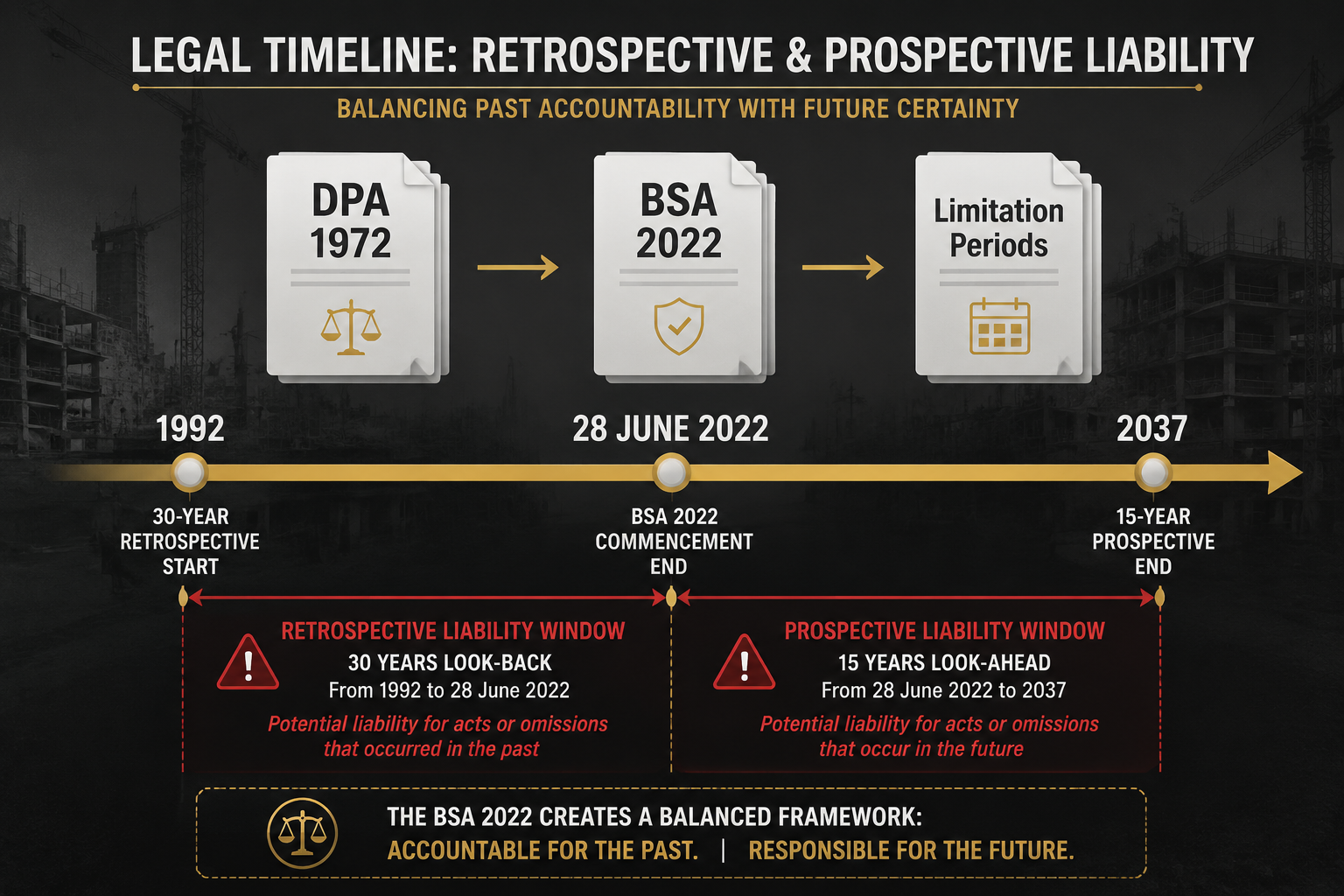
- The BSA 2022 extended retrospective limitation periods to 30 years for pre-June 2022 claims under the Defective Premises Act 1972, and 15 years for post-June 2022 claims [1][4]
- Contractual limitation clauses no longer protect contractors and consultants from BSA-related claims [1]
- The defendant pool has widened significantly — developers can now pursue consultants directly for defective works [1]
- Party wall surveyors play a critical documentation role in managing historical defect exposure
- Expert witnesses must align their reports with BSA-era evidentiary standards to withstand extended litigation timelines
Understanding the New Limitation Period Framework
The 30-Year Retrospective Window
Before the BSA, the standard limitation period under the Defective Premises Act 1972 (DPA) was six years from the date a dwelling was completed. The BSA demolished that boundary.
For causes of action that accrued before 28 June 2022, claimants now have 30 years from the date the right of action accrued to bring a claim under Section 1 of the DPA [4]. In practical terms, this means defects arising from construction work completed as far back as 1992 are now potentially actionable [2].
💬 "The retrospective extension is not a technicality — it is a liability resurrection for thousands of construction professionals who believed their exposure had long since expired."
The 15-Year Prospective Window
For claims accruing after 28 June 2022, the limitation period is now 15 years — more than double the previous six-year standard [2]. This applies to all qualifying residential buildings going forward and represents a permanent recalibration of how long liability attaches to construction professionals.
| Claim Type | Previous Period | New Period Under BSA 2022 |
|---|---|---|
| Pre-28 June 2022 (retrospective) | 6 years | 30 years |
| Post-28 June 2022 (prospective) | 6 years | 15 years |
| Higher-risk buildings (18m+/7 storeys+) | 6 years | 30 years (retrospective) |
What Counts as a "Relevant Defect"?
A Relevant Defect under the BSA is defined as any defect creating a building safety risk arising from an act, omission, or thing used (or not used) in connection with Relevant Works conducted in the 30 years prior to the BSA's enactment [1]. This broad definition captures:
- Structural inadequacies in party walls
- Fire safety failings in shared elements
- Waterproofing failures in basement conversions
- Non-compliant cladding or insulation systems
Contractual Protections No Longer Apply
One of the most disruptive provisions is the nullification of contractual limitation clauses. Contractors, consultants, and developers can no longer rely on bespoke contractual periods to shield themselves from BSA-related claims [1]. This strips away a key risk management tool that professionals have relied upon for decades.
Party Wall Surveys as a Risk Management Tool Under Extended Liability
Why Party Wall Documentation Matters More Than Ever
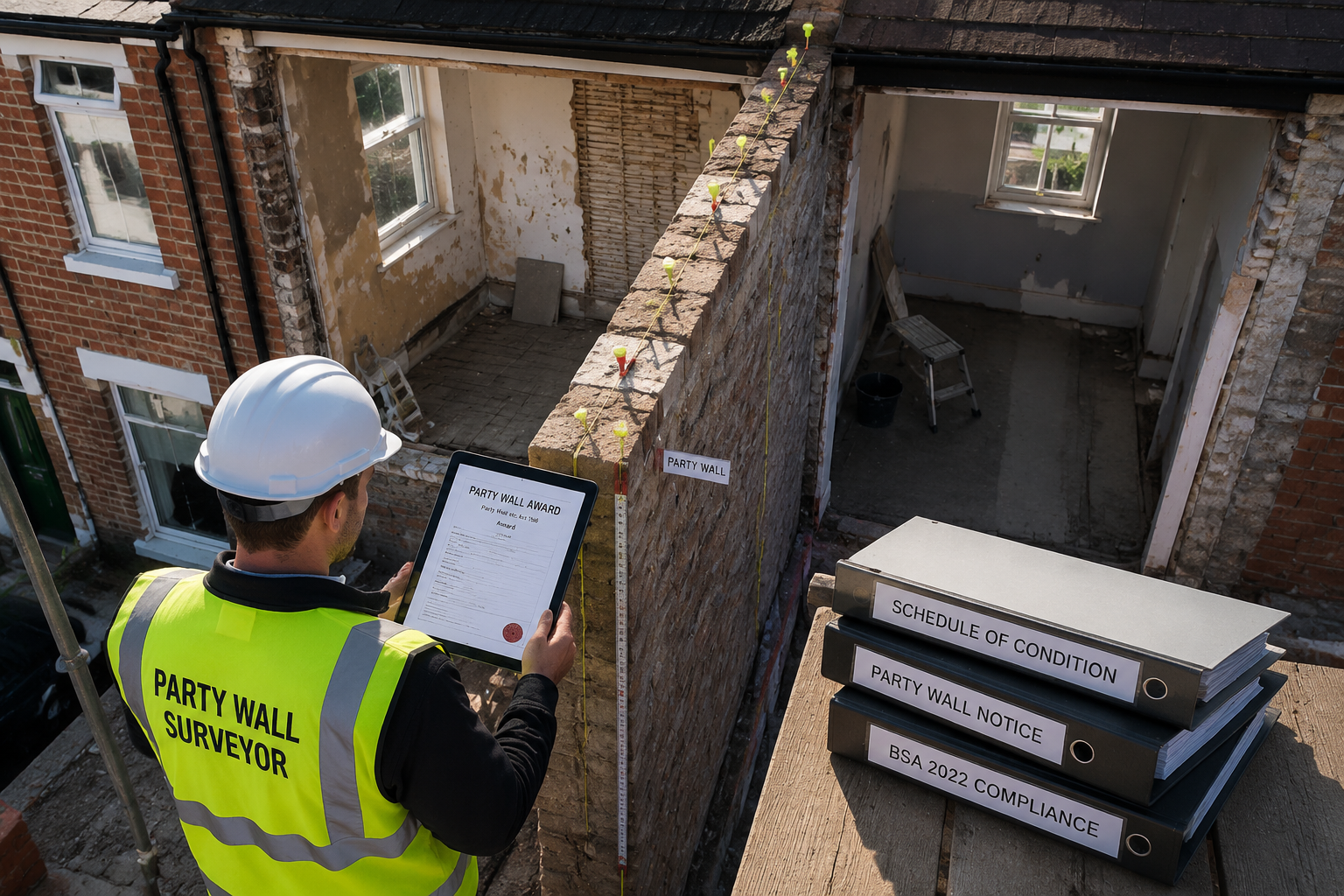
The extended limitation windows created by Building Safety Act 2022 Limitation Periods: Party Wall and Expert Witness Strategies for Extended Liability in 2026 have a direct and urgent implication for party wall practice. A Schedule of Condition prepared before notifiable works begin is no longer just good practice — it is a potential legal lifeline decades into the future.
If a claimant brings a retrospective defect claim in 2026 for works completed in 2005, the quality of the original party wall documentation will determine whether liability can be attributed, defended, or shared. Poor records create ambiguity; ambiguity creates liability.
Understanding your party wall rights is the essential first step before any notifiable works begin. Equally important is avoiding the common misconceptions about party wall agreements that can leave building owners exposed.
Key Documentation Protocols for 2026 🗂️
Surveyors and building owners undertaking notifiable works should ensure the following are in place:
- Photographic Schedule of Condition — timestamped, geo-tagged, and stored in a retrievable format
- Party Wall Award — clearly defining the scope of permitted works and responsibility for any damage
- Pre- and post-works inspections — with independent sign-off where possible
- Digital archiving — stored for a minimum of 15–30 years in line with the new limitation windows
For basement excavations and underpinning — works that carry significant party wall risk — specialist guidance is essential. Projects involving basements and party wall considerations in Surrey illustrate the complexity that arises when structural works affect shared boundaries.
When a Neighbour Refuses to Engage
The BSA's extended liability windows add urgency to situations where a neighbour refuses to respond to a party wall notice. Delays in formalising a Party Wall Award leave both parties exposed to undocumented defect risk. Knowing what to do when a neighbour refuses party wall works is now a critical piece of knowledge for any building owner or surveyor.
Higher-Risk Buildings: Elevated Obligations 🏢
Buildings that are at least 18 metres high or have 7 or more storeys and contain at least two residential units are classified as higher-risk buildings under the BSA [2]. These structures must produce and maintain safety case reports — a requirement that intersects directly with party wall obligations in multi-occupancy residential blocks.
For those managing blocks or residential developments, health and safety inspections form a core part of ongoing BSA compliance.
Expert Witness Strategies for Extended Liability Litigation in 2026
The Expanding Role of the Expert Witness
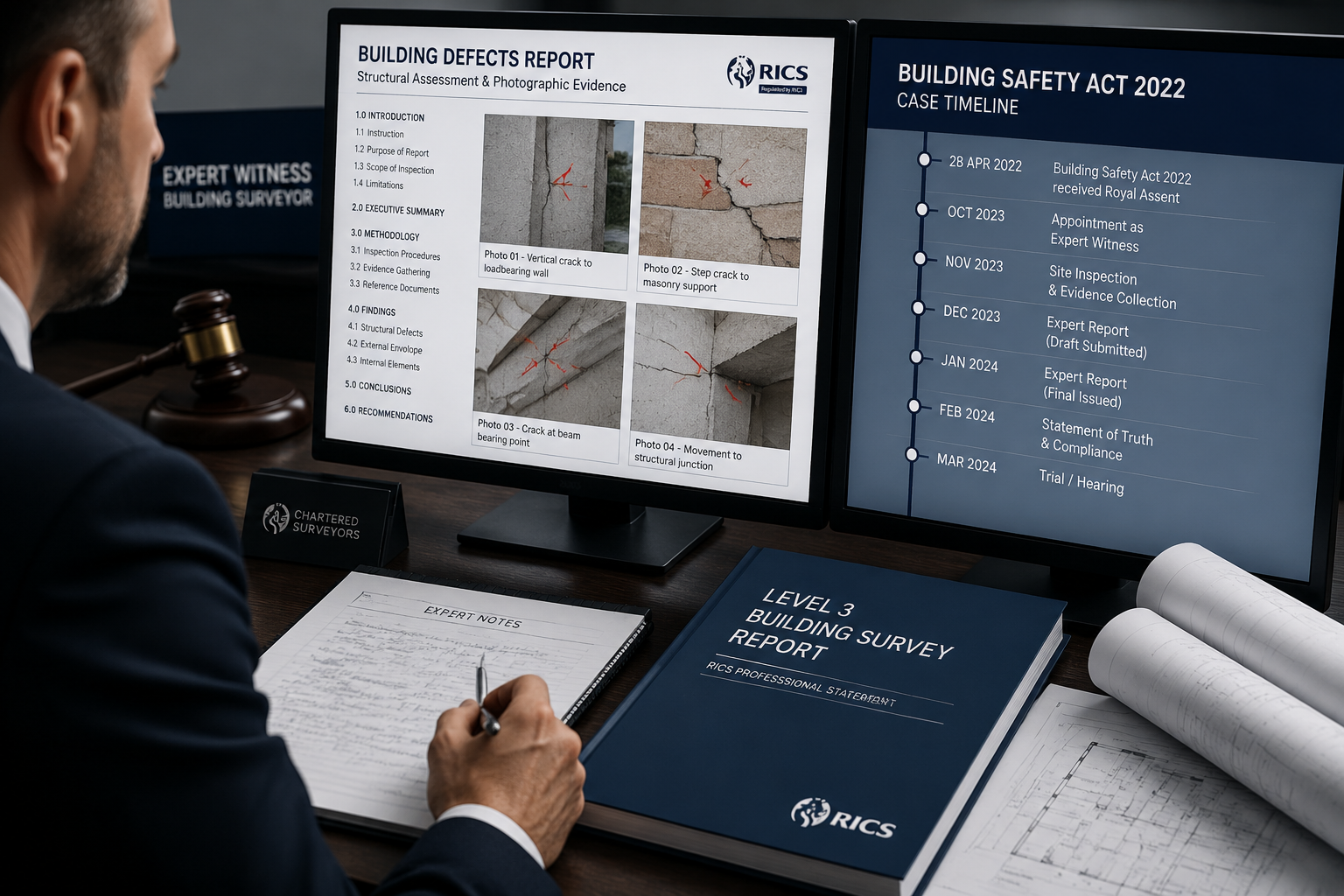
As Building Safety Act 2022 Limitation Periods: Party Wall and Expert Witness Strategies for Extended Liability in 2026 reshape the litigation landscape, the expert witness surveyor has become a central figure in construction disputes. Courts are increasingly relying on independent technical experts to:
- Establish the nature and timing of a defect
- Attribute causation across multiple parties and contractors
- Assess whether remedial works were necessary and proportionate
- Quantify the cost of remediation in line with current standards
The Supreme Court's decision in URS Corporation Ltd v BDW Trading Ltd confirmed that parties can seek contribution claims under the DPA even if no current or previous third-party claims exist — the sole requirement being that the claimant has paid compensation or carried out remedial works [1]. This ruling dramatically increases the number of scenarios in which expert evidence will be required.
What Makes a BSA-Compliant Expert Witness Report? ✅
An expert witness report prepared for BSA-related litigation must go beyond standard defect identification. In 2026, courts expect:
- Clear temporal analysis — establishing when the defect arose relative to the BSA commencement date
- Causation mapping — identifying which party's act or omission created the Relevant Defect
- Remediation cost evidence — supported by current market rates and contractor quotes
- Compliance assessment — measuring the original works against the building regulations in force at the time
- Independence declaration — meeting the requirements of CPR Part 35
A professional expert witness report prepared by a chartered surveyor with construction law awareness is the gold standard for this type of instruction.
Broadened Defendant Pool: Who Can Be Sued? ⚖️
The BSA expanded Section 1 of the DPA to include developers and consultants as potential defendants — not just contractors [1]. This means:
- Architects can be pursued for design defects
- Structural engineers face claims for specification failures
- Project managers may be liable for supervision shortcomings
- Developers can lodge claims against consultants for defective works
For expert witnesses, this broadened pool means reports must be drafted with careful attention to multi-party attribution. A defect may have multiple contributing causes, and the expert must be prepared to apportion responsibility across several defendants.
Retrospective Claims: Practical Challenges for Experts 🔍
When investigating defects in buildings constructed in the 1990s or early 2000s, expert witnesses face unique evidentiary challenges:
- Original drawings and specifications may be incomplete or lost
- Building control records may be archived or destroyed
- Material standards have changed significantly since original construction
- Witness recollection is unreliable over 20+ year periods
This is where a thorough Level 3 Building Survey becomes invaluable — providing a current-state assessment that can be compared against historical records to establish the trajectory of a defect.
Additionally, building pathology expertise is essential when diagnosing the root causes of long-standing defects in party wall structures, foundations, and shared building elements.
Contribution Claims: A New Litigation Pathway
Following URS v BDW, developers who have already spent money on remediation works — such as cladding replacement or structural repairs — can now pursue contribution claims against consultants and contractors without needing an active third-party claim [1]. Expert witnesses supporting these claims must be able to:
- Confirm that the remedial works were necessary and appropriate
- Evidence that the costs incurred were reasonable
- Demonstrate the causal link between the original defect and the remediation required
This creates a new category of expert instruction that is distinct from traditional defect litigation and requires a specific skill set combining technical surveying knowledge with cost analysis.
Practical Compliance Steps for 2026 and Beyond
For Building Owners and Developers 🏗️
- Audit historical projects completed between 1992 and 2022 for potential Relevant Defects
- Review consultant appointments — contractual limitation clauses no longer provide protection [1]
- Ensure all party wall notices and awards are digitally archived for the full limitation period
- Commission a building defects survey for older residential assets before claims arise
For Surveyors and Consultants 🔧
- Update professional indemnity insurance to reflect the extended 15–30 year liability windows
- Implement enhanced record-keeping protocols for all party wall instructions
- Develop familiarity with the BSA's definition of Relevant Defects and higher-risk buildings [2]
- Consider specialist training in expert witness instruction under CPR Part 35
For Lenders and Investors 💼
- Factor BSA limitation exposure into due diligence on residential acquisitions
- Request evidence of party wall awards and schedules of condition for properties built post-1992
- Understand that Remediation Contribution Orders (RCOs) can apply retrospectively to costs incurred before the BSA's enactment [1]
Conclusion: Acting Now to Manage Tomorrow's Liability
The Building Safety Act 2022 has fundamentally altered the risk calculus for everyone involved in residential construction. The extended limitation periods — 30 years retrospectively and 15 years prospectively — combined with the nullification of contractual protections and a broadened defendant pool, mean that historical defects are very much a live concern in 2026 [1][2][4].
Party wall surveyors are on the front line of this shift. Robust documentation, properly executed Party Wall Awards, and comprehensive schedules of condition are no longer administrative formalities — they are critical evidence in a litigation landscape that now spans decades.
Expert witnesses must evolve their practice to meet the demands of BSA-era disputes: multi-party attribution, temporal defect analysis, and remediation cost evidence are the new benchmarks.
Actionable Next Steps ✅
- Review all live and historical projects for potential BSA exposure — particularly those completed between 1992 and 2022
- Commission a professional party wall survey before any notifiable works begin
- Engage a chartered surveyor with expert witness experience for any emerging defect disputes
- Update record-keeping and archiving systems to retain documentation for the full limitation period
- Seek specialist legal advice if you believe a historical defect may now fall within the extended BSA limitation window
The window for proactive risk management is open — but it will not remain so indefinitely.
References
[1] The Building Safety Act 2022 Increased Liability For Stakeholders – broadfield-law.com
[2] Building Safety Act 2022 What Lenders 7785422 – jdsupra.com
[3] BROC BSA Review 2026 – cms.law
[4] Building Safety Act 2022 Section 135 – legislation.gov.uk
[5] Building Safety Act 2022 Changes To The Defective Premises Act 1972 – clarionsolicitors.com