

Geopolitical turbulence, rising interest rates, and shifting market fundamentals have made one thing brutally clear: an inaccurate property valuation in 2026 is not just a professional embarrassment — it can cost clients millions. Against this backdrop, AI and Technology Transforming Property Valuations: RICS-Compliant Tools for Chartered Surveyors in 2026 has moved from industry buzzword to operational reality. Researchers at The University of Manchester have reported AI valuation system accuracy exceeding 96%, compared to 70–85% for traditional approaches [3]. For chartered surveyors operating under RICS standards, understanding how to harness these tools — without sacrificing professional judgment or ethical accountability — is now a core competency.
Key Takeaways 📌
- AI-driven Automated Valuation Models (AVMs) now achieve accuracy rates above 94–96%, with error margins below 3% in established markets [1][2]
- Speed has transformed: AI delivers valuations in under 60 seconds vs. 3–5 days for traditional manual appraisals [1]
- RICS has published formal guidance on responsible AI use in real estate valuation, emphasising professional judgment, transparency, and accountability [4]
- The hybrid model — combining algorithmic speed with chartered surveyor expertise — is emerging as industry best practice [5]
- Digital twins and AVMs are the two most impactful technologies reshaping how property assets are assessed in 2026 [2]
The Accuracy Revolution: What AI Is Actually Achieving
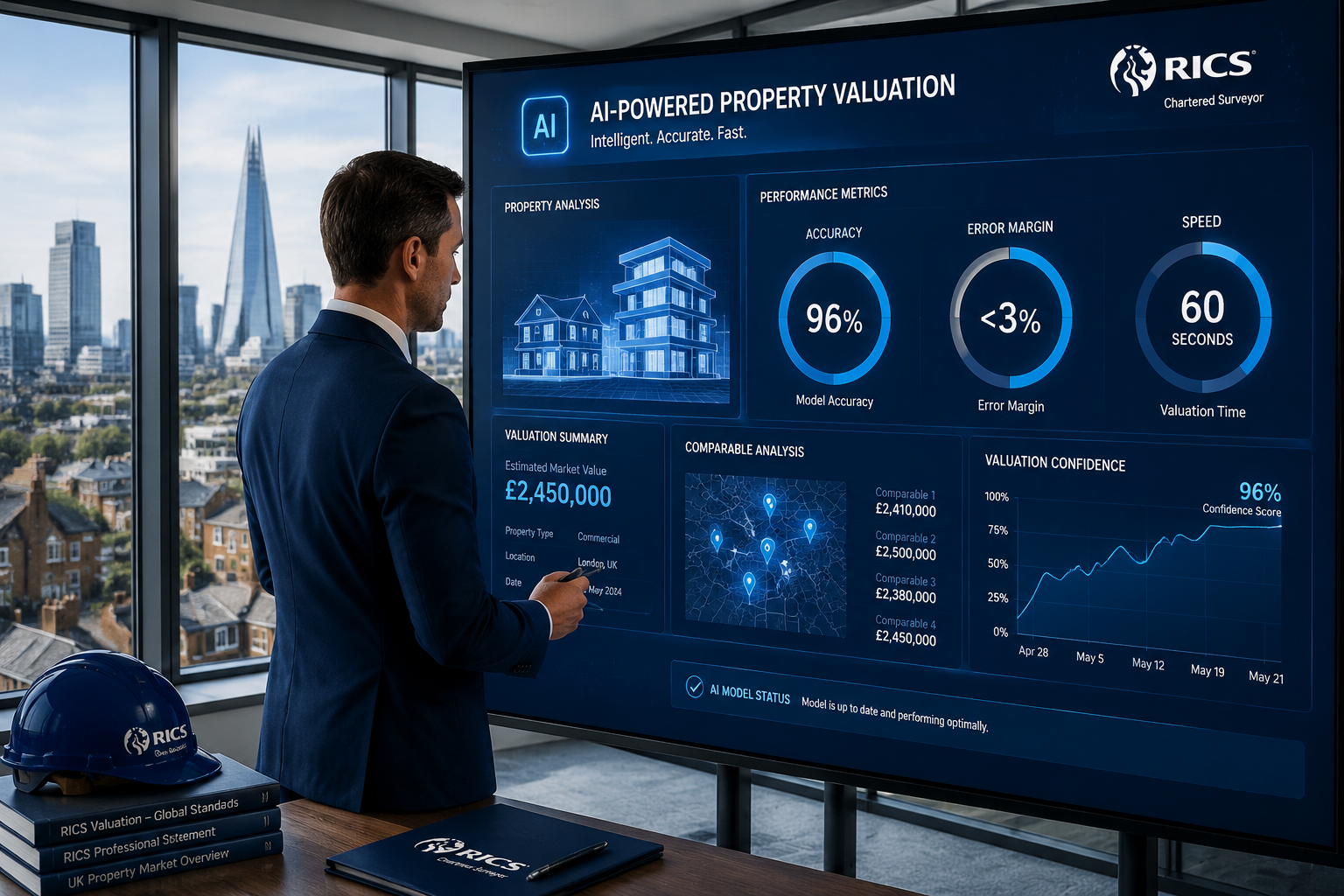
The numbers are difficult to ignore. Traditional manual appraisals typically achieve accuracy rates of 85–90%, with variance margins of 10–15% [2]. Modern AI-driven valuation models have slashed those error margins to under 3% in established markets — a shift that fundamentally changes the risk profile of property decisions [2].
This leap in precision comes from the sheer volume of data AI systems can process simultaneously. Where a human appraiser might weigh 20–30 comparable factors, AI systems now analyse 300+ market variables at once, including:
- 📊 Historical sales data and comparable transactions
- 🌍 Neighbourhood demographic trends
- 🚶 Foot traffic analytics
- 🌊 Flood risk and environmental data
- 📋 Planning history and permitted development rights
- ⚡ Energy Performance Certificate (EPC) ratings
- 💬 Social media sentiment and local amenity scores
- 📈 Real-time macroeconomic indicators [1][2]
This multi-dimensional analysis is simply beyond human cognitive capacity at scale. For chartered surveyors handling commercial valuations or complex leasehold extension and enfranchisement valuations, AI tools provide a data foundation that dramatically reduces subjective bias.
"AI-driven valuation models achieve error margins of less than 3% in established markets, compared to 10–15% variance in traditional appraisals — a fundamental shift in valuation precision." [2]
Speed and Cost: The Operational Transformation
Beyond accuracy, the operational case for AI adoption is compelling:
| Metric | Traditional Appraisal | AI-Powered Valuation |
|---|---|---|
| Delivery Time | 3–5 days | Under 60 seconds |
| Cost Per Valuation | £250–£400+ | £4–£12 equivalent |
| Data Points Analysed | 20–30 | 300+ |
| Error Margin | 10–15% | Under 3% |
| Accuracy Rate | 85–90% | 94–96%+ |
Sources: [1][2][3]
The cost reduction is particularly significant for organisations managing large property portfolios. For tasks such as insurance reinstatement cost valuations across multiple assets, AI can generate preliminary assessments at a fraction of the traditional cost, freeing chartered surveyors to focus their expertise where it matters most.
McKinsey projects a 40% growth in AI adoption across the real estate sector in the coming years, with early adopters already demonstrating measurable advantages in portfolio returns and operational efficiency [2]. In 2026, that adoption curve is accelerating rapidly.
RICS-Compliant AI Tools: The Technology Landscape in 2026
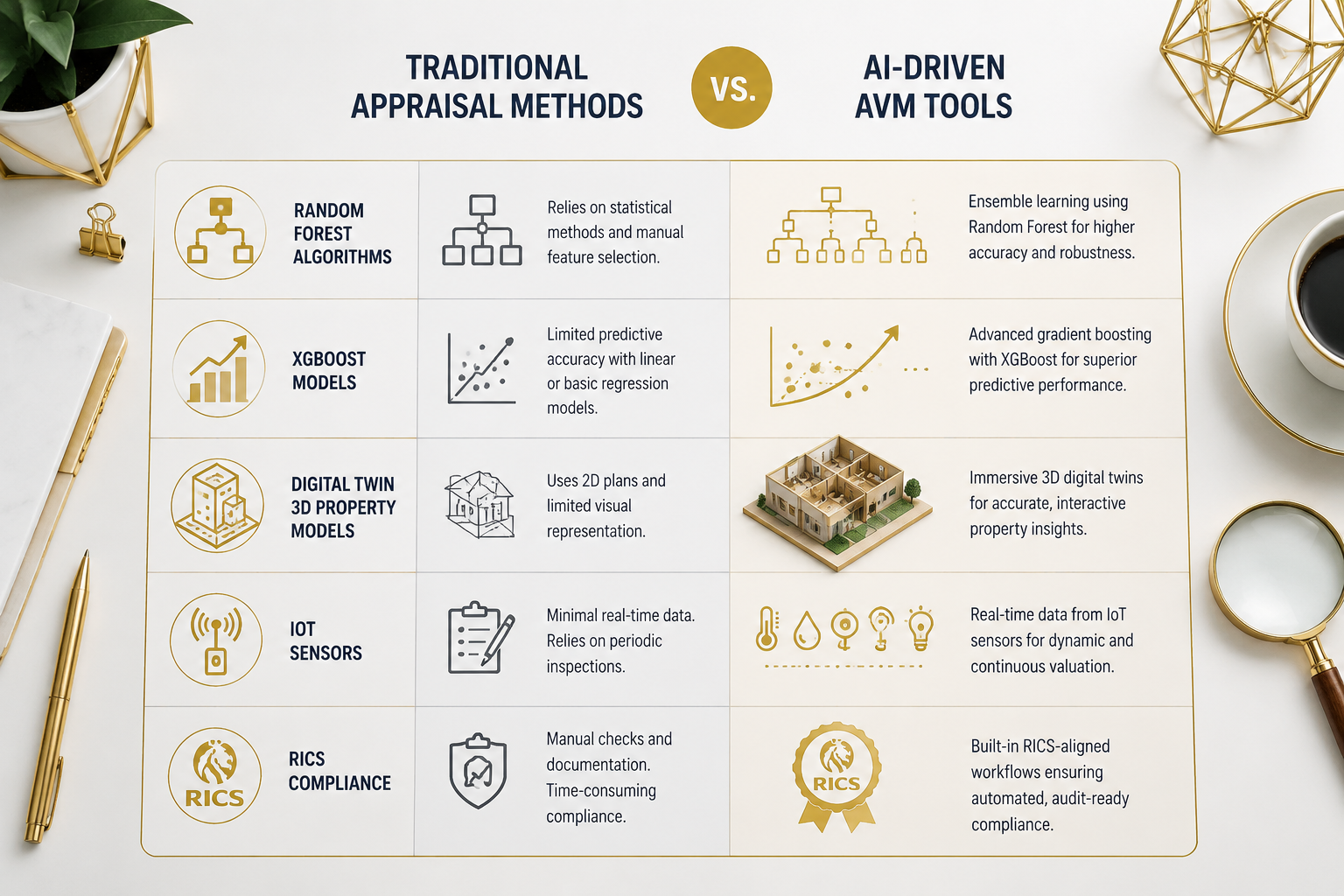
Understanding which tools are available — and how they align with RICS professional standards — is essential for any chartered surveyor looking to integrate AI responsibly.
Automated Valuation Models (AVMs)
AVMs powered by machine learning algorithms represent the most widely deployed AI technology in property valuation today. The leading approaches include:
- Random Forest algorithms — ensemble learning models that combine multiple decision trees to reduce overfitting and improve generalisation across diverse property types [1]
- XGBoost models — gradient boosting frameworks that excel at identifying complex, non-linear relationships between property characteristics and market value [1][2]
- Neural networks — deep learning architectures capable of processing unstructured data, including property images and textual descriptions
These models continuously learn from new transaction data, adapting to emerging market dynamics that static valuation models would miss [1]. This is particularly valuable in volatile conditions where timing and precision are critical — exactly the environment chartered surveyors are navigating in 2026.
Digital Twin Technology
Digital twins — virtual replicas of physical properties — represent the next frontier in valuation sophistication. These dynamic three-dimensional models integrate data from:
- IoT sensors monitoring building performance
- Building management systems
- Weather pattern data
- Local foot traffic analytics [2]
For chartered surveyors, digital twins enable something previously impossible: simulating the impact of renovations, energy efficiency improvements, or change-of-use scenarios before committing capital. This capability is transforming capital gains tax valuations and annual tax assessments, where scenario modelling can significantly influence strategic decisions.
Platform Tools in Active Use
Industry practitioners are already deploying specific AI platforms in live valuation work. Valos, for example, is an AI-driven software platform used by firms including Vail Williams. It automates the retrieval of:
- Rateable values
- EPC data
- Flood risk assessments
- Planning history
Work that previously required manual data gathering from multiple local authorities and agencies now completes in seconds [5]. This kind of automation directly supports RICS compliance by ensuring data completeness and reducing the risk of human error in data collection.
What RICS Says About AI
The Royal Institution of Chartered Surveyors has published formal guidance on AI in real estate valuation, establishing a globally relevant framework for responsible use [4]. The RICS position is clear and balanced:
✅ AI is a legitimate and valuable tool when used proportionately
✅ Professional judgment remains non-negotiable — AI cannot replace the chartered surveyor's accountability
✅ Transparency is required — valuers must be able to explain and justify AI-assisted conclusions
✅ Bias awareness is essential — AI models trained on historical data may perpetuate historical market biases [4]
RICS Modus coverage from January 2026 further reinforces that the profession views AI as an augmentation of professional practice, not a replacement for it [6]. Chartered surveyors who understand both the capabilities and limitations of these tools are positioned to deliver superior outcomes while maintaining the ethical standards the profession demands.
For those seeking an independent property valuation, the integration of AI tools within a RICS-compliant framework provides greater confidence in the reliability and defensibility of the final figure.
The Hybrid Model: Where Human Expertise Meets Algorithmic Power
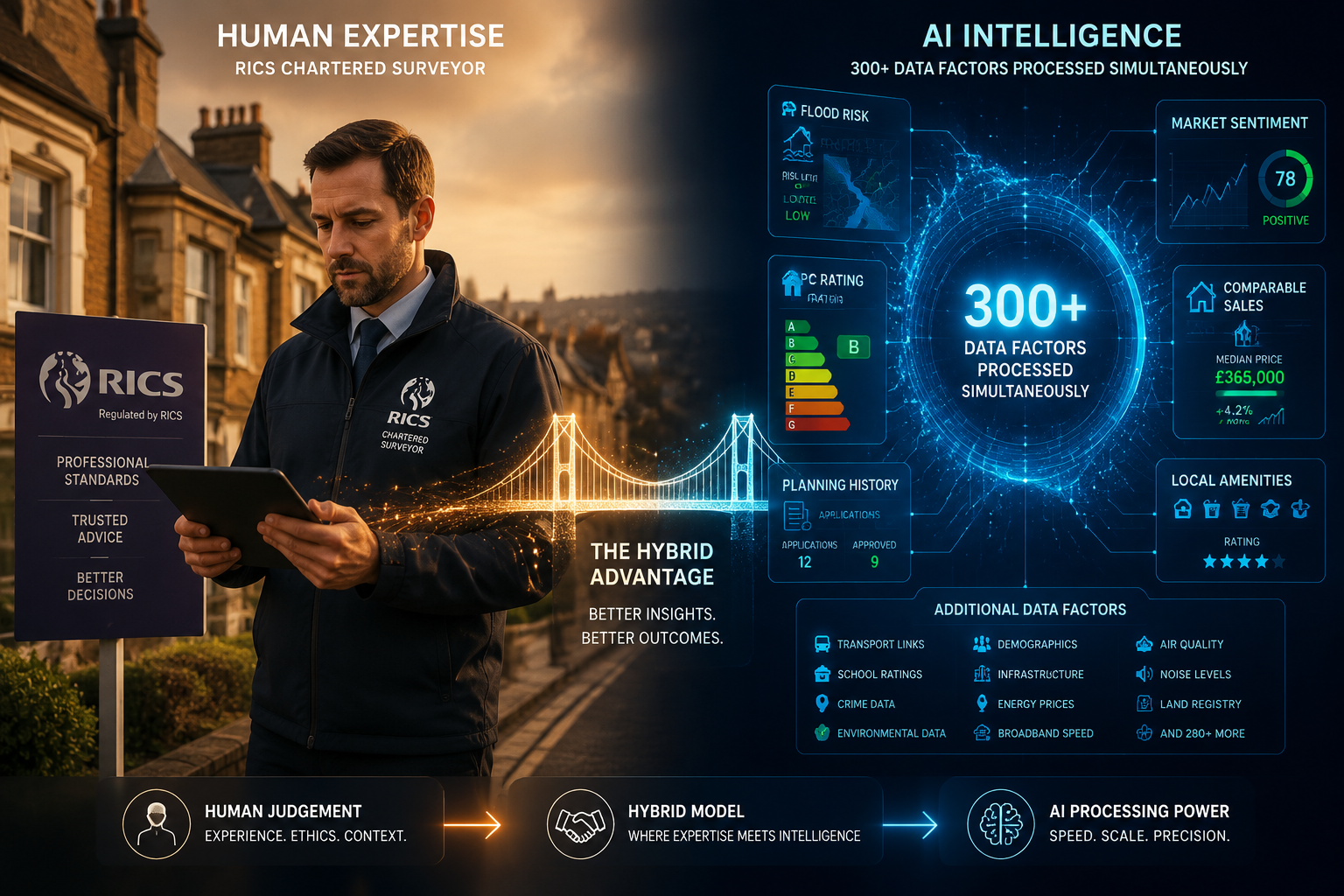
The most important insight emerging from 2026 valuation practice is this: neither pure AI nor pure manual appraisal represents best practice. The winning approach is the hybrid model — and the evidence strongly supports it [5].
Why AI Alone Is Not Enough
AI systems excel at processing structured data at scale, but they have well-documented limitations:
- Unique or unusual properties — listed buildings, conversions, and highly bespoke assets resist algorithmic valuation because comparable transaction data is sparse
- Local market nuance — hyperlocal factors such as a new planning application, a proposed infrastructure project, or community sentiment require human contextual knowledge
- Legal and contractual complexity — lease structures, restrictive covenants, and easements require professional legal and surveying judgment
- Ethical accountability — RICS-regulated professionals carry personal liability that cannot be delegated to an algorithm [4][5]
Chartered surveyors operating across areas such as West London or Central London will recognise that even adjacent streets can carry dramatically different value profiles — nuances that require local expertise to interpret correctly.
Why Manual Alone Is No Longer Sufficient
Conversely, purely manual approaches carry their own risks in 2026:
- Cognitive limitations — human appraisers cannot process 300+ variables simultaneously [1]
- Inconsistency — manual valuations are subject to individual bias, fatigue, and varying methodologies
- Speed disadvantage — in fast-moving markets, a 3–5 day turnaround can mean decisions are made on stale data [1]
- Cost barriers — high per-valuation costs limit the frequency and breadth of portfolio assessments [1]
The Hybrid Workflow in Practice
The most effective hybrid workflows follow a structured process:
- AI data ingestion — automated retrieval of statutory, environmental, and market data via platforms like Valos [5]
- AVM preliminary assessment — machine learning models generate an initial valuation range with confidence intervals
- Chartered surveyor review — the professional assesses AI outputs, applies local market knowledge, and identifies any anomalies or unique factors
- Physical inspection — where required, on-site assessment captures condition, specification, and qualitative factors
- Final RICS-compliant report — the surveyor takes professional responsibility for the concluded value, supported by transparent AI-assisted analysis [4][7]
"The most successful approach combines algorithmic speed with human professional judgment — AI for scale, professional insight for nuance." [5]
This workflow is particularly powerful for portfolio-level work. A chartered surveyor can use AI to triage a 50-property portfolio in minutes, identifying which assets require detailed manual inspection and which can be assessed with higher confidence from the algorithmic output alone.
Addressing the Bias Problem
One challenge that cannot be overlooked: AI models trained on historical transaction data can inadvertently perpetuate historical pricing biases — including those related to location, property type, or demographic factors. RICS guidance specifically flags this as an area requiring active professional vigilance [4]. Chartered surveyors using AI tools must interrogate model outputs critically, not accept them uncritically.
Ongoing model validation, diverse training datasets, and regular audits of AI outputs are now part of responsible valuation practice. Firms that treat AI as a black box — rather than a transparent, explainable tool — risk both professional censure and client harm.
Conclusion: Actionable Steps for Chartered Surveyors in 2026
The evidence is unambiguous: AI and Technology Transforming Property Valuations: RICS-Compliant Tools for Chartered Surveyors in 2026 is not a future trend — it is the present reality of professional practice. The chartered surveyors who will thrive are those who embrace these tools intelligently, within the ethical and professional framework that RICS provides.
Actionable Next Steps ✅
- Audit your current toolkit — identify where AI-powered data retrieval and AVM tools can reduce manual data gathering time without compromising report quality
- Review RICS AI guidance — familiarise yourself with the formal RICS framework on AI in real estate valuation to ensure your practice remains compliant [4]
- Pilot a hybrid workflow — select a category of valuation work (e.g., portfolio assessments or tax valuations) and test an AI-assisted process alongside your existing methodology
- Invest in AI literacy — understanding how algorithms like Random Forest and XGBoost work — even at a conceptual level — enables more critical and effective use of AI outputs
- Prioritise transparency — ensure every AI-assisted valuation report clearly documents which tools were used, what data was processed, and how professional judgment was applied
- Stay connected to professional development — RICS events and industry forums are increasingly focused on AI integration; active participation keeps practitioners ahead of regulatory and market developments
The geopolitical and economic uncertainty of 2026 makes reliable, defensible property valuations more critical than ever. AI provides the data processing power to meet that challenge. Chartered surveyors provide the professional judgment, ethical accountability, and local expertise that no algorithm can replicate. Together, they represent the future of valuation excellence.
Explore the full range of professional valuation services available from RICS-regulated chartered surveyors to understand how AI-assisted approaches are being applied across residential, commercial, and specialist property sectors.
References
[1] Ai Property Valuation – growthfactor.ai
[2] How Ai Is Transforming Property Valuations In 2026 – european.realestate
[3] How Ai Is Transforming Property Valuations In 2026 – tkpg.co.uk
[4] Ai In Real Estate Valuation – rics.org
[5] Ai And The Art Of Valuation Why Technology Can Support But Not Replace Professional Judgement – vailwilliams.com
[6] Modus By Rics January 2026 – rics.org
[7] Ai Driven Precision In Property Surveying Revolutionizing Workflows In 2026 – nottinghillsurveyors.com