

Buildings in the UK waste an estimated £3 billion annually in energy losses that go undetected during conventional inspections — losses that are now measurable, mappable, and preventable before a single compliance deadline is missed. The convergence of digital twins and thermal imaging in building surveys is reshaping how surveyors detect defects, validate energy performance, and deliver RICS-standard reports that hold up under 2026 regulatory scrutiny.
This article explores how these non-drone technologies — digital twins, infrared thermal imaging, and 3D scanning — are transforming the predictive accuracy of building surveys and compliance checks in 2026.
Key Takeaways 📌
- Digital twins combined with thermal imaging can deliver energy savings in the 20–28% range for building operations [1]
- Organizations using digital twins already report a 15–16% improvement in operational and sustainability metrics [3]
- Thermal imaging reveals hidden defects — moisture, air leakage, insulation failure — that visual inspections routinely miss
- The 2026 compliance landscape demands live operational data, not static snapshots, making BIM-to-BMS integration essential [2]
- Only 13% of organizations currently excel at digital twin deployment, creating a significant competitive advantage for early adopters [3]
Why Traditional Building Surveys Are No Longer Enough for 2026 Compliance
The standard visual inspection — a surveyor with a clipboard, a damp meter, and a keen eye — has served the industry for decades. But 2026's compliance requirements are demanding something fundamentally different: evidence-based, data-rich reports that demonstrate ongoing performance, not just point-in-time condition.
Regulatory frameworks around energy performance, fire safety, and structural integrity are tightening. The Building Safety Act 2022 continues to roll out its higher-risk building provisions. EPC (Energy Performance Certificate) reform discussions are pushing toward more rigorous measurement standards. In this environment, a survey that cannot quantify thermal bridging, air infiltration, or moisture ingress with measurable data is increasingly insufficient.
"The shift in 2026 is from static design models and visualization to live operational decision systems — environments that are too dense, too dynamic, or too interconnected to manage with static models." [3]
This is precisely where digital twins and thermal imaging in building surveys step in, offering a fundamentally upgraded approach to predictive accuracy and compliance validation.
What Visual Inspections Miss
| Defect Type | Visual Inspection | Thermal Imaging Detection |
|---|---|---|
| Interstitial moisture | ❌ Rarely detected | ✅ Clearly visible as cold spots |
| Air leakage paths | ❌ Invisible | ✅ Mapped via temperature differentials |
| Insulation voids | ❌ Requires destructive testing | ✅ Non-invasive heat pattern analysis |
| Electrical hotspots | ❌ Dangerous to assess | ✅ Safe remote detection |
| Structural stress points | ⚠️ Partially visible | ✅ Combined with 3D scanning data |
Understanding what causes moisture in buildings is one thing — detecting it behind finished surfaces without destructive investigation is another entirely. Thermal imaging bridges that gap.
How Thermal Imaging Works in Modern Building Surveys
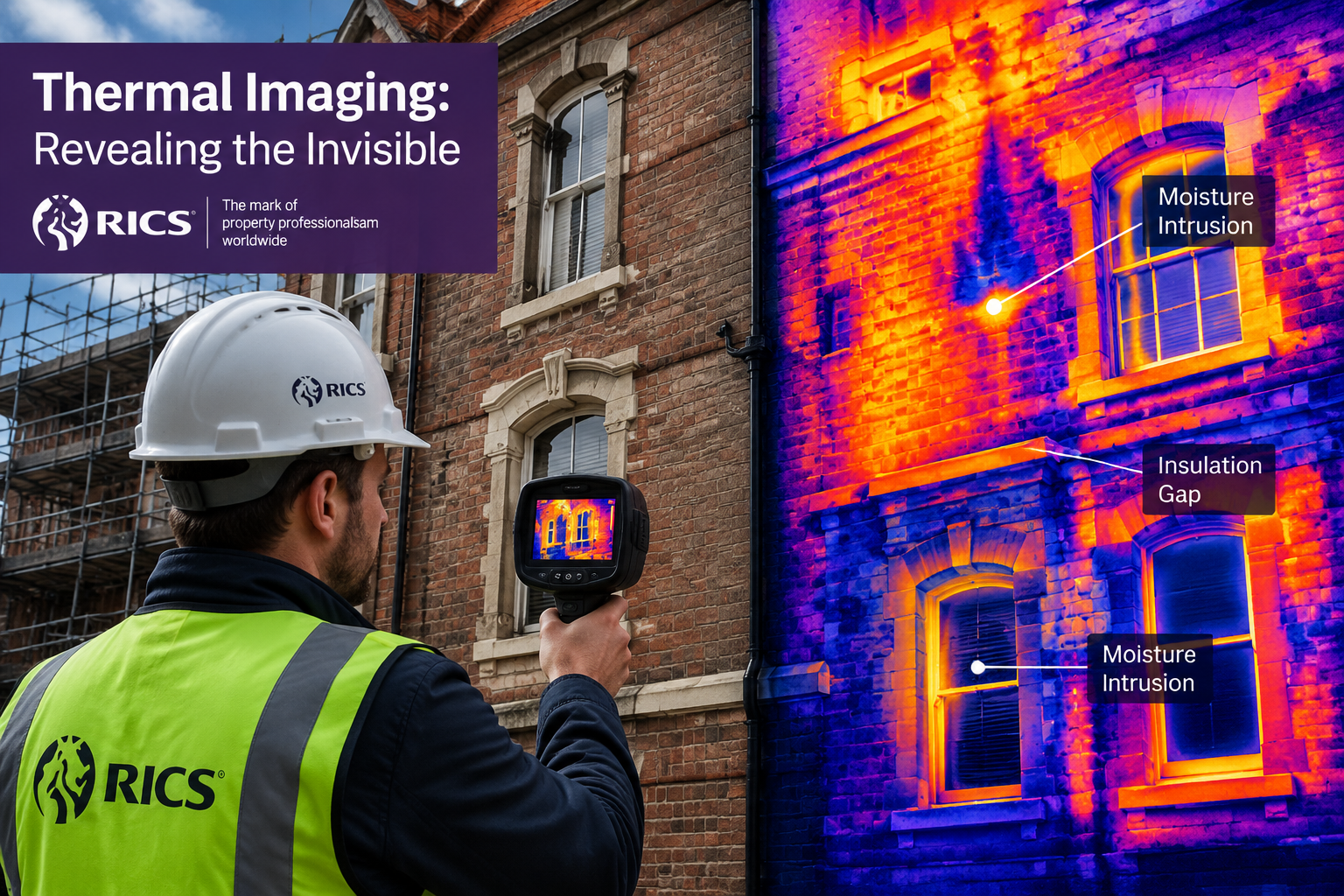
Thermal imaging (infrared thermography) captures the heat emitted from building surfaces using a specialist camera that converts temperature differences into a false-colour image. Hotter areas appear in reds and oranges; cooler areas in blues and greens. Anomalies in these patterns reveal defects that are otherwise invisible.
The Science Behind the Colours 🌡️
Every material has a thermal signature. When insulation is missing, a wall will show a distinctly cooler patch on its interior surface during cold weather. When moisture is present, evaporative cooling creates a characteristic cold zone. When electrical components overheat, they radiate excess heat that stands out immediately.
For building surveyors, this translates into actionable intelligence:
- Flat roof surveys: Detect water ingress trapped beneath membrane layers
- Cavity wall surveys: Identify insulation settlement or voids
- Heritage and listed buildings: Non-invasive assessment of building pathology without surface damage
- Commercial buildings: Locate thermal bridging in curtain wall systems and glazing units
Conditions for Accurate Thermal Surveys
Thermal imaging is not a point-and-shoot technology. Accurate results require:
- A minimum 10°C temperature differential between interior and exterior
- Stable conditions — no direct solar radiation on the surface being surveyed
- Appropriate emissivity settings for different surface materials
- Qualified thermographers — ideally certified to ITC Level 1 or above
When these conditions are met, thermal imaging delivers defect detection accuracy that far exceeds what a Level 3 full building survey can achieve through visual means alone.
Digital Twins and Thermal Imaging in Building Surveys: The Integration That Changes Everything
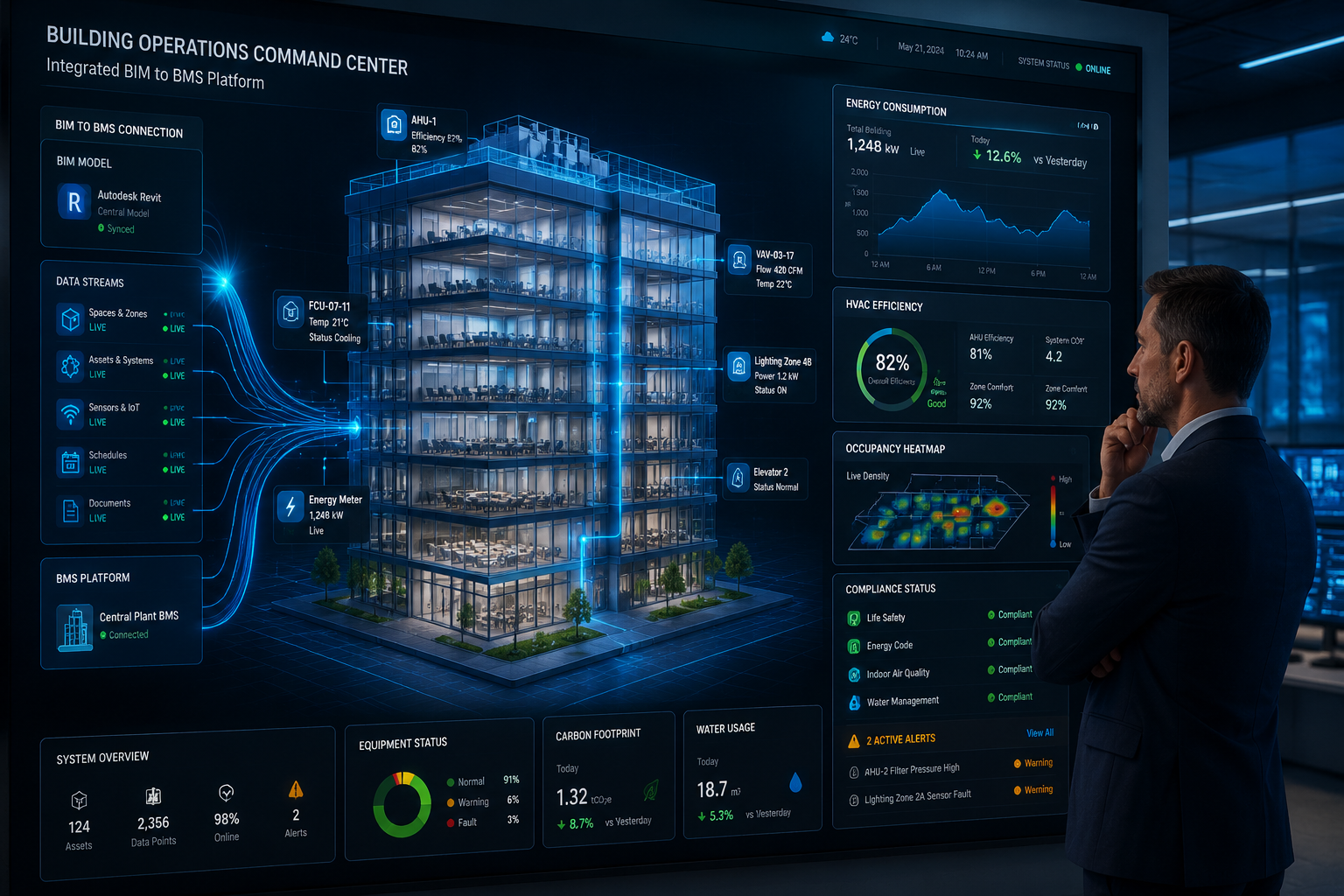
A digital twin is a live, dynamic virtual replica of a physical building — continuously updated with real-world data from sensors, BMS systems, and survey inputs. Unlike a static BIM model, a digital twin evolves as the building does.
When thermal imaging data is fed into a digital twin, something powerful happens: defects are no longer isolated findings — they become georeferenced data points within a continuously monitored building model.
From BIM to BMS: The 2026 Integration Standard
The most significant development in 2026 building management is the maturation of BIM-to-BMS (Building Management System) integration. Digital twins now function as bridges between design-stage building information models and live operational systems, enabling:
- Real-time energy consumption monitoring mapped against the building model
- Occupancy pattern analysis overlaid on thermal performance data
- HVAC efficiency tracking with predictive maintenance alerts
- Compliance dashboards that flag deviations from EPC benchmarks automatically [2]
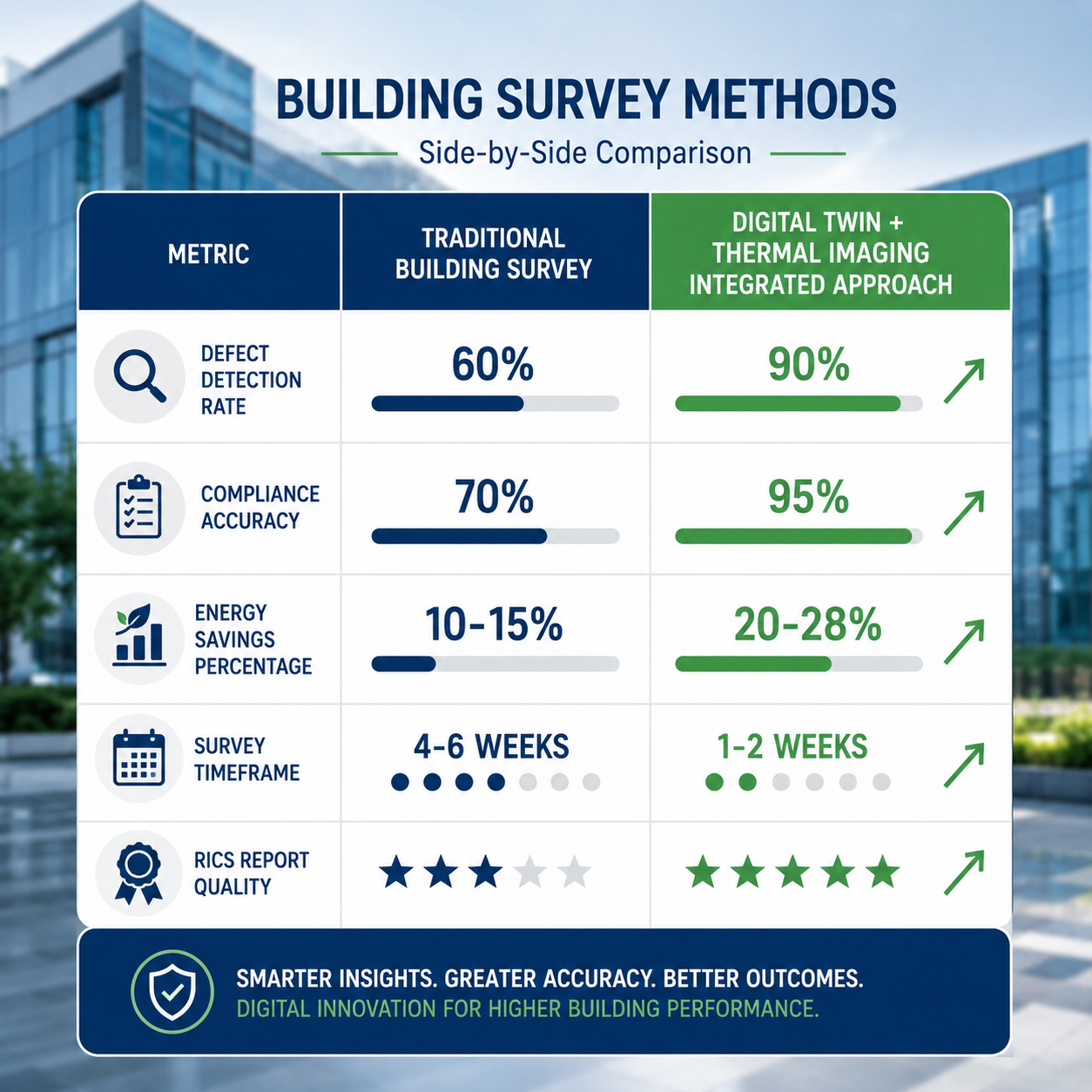
Research confirms that organizations implementing digital twins are achieving an average 15% improvement in key operational metrics and a 16% improvement in sustainability metrics [3]. For building owners facing 2026 compliance checks, these are not abstract figures — they represent measurable reductions in energy bills, maintenance costs, and regulatory risk.
Energy Savings: The Headline Number
Pilots and real-world deployments of digital twins combined with advanced building analytics are demonstrating energy savings in the 20–28% range [1]. To put that in context for a commercial building with a £200,000 annual energy bill, that is a saving of £40,000–£56,000 per year — while simultaneously satisfying compliance requirements.
The mechanism is straightforward:
- Thermal imaging identifies where energy is escaping
- Digital twin models quantify the energy impact of each defect
- Remediation is prioritised by ROI, not by guesswork
- Post-remediation thermal surveys confirm improvement
- The digital twin updates to reflect the improved baseline
This creates a continuous improvement loop that static surveys simply cannot replicate.
Extending Asset Lifecycle Value
One of the most compelling arguments for digital twin adoption in 2026 is the extension of BIM investment value from construction into the full operational lifecycle of a building [2]. Post-handover, the digital twin becomes a living compliance record — tracking every survey, every thermal anomaly, every remediation action.
For facilities managers, this means:
- Audit trails that satisfy regulatory inspectors
- Predictive maintenance schedules based on thermal trend data
- Insurance documentation that demonstrates proactive building management
- Resale and refinancing evidence of ongoing compliance
Exploring what a measured building survey involves provides useful context for understanding how spatial data feeds into these digital twin models.
3D Scanning: The Third Pillar of Non-Drone Survey Technology
While thermal imaging captures thermal performance and digital twins provide the operational framework, 3D laser scanning (LiDAR) completes the non-drone technology triad by delivering millimetre-accurate spatial data.
How 3D Scanning Complements Thermal Imaging
| Technology | Primary Output | Best Used For |
|---|---|---|
| Thermal Imaging | Heat map / anomaly detection | Defect identification, energy loss |
| 3D Laser Scanning | Point cloud / spatial model | Dimensional accuracy, structural analysis |
| Digital Twin | Live virtual building model | Ongoing monitoring, compliance tracking |
When combined, these three technologies produce survey outputs that are:
- Spatially accurate — defects are precisely located in 3D space
- Thermally verified — energy performance is quantified, not estimated
- Continuously monitored — the digital twin updates as conditions change
For complex structures, understanding stresses in structural members of commercial buildings is critical — and 3D scanning provides the geometric data that makes structural analysis genuinely reliable.
Digital Twins and Thermal Imaging in Building Surveys: Delivering RICS-Standard Reports
The RICS (Royal Institution of Chartered Surveyors) sets the professional standard for building surveys in the UK. For 2026 compliance checks, the expectation is increasingly that survey reports will include quantified, evidence-based findings — not just qualitative assessments.
What a Digital Twin-Enhanced RICS Report Includes
A modern, technology-enhanced building survey report supported by thermal imaging and digital twin data will typically contain:
- ✅ Thermal images with annotations identifying specific defect locations
- ✅ Georeferenced defect mapping within the building model
- ✅ Energy performance quantification (U-values, air permeability estimates)
- ✅ Prioritised remediation schedule with cost-benefit analysis
- ✅ Compliance status dashboard against current regulatory benchmarks
- ✅ Predictive maintenance timeline based on thermal trend analysis
This level of reporting answers the questions that savvy clients are now asking during a building survey — and goes well beyond what traditional methods can provide. Understanding what questions to ask during a building survey helps clients engage meaningfully with these enhanced reports.
Interoperability: Avoiding Vendor Lock-In in 2026
A critical consideration for organisations investing in digital twin infrastructure is interoperability — the ability to share data across platforms using open standards [3]. Thermal imaging data, 3D scan point clouds, and BMS feeds must be able to flow into a single digital twin environment without being trapped in proprietary formats.
The 2026 market is moving decisively toward open standards such as:
- IFC (Industry Foundation Classes) for BIM data exchange
- COBie (Construction Operations Building Information Exchange) for asset data
- MQTT and REST APIs for real-time sensor data integration
Organisations that build their compliance workflows on open standards today will avoid costly platform migrations as regulatory requirements evolve.
Practical Implementation: Getting Started with Thermal-Digital Twin Integration
For building owners, facilities managers, and surveyors looking to implement these technologies for 2026 compliance, a phased approach is most effective:
Phase 1: Baseline Thermal Survey 🔍
Commission a professional thermal imaging survey under appropriate conditions. This establishes the defect baseline and identifies priority areas for remediation.
Phase 2: 3D Scan and BIM Model Creation 📐
If a BIM model does not already exist, a 3D laser scan creates the spatial foundation for the digital twin. For existing buildings, scan-to-BIM workflows are now mature and cost-effective.
Phase 3: Digital Twin Deployment 🖥️
Connect the BIM model to live BMS data feeds. Integrate thermal sensor data (if continuous monitoring is required) or schedule periodic thermal survey updates.
Phase 4: Compliance Dashboard Configuration ✅
Configure the digital twin to flag compliance deviations automatically — EPC rating changes, thermal performance degradation, HVAC efficiency drops.
Phase 5: Ongoing Monitoring and Reporting 📊
Use the digital twin as the single source of truth for all compliance reporting. Annual thermal surveys update the model; the digital twin tracks trends over time.
For health and safety inspections in block management contexts, this ongoing monitoring capability is particularly valuable — providing continuous evidence of compliance rather than point-in-time snapshots.
The Competitive Landscape: Why Early Adoption Matters
Despite the clear benefits, only 13% of organisations currently excel at digital twin deployment [3]. This means the majority of building owners and surveyors are still operating with technology gaps that will become increasingly costly as 2026 compliance requirements bite.
The organisations that move now gain:
- First-mover advantage in demonstrating compliance proactively
- Lower remediation costs through early defect detection
- Premium positioning in the market for energy-efficient, well-documented buildings
- Reduced insurance premiums through demonstrable risk management
For block management portfolios in particular, the ability to demonstrate thermal performance and compliance across multiple buildings through a unified digital twin platform represents a significant operational efficiency gain.
Conclusion: Actionable Next Steps for 2026 Compliance
Digital twins and thermal imaging in building surveys are no longer emerging technologies — they are the 2026 standard for organisations serious about predictive accuracy, regulatory compliance, and operational efficiency.
The evidence is compelling: energy savings of 20–28% [1], 15–16% improvements in operational and sustainability metrics [3], and a continuous compliance record that satisfies regulators, insurers, and investors alike [2].
Actionable Next Steps ✅
- Commission a baseline thermal imaging survey before the next compliance deadline — identify defects while remediation is still cost-effective
- Audit existing BIM models to assess digital twin readiness — is the data current enough to serve as an operational foundation?
- Engage a RICS-qualified surveyor experienced in technology-enhanced survey methods to ensure reports meet 2026 standards
- Specify open-standard data formats in any digital twin procurement to protect against vendor lock-in
- Integrate thermal survey schedules into planned maintenance cycles — annual surveys feeding the digital twin create a compliance audit trail automatically
The buildings that perform best in 2026 compliance checks will not be the newest or the most recently renovated. They will be the ones whose owners chose to see inside their buildings — and act on what they found.
References
[1] 10 Digital Twin Use Cases In 2026 For Manufacturing Energy Smart Buildings – pratititech.com
[2] Digital Twins In 2026 From Buzzword To Business Value – instandart.com
[3] Digital Twin In 2026 Why The Real Opportunity Is Moving From Design Models To Live Infrastructure Control – datamintelligence.com
[5] Digital Twin Technology In Construction Industry – gisdrones.com