

Over 70% of UK property buyers who commission a building survey discover defects significant enough to justify a price renegotiation — yet fewer than half successfully convert those findings into a defensible, quantified reduction. The gap between identifying a problem and proving its financial impact is where transactions stall, disputes arise, and buyers overpay.
This article presents a practical framework for building survey defect quantification for valuation adjustments: methodology for translating inspection findings into accurate price impact. Whether preparing for expert witness work, advising a buyer client, or defending a renegotiation position, the methodology outlined here provides the structured, evidence-based approach that surveyors and property professionals need in 2026's increasingly cautious market. [1]
Key Takeaways 📌
- Defect quantification is a distinct discipline from defect identification — it requires costing, categorisation, and valuation impact modelling.
- A four-stage methodology (classify → cost → contextualise → calculate adjustment) provides a defensible, repeatable framework.
- RICS Red Book Global Standards set the authoritative benchmark for professional valuation practice involving defect impact. [4]
- Independent professional assessment is essential — any financial interest in the transaction undermines credibility. [2]
- In a flat or declining market, precise defect-based adjustments carry greater negotiating weight than broad percentage estimates.
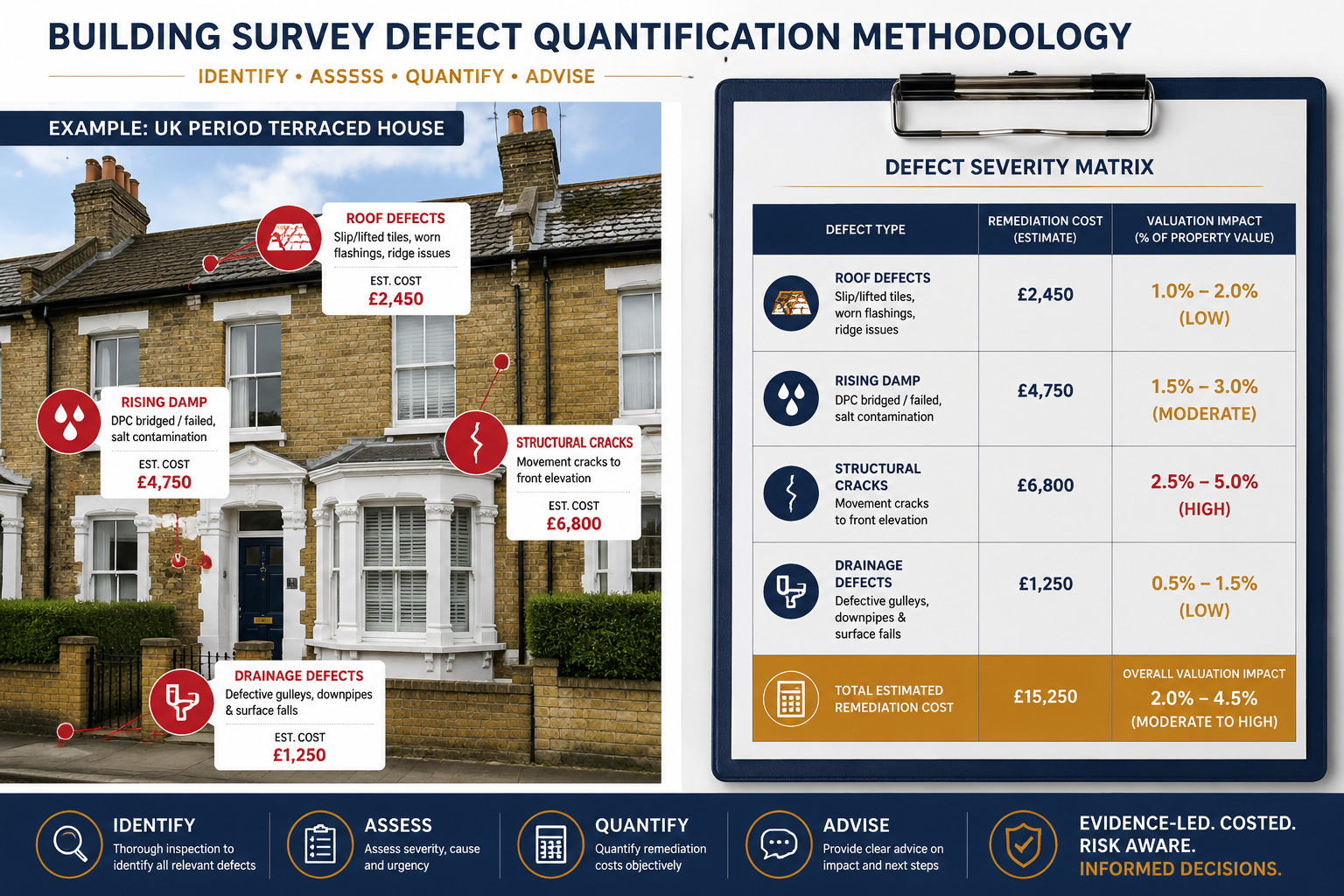
Why Defect Quantification Is Not the Same as Defect Identification
Most building surveys do an excellent job of finding problems. A Level 3 full building survey will typically document dozens of items — from minor surface cracks to serious structural movement. But documentation alone does not produce a valuation adjustment. That requires a second, deliberate analytical step.
The Identification-to-Quantification Gap
Consider a surveyor who notes "significant rising damp to ground floor front elevation, affecting plasterwork and floor joists." That finding is valuable. But to translate it into a price impact, the surveyor must answer:
- What is the full remediation cost (including investigation, treatment, reinstatement, and contingency)?
- Does the defect affect structural integrity, habitability, or mortgageability?
- What is the market perception of this defect type in this property category?
- Is the defect latent or patent — and does that affect liability?
💬 "A defect without a cost is an observation. A defect with a cost, a timeline, and a valuation impact is a negotiating instrument."
This distinction matters enormously in 2026's market. RICS February 2026 data indicates buyer demand dips and regional price flatness across much of England and Wales, meaning sellers face greater scrutiny and buyers have more leverage — but only if they can substantiate their position with precise, professional analysis. [1]
The Four-Stage Methodology for Translating Inspection Findings into Accurate Price Impact
The core of building survey defect quantification for valuation adjustments rests on a structured four-stage process. Each stage builds on the last, producing a layered, defensible output.
Stage 1: Defect Classification by Severity and Type
Before any cost can be assigned, defects must be classified systematically. The RICS condition rating system (used in Level 2 and Level 3 surveys) provides a starting point, but valuation-focused work requires additional granularity.
Recommended Classification Matrix:
| Category | Severity Level | Examples | Valuation Relevance |
|---|---|---|---|
| Structural | Critical | Subsidence, failed lintels, roof spread | High — affects mortgageability |
| Fabric | Significant | Roof covering failure, wet rot, damp | Medium-High — affects habitability |
| Services | Moderate | Outdated electrics, boiler failure | Medium — affects insurability |
| Cosmetic | Minor | Decorative cracking, worn finishes | Low — buyer preference |
| Compliance | Variable | Unlawful extensions, fire safety gaps | High — legal/regulatory risk |
Understanding building pathology — the science of diagnosing how and why buildings fail — is essential at this stage. A crack that appears cosmetic may indicate progressive structural movement; a damp patch may signal failed drainage rather than surface condensation. Misclassification at Stage 1 corrupts every downstream calculation.
Stage 2: Remediation Cost Estimation
This is the most technically demanding stage. Remediation cost estimation requires:
- Elemental cost analysis — breaking repair work into measurable quantities (m², linear metres, number of items)
- Current market rates — using recognised cost databases (BCIS, Spon's, or verified contractor quotes)
- Contingency allowances — typically 10–20% for hidden or progressive defects
- Professional fees — design, specification, project management, and statutory approvals where required
For defects involving urgent or dangerous building issues, cost estimation must also factor in emergency stabilisation, temporary works, and potential decant costs if the property is occupied.
Key principle: Always cost to full reinstatement standard, not patch repair. Patch repairs may be cheaper in the short term but do not restore market value equivalently.
Stage 3: Contextualisation — Market, Property, and Buyer Factors
Raw remediation cost is not the same as valuation adjustment. Three contextual factors modify the relationship between cost and price impact:
1. Market Conditions 🏘️
In a rising market, buyers may absorb some defect costs in anticipation of capital growth. In a flat or declining market — as RICS data indicates for Spring 2026 — defect costs translate more directly into price reductions because buyers have no growth buffer. [1]
2. Property Type and Age
A £15,000 roof repair on a £200,000 terrace represents a 7.5% price impact. On a £1.2 million detached property, the same cost is 1.25%. The proportionality principle means surveyors must always express costs as a percentage of agreed or estimated value. Period properties, particularly those with planning or statutory considerations, often carry additional remediation complexity that inflates costs beyond standard rates.
3. Buyer Circumstances
A cash buyer may accept a smaller adjustment in exchange for speed. A buyer requiring a mortgage may need the defect resolved before completion — making the full cost non-negotiable. Understanding buyer leverage is part of contextualisation.
Stage 4: Calculating the Valuation Adjustment
With classification, costs, and context established, the surveyor can apply a structured adjustment model. Three approaches are commonly used:
A. Direct Cost Deduction
The simplest approach: deduct the full remediation cost from the agreed price. Appropriate for discrete, well-defined defects with clear cost certainty.
B. Weighted Impact Model
For multiple defects of varying severity, apply a weighting factor based on urgency and market perception:
- Critical/structural defects: 100–120% of remediation cost (reflecting risk premium)
- Significant fabric defects: 80–100% of remediation cost
- Moderate service defects: 60–80% of remediation cost
- Minor cosmetic defects: 20–40% of remediation cost
The premium above 100% for critical defects reflects the market's tendency to discount properties with structural issues beyond the literal repair cost — buyers price in uncertainty, financing risk, and resale impact.
C. Comparable Sales Analysis
Where sufficient market data exists, compare the subject property against recent sales of similar properties with and without the identified defects. This approach, anchored in the RICS Red Book Global Standards framework, provides the most robust valuation evidence for expert witness or dispute contexts. [4]
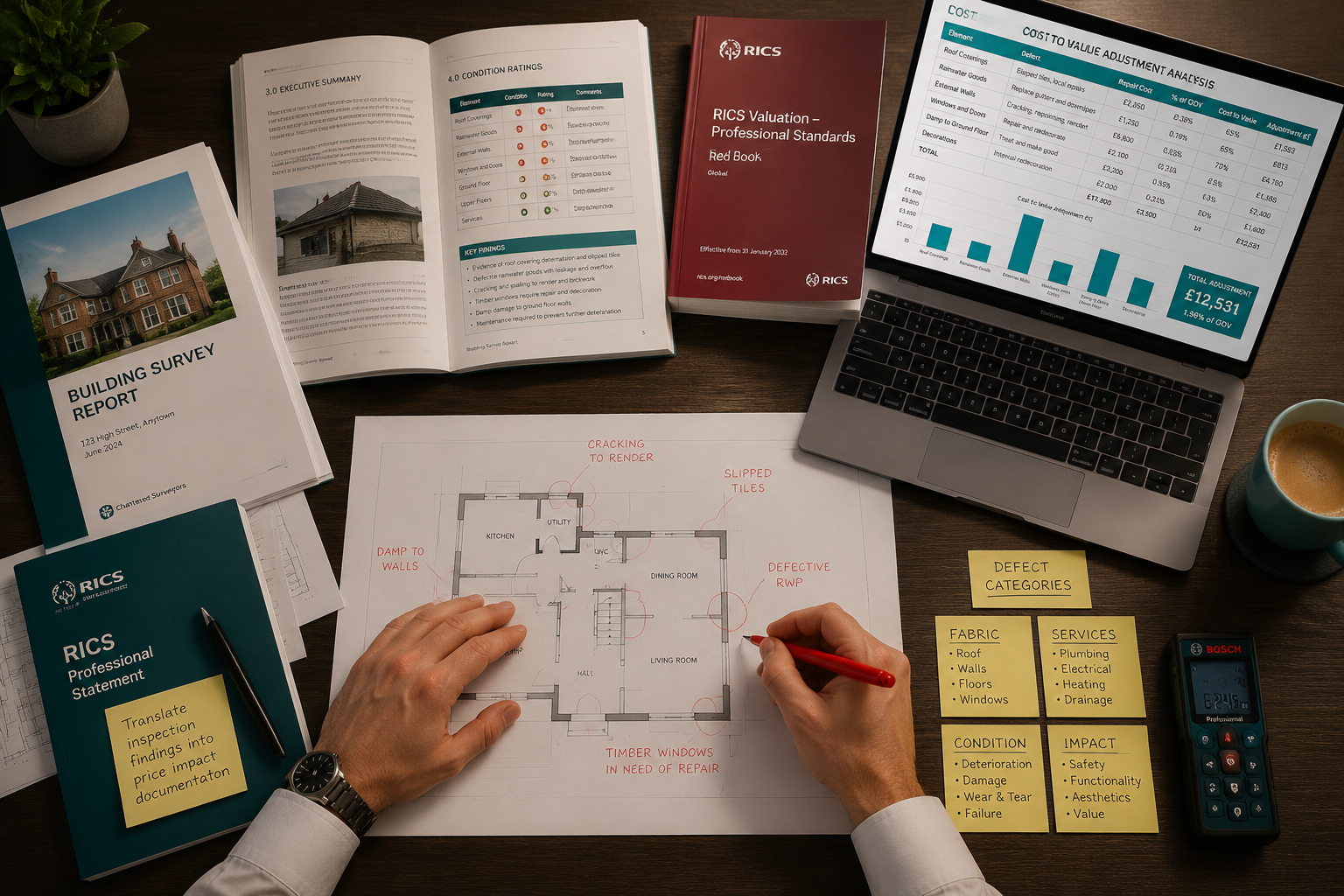
Practical Tools and Technologies Supporting Defect Quantification
Modern surveying practice increasingly integrates technology into the defect quantification process, improving both accuracy and client credibility.
Laser Scanning and Measured Survey Integration
Laser scanning and measured building survey technologies are transforming how surveyors capture and communicate defect data. Point cloud surveys can detect structural deformation, settlement patterns, and dimensional anomalies that are invisible to the naked eye — providing objective, measurable evidence that strengthens valuation adjustment arguments. [3]
Where a surveyor previously estimated that a wall had deviated "approximately 30mm from vertical," a laser scan produces a precise, legally defensible measurement. This precision matters in disputed adjustments and expert witness scenarios.
Defect Analysis Surveys as a Targeted Tool
For properties where a full Level 3 survey has already been completed but specific defects require deeper investigation, a targeted defect analysis survey provides a cost-effective methodology for pinpointing concerns and establishing their financial impact. [5] This approach is particularly valuable when:
- A mortgage valuer has flagged a specific issue
- A previous survey identified a defect but did not cost it
- A vendor disputes the severity of a finding
Documentation Standards for Defensible Outputs
Regardless of the tools used, the output must meet a consistent documentation standard:
✅ Photographs with scale references and date stamps
✅ Written defect descriptions using RICS condition rating language
✅ Itemised cost schedules with source references (BCIS, contractor quotes)
✅ Valuation adjustment calculation with methodology explained
✅ Caveats and assumptions clearly stated
✅ Professional indemnity disclosure
Best practice requires that the surveyor or chartered surveyor producing the valuation adjustment has no financial interest in the transaction outcome — a principle central to independent professional valuation methodology. [2]
Applying the Methodology: Common Defect Scenarios and Their Price Impact
The following examples illustrate how the four-stage methodology applies to real-world defect types encountered in UK residential surveys.
🔴 Scenario 1: Roof Structure Failure
Finding: Significant sagging to main roof slope; rafters showing signs of spread; ridge board deflecting.
Classification: Structural — Critical
Remediation Cost: £22,000–£28,000 (full rafter replacement, ridge repair, re-tiling, scaffolding)
Contextualisation: Property value £380,000; flat market conditions; buyer requires mortgage
Adjustment: 100–120% of mid-range cost = £27,500–£33,000 recommended adjustment
For more on common roof defect types and their structural implications, see this detailed guide to pitched roof types and common defects.
🟡 Scenario 2: Widespread Rising Damp
Finding: Rising damp to ground floor walls on three elevations; failed DPC; affected plasterwork and timber skirtings.
Classification: Fabric — Significant
Remediation Cost: £8,500–£12,000 (DPC injection, replastering, timber treatment, redecoration)
Contextualisation: Property value £245,000; period terrace; buyer is cash purchaser
Adjustment: 85% of mid-range cost = approximately £8,900 recommended adjustment
🟢 Scenario 3: Outdated Electrical Installation
Finding: Rewirable fuse board; no RCD protection; partial rewire evident from previous works.
Classification: Services — Moderate
Remediation Cost: £4,500–£6,500 (full rewire, consumer unit replacement, certification)
Contextualisation: Property value £310,000; buyer requires mortgage; lender may require works before drawdown
Adjustment: 90% of mid-range cost = approximately £4,950 — but full cost may be non-negotiable if lender insists on pre-completion works
Credibility, Independence, and Expert Witness Considerations
The methodology described above is only as strong as the professional delivering it. In contested adjustments, litigation support, or expert witness contexts, the surveyor's credibility rests on three pillars:
1. Methodological transparency — every calculation must be traceable and reproducible
2. Independence — no financial interest in the transaction; no relationship with either party that could compromise objectivity [2]
3. Standards compliance — alignment with RICS Red Book Global Standards (incorporating International Valuation Standards) provides the authoritative framework that courts, lenders, and professional bodies recognise [4]
For buyers seeking to understand how survey findings typically translate into negotiated outcomes, the average price reduction after survey provides useful market context — though individual adjustments must always be grounded in property-specific defect analysis rather than averages.
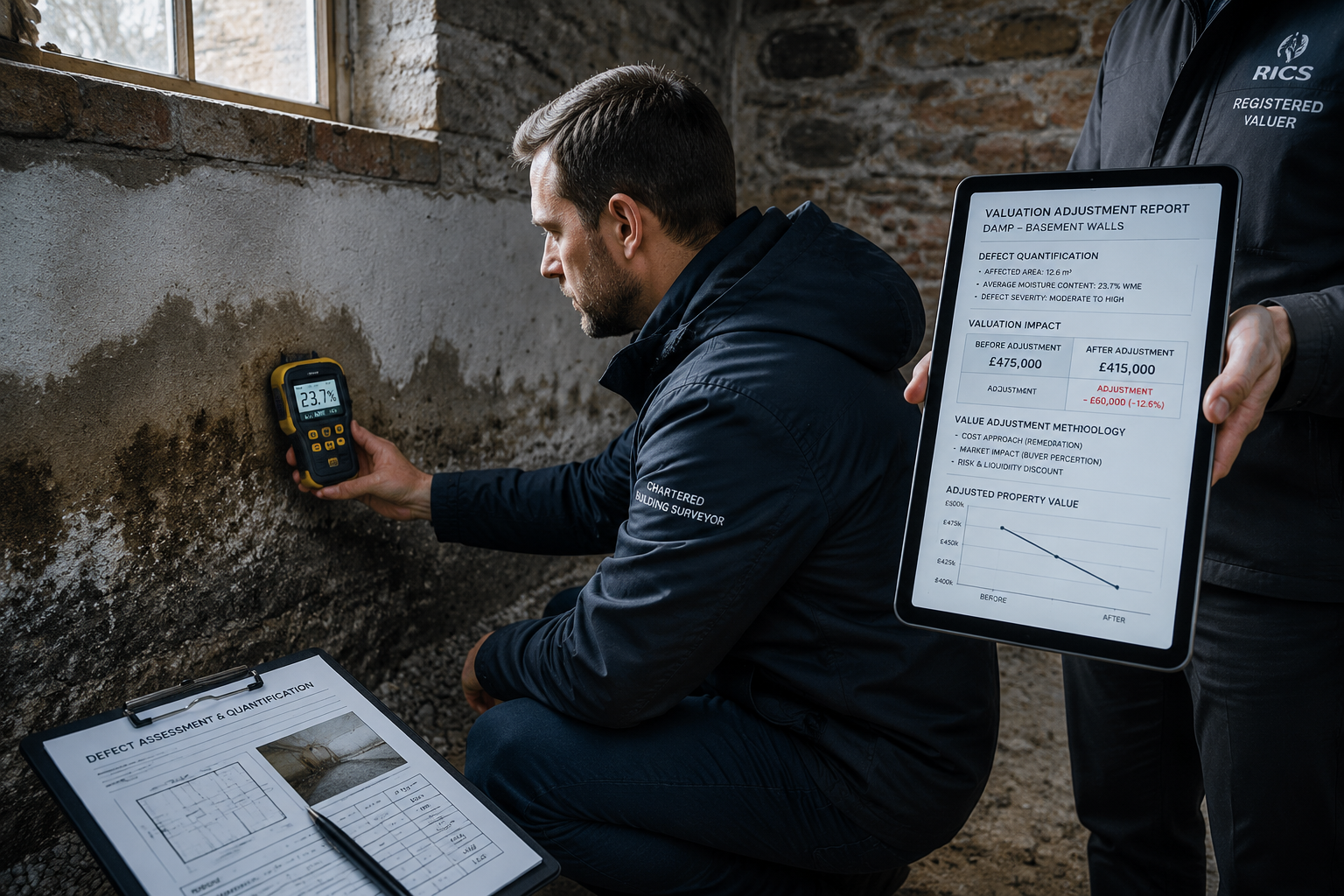
Building Survey Defect Quantification for Valuation Adjustments: Common Errors to Avoid
Even experienced surveyors make avoidable errors when translating inspection findings into price impact. The most common include:
❌ Using patch repair costs instead of full remediation costs — understates true impact
❌ Ignoring consequential damage — e.g., costing roof repair without accounting for damaged ceilings and insulation below
❌ Applying flat percentage rules — "deduct 1% per major defect" has no methodological basis
❌ Failing to account for access and disruption costs — particularly relevant for building surveyor access challenges in occupied or listed properties
❌ Omitting professional fees — design, specification, and project management can add 15–20% to base construction costs
❌ Not distinguishing between deferred maintenance and structural defects — these carry very different market perceptions and adjustment multipliers
Conclusion: From Findings to Financial Precision
Building survey defect quantification for valuation adjustments: methodology for translating inspection findings into accurate price impact is not a soft skill — it is a technical discipline with clear standards, reproducible processes, and significant financial consequences for all parties.
The four-stage framework — classify, cost, contextualise, calculate — provides surveyors and property professionals with a structured approach that withstands scrutiny from buyers, sellers, lenders, and courts alike. In 2026's cautious market, where RICS data points to buyer demand softening and regional price flatness, the ability to produce precise, defensible defect-based adjustments is more valuable than ever. [1]
Actionable Next Steps ✅
- Adopt the four-stage methodology as a standard output for all survey reports where valuation adjustment is relevant
- Build a cost database using BCIS rates and verified contractor quotes, updated at least annually
- Document everything — photographs, measurements, cost sources, and calculation methodology
- Maintain independence — never produce a defect quantification report where a financial interest exists [2]
- Invest in technology — laser scanning and measured survey tools improve precision and client confidence [3]
- Commission a professional building survey before any significant property transaction — the cost of a survey is always less than the cost of an undiscovered defect
For properties with complex defect profiles, environmental concerns, or regulatory compliance issues, working with a chartered surveying team that combines building pathology expertise with valuation methodology delivers the most robust outcomes for clients and professionals alike.
References
[1] Valuation Adjustments For Cautious Spring 2026 Housing Market Rics February Insights On Buyer Demand Dips And Regional Price Flatness – nottinghillsurveyors.com
[2] Understanding Property Valuations How To Ensure Youre Not Overpaying – structurasurveying.com
[3] Measured Building Surveys Accuracy Clarity And Confidence In The Built Environment – academyg.com
[4] Red Book Global Standards Incorporating Ivs – rics.org
[5] Defect Analysis Surveys – roger-hannah.co.uk