

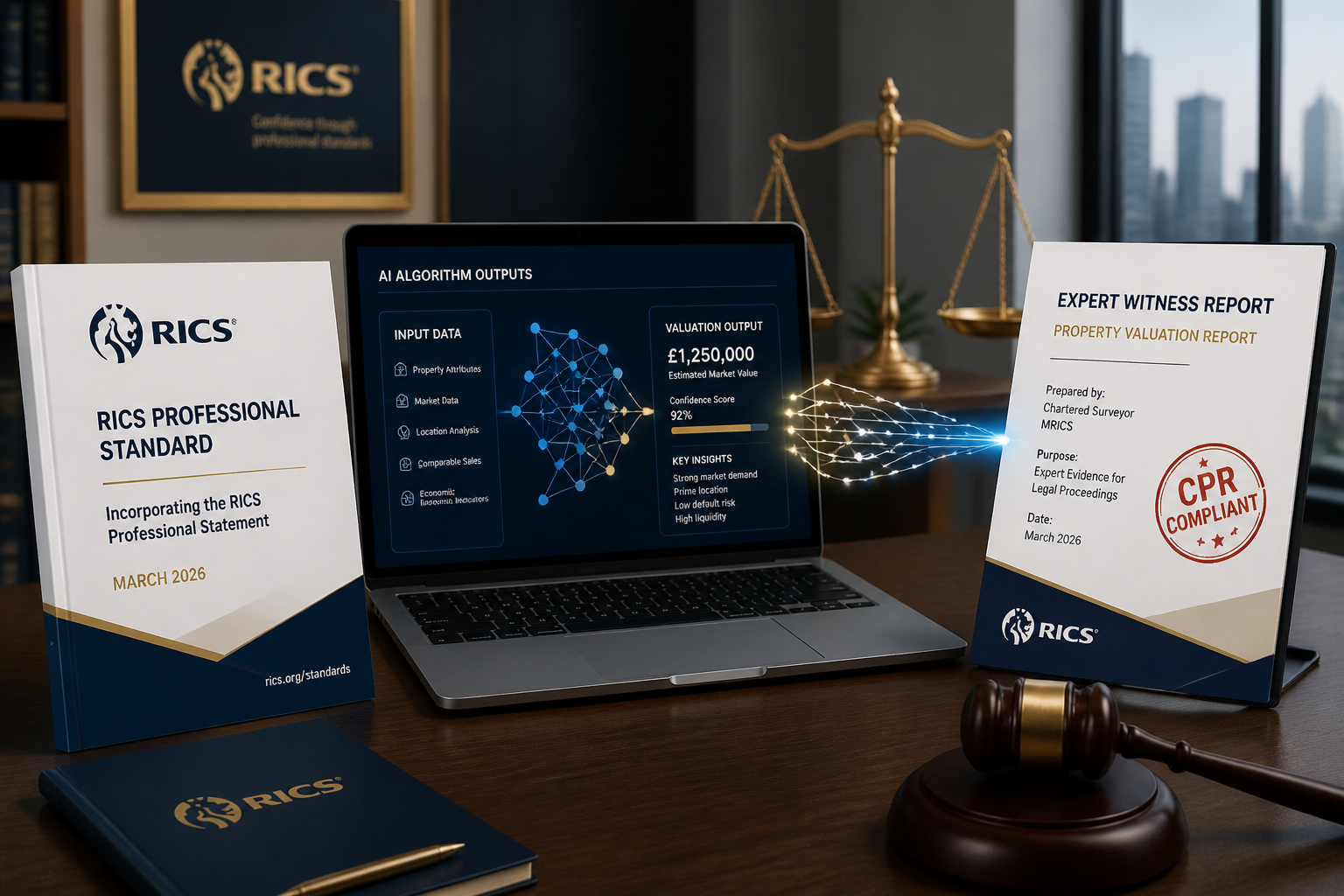
A single undisclosed AI tool in an expert witness report can now be grounds for a legal challenge — and since 9 March 2026, RICS members have had no excuse for not knowing it. The Royal Institution of Chartered Surveyors' new professional standard on the responsible use of AI fundamentally changes how valuers must approach, document, and defend their work in courtroom settings. For property professionals producing expert witness reports, the rules have shifted in ways that demand immediate attention.
This article unpacks what the Responsible AI for Expert Witness Reports: RICS March 2026 Standards for Bias-Free Valuations in Courtroom Disputes means in practice — from mandatory disclosure obligations to bias-testing protocols and CPR compliance strategies.
Key Takeaways 📌
- Mandatory disclosure: From 9 March 2026, RICS members must disclose any use of AI tools in expert witness reports, including the nature, scope, and limitations of those tools. [5]
- Bias-free valuations are now a professional obligation, not just best practice — AI outputs must be audited for algorithmic bias before inclusion in court documents.
- CPR Part 35 compliance remains the legal backbone for expert witnesses; the new RICS AI standard adds a professional compliance layer on top.
- Data transparency is central to the updated framework — valuers must document data sources, protect confidentiality, and justify AI-assisted conclusions. [2]
- ESG data integration is now mandatory in valuations, adding another layer of complexity to AI-assisted property assessments. [2]
What Changed on 9 March 2026: The RICS AI Standard Explained
The RICS "Responsible Use of AI in Surveying Practice" professional standard became effective on 9 March 2026, applying to all RICS members and regulated firms globally [5]. This is not guidance — it is a mandatory professional standard. Non-compliance carries the same regulatory consequences as any other breach of RICS rules.
The standard addresses a gap that had grown uncomfortably wide. AI tools had quietly entered valuation workflows — automated valuation models (AVMs), machine learning comparables tools, natural language report drafting assistants — yet no formal framework governed their use in high-stakes legal contexts. Courts, meanwhile, were beginning to ask harder questions about how expert opinions were formed.
💬 "The standard requires members to understand, manage, and be transparent about AI use — particularly where outputs inform professional opinions presented to third parties." — RICS Construction Journal [5]
Who Is Affected?
The standard applies to:
- Chartered surveyors producing expert witness reports for litigation, arbitration, or tribunal proceedings
- RICS-regulated firms using AI tools in any part of the valuation or reporting workflow
- Valuation professionals working across residential, commercial, and specialist property sectors
Compliance is required regardless of whether the AI tool is a proprietary platform, a third-party AVM, or a general-purpose language model used to draft sections of a report [5].
Understanding Bias Risks in AI-Assisted Property Valuations
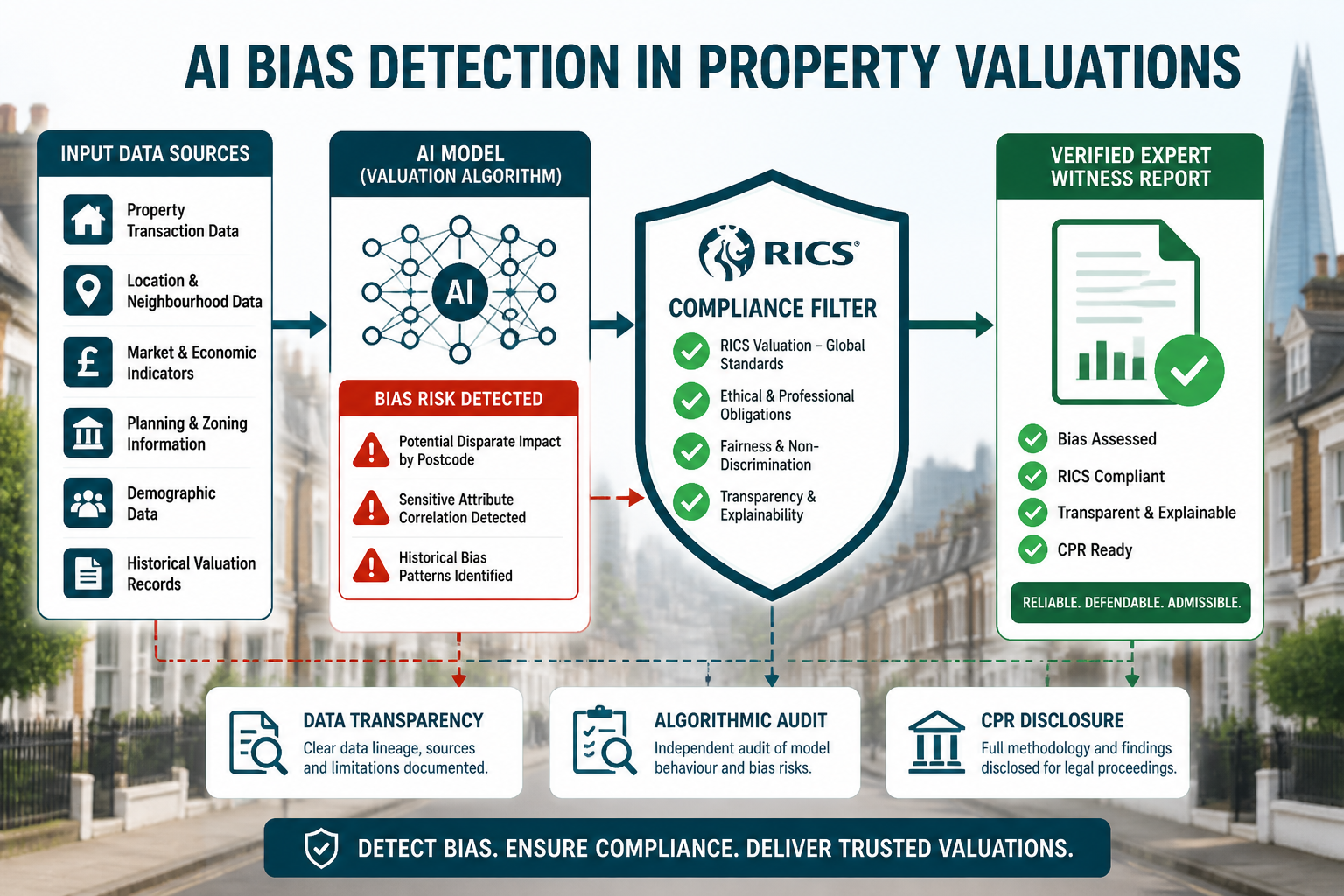
Algorithmic bias in property valuation is not theoretical. Historical training data often reflects systemic inequalities — in pricing, in lending patterns, in geographic investment — and AI models trained on that data can perpetuate and amplify those patterns without any human intent to discriminate.
In a courtroom context, this creates a specific and serious problem. An expert witness opinion must be independent, objective, and defensible. If an AI tool has introduced a systematic skew into a valuation — whether by underweighting certain property types, over-relying on a narrow comparables dataset, or applying weighting factors that reflect outdated market conditions — the entire opinion becomes vulnerable to challenge.
Common Sources of Algorithmic Bias in Valuations
| Bias Type | Description | Risk in Court |
|---|---|---|
| Training data bias | Model trained on historically skewed transaction data | Challenges to comparables selection |
| Geographic bias | Underrepresentation of certain postcodes or property types | Undermines market value conclusions |
| Temporal bias | Model weights older data too heavily | Misrepresents current market conditions [4] |
| Confirmation bias | AI output aligns with instructing party's preferred figure | Attacks on independence and objectivity |
| ESG data gaps | Failure to integrate mandatory sustainability metrics | Non-compliance with RICS Red Book updates [2] |
Understanding these risks is the first step. The RICS March 2026 standard requires professionals to actively test, document, and disclose how AI tools have been used and what steps were taken to identify and mitigate bias [5].
For valuations used in sensitive legal proceedings — such as matrimonial valuations or inheritance tax valuations — where the stakes are high and opposing parties will scrutinise every figure, the imperative to demonstrate bias-free methodology is especially acute.
Responsible AI for Expert Witness Reports: RICS March 2026 Standards for Bias-Free Valuations in Courtroom Disputes — The Disclosure Framework
The most immediate practical implication of the new standard is the disclosure obligation. Expert witnesses using AI tools must now address the following in their reports or supporting documentation:
1. 🔍 Identify the AI Tool(s) Used
Reports must specify which AI tools contributed to the valuation or report drafting process. This includes:
- The name and version of the tool
- The provider and any known limitations
- Whether the tool was used for data analysis, comparables selection, report drafting, or all three
2. 📊 Describe the Role of AI in the Opinion
The report must make clear where human professional judgement was applied and where AI output was relied upon. The expert's opinion must remain their own — AI is a tool, not the expert.
3. ⚠️ Disclose Known Limitations and Bias Risks
Any known limitations of the AI tool — including data coverage gaps, training data vintage, or known performance issues in specific market segments — must be disclosed. This is directly aligned with the broader RICS emphasis on enhanced data management and transparency [2].
4. ✅ Confirm Audit and Override Steps
The expert must confirm that AI outputs were reviewed, tested for plausibility, and where necessary overridden by professional judgement. This is not optional — it is the mechanism by which the expert retains ownership of their opinion.
CPR Part 35 Alignment
The Civil Procedure Rules Part 35 already require expert witnesses to confirm that their duty is to the court, not to the instructing party. The RICS AI disclosure framework reinforces rather than replaces this obligation. An expert who cannot explain how their AI tool works, what data it used, or how they tested its output for bias will struggle to satisfy a court that their opinion is truly independent.
For professionals involved in boundary disputes or complex leasehold extension and enfranchisement valuations, where opposing expert evidence is routinely tested under cross-examination, this level of methodological rigour is not just advisable — it is essential.
Responsible AI for Expert Witness Reports: RICS March 2026 Standards for Bias-Free Valuations in Courtroom Disputes — Practical Compliance Steps
Knowing the rules is one thing. Implementing them in a live caseload is another. The following framework offers a practical pathway to compliance for RICS-regulated professionals.
Step 1: Audit Your Current AI Tool Stack 🛠️
Before the next instruction lands, review every AI or automated tool currently used in the valuation and reporting workflow. For each tool, ask:
- What data was it trained on, and when?
- Does the provider publish a model card or transparency documentation?
- Has it been independently validated for the property types and geographies relevant to your practice?
Step 2: Build a Disclosure Template
Create a standard disclosure section for expert witness reports that can be adapted to each instruction. This should include:
- A brief description of AI tools used
- Their role in the process
- Steps taken to verify and validate outputs
- A statement confirming the expert's independent professional judgement
Step 3: Implement a Bias-Testing Protocol
For every AI-assisted valuation, document a structured check:
- Comparables review: Do the AI-selected comparables reflect the full available market, or is there a pattern of exclusion?
- Value sense-check: Does the AI output fall within the range a competent valuer would expect from manual analysis?
- ESG integration check: Has mandatory ESG data been incorporated and assessed for value impact? [2]
- Temporal relevance check: Does the model reflect current market conditions, including any recent volatility? [4]
Step 4: Maintain an AI Use Log
Keep a contemporaneous record of AI tool use for each instruction. This log should be retained as part of the file and should be available for disclosure if challenged. The RICS Valuation Compliance Framework pilot emphasises the importance of audit trails and consistent documentation practices [3].
Step 5: Stay Current with RICS and IVS Developments
The International Valuation Standards (IVS) consultation process has highlighted the need for ongoing alignment between global standards and emerging technology practices [6]. RICS members should monitor updates to both the Red Book and the AI standard, particularly as courts begin to develop their own expectations around AI disclosure in expert evidence.
For professionals seeking to understand what factors are examined during a property valuation, the addition of AI methodology to that list represents a significant evolution in professional practice.
ESG, Data Management, and the Expanding Scope of Responsible AI
The RICS March 2026 AI standard does not exist in isolation. It sits within a broader framework of updated valuation standards that have expanded the scope of what expert witnesses must address in their reports.
Mandatory ESG Integration 🌱
ESG data is now a mandatory consideration in RICS valuations [2]. For expert witness reports, this means:
- Environmental factors (flood risk, energy performance, climate exposure) must be recorded and assessed
- Social factors (community infrastructure, accessibility) may be relevant in certain dispute contexts
- Governance factors (lease structures, management quality) are particularly relevant in leasehold and block management disputes
AI tools that do not incorporate ESG data — or that treat it as optional — will produce valuations that are non-compliant with current RICS standards, regardless of their technical sophistication.
Data Rights and Confidentiality
The updated standards require valuers to protect data rights and confidentiality as the number of data sources used in valuations grows [2]. In an AI context, this raises specific questions:
- Does the AI tool transmit client data to external servers?
- Could confidential transaction data be incorporated into the tool's training dataset?
- What are the data retention and deletion policies of the AI provider?
These are not just IT questions — they are professional obligations that RICS members must address before using any AI tool in client work.

Defending AI-Assisted Valuations Under Cross-Examination
The ultimate test of any expert witness report is its performance under cross-examination. Opposing counsel will increasingly be equipped with questions specifically designed to probe AI-assisted methodology. The following scenarios illustrate the challenges — and how to prepare.
Scenario A: "Can you explain how the algorithm selected those comparables?"
The unprepared answer: "The software selected them automatically based on proximity and size."
The prepared answer: "The tool applied a weighted selection model based on [specific parameters]. I reviewed the output against my own market knowledge, excluded [specific comparables] for [specific reasons], and confirmed that the final selection represents the best available evidence. My report documents this process at paragraph [X]."
Scenario B: "Was the AI tool trained on data that included properties in this specific market segment?"
The unprepared answer: "I assume so — it's a widely used platform."
The prepared answer: "The provider's documentation confirms the training dataset covers [geographic scope and time period]. I supplemented the AI output with [specific manual research] to address any gaps in coverage for this property type."
Scenario C: "Did you consider whether the AI tool has any known biases?"
The unprepared answer: "I'm not aware of any issues."
The prepared answer: "I reviewed the provider's published model limitations and conducted a bias-testing protocol as part of my methodology. My file note documents the steps taken and my conclusions. I am satisfied that the AI output did not introduce any material bias into my valuation opinion."
The difference between these answers is preparation — and the RICS March 2026 standard provides the framework for that preparation.
Conclusion: Actionable Next Steps for RICS Professionals in 2026
The introduction of Responsible AI for Expert Witness Reports: RICS March 2026 Standards for Bias-Free Valuations in Courtroom Disputes is not a bureaucratic hurdle — it is a professional opportunity. Valuers who embrace transparent, auditable AI methodology will produce more defensible reports, withstand greater scrutiny, and ultimately serve their clients and the courts more effectively.
✅ Immediate Actions for Compliance
- Audit all AI tools currently used in valuation and reporting workflows against the RICS March 2026 standard requirements [5]
- Update report templates to include a standardised AI disclosure section aligned with CPR Part 35 obligations
- Implement a written bias-testing protocol and apply it consistently to every AI-assisted instruction
- Review ESG data integration in AI tools to confirm compliance with updated RICS Red Book requirements [2]
- Train all fee earners involved in expert witness work on the disclosure obligations and cross-examination preparation strategies outlined above
- Maintain an AI use log for every instruction as part of the standard file management process [3]
The courts will not wait for the profession to catch up. RICS members who treat the March 2026 standard as a minimum baseline — and who invest in genuinely robust AI governance — will be best placed to defend their opinions, protect their professional reputation, and deliver the independent, bias-free valuations that justice requires.
For expert guidance on compliant, court-ready property valuations, explore Prince Chartered Surveyors' specialist expert witness report services and their full range of professional valuation services.
References
[1] RICS APC Hot Topics 2026 QA Practice – resources.apcguide.com
[2] Changing Playbook: What RICS Red Book Revisions Mean for CRE Valuations – altusgroup.com
[3] The Valuation Compliance Framework Pilot: Key Information – rics.org
[4] Valuation Adjustments for March 2026 RICS Survey: Navigating Softer House Prices and Middle East Conflict Impacts – nottinghillsurveyors.com
[5] AI Responsible Use Standard – ww3.rics.org
[6] Finalised IVS Consultation Response – rics.org
[7] Valuation Standards – rics.org
[8] Navigating Uncertainty in Spring 2026 Valuations: How RICS Real-Time Surveyor Data Outperforms Automated Valuation Models – nottinghillsurveyors.com