

87% of surveying professionals say the skills gap is already affecting their work — and for more than a quarter of them, the impact is critical [2]. As the UK accelerates its retrofit agenda and a wave of infrastructure investment reshapes regions from Staffordshire to Surrey, the Skills Shortage in Building Surveying: RICS 2025 Strategies for Firms Facing 2026 Infrastructure and Retrofit Demands has become one of the most urgent workforce challenges in the built environment sector.
The pipeline of work is growing. The talent pipeline is not keeping pace.
Firms handling high volumes of building surveys, party wall matters, and defect investigations are feeling this most acutely. Without a clear plan — covering recruitment, apprenticeships, digital upskilling, and retention — practices risk turning away profitable work or delivering below the standard clients expect.
This article breaks down what the RICS 2025 Surveying Skills Report reveals, and what firms can do right now to close the gap before 2026 demand peaks.
Key Takeaways 📌
- 87% of professionals report the skills gap is impacting their practice, with 27% calling it critical [2]
- Building surveying, quantity surveying, and residential surveying face the most severe shortages across all RICS disciplines [4]
- Aging workforce attrition combined with low graduate replacement rates is accelerating the crisis [4]
- Digital skills, sustainability knowledge, and business acumen are the three capability areas most urgently needed [2]
- Firms that invest in apprenticeships, structured CPD, and flexible recruitment now will be best positioned for 2026's infrastructure and retrofit surge [6]
Understanding the Scale: What RICS 2025 Data Really Shows

The RICS 2025 Surveying Skills Report paints a stark picture. This is not a minor staffing inconvenience — it is a structural workforce problem decades in the making [4].
The Numbers Behind the Crisis
| Metric | Finding |
|---|---|
| Professionals reporting skills gap impact | 87% |
| Reporting critical/severe impact | 27% |
| Prioritising AI and digital tools development | 59% |
| Citing sustainability/decarbonisation skills | 41% |
| Citing data analytics as a critical need | 40% |
| Believing business skills need most improvement | 51% |
Source: RICS Surveying Skills Report 2025 [4]
💬 "The profession must prioritize development of advanced digital tools and AI skills to prepare for the future." — RICS Skills Report [2]
Building surveying sits alongside quantity surveying and residential surveying as the three disciplines experiencing the most significant shortages [4]. This is not coincidental. These are the roles most directly tied to the UK's housing stock condition, retrofit compliance, and infrastructure delivery — precisely the areas facing the biggest demand surge in 2026.
Why the Gap Is Widening
Several forces are converging simultaneously:
- 🏗️ An aging workforce — senior surveyors are retiring faster than graduates can replace them [4]
- 📉 Insufficient APC completion rates — many candidates begin the pathway but do not finish
- 🏠 Surging demand — retrofit mandates, building safety reforms, and new infrastructure projects are creating unprecedented workloads
- 🌍 Evolving skill requirements — the job now demands digital literacy, sustainability expertise, and data fluency that traditional training programmes did not cover [1]
The RICS President's column from early 2025 acknowledged this directly, calling for urgent coordinated action across firms, universities, and professional bodies [3].
Skills Shortage in Building Surveying: RICS 2025 Strategies Firms Are Adopting
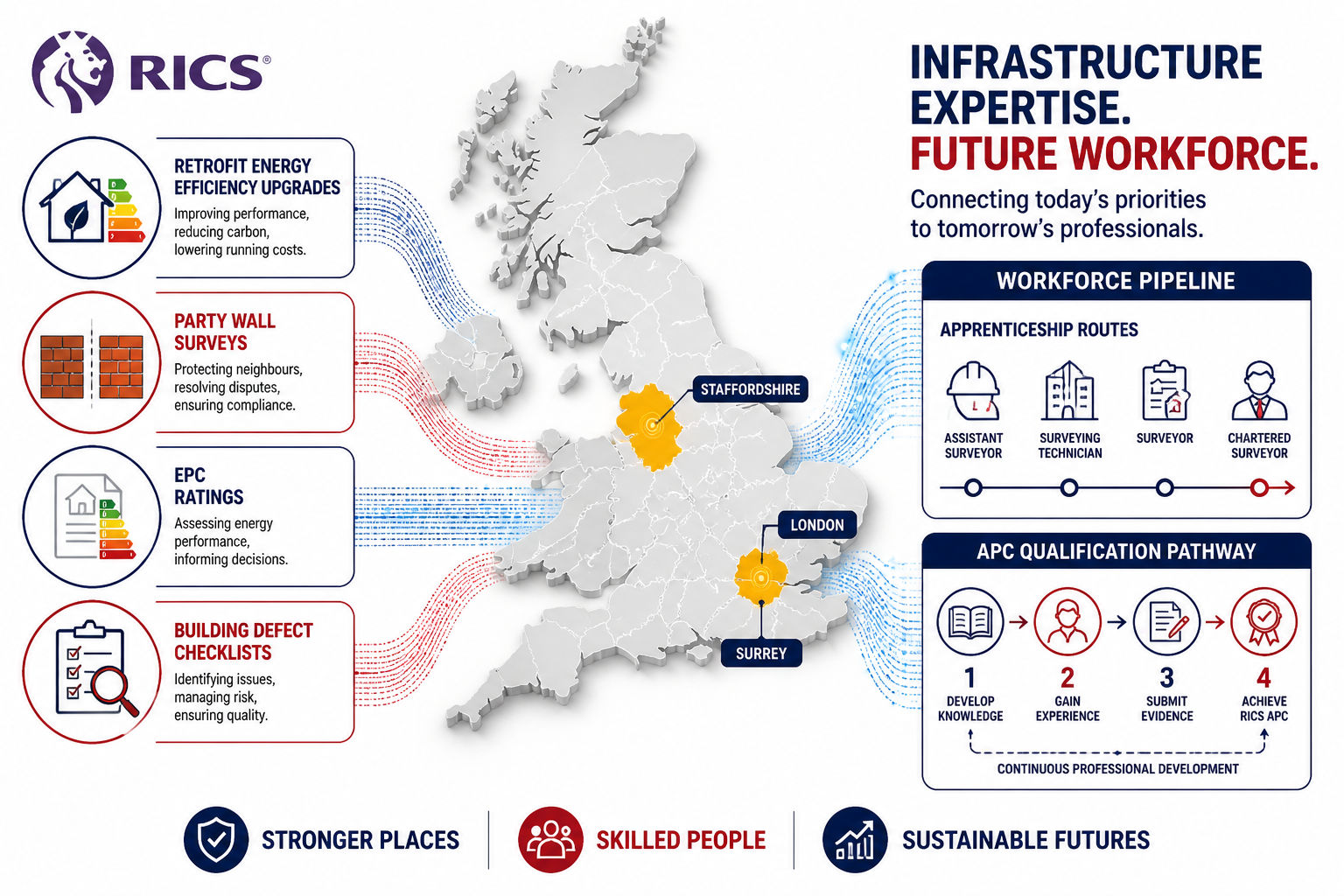
Addressing the Skills Shortage in Building Surveying: RICS 2025 Strategies for Firms Facing 2026 Infrastructure and Retrofit Demands requires action on multiple fronts. No single fix will work. The firms gaining ground are those treating this as a strategic priority, not an HR afterthought.
1. Rebuilding the Talent Pipeline Through Apprenticeships
The degree apprenticeship route has emerged as one of the most effective tools for bringing new talent into building surveying without requiring candidates to leave employment. Several key advantages make this route attractive in 2026's market:
- Apprentices earn while they learn, removing a major barrier to entry
- Firms retain candidates throughout training, building loyalty from day one
- The Apprenticeship Levy can offset significant training costs for qualifying employers
- Apprentices develop practical skills in real project environments — highly relevant for defect investigation and building inspections
Firms in high-demand regions like Staffordshire, Surrey, and the South East are increasingly partnering with local universities and colleges to create direct-entry pipelines. This regional approach matters: surveying recruitment trends for 2026 show that building safety and housing compliance roles are particularly hard to fill outside major city centres [6].
2. Retaining Senior Talent Through Flexible Working
Losing an experienced chartered surveyor is not just a headcount problem. It is a loss of institutional knowledge, client relationships, and technical judgment that takes years to rebuild.
Retention strategies that are proving effective include:
- Phased retirement programmes — allowing senior surveyors to reduce hours gradually rather than exit abruptly
- Mentoring roles — pairing experienced professionals with APC candidates creates value on both sides
- Flexible project allocation — giving senior staff more autonomy over the type and volume of work they take on
- Competitive remuneration reviews — salaries in building surveying have risen sharply; firms that do not benchmark regularly are losing staff to competitors [6]
For practices handling significant volumes of party wall work, defect surveys, and Level 3 full building surveys, the loss of even one experienced surveyor can create serious capacity bottlenecks.
3. Upskilling Existing Staff: The Three Priority Areas
The RICS data is clear about where the capability gaps are most damaging. Firms should structure their CPD programmes around three core areas:
🤖 Digital Tools and AI
With 59% of professionals identifying this as the top priority [2], firms need to invest in training staff to use:
- AI-assisted defect analysis platforms
- Digital survey reporting tools
- BIM (Building Information Modelling) for complex projects
- Drone and thermal imaging technology for building access and inspection
🌿 Sustainability and Decarbonisation
41% of professionals flag this as the next most critical skill area [2]. With EPC reform and MEES regulations driving demand for retrofit assessments, surveyors who understand EPC ratings and MEES compliance are commanding premium rates and are in short supply.
The UK's retrofit agenda — upgrading millions of homes to meet energy efficiency targets — is creating a sustained demand for surveyors who can assess existing fabric, identify defects like moisture issues and wood rot, and specify appropriate interventions.
📊 Business and Data Skills
51% of professionals believe business skills represent the area with the most scope for improvement among new entrants [2]. This includes:
- Client communication and report writing
- Commercial awareness and fee negotiation
- Data analytics for portfolio-level assessments
- Project management fundamentals — skills increasingly valued as firms take on larger infrastructure commissions
Facing 2026 Infrastructure and Retrofit Demands: Practical Steps for Firms
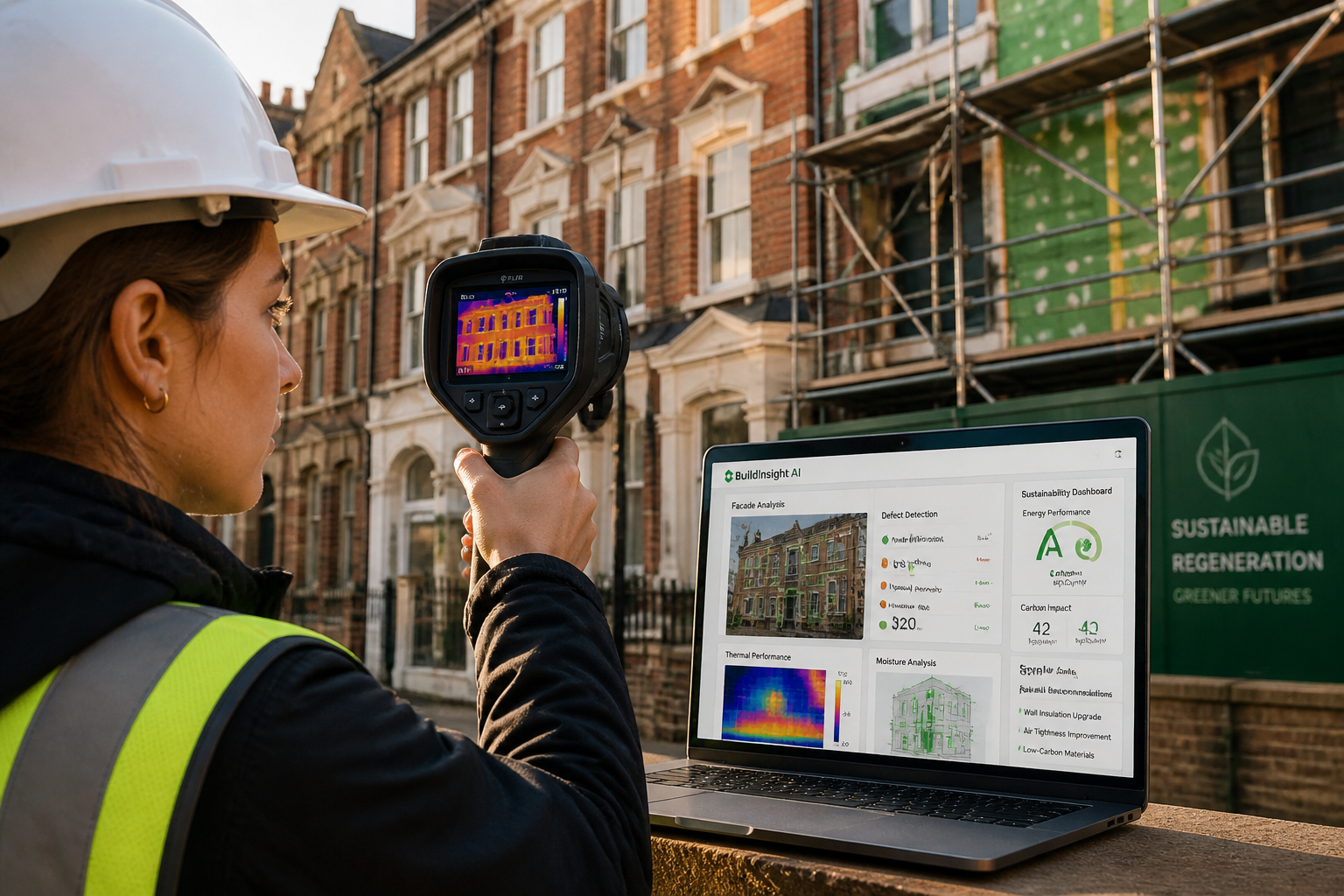
The Skills Shortage in Building Surveying: RICS 2025 Strategies for Firms Facing 2026 Infrastructure and Retrofit Demands is not an abstract policy debate. For practice principals and team leaders, it translates into daily decisions about how to staff projects, manage APC candidates, and deliver quality work under capacity pressure.
Structuring Your Firm for High-Volume Demand
Firms anticipating significant growth in party wall instructions, defect surveys, and retrofit assessments in 2026 should consider restructuring their delivery model:
Team tiering works well for high-volume practices:
| Tier | Role | Responsibility |
|---|---|---|
| Senior Chartered Surveyors | Technical sign-off, complex cases | Quality control, APC supervision |
| Associate Surveyors | Day-to-day survey delivery | Primary client contact |
| APC Candidates | Supported fieldwork | Skill development under supervision |
| Apprentices/Graduates | Data gathering, report drafting | Foundation building |
This model allows firms to handle greater volumes without compromising the quality that RICS standards demand. It also creates a natural career progression pathway that aids retention.
Recruitment Beyond the Usual Channels
Traditional job boards are no longer sufficient in a candidate-short market. Firms are finding success through:
- University partnerships — sponsoring final-year projects and offering placement years
- Careers fairs — particularly targeting built environment and civil engineering students who may not have considered surveying
- Social media recruitment — LinkedIn and sector-specific platforms are increasingly where mid-career professionals look for opportunities
- Internal referral schemes — existing staff networks often surface the best candidates
- Exploring careers pages — firms with a clear careers proposition that communicates culture, development pathways, and project variety attract stronger applicants
APC Support as a Retention Tool
Candidates sitting the APC are among the most flight-risk employees in any surveying firm. The process is demanding, and without structured support, candidates either fail or move to firms that offer better mentoring.
Effective APC support programmes include:
- Dedicated supervisor time (not just nominal allocation)
- Mock assessment interviews
- Structured diary review sessions
- Access to a breadth of work types — including what types of building surveys are available to ensure candidates meet competency requirements
- Study leave allowance in the months before submission
RICS APC hot topics for 2025 include sustainability, building safety, and digital competence — all areas where firms can provide real project experience that directly supports candidate development [7].
Addressing the Retrofit Skills Gap Specifically
The retrofit wave is unlike anything the profession has previously managed at scale. Surveyors need to understand:
- Whole-house retrofit assessment methodologies
- Interaction between insulation upgrades and existing defects (particularly damp and ventilation)
- EPC improvement pathways and their structural implications
- How to advise clients on renovation sequencing to avoid creating new problems
Firms that develop genuine retrofit expertise — and communicate it clearly — will be well positioned to win both residential and commercial retrofit contracts throughout 2026 and beyond.
Building a Resilient Practice: Long-Term Thinking in a Tight Market
Short-term recruitment fixes will not solve a structural problem. The firms that will thrive through the 2026 demand surge are those building resilience into their operating model now.
Key Principles for Long-Term Workforce Resilience
- Treat workforce planning as a board-level priority — not just an HR function
- Invest in CPD budgets — surveyors who feel professionally supported stay longer
- Build regional networks — particularly in growth areas like Staffordshire, the South East, and major urban centres where infrastructure investment is concentrated
- Collaborate with RICS — the professional body is actively developing resources, guidance, and frameworks to support firms navigating the skills crisis [3]
- Diversify your talent pool — actively recruiting from underrepresented groups expands the available candidate base and brings different perspectives to complex technical challenges [1]
💬 "Bridging the skills gap requires action at every level — from individual firms investing in their people to the profession as a whole rethinking how it attracts and develops talent." [1]
Conclusion: Act Now Before 2026 Demand Peaks
The evidence from the RICS 2025 Surveying Skills Report is unambiguous. The Skills Shortage in Building Surveying: RICS 2025 Strategies for Firms Facing 2026 Infrastructure and Retrofit Demands represents both a serious risk and a genuine opportunity. Firms that move decisively will capture market share. Those that wait will find themselves understaffed and unable to meet client commitments at exactly the moment demand is highest.
Actionable Next Steps for Firm Leaders
✅ Audit your current team — identify who is approaching retirement, who is mid-APC, and where your technical skill gaps are most acute
✅ Launch or expand your apprenticeship programme — use Levy funding where available and build university partnerships in your region
✅ Invest in digital and sustainability training — prioritise the three RICS-identified skill areas in your 2026 CPD plan
✅ Review your APC support structure — ensure candidates have genuine mentoring, not just nominal supervision
✅ Benchmark salaries and benefits — in a candidate-short market, retention is cheaper than replacement
✅ Communicate your firm's career proposition clearly — whether through your careers page, social media, or university partnerships
The infrastructure and retrofit demands of 2026 will not wait for the profession to catch up. The time to build your team is now.
References
[1] Bridging The Skills Gap Key Insights From The Rics 2025 Surveying Skills Report – whitewaterpc.com
[2] Rics Skills Report – rics.org
[3] President Column Justin Sullivan February 2025 – ww3.rics.org
[4] Surveying Skills Report 2025 – rics.org
[6] Surveying Recruitment Trends 2026 Skills Shortages In Building Safety And Housing Compliance Roles – nottinghillsurveyors.com
[7] Rics Apc Hot Topics 2025 Questions Answers – resources.apcguide.com
How Prince Surveyors can help: explore our Level 3 building surveys or learn about our Level 2 vs Level 3 guide.