

Nearly one in five mortgage applications involving non-standard construction properties is declined or significantly delayed — not because the building is necessarily unsafe, but because the risks were never properly identified in the first place. Non-Standard Construction and Building Surveys: Identifying Hidden Risks in Converted and Altered Properties sits at the intersection of professional liability, buyer protection, and valuation accuracy, yet it remains one of the most inconsistently handled areas in the surveying profession.
RICS Level 3 surveys are explicitly recommended for unusual, altered, or non-conventionally built properties. However, no universally standardised protocol exists for how surveyors should assess non-standard construction methods — a gap that creates real consequences for buyers, lenders, and surveyors alike. Understanding what these surveys should cover, and where the risks hide, is essential knowledge for anyone buying, selling, or financing a converted or altered property in 2026.
Key Takeaways
- ✅ Non-standard construction properties require a RICS Level 3 Building Survey as a minimum — a basic valuation or Level 2 HomeBuyer Report is rarely sufficient.
- ⚠️ Converted and altered properties carry layered risks: original defects, conversion-era problems, and post-alteration issues can all coexist.
- 🔍 Surveyors must assess structural integrity, moisture ingress, insulation performance, and compliance — areas where non-standard builds frequently fail.
- 📋 The absence of standardised survey protocols for non-conventional construction creates liability gaps that buyers and lenders often discover too late.
- 💡 Commissioning the right survey before exchange can save tens of thousands of pounds in remediation costs and prevent mortgage refusals.
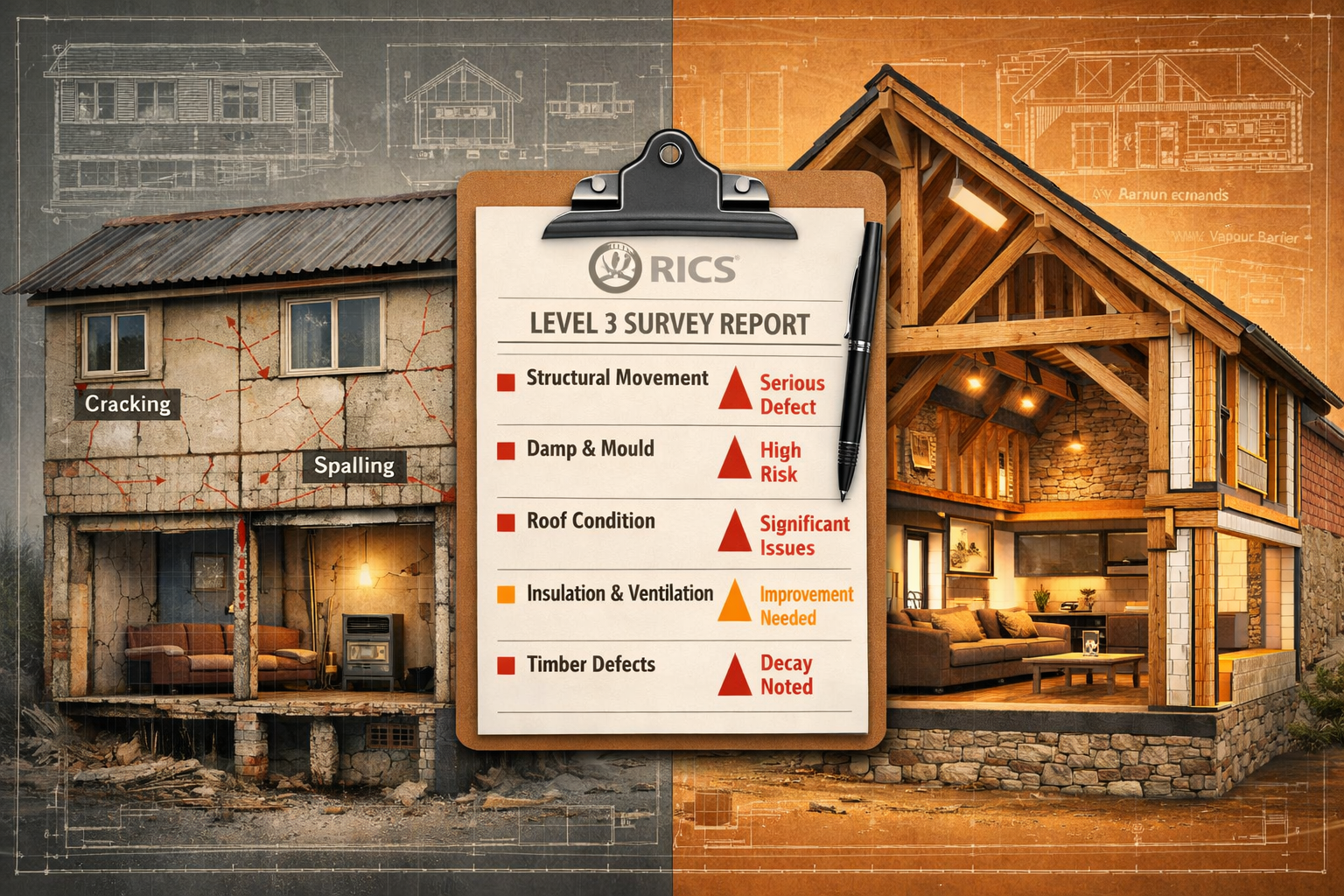
What Counts as Non-Standard Construction?
Before examining survey methodology, it is worth establishing what the term actually covers. Standard construction typically means a property with brick or stone cavity walls, a pitched roof with slate or tile covering, and a concrete or timber floor. Anything that deviates meaningfully from this definition falls into non-standard territory.
Common Non-Standard Construction Types
| Construction Type | Era | Key Risk Areas |
|---|---|---|
| Prefabricated concrete (Airey, BISF, Wimpey No-Fines) | 1940s–1960s | Carbonation, reinforcement corrosion, moisture ingress |
| Timber frame (including SIPs panels) | Various | Interstitial condensation, rot, fire spread |
| Steel frame (including BISF houses) | Post-WWII | Corrosion, thermal bridging, insulation failure |
| Thatched roof properties | Pre-1900 | Fire risk, vermin, moisture, structural loading |
| Converted barns, churches, schools | Various | Structural repurposing, damp, planning compliance |
| Flat-roofed extensions | 1960s–present | Waterproofing failure, thermal performance |
| Properties with significant extensions or alterations | Any era | Structural compatibility, building regulations compliance |
This list is not exhaustive. Properties with unusual foundations, large-span roofs, or significant alterations to load-bearing walls also present non-standard risk profiles that demand specialist attention.
For a broader understanding of the different survey levels available, the guide to what types of building surveys exist provides a useful starting point.
Why Non-Standard Construction and Building Surveys: Identifying Hidden Risks in Converted and Altered Properties Demands Specialist Expertise
"A standard survey checklist applied to a non-standard building is like using a road map to navigate a river — the tool simply wasn't designed for the terrain."
The core problem is structural: most survey training and reporting frameworks are built around conventional properties. When a surveyor encounters a 1960s prefabricated concrete house, a converted mill, or a Victorian terrace with a rear steel-frame extension, the standard inspection approach may miss critical defects entirely.
The Three Layers of Risk in Converted Properties
Converted and significantly altered buildings carry what can be described as layered risk — defects that exist at multiple historical stages of the building's life:
Layer 1 — Original Construction Defects
These are problems inherent to the building's original materials or methods. In prefabricated concrete properties, carbonation of the concrete and corrosion of embedded steel reinforcement are well-documented issues. In older timber-frame barns, beetle infestation and wood rot may have been present for decades before conversion work began.
Layer 2 — Conversion-Era Problems
When a building is converted — from agricultural to residential use, for example — the work introduces new risks. Insulation added between original structural elements can create interstitial condensation zones. New openings cut through load-bearing walls without adequate structural support are a persistent finding. Drainage systems designed for a different use may be wholly inadequate.
Layer 3 — Post-Alteration Deterioration
Even well-executed conversions degrade over time. Flat roofs added to barn conversions develop waterproofing failures. Steel beams inserted during conversion corrode if moisture control was inadequate. Extensions built under different building regulations than those current today may not meet modern thermal or structural standards.
Understanding what causes moisture in buildings is particularly relevant here, since moisture-related defects are among the most common — and most costly — findings in non-standard and converted properties.
The Liability Gap in Survey Protocols
RICS guidance recommends a Level 3 Building Survey for non-standard, older, or significantly altered properties. This is the most comprehensive residential survey available. Yet the RICS Level 3 framework itself does not prescribe specific inspection protocols for individual non-standard construction types. This means that the depth and accuracy of assessment can vary significantly between surveyors.
For buyers, this gap can be financially devastating. A surveyor who does not specifically test for carbonation in a prefabricated concrete property, or who fails to assess the structural implications of a removed chimney breast, may produce a report that appears thorough but misses the most consequential risks.
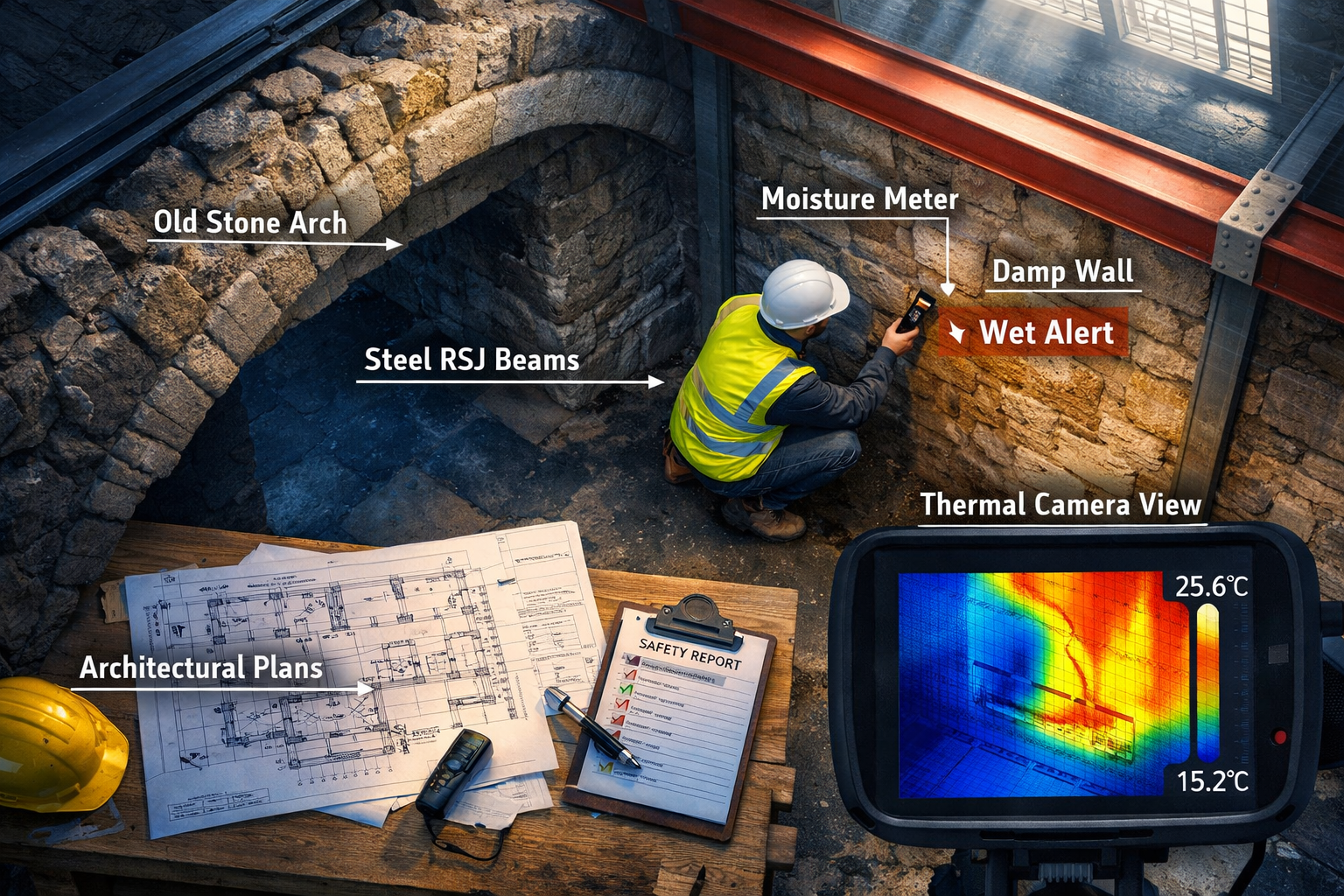
Critical Risk Areas: What a Thorough Survey Must Examine
Structural Integrity and Load-Bearing Alterations
Alterations to load-bearing elements are among the highest-risk findings in any property survey, but they are especially prevalent in converted buildings. Common issues include:
- Removed chimney breasts without adequate support for the remaining stack above
- Enlarged openings in load-bearing walls without properly sized lintels or padstones
- New floor levels introduced during conversion that alter the structural behaviour of original walls
- Roof structure modifications that redistribute loading onto walls not designed for it
Understanding stresses in structural members of buildings is directly relevant when assessing whether alterations have compromised structural performance. A competent Level 3 surveyor will identify where structural interventions have occurred and flag where specialist structural engineering input is required.
Moisture, Damp, and Thermal Performance
Non-standard construction types are disproportionately prone to moisture-related defects. Key areas to assess include:
- Rising damp in solid-wall properties without effective damp-proof courses
- Penetrating damp through non-standard wall systems, particularly in converted agricultural buildings with original stone or rubble-fill walls
- Interstitial condensation within insulated timber or steel frame panels
- Flat roof waterproofing on extensions and conversions
- Thermal bridging at junctions between original fabric and new construction
Building Regulations Compliance and Planning Consent
Converted properties frequently carry compliance risks that are invisible to the untrained eye. A survey should investigate:
- Whether planning permission was obtained for the conversion and any subsequent alterations
- Whether building regulations approval was granted and completion certificates issued
- Whether listed building consent applies — a critical consideration for historic conversions (see the guide to listed buildings and conservation areas for more detail)
- Whether any permitted development rights have been used correctly
The absence of completion certificates for building regulations work is a significant red flag. It can affect mortgage availability, insurance, and future saleability.
Energy Performance and Modern Standards
In 2026, energy performance is increasingly central to property value and mortgage eligibility. Non-standard construction types frequently perform poorly against modern thermal standards. Solid walls, uninsulated roofs, and single-glazed windows in converted properties can result in very low Energy Performance Certificate (EPC) ratings. The relationship between EPC ratings, MEES regulations, and building surveys is particularly important for buyers of converted properties who intend to let them.
Non-Standard Construction and Building Surveys: Identifying Hidden Risks — The Survey Process in Practice
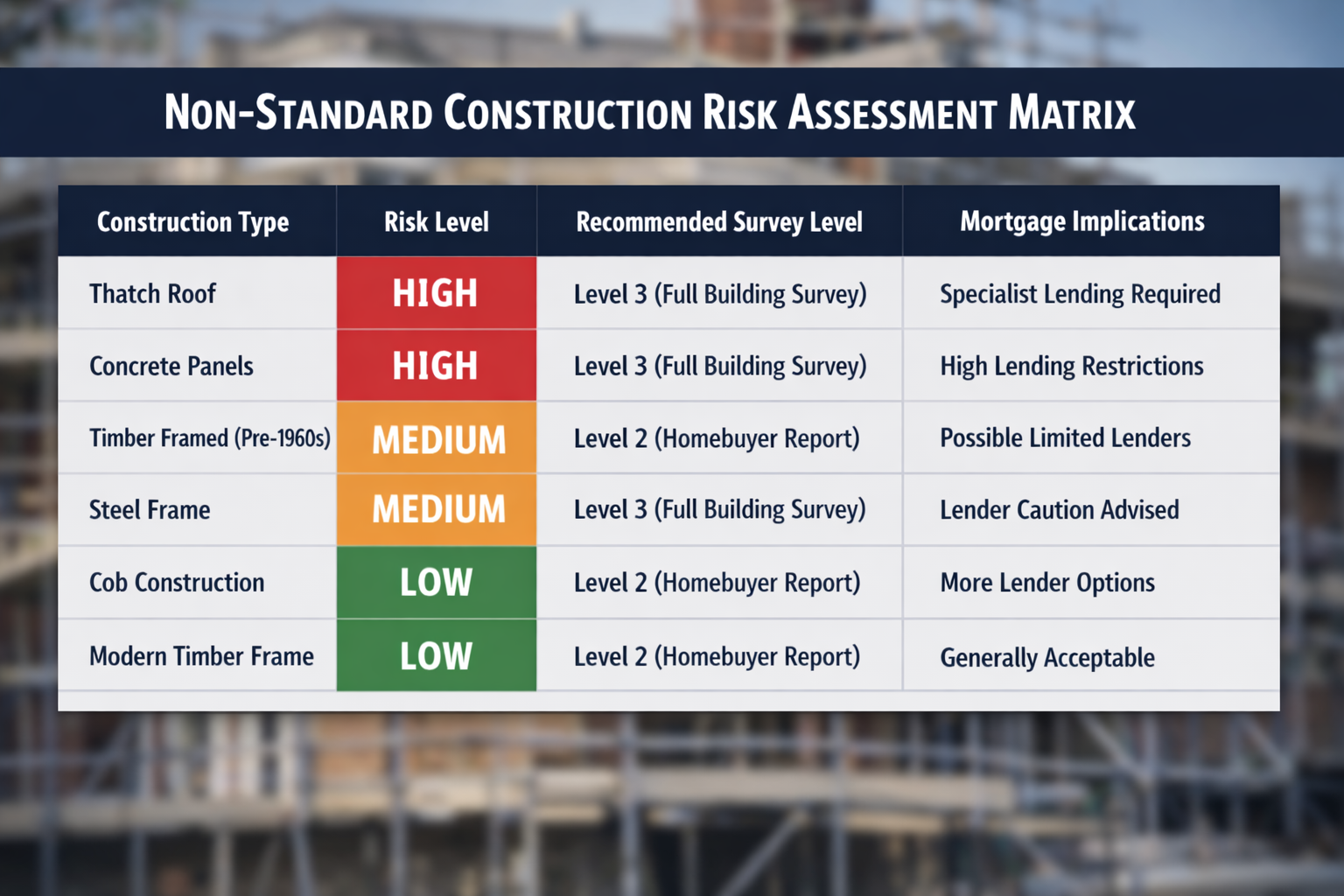
Choosing the Right Survey
The first decision is selecting the appropriate survey type. For any property that falls outside standard construction, a Level 3 Building Survey is the appropriate choice. This provides:
- A full visual inspection of all accessible parts of the building
- Detailed reporting on construction type and condition
- Specific advice on defects, their cause, and recommended remediation
- Commentary on risks that may not yet be visible but are likely to develop
For guidance on which building survey is right for a specific property, it is worth consulting a chartered surveyor before commissioning any report.
Questions to Ask Before and During the Survey
Buyers should be proactive. Key questions to raise with a surveyor before commissioning a report include:
- Do you have specific experience with this type of non-standard construction?
- Will you test for [specific risks relevant to the construction type]?
- Will the report include recommendations for specialist investigations where needed?
- How will you assess compliance with building regulations for the conversion works?
The questions to ask during a building survey resource provides additional guidance on getting maximum value from the survey process.
Updated Standards and Documentation in 2026
The 2026 ALTA/NSPS Land Title Survey Standards, which took effect in February 2026, reflect a broader industry shift toward more rigorous field documentation and risk identification [1]. The updated standards require surveyors to more clearly document observations during fieldwork, including evidence of possession, physical features indicating encroachments, and conditions affecting title or use [1]. A new optional summary table allows surveyors to present observed conditions — including encroachments, conflicts, and use issues — in a structured format designed to reduce uncertainty and support smoother transactions [1].
While these standards apply primarily to land title surveys in the US context, the underlying principle — that better documentation and earlier risk identification reduces liability and transaction risk — is directly applicable to building surveys of non-standard properties in the UK. The direction of travel across the surveying profession is clearly toward greater specificity and accountability in reporting.
The Role of Specialist Investigations
A Level 3 survey is a visual inspection. For non-standard construction types, it will frequently identify the need for specialist investigations that go beyond what a general surveyor can assess. These may include:
- Structural engineer's report — for properties with significant alterations to load-bearing elements
- Timber and damp specialist survey — for properties with suspected rot, beetle infestation, or rising damp
- Drainage CCTV survey — for converted properties where drainage systems have been significantly altered
- Asbestos survey — for properties built or converted between 1950 and 2000
- Electrical and gas installation inspection — particularly where wiring or pipework has been rerouted during conversion
These specialist reports add cost and time to the buying process, but they are far less expensive than discovering major defects after completion.
Mortgage and Insurance Implications
Non-standard construction properties present specific challenges for mortgage lenders and insurers. Many high-street lenders will not lend against certain construction types — particularly prefabricated concrete properties — without specialist reports confirming structural adequacy. Even where lending is available, it may be subject to conditions or retention of funds pending remediation.
For insurance purposes, non-standard construction affects both the availability and cost of buildings insurance. An accurate insurance reinstatement cost valuation is essential for converted properties, where rebuilding costs may differ significantly from standard construction due to specialist materials, skills, or planning requirements.
Buyers should obtain written confirmation of mortgage and insurance terms before exchange of contracts — not after.
Common Defects Found in Converted and Altered Properties
The following defects appear repeatedly in Level 3 surveys of non-standard and converted properties:
- 🔴 Structural movement — settlement cracks, leaning walls, deflected beams
- 🔴 Roof covering failure — particularly on flat roofs and non-standard materials
- 🟡 Damp penetration — through walls, at floor level, or via roof
- 🟡 Inadequate insulation — creating thermal bridging and condensation risk
- 🟡 Missing or defective damp-proof course — common in solid-wall and converted agricultural buildings
- 🟡 Absence of building regulations completion certificates — for conversion and alteration works
- 🟠 Asbestos-containing materials — in properties converted during the 1960s–1990s
- 🟠 Substandard electrical installations — particularly where wiring has been extended during conversion
For a broader overview, the 11 common defects found in older homes provides useful context on the types of issues that frequently emerge in period and non-standard properties.
Conclusion: Actionable Next Steps for Buyers and Owners
Non-standard construction and building surveys — particularly for converted and altered properties — demand a level of specialist knowledge and thoroughness that goes beyond a standard inspection checklist. The risks are real, they are layered, and they are frequently invisible to the untrained eye.
Here are the actionable steps to take in 2026:
-
Identify the construction type early — before commissioning any survey, establish whether the property falls outside standard construction. Ask the estate agent, check the listing, and review any available planning history.
-
Commission a RICS Level 3 Building Survey — for any non-standard, converted, or significantly altered property, this is the minimum appropriate survey level. Do not accept a Level 2 HomeBuyer Report as adequate.
-
Choose a surveyor with relevant specialist experience — ask specifically about their experience with the construction type in question. A surveyor who has never assessed a BISF steel-frame house or a barn conversion may miss the most important risks.
-
Budget for specialist investigations — expect the Level 3 survey to recommend further specialist reports. Factor this cost into the buying budget from the outset.
-
Confirm mortgage and insurance terms before exchange — do not assume that a non-standard property will be mortgageable or insurable on standard terms. Get written confirmation early.
-
Review compliance documentation carefully — ensure planning permissions, building regulations approvals, and completion certificates are in place for all conversion and alteration works.
The cost of a thorough survey is modest compared to the potential cost of discovering major defects after completion. In a property market where non-standard and converted buildings represent a growing share of available stock, getting the survey right is not optional — it is essential.
References
[1] Alta Nsps 2026 Survey Standards Whats Changed And What It Means For The Industry – atwell.com