

Only 29% of private rental sector properties in England meet all current HHSRS hazard standards — yet from 2026, landlords face legally enforceable repair timelines that could place them in front of a tribunal within weeks of a complaint. For surveyors asked to act as expert witnesses, the stakes have never been higher.
Expert Witness Preparation for Excess Temperature and Falls Hazards in Awaab's Law 2026 PRS Extensions is now one of the most pressing professional challenges facing chartered surveyors. As Awaab's Law moves beyond its Phase 1 focus on damp and mould into Phase 2 hazards — including excess heat, excess cold, and falls on stairs and baths — the demand for rigorous, court-ready expert evidence is accelerating fast.
This guide sets out a clear protocol for surveyors preparing to act as expert witnesses in disputes arising from these newly enforced hazard categories under the private rental sector (PRS) extensions anticipated in 2026.
Key Takeaways 📋
- Awaab's Law Phase 2 (expected later in 2026) extends enforceable hazard timelines to include excess temperature and structural/falls hazards [1]
- Expert witnesses must produce HHSRS-compliant, court-ready reports that withstand cross-examination
- Excess heat and falls on stairs and baths are among the most litigated HHSRS categories in the PRS
- Documentation quality — temperature logs, photographic evidence, and repair history — is decisive in tribunal outcomes
- Surveyors must remain impartial, evidence-led, and compliant with Civil Procedure Rules (CPR) Part 35
Understanding Awaab's Law and Its 2026 PRS Extensions
Awaab's Law was enacted following the tragic death of two-year-old Awaab Ishak, who died in 2020 from a respiratory condition caused by severe mould in a social housing property. The law introduced mandatory timelines for landlords to investigate and remediate hazards.
Phase 1, which came into force in October 2025, requires social landlords to:
- Acknowledge hazard reports within 24 hours for emergencies
- Begin investigations within 14 calendar days
- Complete repairs within 7 calendar days for emergency hazards
- Address significant hazards within 10 working days [1]
Phase 2, arriving later in 2026, expands the scope to include excess cold, excess heat, structural collapse, and electrical hazards [2]. Full coverage of all 29 HHSRS hazard categories is expected by 2027 [1].
💡 Pull Quote: "The extension of Awaab's Law to excess temperature and falls hazards marks a fundamental shift in how landlords — and the courts — will assess housing fitness in 2026 and beyond."
What About the Private Rental Sector?
The original legislation targeted social landlords specifically. However, the Renters' Rights Act 2025 and associated secondary legislation are expected to extend similar obligations to the private rental sector (PRS) during 2026. While formal confirmation of full PRS parity is still awaited, enforcement bodies, housing ombudsmen, and county courts are already applying HHSRS standards to private tenancy disputes.
The Housing Ombudsman's 2026 hazards report called explicitly for a sharper focus on early warning signs in hazard identification — a direct signal that proactive, evidence-based assessments will be central to compliance and dispute resolution [3].
For surveyors, this means that expert witness instructions in PRS cases involving excess temperature and falls hazards are now arriving regularly — and the professional bar for evidence quality is rising sharply.
The 29 HHSRS Hazards: Which Matter Most for Expert Witnesses?
Under the Housing Health and Safety Rating System (HHSRS), hazards are scored by likelihood and severity of harm. For expert witnesses in 2026 PRS disputes, the most frequently contested categories include:
| HHSRS Hazard | Category | Common Dispute Trigger |
|---|---|---|
| Excess heat | Environmental | Overheating flats, broken cooling systems |
| Excess cold | Environmental | Inadequate heating, poor insulation |
| Falls on stairs | Safety | Worn treads, broken banisters |
| Falls on the level | Safety | Uneven flooring, wet surfaces |
| Falls associated with baths | Safety | Slippery surfaces, absent grab rails |
| Structural collapse | Structural | Ceiling/roof failures |
Understanding building defects and their consequences is essential groundwork before any expert witness instruction is accepted.
Expert Witness Preparation for Excess Temperature and Falls Hazards in Awaab's Law 2026 PRS Extensions: Core Protocols
Effective expert witness preparation is not simply about knowing the law. It requires a structured methodology that produces defensible, impartial evidence. The following protocols are designed specifically for excess temperature and falls hazards under the 2026 PRS framework.
Protocol 1: Accepting the Instruction — Scope and Impartiality
Before accepting any expert witness instruction, surveyors must confirm:
✅ The instruction is from solicitors or the court — not from the landlord or tenant directly as a partisan advisor
✅ The scope covers the specific HHSRS hazard categories in dispute
✅ There is no conflict of interest (e.g., prior involvement in the property's management)
✅ CPR Part 35 duties are understood and accepted — the expert's primary duty is to the court, not the instructing party
⚠️ Critical: Surveyors who blur the line between advocate and expert risk having their evidence excluded. Impartiality is non-negotiable.
Protocol 2: Site Inspection for Excess Temperature Hazards
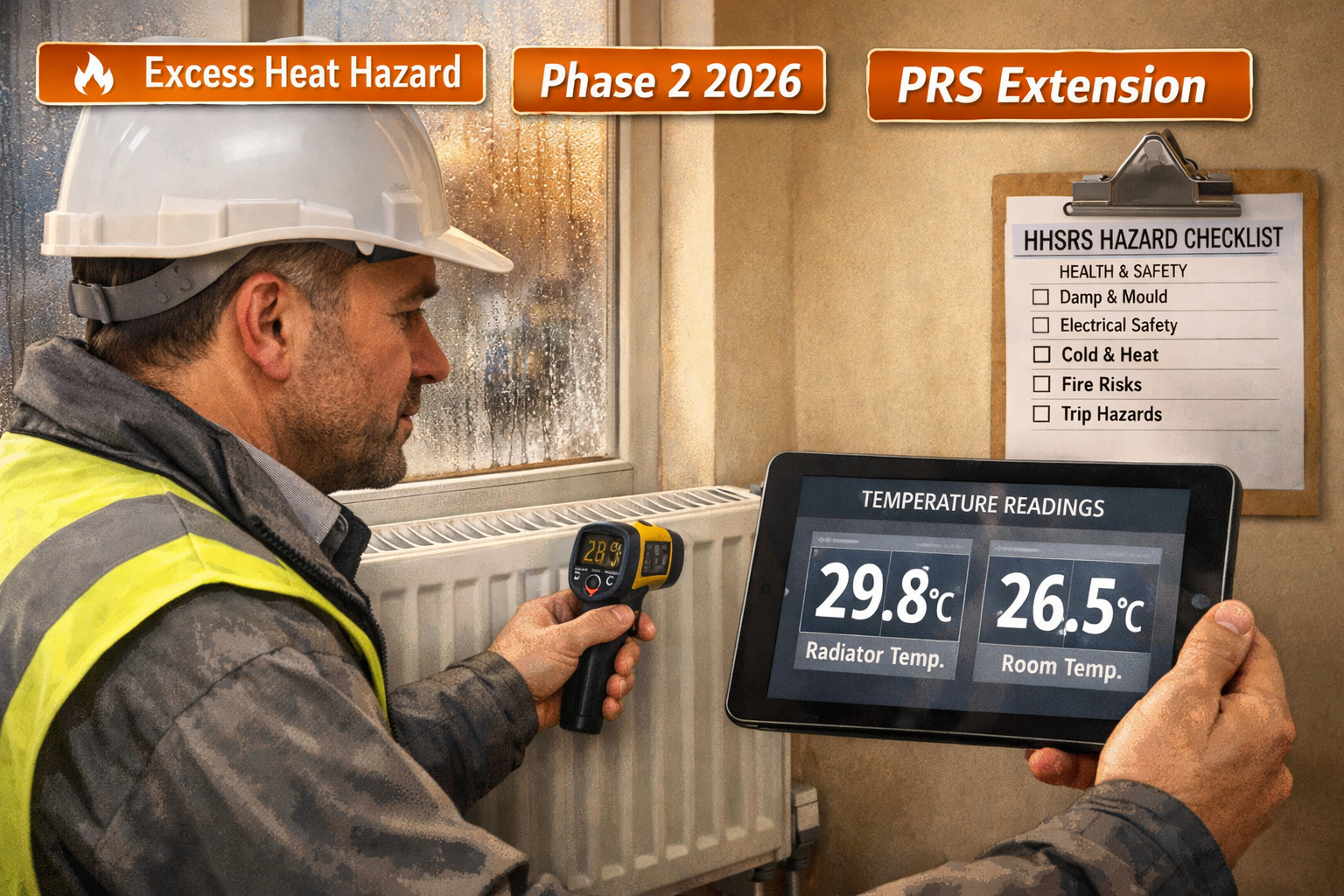
Excess heat is a Category 1 hazard under HHSRS when it poses a significant risk of harm to occupants — particularly the elderly, young children, and those with respiratory or cardiovascular conditions.
During inspection, surveyors should record:
- Ambient temperature readings at multiple points and times of day (ideally over 48–72 hours using data loggers)
- Thermal imaging of walls, ceilings, and floors to identify heat retention or cold bridging
- Ventilation adequacy — window sizes, trickle vents, mechanical ventilation systems
- Solar gain factors — orientation, glazing type, external shading
- Heating system condition — boiler age, thermostat calibration, radiator output
- Insulation levels — loft, cavity wall, floor (relevant to both excess heat and excess cold)
For context on how insulation and energy performance intersect with hazard compliance, reviewing EPC, MEES, and building survey requirements provides useful background.
Recommended equipment checklist:
- Calibrated digital thermometer (±0.3°C accuracy)
- Data logging temperature sensors (minimum 48-hour deployment)
- Thermal imaging camera
- Hygrometer (humidity affects perceived heat stress)
- Lux meter (for associated lighting hazards)
Protocol 3: Site Inspection for Falls Hazards
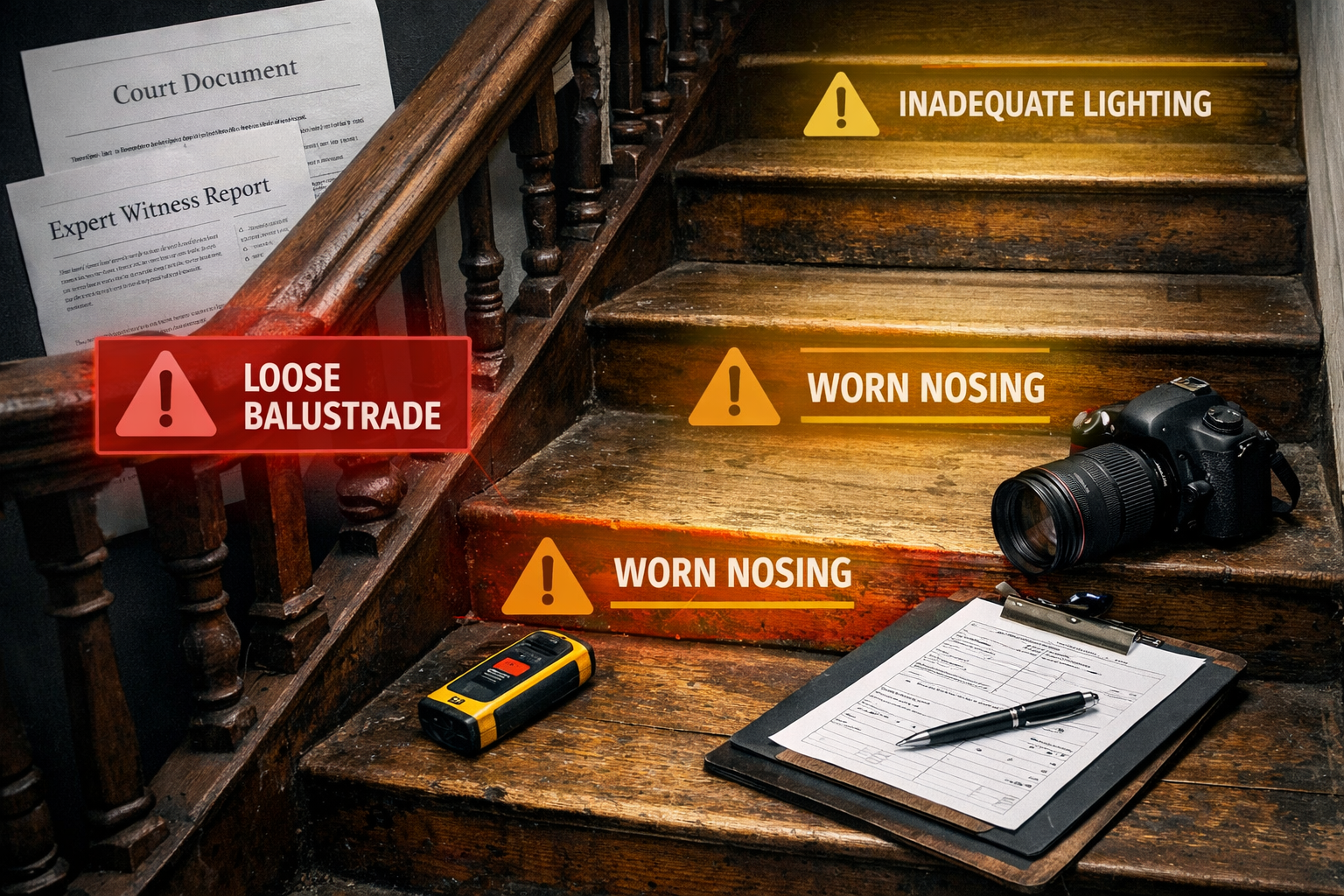
Falls on stairs, baths, and level surfaces are among the most common causes of serious injury in rental properties. Under HHSRS, the expert must assess both the likelihood of a fall occurring and the probable severity of harm.
Staircase assessment checklist:
- Tread dimensions — rise, going, and consistency (Building Regulations Approved Document K benchmarks apply)
- Nosing condition — worn, loose, or absent nosings dramatically increase slip risk
- Balustrade and handrail integrity — test for lateral movement, height compliance (900mm minimum)
- Lighting levels — measured in lux at tread level
- Surface materials — carpet condition, hard floor slip resistance (pendulum test data if available)
- Headroom — minimum 2m clearance throughout
Bath and shower falls assessment:
- Presence and condition of grab rails
- Bath/shower tray surface slip resistance
- Floor surface outside bath — wet area slip resistance
- Step-over height for bath entry
- Tap and mixer control accessibility
A thorough Level 3 building survey methodology provides the most robust foundation for falls hazard documentation, as it captures the full condition of all structural and finish elements.
For properties with complex structural features, understanding how stresses affect structural members can inform assessments of staircase structural integrity.
Protocol 4: HHSRS Scoring — Getting It Right Under Cross-Examination
The HHSRS scoring process is the technical heart of any expert witness report on hazard disputes. Courts and tribunals will scrutinise the scoring methodology closely.
Key scoring elements:
| Element | Description |
|---|---|
| Likelihood | Probability of a hazard event occurring within 12 months |
| Spread of harm | Range of potential health outcomes |
| Weighting | HHSRS prescribed weights for each harm outcome |
| Hazard Score | Calculated from likelihood × weighted harm |
| Band | A (highest) to J (lowest) — Category 1 = Band A–C |
💡 Pull Quote: "A poorly calculated HHSRS score is the single most common reason expert evidence fails under cross-examination. Show your working — every step."
Surveyors must be prepared to defend every element of their scoring under questioning. This means:
- Citing the HHSRS Operating Guidance (2006) and any updated guidance
- Referencing comparable cases and precedent scores where available
- Distinguishing clearly between Category 1 (enforceable) and Category 2 hazards
- Acknowledging uncertainty ranges honestly
Building the Court-Ready Expert Witness Report
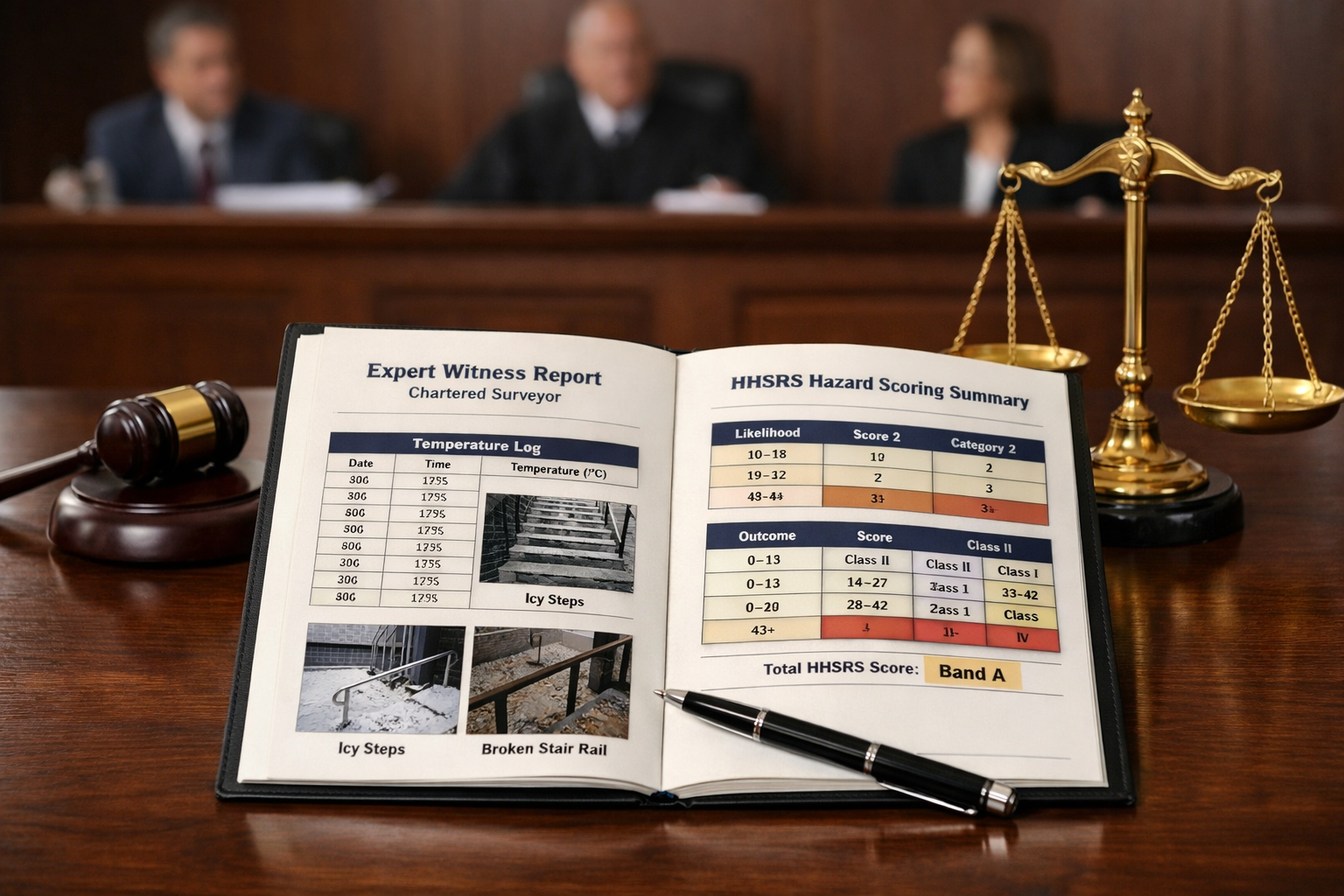
The written report is the expert witness's primary contribution to proceedings. For Expert Witness Preparation for Excess Temperature and Falls Hazards in Awaab's Law 2026 PRS Extensions, the report must satisfy both technical and legal standards simultaneously.
Mandatory Report Structure
A CPR Part 35-compliant expert witness report must include:
- Statement of truth and declaration of impartiality
- Expert's qualifications and relevant experience
- Instructions received — summarised accurately
- Documents reviewed — tenancy agreements, repair logs, correspondence, prior surveys
- Site inspection methodology — dates, access conditions, equipment used
- Factual findings — temperature data, photographic evidence, measurements
- HHSRS assessment — hazard identification, scoring, and banding
- Opinion — causation, landlord awareness, remediation adequacy
- Conclusions — clear, concise, and tied to the legal questions posed
- Appendices — photographs, data logs, equipment calibration certificates
Handling Repair History and Landlord Awareness
Under Awaab's Law, landlord awareness of a hazard is a key legal threshold. The expert must assess:
- When the hazard first became apparent or reportable
- Whether the tenant gave written notice (and when)
- Whether the landlord investigated within the prescribed timelines [2]
- Whether repairs undertaken were adequate and durable
The Housing Ombudsman's 2026 report emphasised the importance of early warning signs — surveyors should assess whether precursor indicators (e.g., minor temperature complaints, previous slip incidents) were present and documented before the formal hazard event [3].
For properties with a history of maintenance issues, a building defects survey can provide a comprehensive baseline that strengthens the expert's timeline analysis.
Photographic and Data Evidence Standards
Courts expect expert evidence to be reproducible and verifiable. For temperature and falls hazards:
- Photographs must be timestamped, geotagged, and labelled with the feature depicted
- Temperature logs must include sensor placement diagrams and calibration records
- Measurements must reference the datum point and instrument used
- Comparative data (e.g., Met Office temperature records for the relevant period) should be included for excess heat claims
Common Pitfalls to Avoid ⚠️
- Advocacy creep — subtly favouring the instructing party's position
- Scope creep — opining on legal questions beyond the expert's remit
- Stale data — relying on a single inspection without longitudinal temperature data
- Incomplete HHSRS scoring — omitting harm weighting or likelihood justification
- Failure to address the 'but for' test — did the hazard cause the harm alleged?
Understanding common defects in older homes helps surveyors contextualise whether identified hazards are systemic or isolated — a distinction that frequently determines liability in tribunal proceedings.
Joint Expert Meetings and Hot-Tubbing
In complex PRS disputes, courts may direct joint expert meetings between opposing surveyors. Preparation for these requires:
- A clear schedule of agreed and disputed facts
- Willingness to narrow issues collaboratively
- A written joint statement produced within the court's deadline
Hot-tubbing (concurrent expert evidence) is increasingly used in property tribunals. Surveyors must be comfortable answering questions from the judge directly, in the presence of the opposing expert, without preparation time.
Compliance, Timelines, and What Landlords Must Understand
For landlords and their advisors, understanding the enforcement architecture of Awaab's Law Phase 2 is essential context for any expert witness instruction.
Phase 2 enforcement timelines (expected 2026):
| Hazard Type | Investigation Deadline | Repair Deadline |
|---|---|---|
| Emergency (Category 1) | 24 hours | 24 hours |
| Significant hazard | 14 calendar days | 10 working days |
| Standard hazard | 28 days | As agreed |
Source: [1][2]
Landlords who fail to meet these timelines face:
- Rent repayment orders (up to 12 months' rent)
- Civil penalties under the Housing Act 2004
- Prohibition orders restricting occupation
- Adverse findings in disrepair litigation
For block management contexts, understanding Section 20 major works obligations is relevant where temperature or falls hazards arise from common parts requiring significant expenditure.
Predictive maintenance and repairs data management are now essential tools for landlords seeking to demonstrate proactive compliance — a factor expert witnesses will be asked to assess [2].
Conclusion: Actionable Next Steps for Surveyors in 2026
The expansion of Awaab's Law into excess temperature and falls hazards — and its anticipated extension to the private rental sector — creates both professional responsibility and commercial opportunity for chartered surveyors acting as expert witnesses.
Immediate actions for surveyors:
- ✅ Refresh HHSRS training — ensure scoring methodology for excess heat and falls categories is current and defensible
- ✅ Invest in calibrated equipment — data loggers, thermal imaging cameras, and slip resistance testing tools are now essential
- ✅ Review CPR Part 35 obligations — impartiality declarations and report structure must be court-compliant
- ✅ Build a photographic and data evidence protocol — standardise timestamping, labelling, and storage
- ✅ Prepare for joint expert meetings — practise articulating agreed and disputed positions clearly
- ✅ Stay current with legislative developments — PRS extension timelines and enforcement guidance are evolving throughout 2026
Expert Witness Preparation for Excess Temperature and Falls Hazards in Awaab's Law 2026 PRS Extensions demands a higher standard of technical rigour, legal awareness, and professional impartiality than most surveying instructions. Those who invest in the right protocols now will be best placed to serve the courts — and their professional reputation — as this legislation reaches full force.
References
[1] Awaabs Law Guide – wordnerds.ai
[2] Awaabs Law Phase 2 Is Coming What Social Landlords Need To Know About Additional Hazard Compliance In 2026 – mobysoft.com
[3] Call For Focus On Early Warning Signs In Hazards Report – housing-ombudsman.org.uk