

Over 11 million households in England rent privately — and from 2026, every single one of those tenancies operates under a fundamentally different set of rules. The Renters' Rights Act 2026 has abolished fixed-term assured shorthold tenancies, introduced a single periodic tenancy model, and — critically — created a formal rent review and challenge process that puts building surveyors at the centre of landlord-tenant disputes. For professionals and property owners navigating Rent Review Disputes Under the Renters' Rights Act 2026, understanding the building surveyor's role in producing defensible valuation evidence is no longer optional. It is essential.
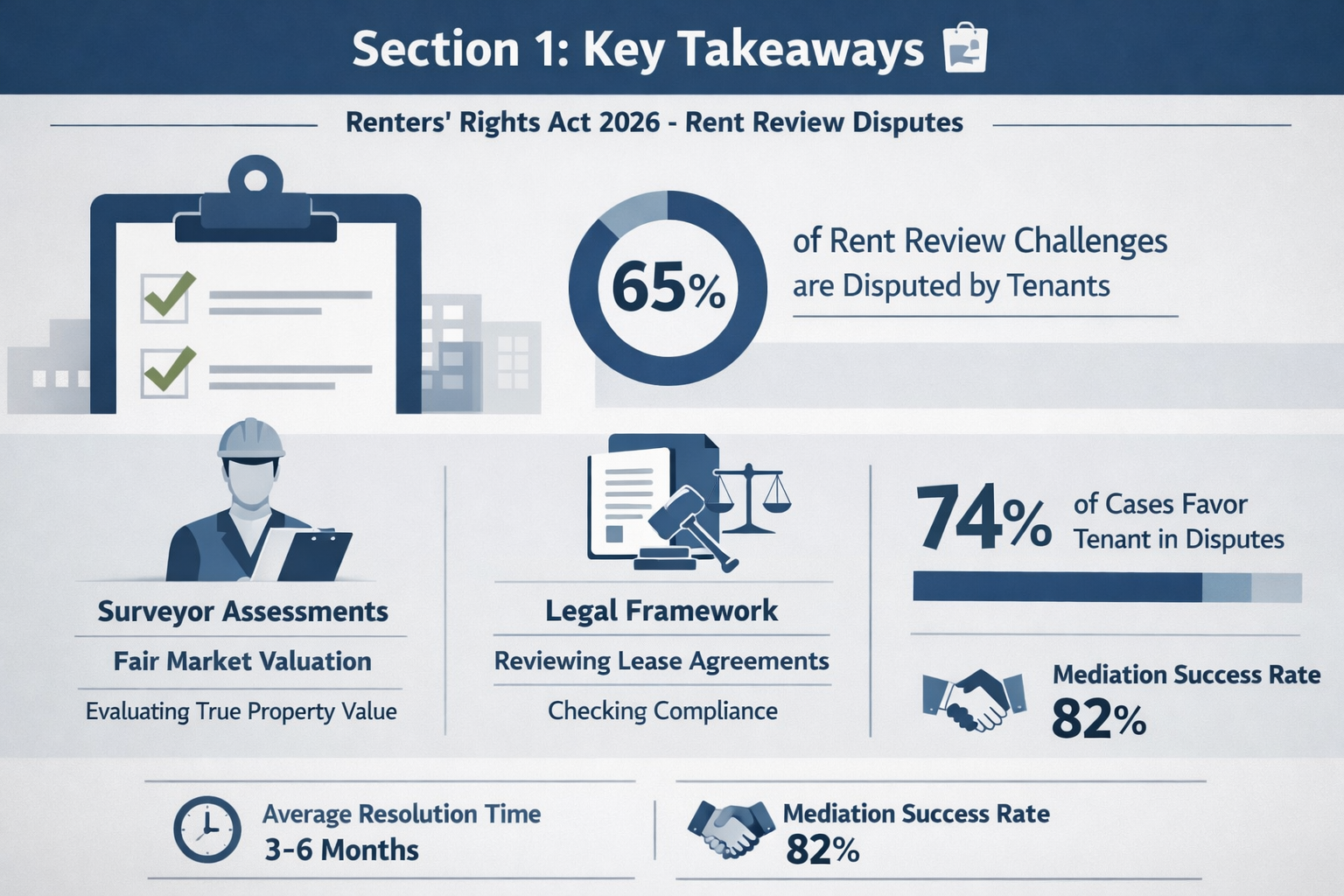
Key Takeaways 📋
- The Renters' Rights Act 2026 introduces a structured Section 13 rent review process, giving tenants the right to formally challenge proposed rent increases at the First-tier Tribunal.
- Tribunals are rejecting rent increases that lack credible, comparable local market evidence — making a building surveyor's valuation report a critical piece of evidence [1].
- Building surveyors must assess not only market comparables but also property condition, repair history, and maintenance standards when preparing valuation evidence.
- Both landlords and tenants can commission independent surveyor reports to support or contest a proposed rent increase.
- Early preparation — ideally before a Section 13 notice is issued — significantly reduces the risk of a tribunal challenge succeeding against a landlord.
Understanding the Renters' Rights Act 2026: What Changed and Why It Matters
The Renters' Rights Act 2026 represents the most significant overhaul of the private rented sector in a generation. At its core, the Act abolishes Section 21 "no-fault" evictions, converts all assured shorthold tenancies into periodic tenancies, and — most relevant to this discussion — introduces a robust, tenant-friendly rent review mechanism.
The Section 13 Process Explained
Under the Act, landlords who wish to increase rent must serve a formal Section 13 notice, providing at least two months' written notice before any increase takes effect. Tenants who believe the proposed increase is above market rate have the right to refer the matter to the First-tier Tribunal (Property Chamber).
Here is how the process flows:
| Stage | Action | Timeline |
|---|---|---|
| 1 | Landlord serves Section 13 notice | At least 2 months before increase |
| 2 | Tenant accepts or challenges | Within the notice period |
| 3 | Tenant refers to First-tier Tribunal | Before the proposed start date |
| 4 | Tribunal assesses market rent | Hearing scheduled |
| 5 | Tribunal sets the rent | Decision is binding |
💡 Pull Quote: "Tribunals are closely examining local market evidence and rejecting increases that appear excessive or unsupported by comparable local properties and property condition." [1]
Critically, the tribunal's job is to determine the open market rent — what a willing landlord and willing tenant would agree in the open market for the property in its current condition. This is precisely where building surveyors become indispensable.
The Act also establishes the Private Rented Sector Ombudsman, a new body that landlords are required to join and which handles complaints, including disputes arising from the rent review process. Surveyors preparing evidence must understand that their reports may be scrutinised not only by tribunals but also by the Ombudsman.
How Rent Review Disputes Under Renters' Rights Act 2026 Require Defensible Surveyor Valuation Evidence
The phrase "market evidence" is central to how the First-tier Tribunal approaches any rent challenge. When a tenant disputes a proposed increase, the tribunal does not simply split the difference — it examines the evidence presented by both parties and reaches a determination based on what the market genuinely supports [6].
What "Market Evidence" Actually Means
For a building surveyor, producing market evidence for a rent review dispute involves several distinct layers of analysis:
1. Comparable rental properties (comparables)
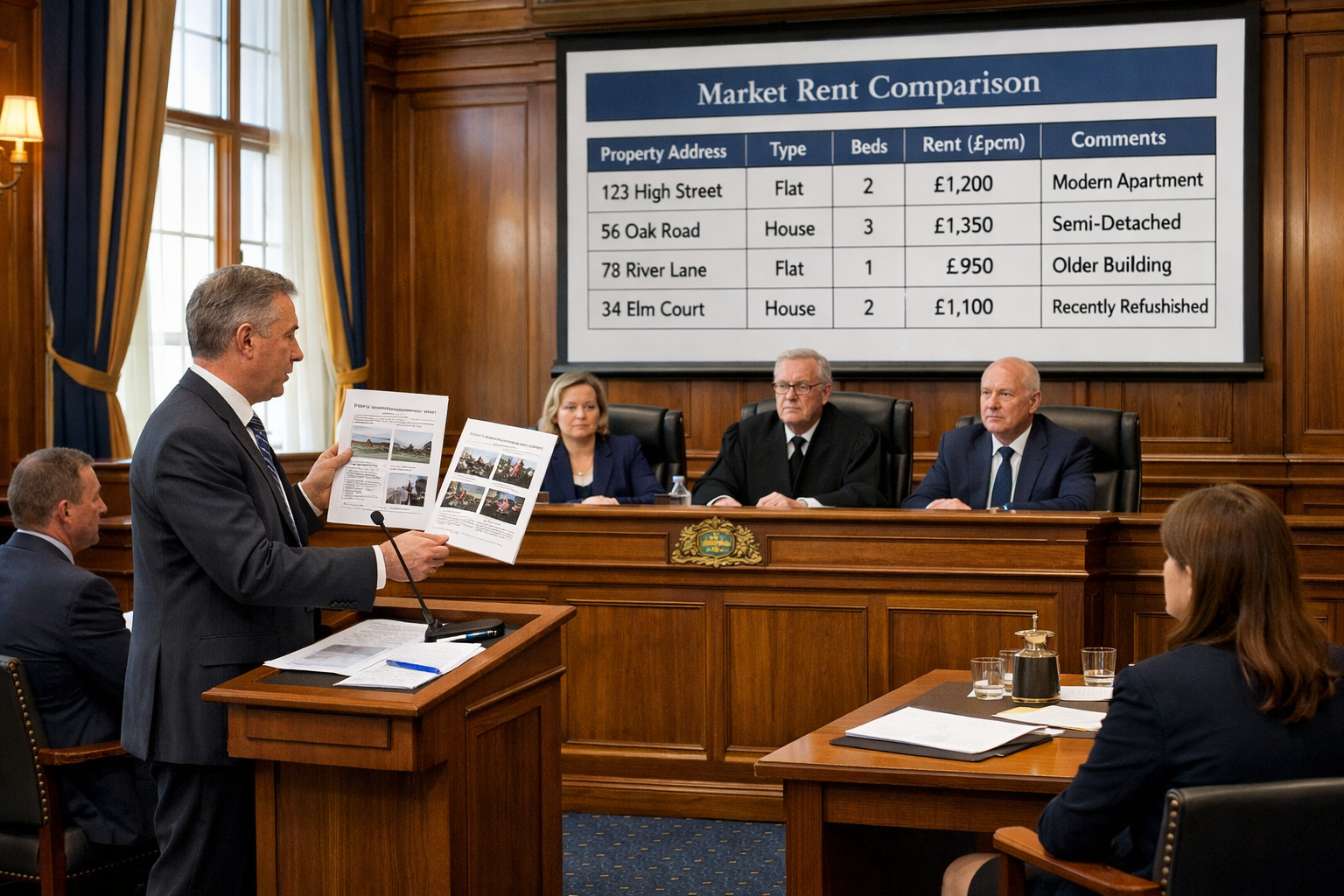
The surveyor must identify genuinely comparable properties — similar in size, type, location, condition, and specification — that have been let recently in the open market. This is not as simple as pulling figures from a portal. Comparables must be:
- Verified (not just asking rents, but agreed rents)
- Recent (ideally within the last 6–12 months)
- Truly comparable (adjustments made for differences in size, condition, or amenities)
- Local (the tribunal will scrutinise geographic relevance)
2. Property condition and repair standard
This is where a building surveyor's technical expertise adds unique value. A property in poor repair cannot command the same rent as a well-maintained equivalent. Surveyors must assess:
- Structural integrity and any defects
- State of fixtures, fittings, and services
- Outstanding maintenance obligations
- Any disrepair the landlord has failed to address
Landlords who have neglected maintenance will find that a surveyor's building condition assessment may actually work against them in a tribunal, reducing the supportable market rent. Conversely, landlords who can demonstrate a high standard of upkeep — evidenced by a detailed construction and condition survey — are far better placed to justify a higher rent.
3. Valuation methodology
The surveyor must apply a recognised valuation methodology, consistent with RICS (Royal Institution of Chartered Surveyors) guidance. A formal commercial or residential valuation report provides the structured, professional framework that tribunals expect to see.
Common Mistakes in Rent Valuation Evidence
❌ Relying solely on online portal asking prices (not agreed rents)
❌ Using comparables from different neighbourhoods or property types
❌ Ignoring the property's condition when setting the comparable rent
❌ Failing to make adjustments for differences between comparables and the subject property
❌ Producing an informal "opinion" rather than a structured professional report
The Building Surveyor's Practical Role: From Inspection to Tribunal
Pre-Dispute Preparation: The Smartest Strategy
The best time for a landlord to commission a surveyor's valuation report is before issuing a Section 13 notice — not after a tenant has already lodged a tribunal challenge. Early preparation allows the landlord to:
- Set a rent increase that is genuinely supportable by market evidence
- Identify and address any property condition issues that could undermine their case
- Demonstrate good faith and transparency in the review process
For tenants, commissioning an independent surveyor's report early in the process provides a credible counter-argument to an excessive proposed increase.
What a Surveyor's Valuation Report Should Include
A robust valuation report prepared for rent review dispute purposes should contain:
- Executive summary — the surveyor's opinion of open market rent
- Property description — size, layout, specification, condition
- Condition assessment — including any defects or disrepair (linked to building pathology findings where relevant)
- Comparable evidence — a schedule of at least 3–5 verified comparables with analysis
- Adjustments — a clear explanation of any upward or downward adjustments made
- Conclusion — the surveyor's reasoned opinion of market rent, expressed as a range or specific figure
- Surveyor's credentials — RICS membership, professional indemnity insurance, declaration of independence
Acting as an Expert Witness
In more complex or high-value disputes, a building surveyor may be called upon to act as an expert witness before the tribunal. In this role, the surveyor's duty is to the tribunal — not to the party that instructed them. This is a critical distinction. Expert witnesses must:
- Present evidence objectively and impartially
- Disclose any material that undermines their client's case
- Be prepared to be cross-examined on their methodology and conclusions
- Comply with the Civil Procedure Rules (CPR) Part 35 on expert evidence
⚖️ Pull Quote: "A surveyor acting as an expert witness owes their primary duty to the tribunal, not to the landlord or tenant who instructed them. Impartiality is non-negotiable."

Property Condition as a Valuation Factor: Why Maintenance Records Matter
One aspect of Rent Review Disputes Under the Renters' Rights Act 2026 that is frequently underestimated is the weight that tribunals place on property condition when assessing market rent. A well-maintained property commands a premium. A poorly maintained one does not — and a landlord who tries to argue otherwise will struggle before an informed tribunal.
The Link Between Maintenance and Rent Justification
Surveyors preparing valuation evidence should review:
- Maintenance history — records of repairs, servicing, and improvements. A detailed property maintenance log is invaluable here.
- Recent improvements — kitchen or bathroom upgrades, new boiler, energy efficiency improvements (EPC rating)
- Outstanding disrepair — any issues the landlord has failed to address that affect habitability or enjoyment
- Repair cost estimates — where disrepair is present, the cost of repairs and restoration may be relevant to adjusting the market rent downward
Landlords who have invested in their properties — and can evidence this through surveyor reports and maintenance records — are in a significantly stronger position to justify rent increases.
Dilapidations and Rent Reviews: An Emerging Crossover
As the Act beds in through 2026, an emerging area of complexity involves the intersection of dilapidations and rent reviews. Where a property has fallen into disrepair — whether due to tenant misuse or landlord neglect — the question of who bears responsibility affects the market rent calculation. Surveyors with expertise in dilapidations assessments are particularly well-placed to navigate this complexity.
Practical Guidance for Landlords and Tenants in 2026
For Landlords 🏠
- Commission a valuation report before serving a Section 13 notice. Do not guess at the market rent — verify it with professional evidence.
- Keep thorough maintenance records. These directly support a higher market rent assessment.
- Address disrepair before seeking a rent increase. A tribunal will not award a market rent for a property in poor condition.
- Join the Private Rented Sector Ombudsman scheme — it is now a legal requirement, and non-compliance weakens your position in any dispute.
- Seek advice from a chartered surveyor with landlord and property expertise before entering the formal review process.
For Tenants 🏡
- Do not assume a rent increase is automatically justified. Request the landlord's evidence base.
- Commission your own independent surveyor's report if you believe the proposed increase exceeds market rent.
- Check comparable rents in your local area using verified sources, not just portal asking prices.
- Refer to the First-tier Tribunal before the proposed increase date — you cannot challenge it after it has taken effect.
- Document any disrepair or maintenance failures — these are directly relevant to the market rent assessment.
Regional Considerations: Local Market Evidence Is Everything
The Renters' Rights Act 2026 applies across England, but rent levels — and therefore the comparables that matter — are intensely local. A surveyor preparing valuation evidence for a dispute in South East London will draw on entirely different data from one preparing evidence for a property in Hertfordshire or Buckinghamshire.
This is why the geographic expertise of the instructed surveyor matters enormously. Tribunals will scrutinise whether comparables are genuinely local and representative of the specific sub-market in question.
Surveyors operating across multiple regions — from East London to South East London, from Hertfordshire to Buckinghamshire — bring the local market intelligence that makes valuation evidence credible and defensible.
Conclusion: Actionable Next Steps for Navigating Rent Review Disputes in 2026
The Renters' Rights Act 2026 has fundamentally changed the landscape of landlord-tenant relations in England. Rent Review Disputes Under the Renters' Rights Act 2026 are no longer informal negotiations — they are formal, evidence-based processes where the quality of valuation evidence determines the outcome.
Building surveyors are uniquely positioned to provide that evidence: combining technical property expertise, market knowledge, and professional credibility to produce reports that stand up to tribunal scrutiny. Whether acting for a landlord seeking to justify a rent increase or a tenant challenging an excessive one, the surveyor's role is to provide objective, well-evidenced, and methodologically sound valuation analysis.
Actionable Next Steps ✅
- Landlords: Commission a professional market rent valuation before issuing any Section 13 notice in 2026.
- Tenants: Seek independent surveyor advice promptly upon receiving a Section 13 notice if the proposed increase seems excessive.
- Both parties: Gather and preserve maintenance records, condition reports, and comparable evidence well in advance of any tribunal hearing.
- Surveyors: Ensure all rent review valuation reports comply with RICS guidance and CPR Part 35 requirements for expert evidence.
- All parties: Engage with the Private Rented Sector Ombudsman process early — it may resolve disputes without the need for a full tribunal hearing.
The stakes are high, the process is formal, and the evidence matters. Getting professional surveying support early is the single most effective step any landlord or tenant can take in navigating the new rent review landscape.
References
[1] Rent Review Rules Explained: What Section 13 Means for Landlords – anderson-knight.co.uk
[6] Watch (Renters' Rights Act – Rent Review Evidence) – youtube.com