

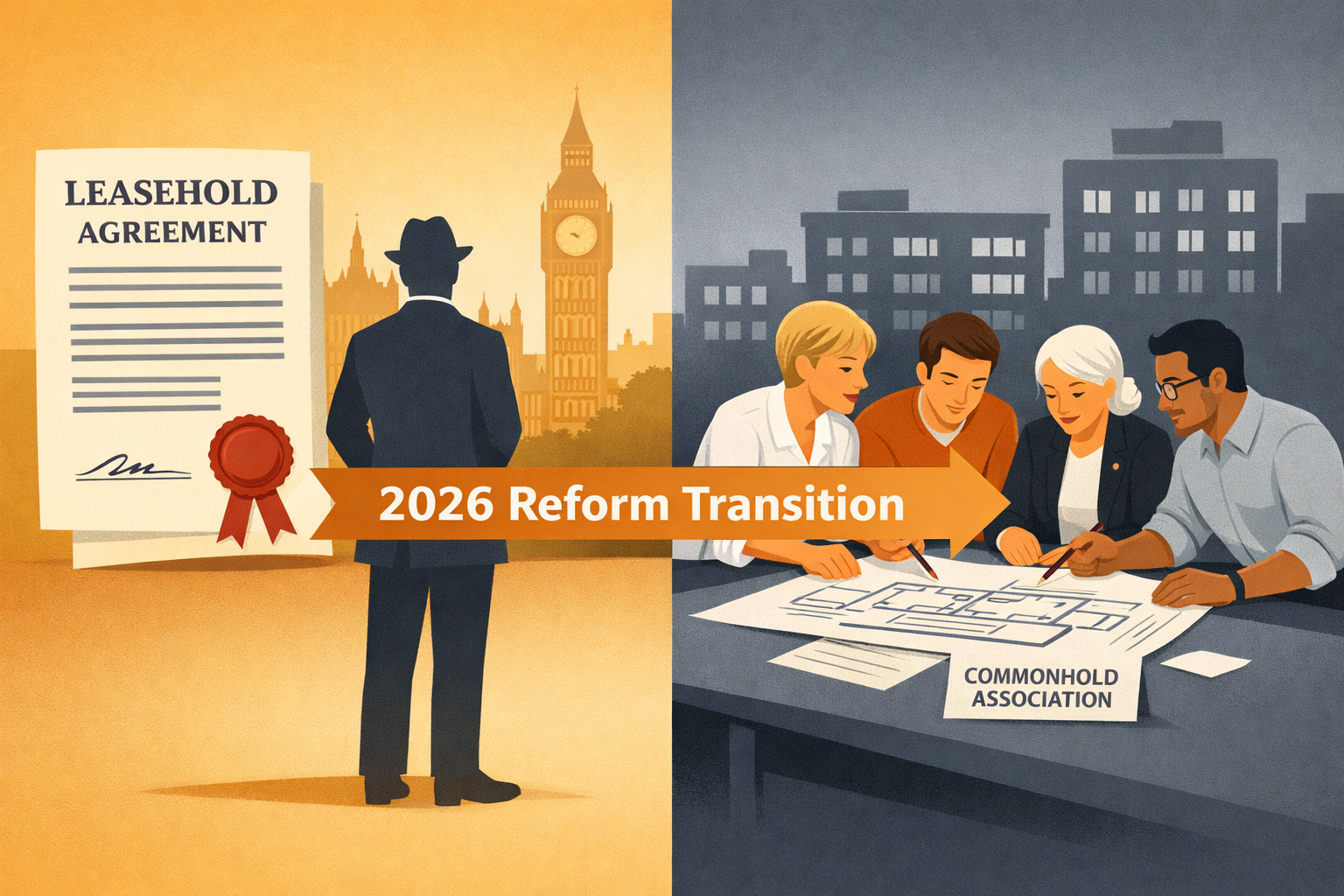
Over 4.98 million leasehold dwellings exist in England alone — and a sweeping legislative overhaul now threatens to make that tenure model obsolete for new flats. The draft Commonhold and Leasehold Reform Bill, published in January 2026, signals the most significant shift in residential property ownership in a generation [3]. For chartered surveyors, this is not a distant policy debate. It is an immediate, practical challenge that demands new protocols, updated skill sets, and a clear understanding of what commonhold conversions in 2026 mean for transition surveys and defect assessments.
This article provides practical, RICS-aligned guidance for surveyors, developers, and leaseholders navigating the conversion process — covering everything from structural survey requirements to the valuation shifts that follow a tenure change.
Key Takeaways 📋
- The draft Commonhold and Leasehold Reform Bill (January 2026) proposes reducing the conversion consent threshold from 100% to 50% of qualifying leaseholders [1].
- A ban on new leasehold flats is targeted for implementation in 2029 [4].
- Chartered surveyors play a central role in transition surveys, shared structure assessments, and pre-conversion defect reporting.
- RICS-compliant transition reports must address communal areas, structural integrity, and latent defects before a commonhold association takes ownership.
- Surveyors must adapt their valuation methodologies to reflect the shift from leasehold to freehold-equivalent commonhold titles.
The 2026 Legislative Landscape: What Surveyors Must Understand
The Draft Bill and Its Key Provisions
The government published the draft Commonhold and Leasehold Reform Bill at the end of January 2026, setting out a clear roadmap for the abolition of leasehold for new flats [3]. The consultation titled "Moving to Commonhold: Banning Leasehold for New Flats" closed on 24 April 2026, marking a pivotal moment in the reform timeline [2].
Key provisions relevant to surveyors include:
| Provision | Current Position | Proposed Change |
|---|---|---|
| Conversion consent threshold | 100% unanimous agreement | Reduced to 50% of qualifying leaseholders [1] |
| New leasehold flats | Permitted | Banned from 2029 [4] |
| Commonhold association | Optional | Default tenure for new multi-unit buildings |
| Shared structure ownership | Freeholder-controlled | Transferred to commonhold association |
💡 Pull Quote: "The reduction of the consent threshold from unanimous to 50% is the single most disruptive change for existing leasehold blocks — and it makes the surveyor's pre-conversion role more critical than ever."
This threshold change is transformative. Previously, a single dissenting leaseholder could block a conversion. Under the proposed rules, a simple majority suffices [1]. That means conversions will happen faster, with less preparation time, and with a greater risk of unresolved building defects being inherited by the new commonhold association.
Why Surveyors Are at the Centre of This Transition
When a leasehold block converts to commonhold, ownership of the shared structure — the roof, foundations, external walls, communal corridors, and mechanical systems — transfers from the freeholder to the commonhold association. Every leaseholder becomes a unit holder with a proportionate share of responsibility for those shared elements.
If defects exist at the point of conversion, those liabilities transfer too. A cracked retaining wall, failing flat roof, or outdated electrical riser that was the freeholder's problem yesterday becomes the collective problem of all unit holders tomorrow. This is precisely why commonhold conversions in 2026 demand rigorous, independent surveying before the transition is legally completed.
For context on how block management responsibilities shift under new ownership structures, see this overview of what block management involves and how it differs from traditional property management.
Commonhold Conversions in 2026: Chartered Surveyor Roles in Transition Surveys and Defect Assessments
The Scope of a Transition Survey
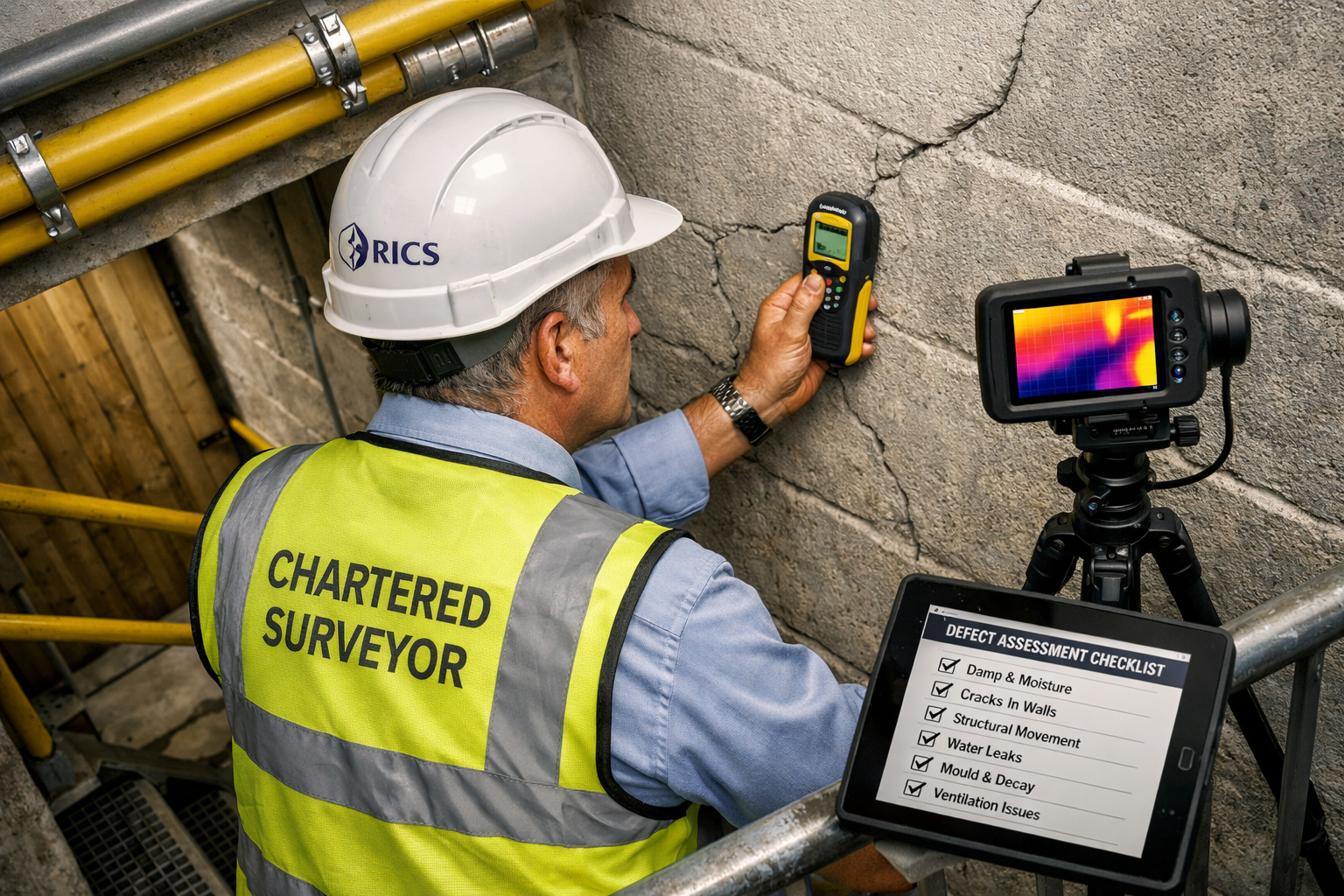
A transition survey for commonhold conversion is not a standard homebuyer report or a routine building survey. It is a bespoke, whole-building assessment that must capture the condition of every element that will fall under the commonhold association's future maintenance obligation.
The scope typically includes:
- 🏗️ Structural elements — foundations, load-bearing walls, floor slabs, roof structure
- 🔧 Mechanical and electrical systems — lifts, communal heating, electrical risers, fire suppression
- 💧 Waterproofing and drainage — flat roofs, gutters, underground drainage, basement tanking
- 🪟 External envelope — cladding, windows in communal areas, external doors
- 🛗 Communal spaces — stairwells, corridors, car parks, bin stores, plant rooms
- 🌿 Site and grounds — boundary walls, paving, landscaping, drainage channels
The surveyor must produce a report that distinguishes between:
- Immediate defects — issues requiring urgent remediation before conversion
- Short-term maintenance items — works likely needed within 1–3 years
- Long-term capital expenditure — planned maintenance items for the association's reserve fund
Understanding the full range of common defects found in older buildings is essential background knowledge for any surveyor undertaking this work, particularly in pre-1980s residential blocks where latent issues are most prevalent.
RICS Compliance Requirements for Transition Reports
RICS members undertaking transition surveys must adhere to the RICS Professional Standards and Guidance applicable to building surveys, supplemented by the specific requirements emerging from the 2026 reform framework. Key compliance considerations include:
Scope of instruction: The surveyor must receive a clearly defined instruction from either the leaseholders' group, the proposed commonhold association, or the developer. The instruction should specify whether the report is for due diligence, defect liability, or reserve fund planning purposes.
Access requirements: Full access to all communal areas, roof spaces, plant rooms, and sub-floor voids is essential. Restricted access must be clearly documented. For guidance on managing access during surveys, building surveyor access protocols provide a useful reference point.
Reporting format: The report should follow a structured format aligned with RICS guidance, clearly separating observations, conclusions, and recommendations. It must be written so that non-technical readers — leaseholders who will become unit holders — can understand the implications.
Professional indemnity: Given the liability implications of a transition survey, surveyors must ensure their PI cover is adequate for whole-building assessments and extends to advice given to groups of leaseholders rather than individual clients.
Defect Assessment: What to Prioritise
Not all defects carry equal weight in a conversion context. The surveyor's role is to triage findings according to their impact on the conversion itself and on the future financial health of the commonhold association.
High-priority defects that may need resolving before conversion proceeds:
- Structural movement or subsidence with active progression
- Fire safety deficiencies (cladding, compartmentation, fire doors) — a fire risk assessment should accompany any transition survey
- Water ingress affecting multiple units or structural elements
- Lift or communal heating systems beyond economic repair
Medium-priority items for the reserve fund:
- Roof coverings approaching end of life
- Repointing or render repairs
- External decoration cycles
- Drainage CCTV surveys with minor root ingress
Lower-priority items for routine maintenance planning:
- Cosmetic redecoration of communal areas
- Minor paving repairs
- Garden maintenance schedules
⚠️ Important: Surveyors should be explicit about uncertainty. Where access was restricted or investigations were non-intrusive, the report must clearly state what cannot be confirmed and recommend further specialist investigations where warranted.
For a deeper understanding of what a full building survey covers and how long the process typically takes, the building survey duration guide offers practical context for managing client expectations during transition assessments.
Valuation Shifts and Reserve Fund Planning in Commonhold Transitions

How Commonhold Changes Property Valuation
One of the most significant — and least discussed — aspects of commonhold conversions in 2026 is the impact on individual unit valuations. Under leasehold, value is partly determined by the unexpired lease term. A flat with 75 years remaining is worth less than an identical flat with 150 years. Leasehold extension costs, ground rents, and service charge disputes all depress values and create friction in the market.
Under commonhold, unit holders own their flat on a freehold-equivalent basis indefinitely. There is no lease to extend, no ground rent to pay, and no freeholder to negotiate with. In theory, this should increase values — particularly for flats with short leases that have been subject to significant leasehold extension and enfranchisement valuations.
However, surveyors must exercise caution. The market for commonhold units in converted blocks is still immature in the UK. Comparable evidence is limited. Lenders' attitudes to commonhold are evolving, and mortgage availability may affect achievable prices in the short term.
Key valuation considerations for surveyors:
| Factor | Leasehold Impact | Commonhold Impact |
|---|---|---|
| Tenure security | Diminishing with lease term | Permanent — no depreciation |
| Ground rent | Annual cost to leaseholder | Eliminated |
| Service charge disputes | Common, affects saleability | Managed by association vote |
| Mortgage availability | Established lender market | Growing but still developing |
| Defect liability | Freeholder's responsibility | Shared by unit holders |
Reserve Fund Assessments: A New Obligation
Under the proposed commonhold framework, commonhold associations will be required to maintain a reserve fund for long-term maintenance and capital expenditure. This is a significant departure from the often-inadequate service charge sinking funds seen in many leasehold blocks.
Chartered surveyors are ideally placed to produce reserve fund assessments (also called long-term maintenance plans or lifecycle cost assessments) as part of the transition process. These documents:
- Project the likely cost of maintaining shared elements over a 10–30 year horizon
- Estimate the annual contribution required from each unit holder
- Identify immediate capital expenditure needs that must be funded before or at conversion
- Provide a transparent financial basis for the commonhold association's first budget
The quality of this reserve fund assessment directly affects the financial viability of the new commonhold association. An under-funded reserve creates the risk of special levies — unexpected, large one-off charges to unit holders — which can cause significant financial hardship and legal disputes.
Surveyors working in areas with high concentrations of purpose-built flats — such as those served by chartered surveyors in London or chartered surveyors in Chelsea — will find demand for these services growing rapidly as the 2029 implementation date approaches.
Practical Steps for Surveyors Preparing for Conversion Mandates
As the legislative timetable tightens, surveyors should begin developing standardised workflows for commonhold transition work. Recommended steps include:
- Develop a transition survey template aligned with RICS guidance and the specific requirements of the draft Bill
- Build relationships with commonhold solicitors — the legal and surveying workstreams must be closely coordinated
- Invest in whole-building inspection skills — particularly for M&E systems, fire safety, and cladding assessments
- Understand reserve fund methodology — RICS guidance on long-term maintenance plans is the starting point
- Stay current with lender requirements — as mortgage products for commonhold evolve, surveyors must understand how lenders assess security
- Engage with RICS CPD — the professional body is actively developing guidance specific to commonhold transitions
For surveyors considering how to position their practice for this growing area of work, the Prince Chartered Surveyors open roles page reflects the kind of specialist expertise now in demand across the sector.
Conclusion: Actionable Next Steps for Surveyors and Leaseholders
The legislative momentum behind commonhold is now undeniable. With the draft Bill published in January 2026 [3], the consultation period closed in April 2026 [2], and a ban on new leasehold flats targeted for 2029 [4], the window for preparation is narrowing fast. The reduction of the conversion consent threshold to 50% means that conversions of existing blocks will accelerate — and with them, the demand for high-quality transition surveys and defect assessments [1].
For chartered surveyors, the priority is to build the technical competencies and reporting frameworks needed to serve this market professionally. That means whole-building inspection skills, reserve fund methodology, RICS compliance, and a clear understanding of how commonhold changes the valuation landscape.
For leaseholders and residents' groups, the message is equally clear: commission an independent transition survey before agreeing to a conversion. Do not inherit a freeholder's deferred maintenance liability without understanding its full extent. Engage a RICS-accredited surveyor with experience in multi-unit residential buildings.
For developers and housing associations, the 2029 deadline for new builds is the starting gun for embedding commonhold-ready design and maintenance planning into every new scheme from the outset.
The role of the chartered surveyor in commonhold conversions in 2026 is not peripheral — it is foundational. The quality of the transition survey and defect assessment will determine whether a commonhold association starts its life on solid ground or inherits a building in distress.
References
[1] The Future Of Commonhold – kuits.com
[2] Leasehold And Freehold Reform Updates 2026 Moving Towards Commonhold – hcrlaw.com
[3] Commonhold Coming Soon To A Development Near You – mishcon.com
[4] The Draft Commonhold And Leasehold Reform Bill – housing.org.uk