

Properties with an EPC rating of F or G are now selling at discounts of up to 20% compared to equivalent C-rated homes in some UK regional markets — and that gap is widening. For surveyors, buyers, and investors navigating Energy Efficiency Retrofits in Cautious 2026 Markets: Valuation Impacts and Building Survey Protocols Under RICS Guidance, this is no longer a peripheral concern. It is a core valuation variable.
As buyer caution persists and price growth remains subdued across much of England and Wales, the ability to accurately assess retrofit potential — and price it correctly — has become a defining skill for any chartered surveyor. RICS has responded decisively, launching its first dedicated residential retrofit standard and embedding ESG metrics directly into valuation methodology [6]. This article unpacks what those changes mean in practice, how surveys must now be structured, and why retrofit cost assessment is becoming as important as structural condition reporting.
Key Takeaways 📋
- EPC ratings now directly influence market value, with low-rated properties facing measurable price penalties in cautious 2026 conditions.
- RICS has published its first residential retrofit standard, formalising protocols that surveyors must integrate into building surveys and valuations [6].
- Eight specific retrofit risks — from moisture ingress to fire hazards — must be documented in compliant survey reports [2].
- Soft measures and in-situ performance testing can prevent costly over-specification and protect both clients and surveyors from liability.
- Regional market context matters: retrofit value uplift varies significantly between London commuter belts, northern urban centres, and rural areas.
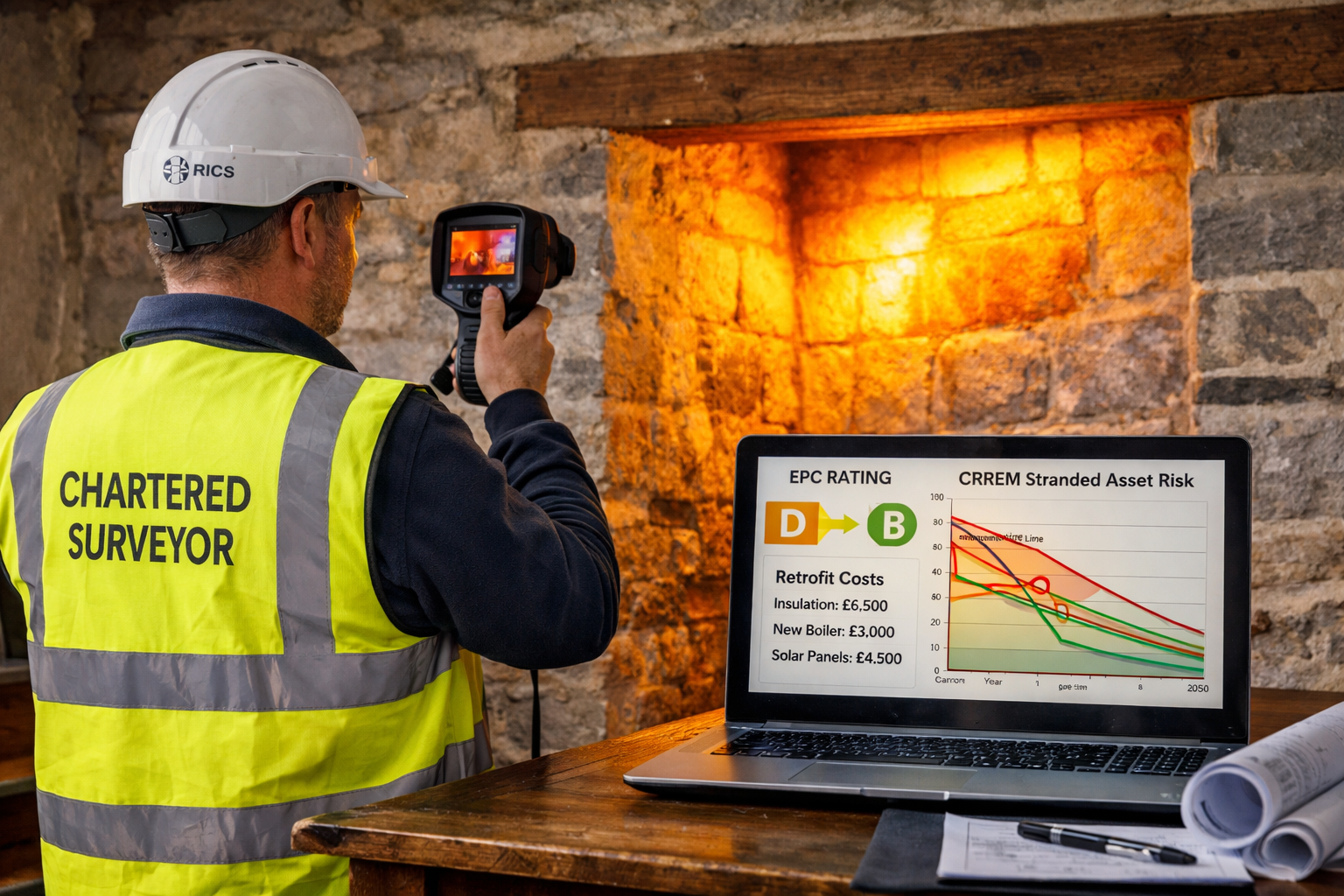
Why Retrofit Assessment Has Moved to the Centre of Building Surveys in 2026
The UK property market in 2026 is defined by two competing pressures. On one side, mortgage affordability constraints and economic uncertainty have kept buyer activity cautious. On the other, regulatory tightening around minimum energy efficiency standards (MEES) and net-zero commitments are forcing a reckoning with the existing housing stock.
Against this backdrop, Energy Efficiency Retrofits in Cautious 2026 Markets: Valuation Impacts and Building Survey Protocols Under RICS Guidance has become a framework that every practitioner must understand — not just as a compliance exercise, but as a commercial reality.
RICS's 2026 Partnership Themes identify four integrated priority areas for building assessment: Energy Efficiency (insulation, windows, HVAC upgrades), Structural Safety, Compliance (updating to current standards), and Sustainability (carbon footprint reduction) [3]. These are no longer siloed concerns. A Level 3 building survey that fails to address retrofit potential is increasingly considered incomplete.
The EPC Premium and Penalty Effect
The evidence is clear: energy performance ratings are now a pricing signal, not just a compliance label. Properties at the lower end of the EPC scale face what analysts call a "brown discount" — a measurable reduction in achievable sale price. In flat or declining price environments, this discount is amplified because buyers have less motivation to absorb retrofit costs into an already stretched budget.
Conversely, properties with strong EPC ratings — particularly those at B or above — command a "green premium" that surveyors must now account for in comparable evidence selection. The Carbon Risk Real Estate Monitor (CRREM) tool has become a valuable instrument for identifying stranded assets: properties that will fail to meet future energy efficiency standards or market expectations, allowing owners to intervene before obsolescence takes hold [2].
For surveyors working across locations such as Hertfordshire, West London, or Guildford, the practical implication is that retrofit cost estimates must now feature prominently in valuation narratives — not buried in an appendix.
💡 Pull Quote: "A building survey that ignores retrofit potential in 2026 is like a structural report that ignores subsidence. It misses the most commercially significant risk on the table."
Valuation Impacts: How Retrofit Costs and EPC Upgrades Affect Market Price
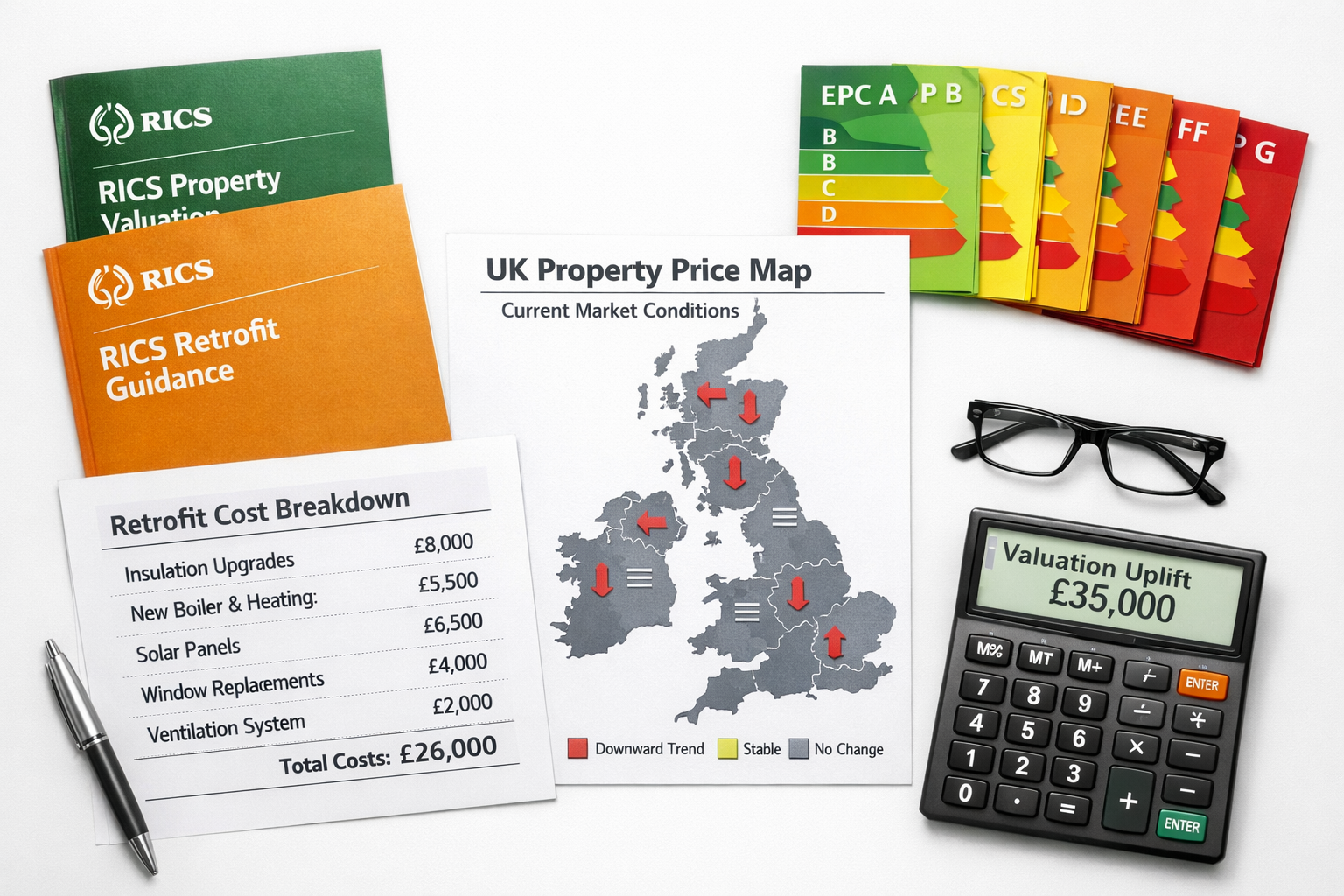
Understanding how retrofit investment translates — or fails to translate — into market value uplift is the central challenge for surveyors and their clients in 2026.
The Retrofit Cost-Value Equation
Not all retrofit measures deliver equivalent value uplift. The relationship between spend and return is highly context-dependent, shaped by:
- Property type and age (pre-1919 solid wall construction vs. 1970s cavity wall)
- Current EPC rating and target rating (moving from G to E has different economics than E to B)
- Regional market conditions (buyer appetite for retrofitted stock varies significantly)
- Funding availability (government schemes, ECO4, and local authority grants affect net cost)
The table below summarises indicative retrofit measures, typical costs, and their likely EPC impact:
| Retrofit Measure | Typical Cost Range | EPC Improvement | Value Uplift Potential |
|---|---|---|---|
| Loft insulation (top-up) | £300–£600 | 1–2 bands | Moderate |
| Cavity wall insulation | £500–£1,500 | 1–2 bands | Moderate |
| External wall insulation | £8,000–£20,000 | 2–3 bands | Variable |
| Air source heat pump | £7,000–£15,000 | 1–2 bands | Emerging |
| Double/triple glazing | £4,000–£12,000 | 1 band | Low–Moderate |
| Solar PV (4kW system) | £5,000–£9,000 | 1–2 bands | Moderate–High |
Costs are indicative for 2026 UK market conditions. Individual properties will vary.
Soft Measures: The Undervalued First Step
Before recommending capital-intensive interventions, surveyors should assess whether soft retrofit measures can deliver meaningful improvement at minimal cost. These include thermally lined curtains, draught exclusion, secondary glazing, low-energy lighting upgrades, and optimising existing heating controls [2].
In cautious markets where buyers are resistant to pricing in future improvement costs, a vendor who has already implemented soft measures — and can demonstrate a genuine EPC improvement — is in a stronger negotiating position. This also avoids unnecessary embodied carbon from premature structural interventions [2].
In-Situ Performance Testing: Why Modelled Data Isn't Enough
One of the most important — and frequently overlooked — aspects of retrofit valuation is the gap between modelled and actual energy performance. Standard EPC assessments using RdSAP methodology can overestimate heating energy needs in traditional construction by significant margins, particularly in older solid-wall properties where thermal mass provides benefits that the model doesn't capture [2].
Surveyors advising clients on retrofit investment should recommend in-situ measurements — including air permeability testing and co-heating tests where appropriate — before committing to major interventions. This protects clients from over-specification and protects surveyors from claims that recommended works failed to deliver projected savings.
For clients concerned about how retrofit costs interact with tax obligations, understanding the implications for capital gains tax valuations or annual tax on enveloped dwellings is also relevant when major improvement programmes are planned.
Building Survey Protocols Under RICS Guidance: What Must Now Be Assessed
The formalisation of Energy Efficiency Retrofits in Cautious 2026 Markets: Valuation Impacts and Building Survey Protocols Under RICS Guidance through RICS's new residential retrofit standard represents a significant shift in professional expectations [6]. Surveyors who have not updated their inspection protocols risk both regulatory non-compliance and professional liability exposure.
The Eight Retrofit Consequence Categories
RICS guidance identifies eight specific consequences of retrofit interventions that must be assessed and documented [2]:
- 💧 Increased moisture levels — Improved airtightness can trap moisture, leading to condensation, mould, and interstitial dampness, particularly in older buildings.
- 🌬️ Airtightness and ventilation issues — Sealing a building without adequate mechanical or passive ventilation creates indoor air quality risks.
- 🏠 Aesthetic impacts — External wall insulation and replacement windows alter the character of historic and period properties.
- 📈 Asset value changes — Both positive (EPC uplift) and negative (character loss, planning constraints) impacts must be considered.
- 🔧 Installation disturbance — Retrofit works can disturb existing fabric, reveal latent defects, or damage services.
- 🛠️ Maintenance implications — New systems (heat pumps, MVHR units) require specialist maintenance that some occupants cannot provide.
- ☀️ Natural daylighting reduction — Deeper window reveals from external insulation can reduce light penetration.
- 🔥 Potential fire risks — Some insulation materials and installation methods introduce fire spread risks if not correctly specified.
A compliant Level 3 building survey must address each of these categories where relevant. Surveyors should refer to the construction and condition survey framework when structuring their reporting approach.
Guidance Frameworks Surveyors Must Reference
Multiple overlapping frameworks now govern retrofit assessment [2]:
- Energy Performance Certificates (EPCs) — Property-specific baseline assessment
- UK Net Zero Carbon Buildings Standard — Whole-life carbon framework
- PAS 2035 / PAS 2038 — Retrofit standards for domestic and non-domestic buildings respectively
- IHBC Retrofit Guidance — Specific protocols for historic and heritage buildings
- CRREM Tool — Stranded asset risk assessment for commercial and residential portfolios
Energy Light Reports — a standardised assessment tool — provide initial evaluations of property energy status, identify appropriate refurbishment measures, forecast EPC classifications post-intervention, and estimate costs and available funding [1]. Surveyors should be familiar with these outputs and able to interpret them for clients.
Drone and Advanced Survey Technologies
In 2026, thermal imaging and drone survey technology have become increasingly integrated into energy efficiency assessments. Aerial thermal surveys can identify heat loss patterns across roofs and upper-floor structures that are impossible to assess from ground level. For complex or large properties, drone survey capabilities now form a legitimate part of the retrofit assessment toolkit.
Roof condition is particularly relevant to retrofit planning — a failing roof covering must be addressed before loft insulation is upgraded, and roof structure must be assessed for any additional loading from solar PV. Detailed guidance on roof survey protocols is essential reading for surveyors incorporating energy measures into their reports.
Statutory and Planning Considerations
Retrofit interventions are not always straightforward from a regulatory perspective. External wall insulation, replacement windows in conservation areas, and heat pump installations all carry potential planning and permitted development implications [2]. Surveyors must flag these constraints clearly.
The statutory considerations framework for Level 3 surveys provides a structured approach to identifying where retrofit proposals may conflict with listed building consent requirements, conservation area designations, or building regulations.
Regional Market Dynamics: Retrofit Value in Context
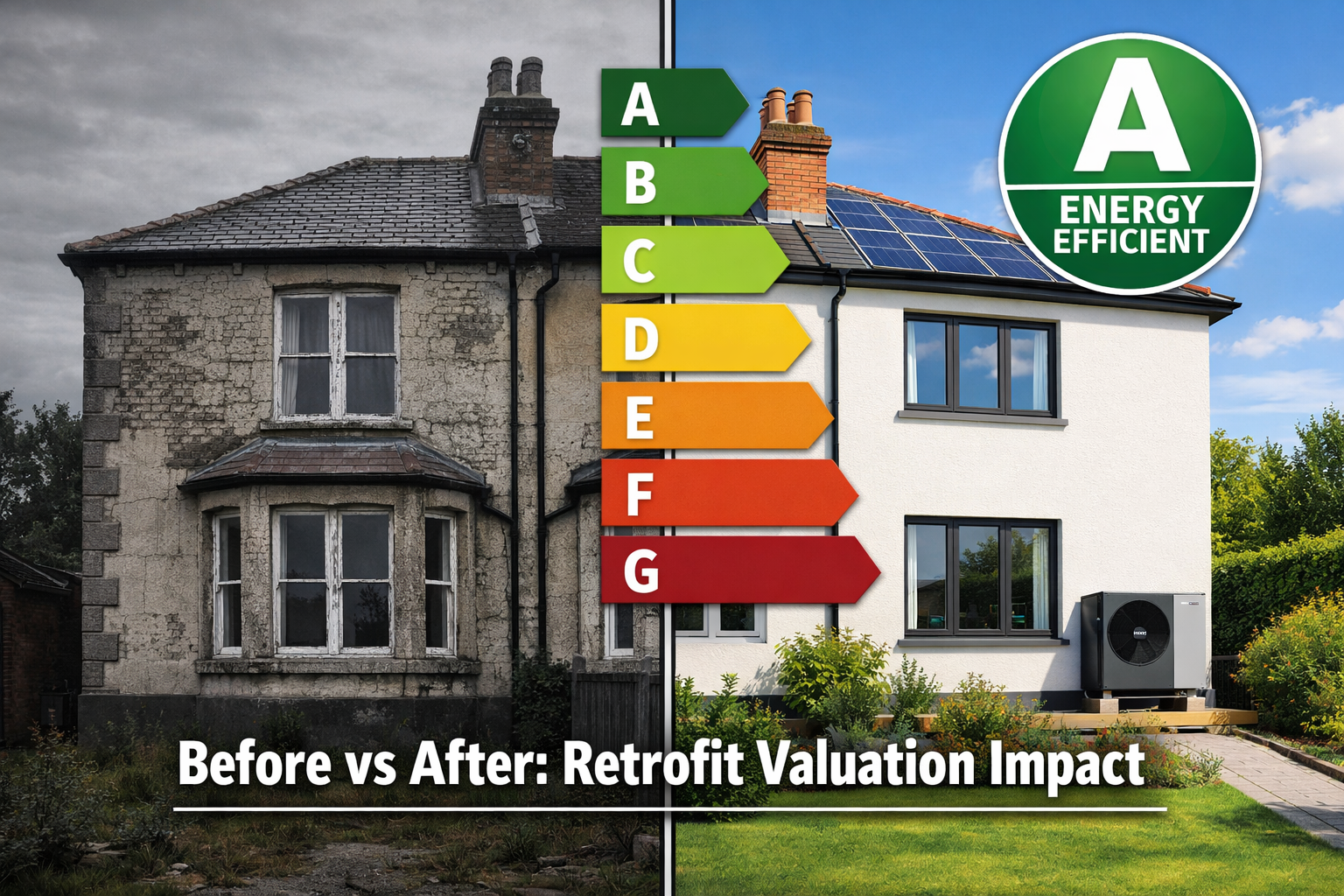
The value impact of energy efficiency improvements is not uniform across the UK. In 2026's cautious market, regional dynamics significantly influence whether retrofit investment is recoverable at sale.
Where Retrofit Premium is Strongest
- London commuter belt markets (Surrey, Hertfordshire, Buckinghamshire): High baseline values mean retrofit costs represent a smaller percentage of property value. Buyer sophistication is higher and green premium is more consistently priced in. Chartered surveyors in Leatherhead and Buckinghamshire report growing client demand for retrofit-integrated valuations.
- Urban regeneration zones: Areas with active housing renewal programmes often have better access to grant funding, improving the cost-benefit equation for vendors.
Where Caution is Warranted
- Lower-value regional markets: Where property prices are modest, the capital cost of deep retrofit (external wall insulation, heat pump installation) may not be recoverable at sale. Surveyors must avoid recommending over-specification.
- Rural properties with oil or LPG heating: Heat pump transitions carry higher upfront costs and may face grid connection challenges, reducing the straightforward value uplift narrative.
Negotiation Leverage for Buyers
In flat markets, EPC evidence has become a powerful negotiation tool. A buyer who commissions a full Level 3 building survey and receives a detailed retrofit cost schedule is in a strong position to negotiate a price reduction that reflects the genuine cost of bringing the property to an acceptable energy standard. Understanding how to negotiate a house price down after a survey is increasingly linked to retrofit cost evidence rather than purely structural defects.
💡 Pull Quote: "In a flat market, a credible retrofit cost schedule is worth more than any asking price reduction a vendor might volunteer. It gives the buyer a defensible, evidence-based negotiating position."
Conclusion: Actionable Steps for Surveyors and Property Owners in 2026
The integration of retrofit assessment into mainstream building survey and valuation practice is no longer optional. RICS has formalised the expectation [6], the market is pricing in the evidence, and clients — whether buyers, sellers, or investors — need competent guidance to navigate the cost-value equation.
Actionable Next Steps ✅
For Chartered Surveyors:
- Update inspection checklists to include all eight RICS retrofit consequence categories [2] as standard reporting fields.
- Familiarise with Energy Light Reports and CRREM outputs — clients will increasingly present these and expect informed commentary [1][2].
- Build regional retrofit cost databases to support defensible valuation adjustments in survey reports.
- Recommend in-situ performance testing before major interventions, particularly in pre-1919 properties, to avoid over-specification liability.
- Integrate drone thermal imaging into survey protocols for properties where roof or upper-floor heat loss assessment is critical.
For Property Owners and Buyers:
- Commission a Level 3 survey before purchasing any property built before 1980 — retrofit potential and risk must be understood before exchange.
- Start with soft measures — draught exclusion, thermal curtains, and lighting upgrades deliver real EPC improvement at minimal cost.
- Seek grant funding assessment before committing to capital works — ECO4 and local authority schemes can significantly alter the cost-benefit calculation.
- Use CRREM or EPC trajectory analysis to understand whether a property faces stranded asset risk over a 5–10 year holding period.
The cautious market conditions of 2026 make accurate retrofit assessment more valuable, not less. Properties that can demonstrate credible, costed pathways to improved energy performance will hold value more effectively than those that cannot. For surveyors, mastering Energy Efficiency Retrofits in Cautious 2026 Markets: Valuation Impacts and Building Survey Protocols Under RICS Guidance is not just a professional obligation — it is a commercial differentiator.
References
[1] Rics Verschaerft Immobilienbewertung Esg Wird Ab 2026 Wertrelevant – purpose-green.com
[2] Retrofitting Historic Buildings Sustainably – ww3.rics.org
[3] Partnership Themes – rics.org
[4] Esg Sustainability Commercial Valuation 4th Edition – rics.org
[5] Building Survey Quality Standards 2026 Navigating Rics Updates And Enhanced Home Inspection Requirements – nottinghillsurveyors.com
[6] Retrofit – rics.org